Hood design-Week 2
HOOD DESIGN
OBJECTIVE:
To Design Hood outer panel, inner panel and the necessary reinforcements by following the Master section mentioned with the design parameter and assembly of Hood inner panel, outer panel, latch, hinge and the reinforcements.
HOOD:
The hood is the hinged cover over the engine of motor vehicles. Hoods can open to allow access to the engine compartment for maintenance and repair.Hoods are typically made out of the same material as the rest of the body work. This may include steel, aluminium, fiberglass or carbon fiber.The hood release system is common on most vehicles and usually consists of an interior hood latch handle, hood release cable and hood latch assembly.
Data to be used:
Hood Thickness Information
- Outer Panel Thickness = 0.75mm
- Inner Panel Thickness = 0.75mm
- Reinforcement Thickness = 1.5mm
Master sketch:
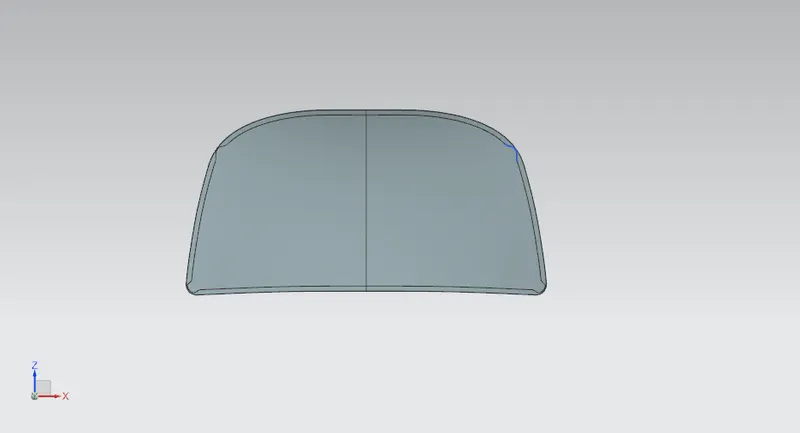
OUTER PANEL:
HEMMING:
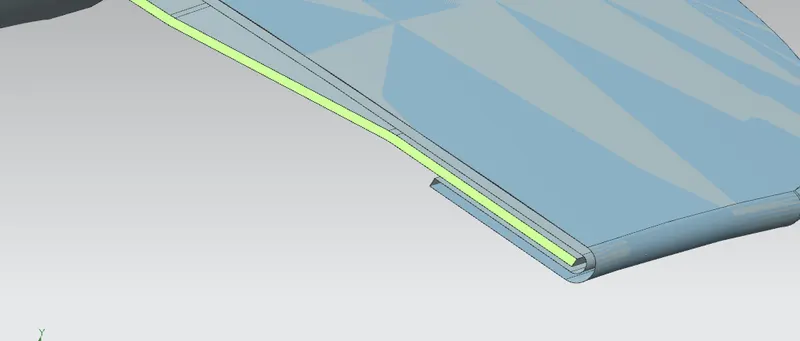
Hemming is a forming operation in which the edges of the sheet are folded or folded over another part in order to achieve a tight fit. Normally hemming operations are used to connect parts together, to improve the appearance of a part and to reinforce part edges.n car part production, hemming is used in assembly as a secondary operation after deep drawing, trimming and flanging operations to join two sheet metal parts (outer and inner) together. Typical parts for this type of assembly are hoods, doors, trunk lids and fenders.The accuracy of the hemming operation is very important since it affects the appearance of the surface and surface quality.
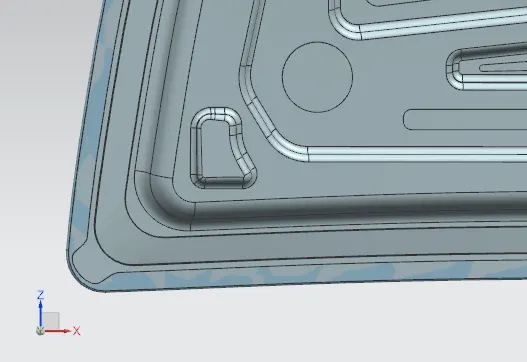
CORNER RELIEF:
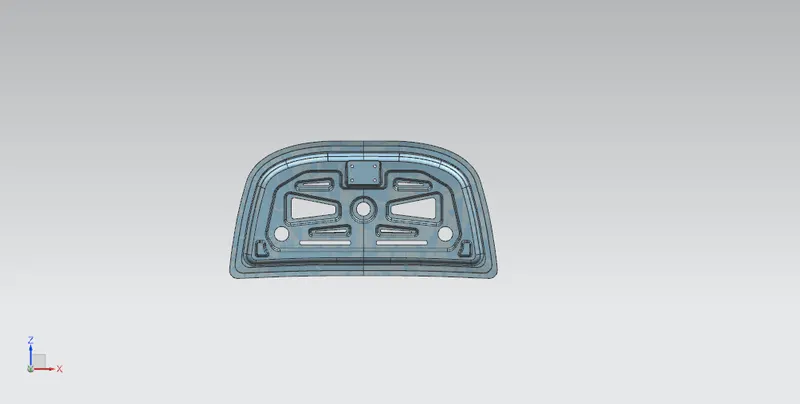
INNER PANEL:
EMBOSSING:
Sheet metal embossing is a stamping process for producing raised or sunken designs or relief in sheet metal. This process can be made by means of matched male and female roller dies, or by passing sheet or a strip of metal between rolls of the desired pattern.
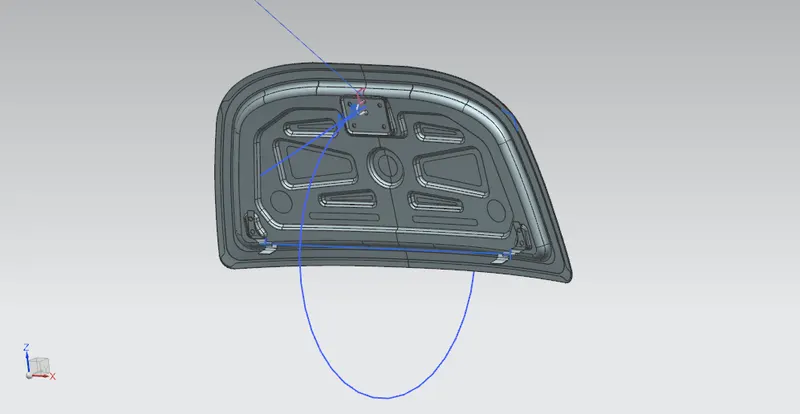
POSITION OF HINGE AND STRIKER:
LATCH AND STRIKER:
A hood latch has a mounting plate, a ratchet and pawl assembly, a secondary release lever and a reinforcement plate. The mounting plate has a fishmouth. The ratchet is pivotally mounted to the mounting plate at a first pivot point. The ratchet cooperates with the fishmouth and moves between an unlatched position and a latched position.
HINGE:
A hinge is a mechanical bearing that connects two solid objects, typically allowing only a limited angle of rotation between them. Two objects connected by an ideal hinge rotate relative to each other about a fixed axis of rotation, all other rotations being prevented, and thus a hinge has one degrees of freedom. Hinges may be made of flexible material or of moving components.
CONCLUSION:
Thus creating a hood panel with the design parameter and assembly of Hood inner panel, outer panel, latch, hinge and the reinforcements.