Hood design-Week 2
HOOD:
Hood is an opening body panel that covers the engine front engine in front engine vehicle. The hood is also another type of door in a vehicle as it of an outer panel and inner panel supported with hinges and striker when it was in closed condition. The inner panel provides strength while outer panel functions as metal cover.
THEORY:
The hood is also known as bonnet of a car. It is considered as the frontal BIW enclosure component. Hood is designed to reduce air flow resistance as it effects the aerodynamic flow around the car. Apart from this, the hood also designed to meet several requirements. This helps to protect passenger inside the car and pedestrians in the event of an accident. It also acts as the cover for the hinge.
The purpose of automotive engine hood is arranged to be opened for the purpose of inspecting the engine room, replenishing cooling water/ engine oil, changing parts, making repairs, etc..
The Hood consist of the following parts:
- Hood outer panel
- Hood inner panel
- Latch and striker reinforcement
- Hinge reinforcement
- Gas stay reinforcement
DESIGN REQUIREMENTS OF HOOD:
Design of hood must be ergonomic. While designing opening angle must follow easy service of a mechanic. In Indian markets the average height if a human is 5’5” (165cm), while in European market, the average height of human is 6’(182cm).
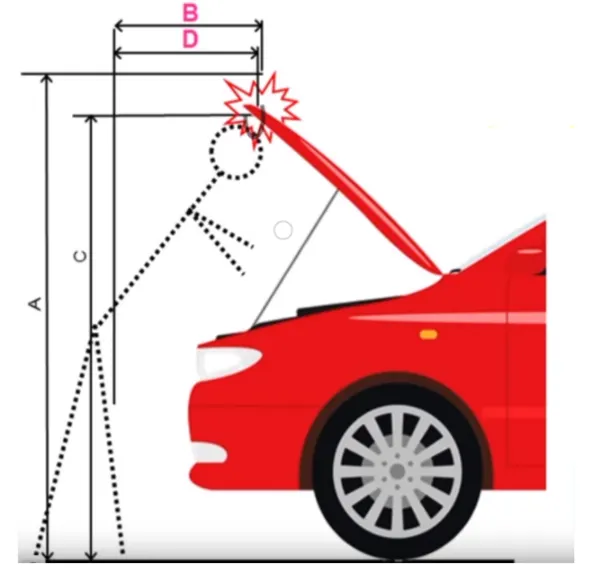
Whenever, releasing the primary latch, we should have a space for about 10-15mm to easily accesses the secondary lever. This secondary lever will be a part of striker mechanism.
Opening angle of a hood is taken as important criteria. When the opening angle is less than the required there is a possibilities of human head injury.
SAFETY REQUIREMENTS OF HOOD:
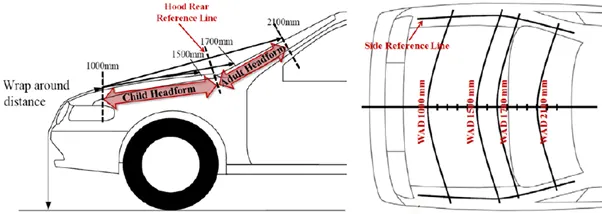
When a car crashes the pedestrian, the whole human body wraps around the front shape of the car and head impacts on the bonnet or the wind screen. The distance on which head impacts on the car from ground is called as wrap around distance.
To be specific wrap around distance, it’s a measurement of distance from ground to head impact zone over the outer surface of the car. The wrap around distance is measured longitudinally in the centre of the vehicle from the ground.
The severity of injured caused by the front crash depends on the type of vehicle, speed of the vehicle and moment of pedestrian relative to vehicle. In addition to these parameters, wrap around distance plays a major role in safety measurement of a pedestrian.
During the crash analysis, based on wrap around distance to test areas will be created namely child head and adult head impact zone.
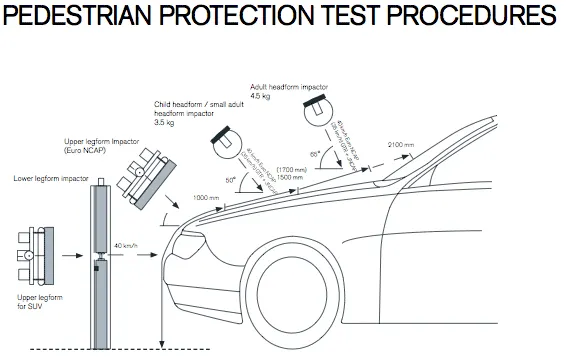
Child head impact zone between 1000-1700mm and child head impact load is 35kg. adult head impact zone between 1700-2100mm and adult head impact load is 45kg.
NOISE VIBRATION AND HARNESS (NVH) REQUIREMENTS:
Noise, vibration and harness (NVH) is the study and modification of the noise and vibration characteristics of vehicles, particularly cars and trucks. While noise and vibration can be readily measured, harness is a subject quality. Many problems are generated as either vibration or noise which are transmitted via a variety of paths into the cabin. These are classified as structure brone noise while others are propagated by air brone paths. Structure brone is attenuated by isolation, while air brone noise is reduced by absorption or through the barrier materials. Vibrations are sensed at the steering wheel, the seat, armrests, or the floor pedal. Some problems are sensed visually such as vibrations of the rear-view mirror or header rail on open-topped cars.
While designing the hood, to reduce the noise vibration for the outer panel of hood one of the important criteria to reduce is to design a mastic pad. Mastic pad plays a major role to reduce the vibration. The hood is specially designed with 80mm circular shape mastic pad with a height if 15mm. these are placed between the outer panel and emboss of the surface.
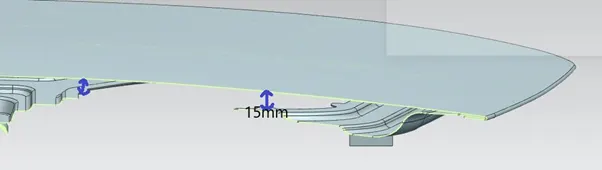
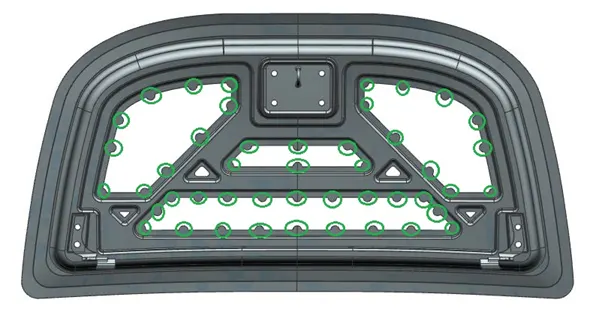
The figure shows the placement of mastic pads which are made of rubber to reduce vibration.
Latch, striker and hinges are used to support hood when in closed condition. But when hood in open condition, Hood stay, a support rod and hinges is used to support to balance hood in open condition.
HOOD STAY:
A Hood stay is an apparatus for an engine room of a car which can safely keep an engine hood in open state even if an external force is abruptly generated due to vibration, wind and can facilitate an opening or closing operation of engine hood.
They are two types of Hood stay.
- Support rod
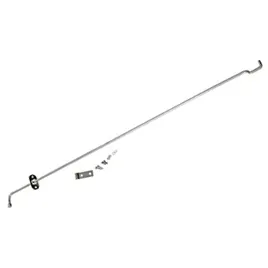
It is a simple metal rod which can easily manufacture but increase in weight. But when striking with an automobile body panel, to leave scares which are likely to cause rust. The metal rod is often too hot to be gripped by hand when one attempt to be keep the engine hood opening for inspecting the engine room immediately after the vehicle has been stopped.
2. Gas stay
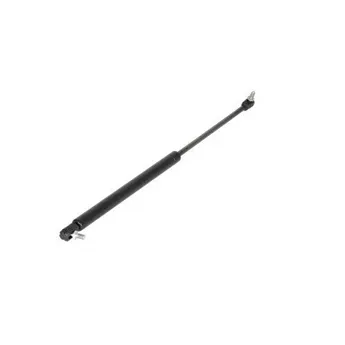
Gas stay is a support of hood with an actuator which activated by gas inside the cylinder. But for the gas stay no manual power is required.
The important design criteria for design and placement of hood stay of an automotive vehicle is, support rod side and battery side should be opposite to each other. Because, in dymanic conditions when hood stay is miss aligned it may be in interfere with positive terminal of the battery. This results a fire accident.
EMBOSS OF A SHEET METAL:
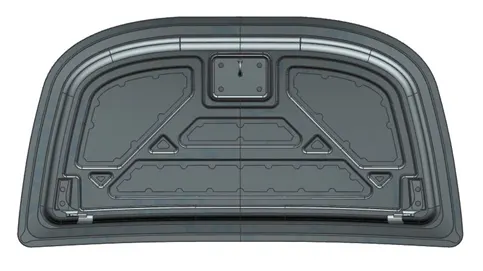
Sheet metal embossing is a stamping process for producing raised or sunken designs or relief in sheet metal. This process can be made by means of matched male and female roller dies, or passing sheet or a strip of metal between rolls of the desired pattern. It is often combined with foil stamping to create a shiny.
DESIGN CRITERIA OF HOOD:
Master sketch of hood:
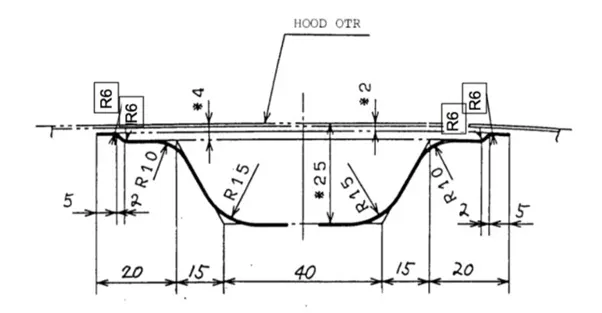
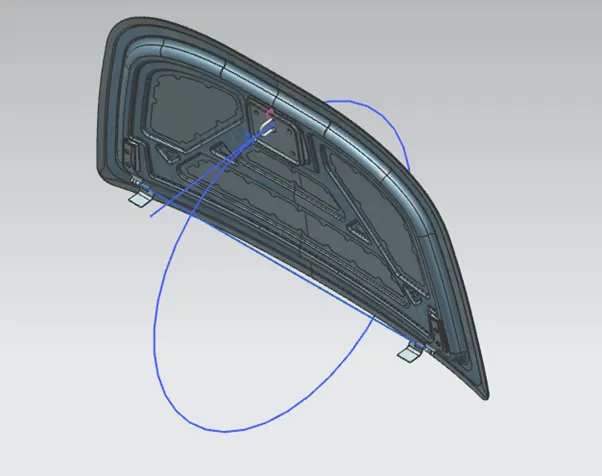
By using this master sketch and with the help of face of outer panel, the inner panel is developed.
Design of inner panel:
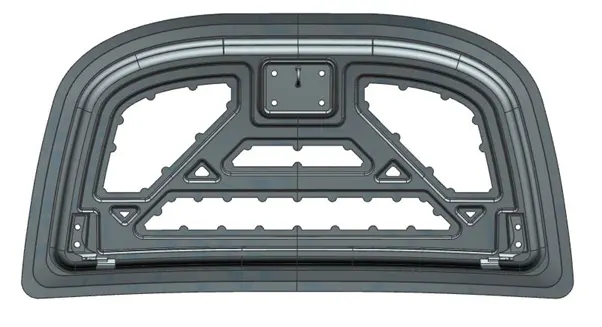
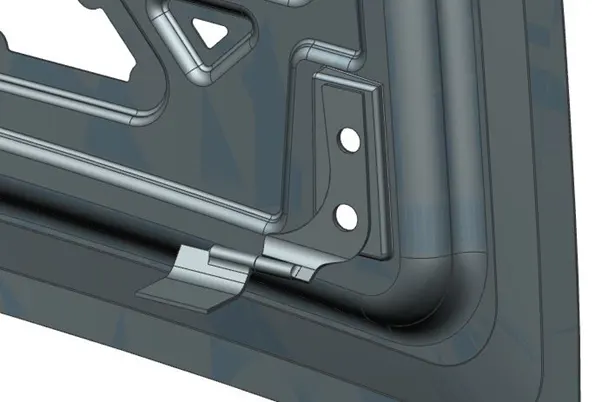
Alignment of hinges on inner panel
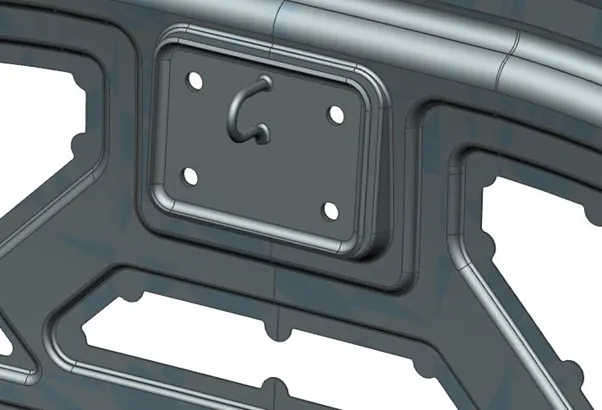
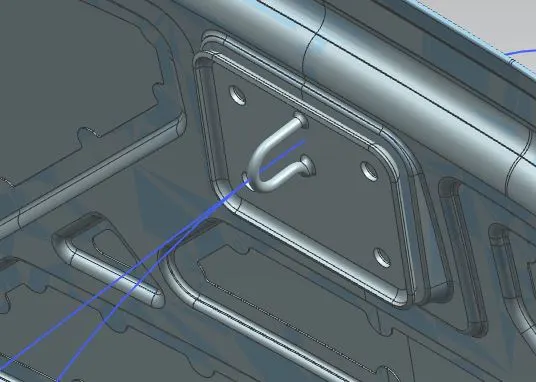
Alignment of latch and striker on the inner panel
DESIGN OF OUTER PANEL:
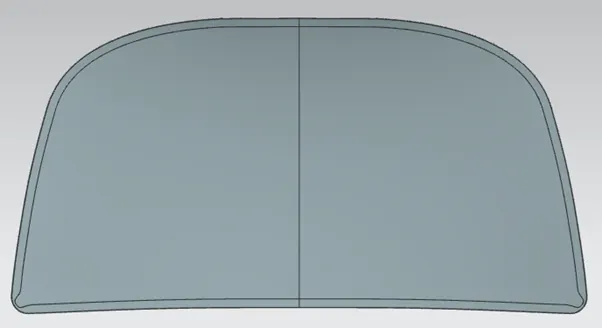
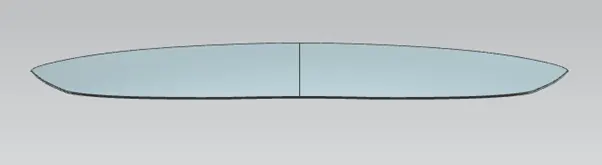
The thickness of outer panel is also 0.75mm. and it is also developed by generated a working of parent surface.
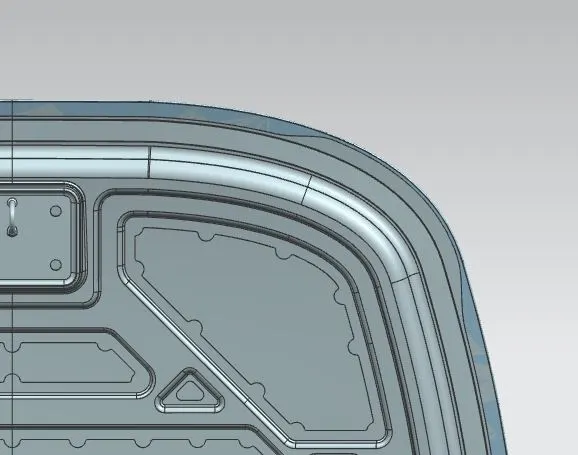
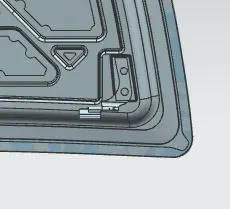
CORNER RELIEF:
CONCLUSION:
with the help of master sketch and surface of outer panel a standard model of Hood is successfully designed as per the automotive standards. And also assembled the outer panel, inner panel, latch and striker and also hinges. Opening portion of hood based on trajectory is successfully matched the axis of hinge.