Hood design-Week 2
Design of car Hood Design by considering Pedestrain safety and some Engineering concept
Aim: To design the car hood and Assemblying the hood by considering the outer panel,inner panel, hinge assembly, Latch and stricke, Pedestrain safety.
Data to be used to create hood assembly
- Outer panel Thickness = 0.75mm
- Inner panel Thickness = 0.75mm
- Reinforcement Thickness = 1.5mm
Introduction on Hood design
Hood is the one of the most important components in BIW design, it is also called as Bonnet. It is designed to closure to the engine compartment ,such as radiator, battery, alternator and other electrical system. Hood are mainly designed for to reduce air resistence as the air flow around the car, in the outer look it shows more luxurious look. The shape of bonnet is made aerodynamic in order to minimize the air effect. The hood also consists Outer panel and inner panel, Outer panel has a function to metal cover and inner panel has a strength.
In the recent years, the work are manily done on the bumper and hood design of the vehicle front end to reduce the injuries to the pedestrains in the event of a pedestrian collision.While designing the hood as a designer need to consider the opening angle for opening and closing the hood.
Master sketch
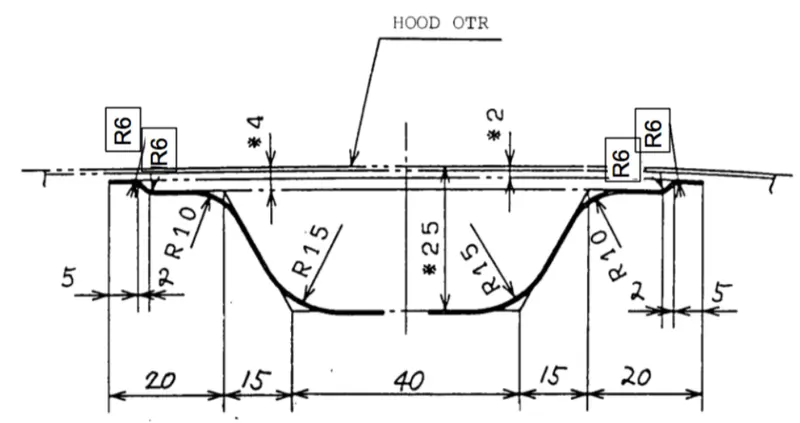
Hood support
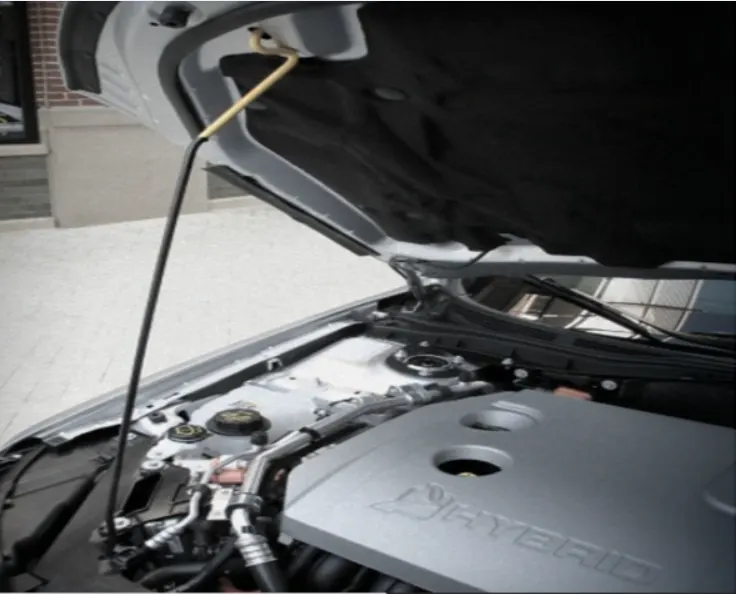
They are mainly two types of supports are:
1. Support rod
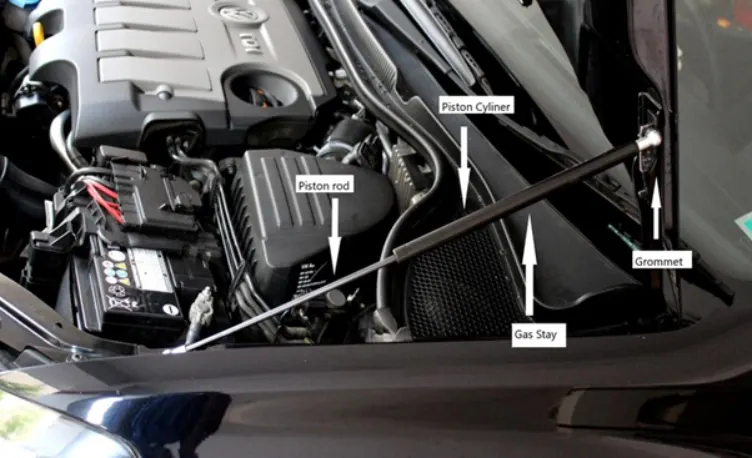
2.Gas stay
After deciding the opening and closing angle then for support purpose ,we use support or gas stay as requirement.
1.Support rod: For support rod after opening angle conformed , hood engineer decided the length of rod,this support rod is widely used in all cars in the front porstion of car for support for hood ,because ths very easy and avaiable at low cost, in this support rod need manually support for opening and clossing the hood. there must be no any collision for hood and engine comportant to avoid collide any were in engine there will be cracklling noise so to avoid this support rod will placed properly.
2.Gas stay: Spring gas stay are designed to be used for upward to lift the back door, for this its automatically opened dont need any manually support.Euro fit stock various size spring depending on the door size requirement. this is mostly used for where the car bonnent weight is heavy.
Designing the hood important points are:
1.Outer panel
2.Inner panel
3.Reinforcement for stricker and hinges
4.Support rod or Gas stay
5. NVH( Noise, Vibration,Hardness)
6.Pedestrain safety
7.Head zone criteria
Head clearance criteria
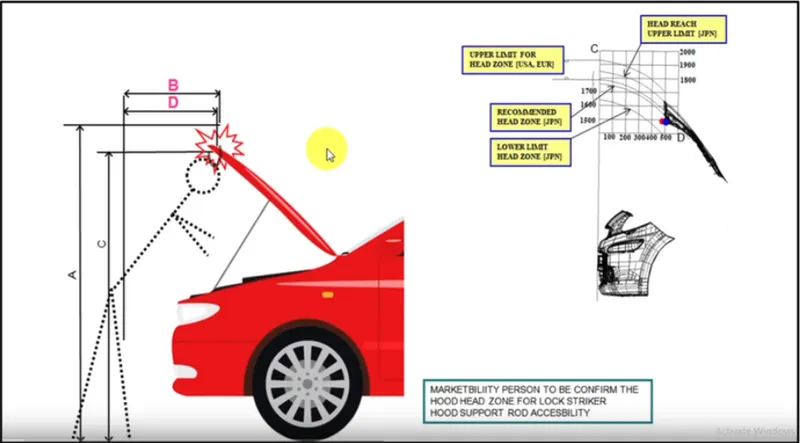
Before designing the hood or Bonnet it is most important part for opening angle, this vary from region to region for head clearance criteria because height of human will vary depending on region , same car will be made in different country will have different opening angle.so here we designing the hood on Japanes criteria.
When a car crashes on the pedestrain the whole human body wraps around the front shape of the car and the head impacts on the bonnet or the windscreen. The distance on which the head impacts on the car from the ground is called as the Wrap around distance (WAD)
To be specific the Warp Around Distance is a measurement of distance from the ground to the head impact zone over the outer surface of the car, Th Warp around diatance is measured longitudinally in the center of the vehicle from the ground.
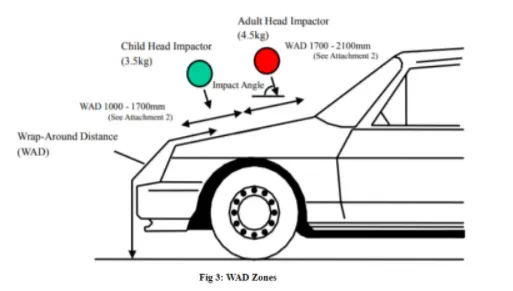
The severity of the injury caused by the frontal crash depends on the type and shape of the vehicle. speed of the vehicle and the movement of the pedestrain relative to the vehicle. In addition to these parameters, the warp around distance plays a major role in the safety measurement of a pedestrain.
During the crash analysis, based on the Warp Around Distance(WAD), two test ares will be created namely,
1. Child head impact zone
2. Adult head impact zone
Child head impact zone is between 1000 to 1700 mm WAD and Adult head impact zone range from between 1700 to 2100 mm WAD.
Design of car Hood using Nx Cad
Class A Surface refers to those surface which are visible and abide to physical meaning in a product . This classification is primarily used in the automative and increasing in consumer rating, the class Asurface will be given by Styling team, This styling team will give the skin data as outer panel by using this we design the inner panel.
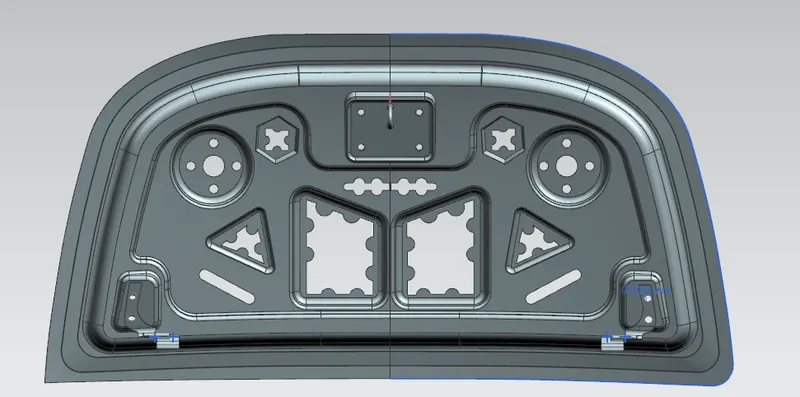
Design of Inner panel
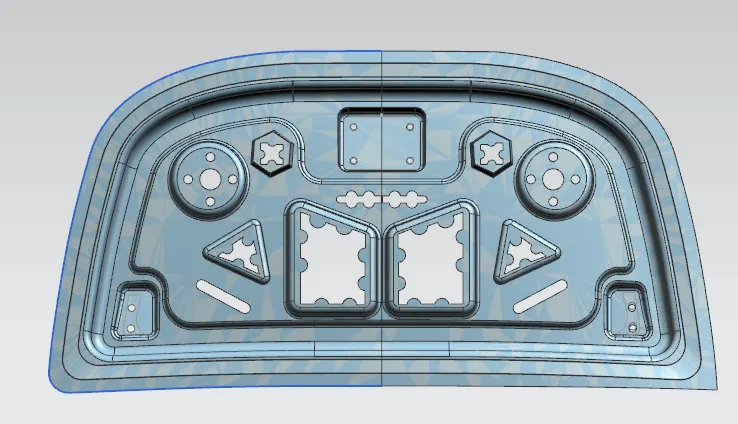
Embosses: By using the Master section we design the Inner panel Embosses will been given to create extra strength to inner panel, if any object hit from the front portion of car the force will dissipated by this embosses created toward upper left and right corner so that less force will reach to the occupants end.
some cuts will be given for Embosses to reduce the material and head impact result, from the CAE Team we get information about thickness of reinforcement.
while designing the inner panel there will be 4 to 5 mm distance from inner to outer panel so mastic point will be created to apply mastic sealent, by this we can join inner and outer panel with each other by providing some heat process so it will spread to all.
Mastic sealent
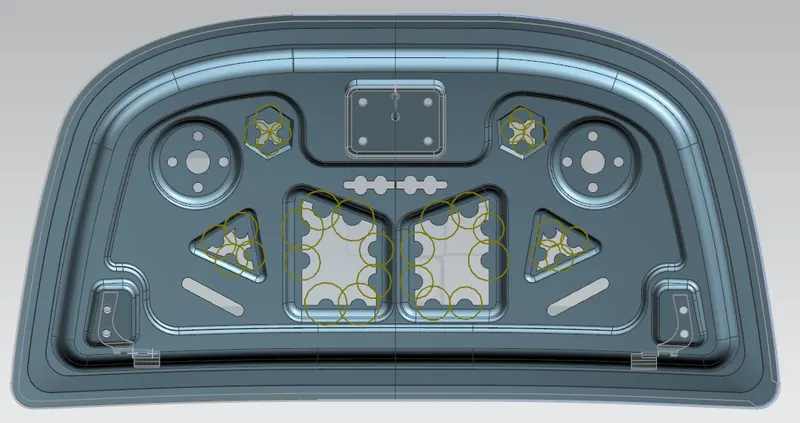
Mastic sealent will give basically to avoid NVH so applying sealent on the embosses will join inner and outer panel and it gives good NVH. one spot of mastic sealent provides strength locally at around 60-80mm in such way it cover outer and inner panel expect reinforcement area like latch and hinges.
so to cover we use mastic sealent because we cannot apply any spot welding on outer panel its losse its aesthetic look from outside.
Outer panel
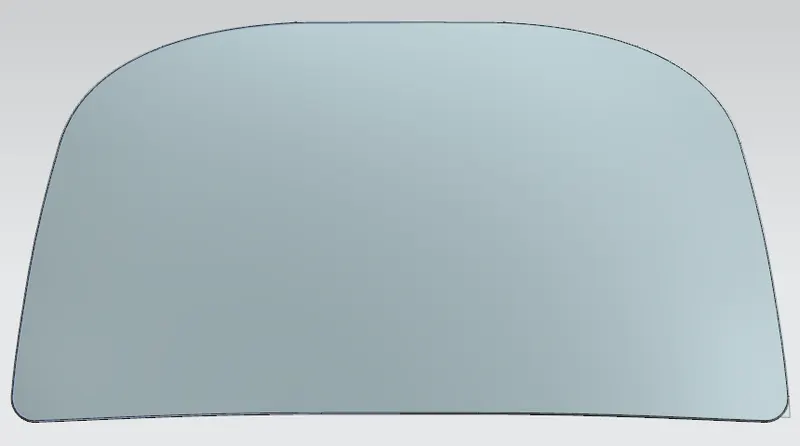
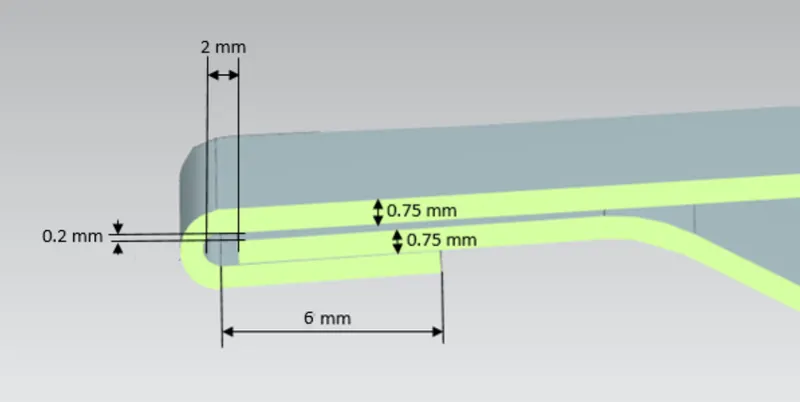
Designing the outer panel is manily imporved for Aesthetic look , the main purposes for outer panel is to cover the inner panel to provide aesthetic look from outside , do here we provide Heamming rather then Spot welding. Heamming is a type of folding or warp around process in which roller bend and press the extrapolated flanges in a way that it holds the inner panel firmly then a sealent will be applied in between the under folds to get water tightening.
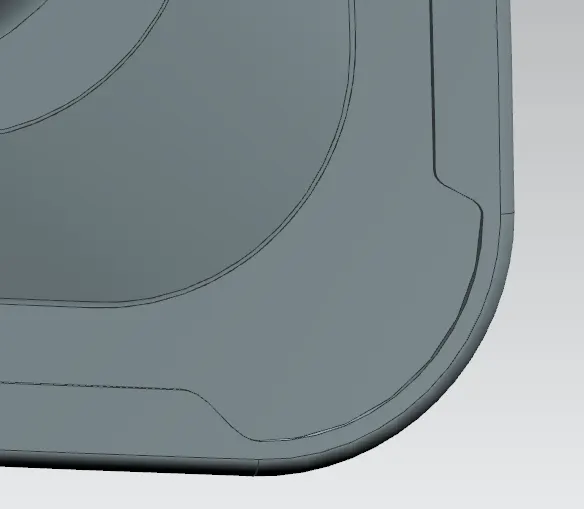
While providing the hemming process we apply relief around croner as it helps easy to hemming so its avoid red zone while simulating.
Deep drawing
Deep drawing is one of the most widely used process in hood manufacturing , apart from its use in many other sector, it applied in the automotive industry for the manufacturing of car body parts.
The deep drawing process is a forming process which occurs under a combination of tensile and compressive conditions. A flat sheet metal blank is formaed into a hollow body open on one side or a hollow body is formed into a hollow body with a smaller crosssection.
Deep drawing process are divided into three types
1. Deep drawing with tools
2.Deep drawing with active means
3. Deep drawing with active energy
Trajectory for hood opening and closing
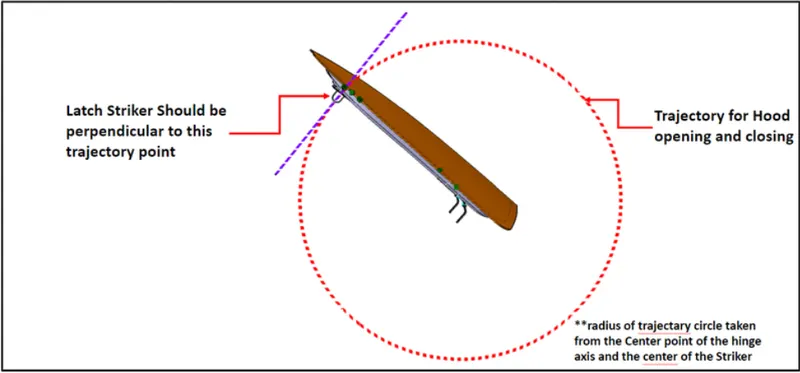
For the Hood opening and closing , the stricker should be placed properly in correct position the stricker should be perpendicular to the trajectory on the hood, then the line are drawn at a straight, the trajectory is derived from the hinge axis from that center distance from the stricker circle will be created.
Pedestrain safety
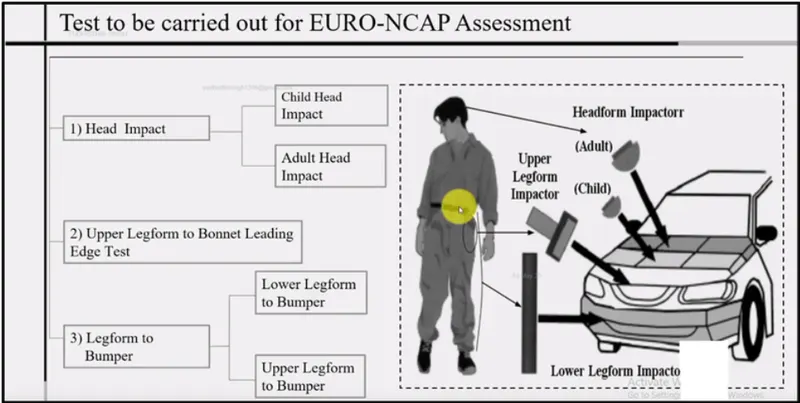
Euro NCAP the european car Assessment program is European car safety performance assessment program based in Leuven and founded in 1997.
From th Euro NCAP guidlines , here in hood we can separate the whole ares of hood into several region during frontal crash. while in any collision with pedestrion from hood so the Euro NCAP specified some guidlines under wihich we can distribute hood region into several parts and trying to get more green region for pedestrian safety purposes.
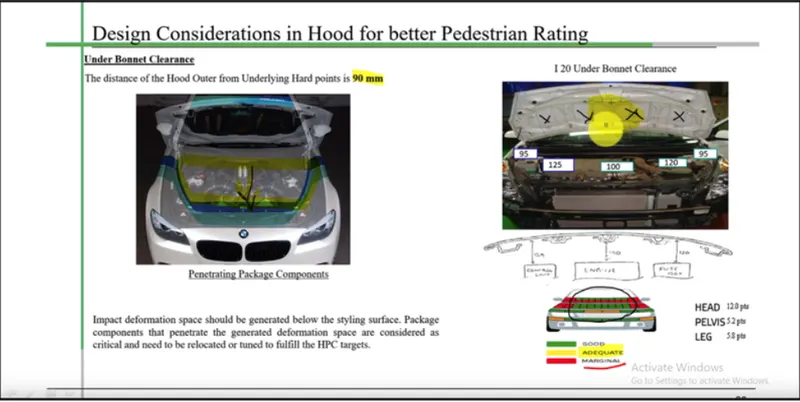
From this region is basically distributed in relation to the height of children and adults who comes in contact from the front while accident. here from the side reference planes lies on the fender means there will be Warp Around Distance is more so the Head Impact is Less.
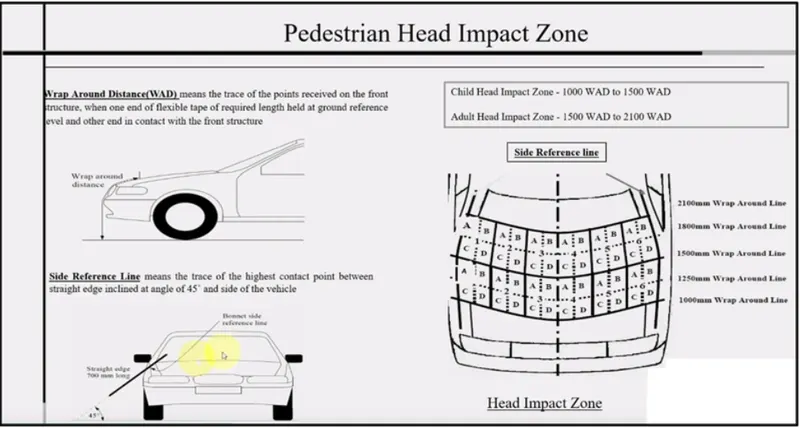
In the simaler way if the side reference plane lies on the hood means there will be less Warp around Distance and Head impact is more. so here here aim is to provide more green region,so here we split s accordingly to improve head impact zone effectiveness in providing less damage to the person while hit them.
Hemming
Hemming are folds to the edges of a parts to create a rounded, safe edge. Hems may be open ,flat, tear dropped and tolerance depends on the hems radius,material thickness, and features near the hem. this processof creating hems is called hemming.In this design for hemming thickness will be 0.75, hemming will be warp the outer and inner panel and holds it tightly together. While providing the hemming process we apply relief around croner as it helps easy to hemming so its avoid red zone while simulating
Conclusion
The car hood or Bonnet is designed as per the master sketch and considering the pedestrian safety and vehical safety.