Hood design-Week 2
AUTOMOTIVE HOOD DESIGN
Projective Objective :
In this project we are going to design the front mounted engine's hood according to the standard . The hood or bonnet is the hinged cover over the engine of motor vehicle that allows access to the engine compartment or trunk for maintanence or repair.
On front-mounted engine car the hood may be hinged at either the front or the rear edge , or in earlier models it may be split into two sections , one each side , each hinged along the centerline. A further varient combines the bonnet and wheel arc into one section and allows the entire front bodywork to tilt forwards around a pivot near the front of the vehicle.
Materials : Hood are typically made of the same material as the rest of the bodywork . This may include Steel, Aluminium ,fiberglass of carbon fiber . However ,some aftermark companies produce replacement for steel hood in fiberglass or carbon fiber to make the vehicle lighter.
Before we dive into the design, let us understand the rules and regulation standard for designing the hood.
- A perfect hood designing means it should have a great impact distribution angle outside the car.
- In Japan and Europe regulation have come into effect that places a limit on the severity of pedestrain head injury when struck by motor vehicle. This is leading to more advance hood desgning , as evidenced by multicore hood inner panel design.
- European Enhanced Vehicle-Safety Committee (EEVC) , European New Car Assessment Program ( Euro NCAP ).
Observation of Adults , Childs ,and lower impact on Car Hood Body :
- The first and foremost safety requirement to be considered while designing the bonnet / hood is the pedestrain safety from a frontal collision.
- The European New Car Assessment Programme ( Euro NCAP) is a European car safety performance assessment program which has developed test specifications and rating system for assessing pedestrain injuries during impact with the front of vehicles such tests include a series of tests using impactors designed to mimic a collision at a speed of 40 KMPH. They describe a situation in which a pedestrain is situated laterally and a car first hits one of his leg. Tests are conducted on the leg , upper leg and most importantly the head , as head trauma is most commonly responsible for casualties.
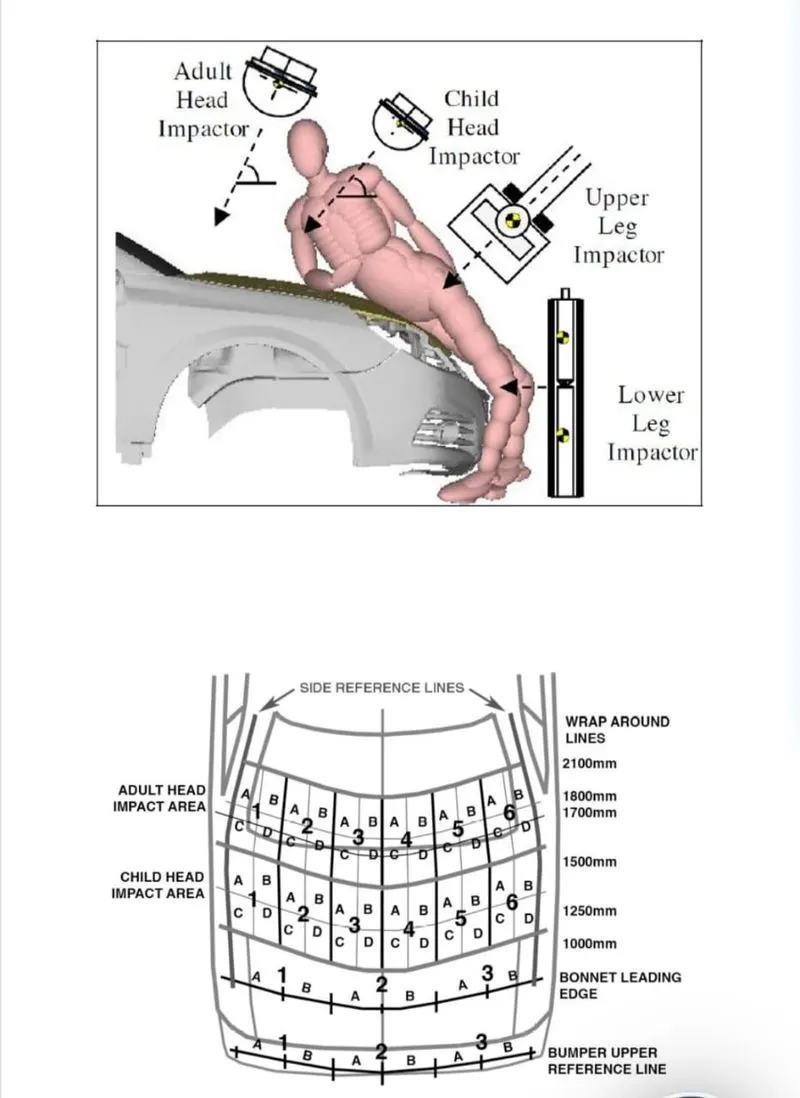
- Thus to avoid severe injuries to the head , the high impact area for adult and childrean is subjected to less thickness. Also no reinforcement should be providede in that area as , during the head collision the hood will absorb the head impact energy leading to the collapse of the hood and thus protecting the severe head injury.
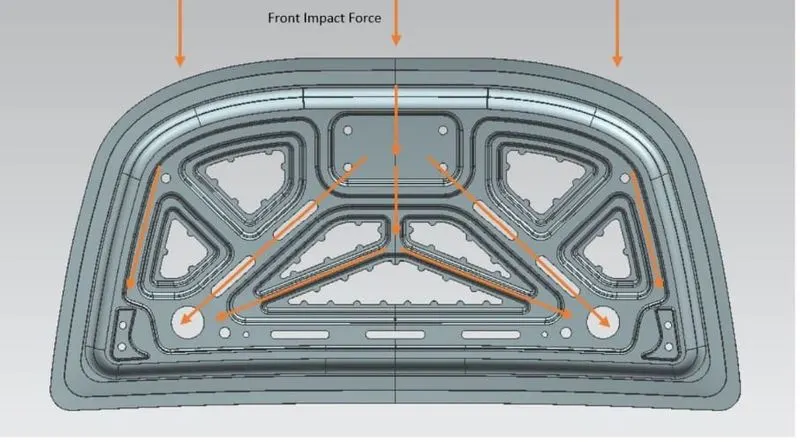
- Another important criterion for the hood design is the protection of the occcupants inside the car during the front collision .The design of the hood should be in such a way that during the collision the force should travel in the outward direction and directed towards the body of the car. Thus protecting the occupants inside the car.
Sheet Metal Operation for Hood Design :
- Blanking and Piercing
- Deep Drawing
- Embossing
- Hemming
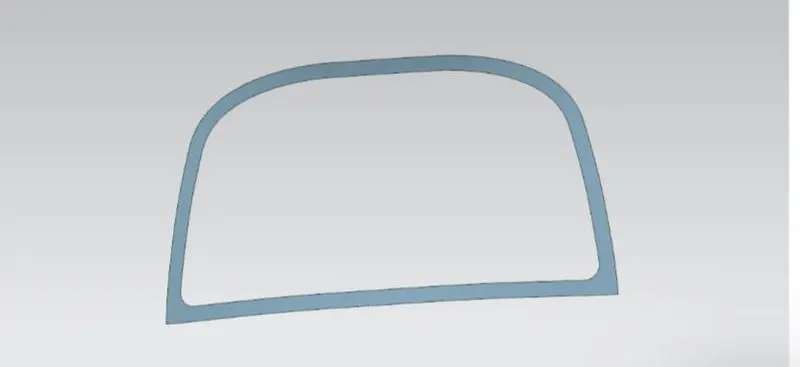
Blanking and Piercing Operation : Blanking and piercing are shearing processes in which a punch and die are used to modify webs. The tooling and processes are the same between the two, only the terminology is different. In blanking the punched out piece is used and called a blank. In piercing the punched out piece is scrap. The process for parts manufactured simultaneously with both techniques is often termed " pierce and blank ". An alternative name of piercing is punching.
Purpose of Blanking and Piercing :
- Reduce the weight and size of part.
- Improve the strength of the body.
- Distribute Impact Force .
- Improve Mileage of car.
BLANKING
PIERCING
Deep Drawing Operation :
Deep drawing of sheet metal is used to form contains or object with depth. It is a plastic deformation in which a flat sheet or plate is formed into a recessed three-dimensional part with a depth several times the thickness of the metal. The process of deep drawing being with a flat sheet metal blank held on the upper surface of die. A deep drawing process is used for the manufacturing of the inner panel. The material used is aluminium as it can absorb twice the crash energy of mild steel, lighter, dent free, and can make body panels thicker while still lowering the weight.
Purpose of Deep Drawing Operation : Operation in which the thickness of the shell wall is reduced and it's surface smooth .When materials get compress between the punch and die, which reduce the thickness and increase the height of the cup.
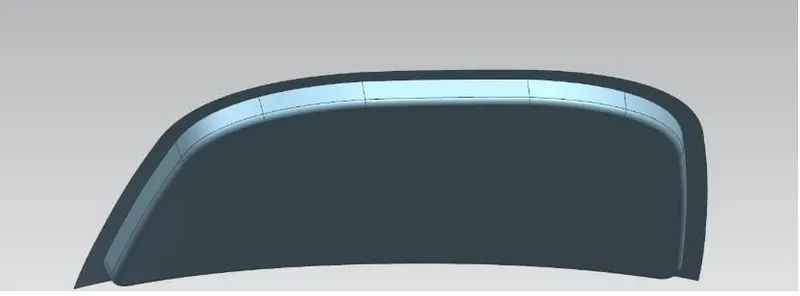
Deep Drawing Operation
Embossing Operation :
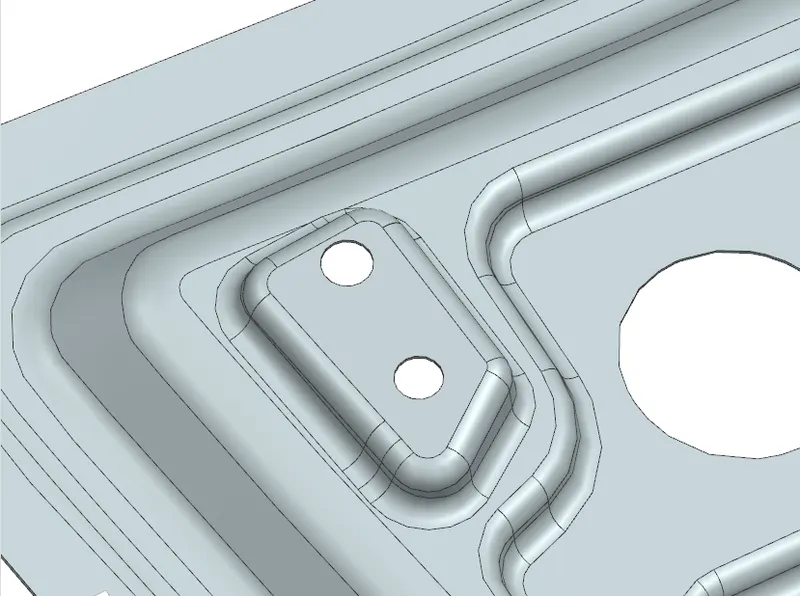
Sheet metal embossing is a stamping process for producing raised or sunken designs or relief in sheet metal . This process can be made by means of matched male and female roller dies or by passing sheet or a strip of metal between the rollers of the desired pattern.
Embossing is done by pressing a sheet of paper ( or another substrate ) into a female die , that has a design engraved or etched into it. This is usually done with a male counterpart underneath the paper so that the paper is sandwiched between the two and the design is transferred to the paper.
Purpose of Embossing Operation :
Embossing enables you to highlight important element of your printed products, such as letters ( company name ) and design ( corporate logo), to make sure they stand out . In sheet metal designing/manufacturing the embossing is used to create some impression or depression shape which provide a certain height or position for any other purpose.
Embossing
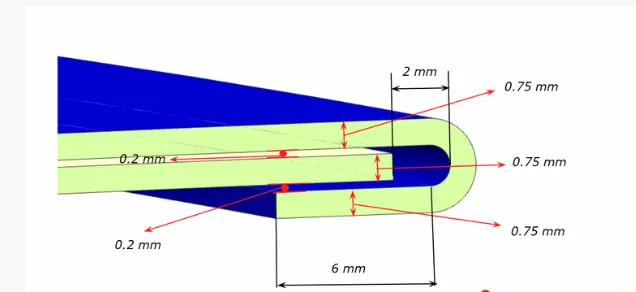
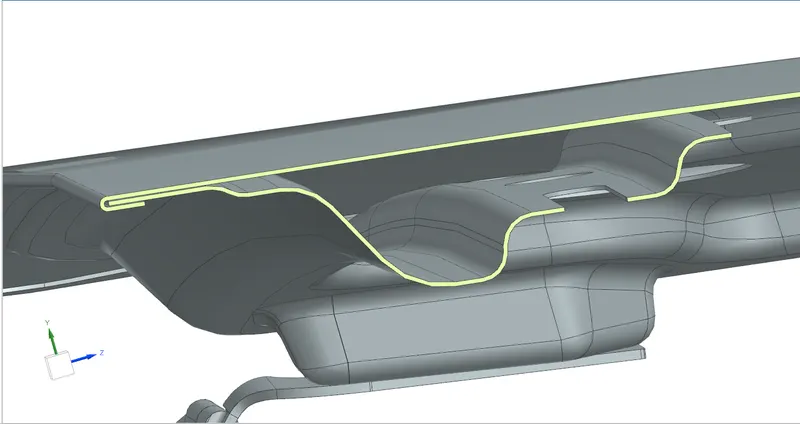
Hemming Operation : Hemming is a sheet metal forming process in which sheets are joined by bending it to 180 degree .Automotive body pannels and automotive parts such as deck-lids ,trunk-lids, doors,hood,and tailgates are formed by the hemming process. In this process,usually a sheet is bent with the help of the inner sheet in three different stages.
Hemming is a forming operation in which the edges of the sheet metal are folded or folded over another part in order to achieve a tight fit.
Purpose of Hemming Operation : Hemming is a sheet metal forming operation in which the edges of sheet is folded back on itself. It serves several purposes : to fasten two sheet metal parts, to improve the appearance of edges ( remove burrs and rough edges) ,and to increase the part stiffness.
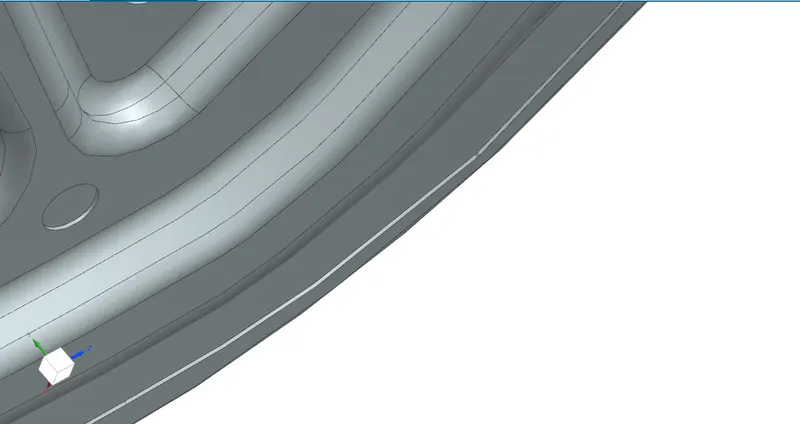
Hemming Operation
HOOD DESIGN PROCESS STEPS :
The master section is already provided by the marketability team and the manufacturing requirements.
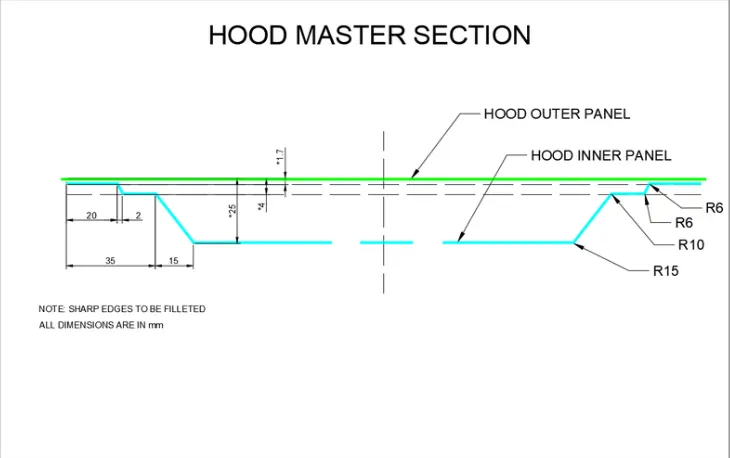
Manufacturing Requirements Data :
- No sharp corner inside the panel .
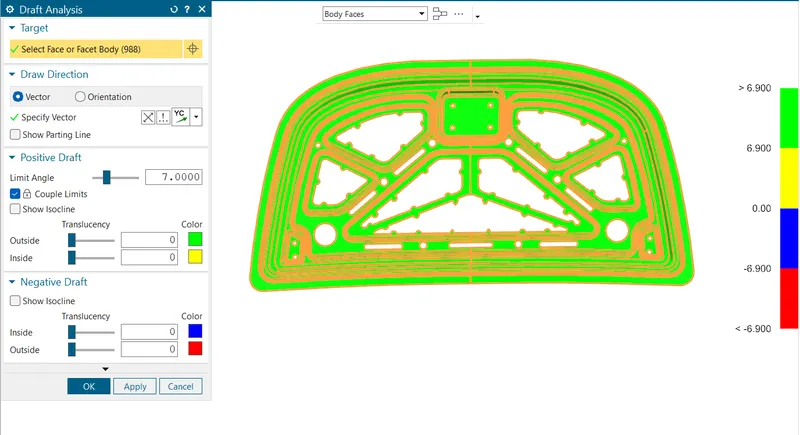
- No negative draft.
- Provide appropriate corner relief on the area of curvature.
- Outer panel thickness : 0.75 mm
- Inner panel thickness : 0.75 mm
- Reinforcement thickness : 1.5 mm
- Minimum fillet radius : 3mm + thickness
Hood Inner Panel Design :
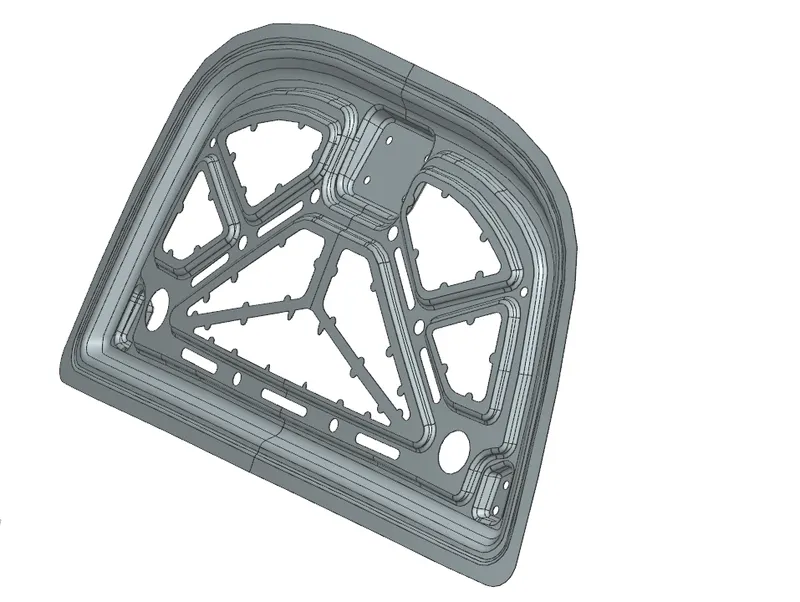
The initial design was created from the master section that was already provided. Embossing is a metal forming process for producing raised or sunken designs or relief in sheet metal by means of matched male and feamle roller dies, theoritically with no change in metal thickness . Embosses are created to provide additional strength and to direct the forces from the front collision towards the hinges and body of the car.
Mastic Data Design :
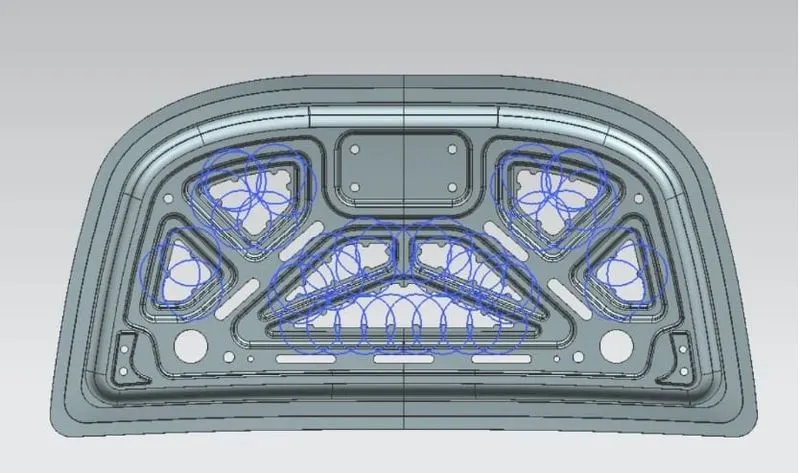
The main purpose of the outer panel is for the aesthetic looks . Thus we cannot use bolts or welding. This has to be done with the help of the hemming and mastic sealants .Mastic sealeants are elastic compound that behaves like the rubber . It is placed between the outer and inner panel. Initially it is in plastic form , but after the hot furnace bath it gets hardened thus joining the outer and inner panel. Mastic sealant has the tendency to increase the strength of the panel and has the influence of 80 mm diameter.
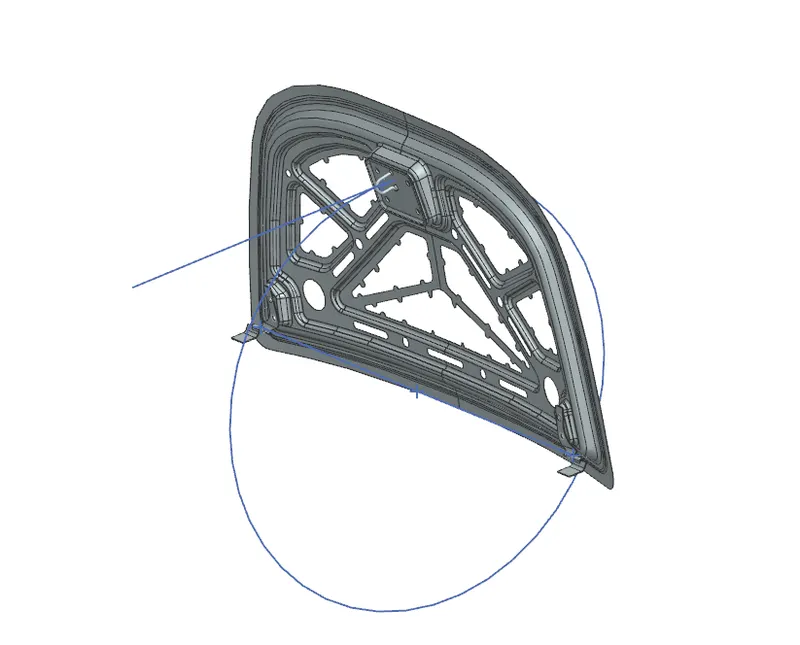
Hinge and striker : For the proper opening and closing of the hood the striker should be perpendicular to the trajectory of the hood. For this the hinge is assembled at its position . Once it is placed the hinge axis is drawn . Using the hinge axis as the center we draw a big circle to the position latch is such a way that it is perpendicular to the hood trajectory.
Force Distribution In Inner Panel :
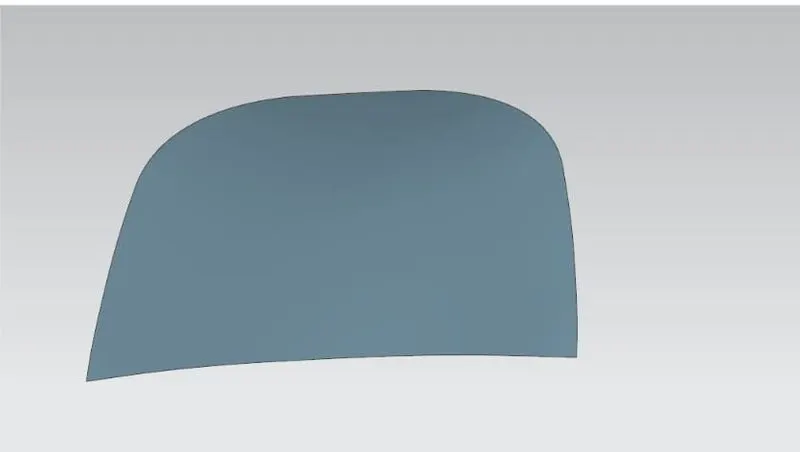
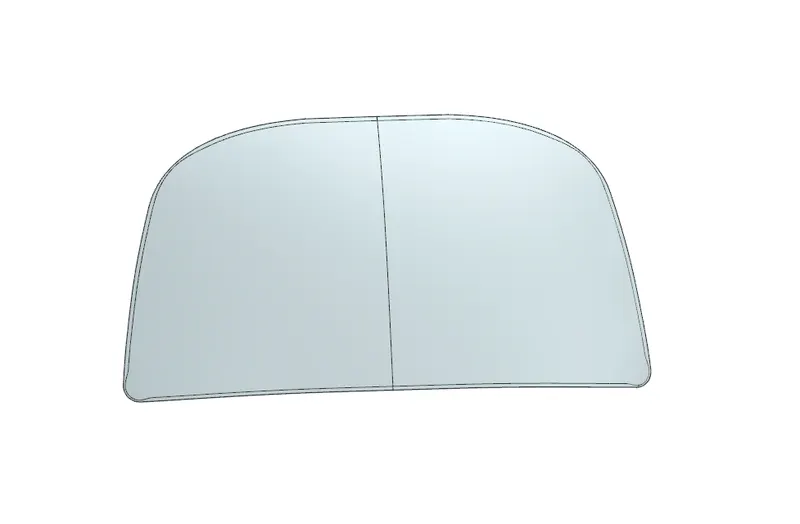
Design of outer Panel :
Hemming Provide In Hood :
Hemming is the process in which the edge is rolled flush to itself , while a seam joins the edges of the two materials. Normally hemming operation are used to connect the sheet metal part together, to improve the appearance of a part , and to reinforce part edges. In hood design , hemming is used in assembly as a secondary operation after deep drawing ,trimming and flanging operation to join two sheet metal parts ( outer and inner ) together .
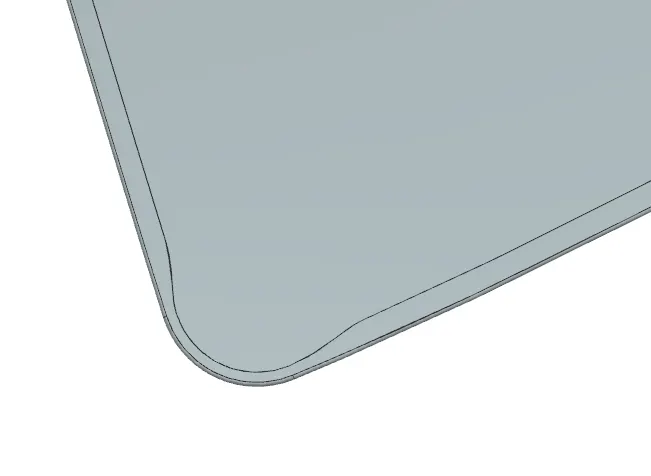
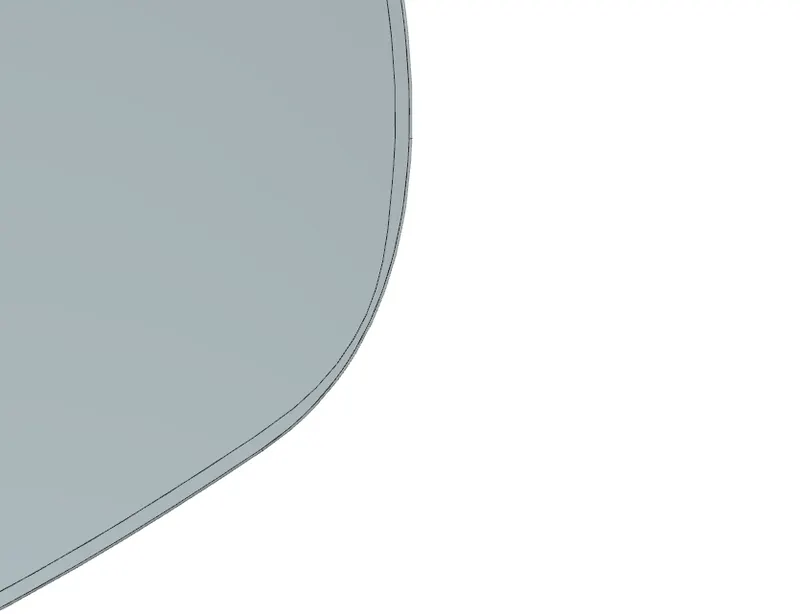
Corner Relief : Corner relief is provided onto the corner of the part or component in order to remove any stresses developed in a particular area i.e. sharp corners that takes place during the hemming process are carried out . Thus corner are rounded or chamfered.
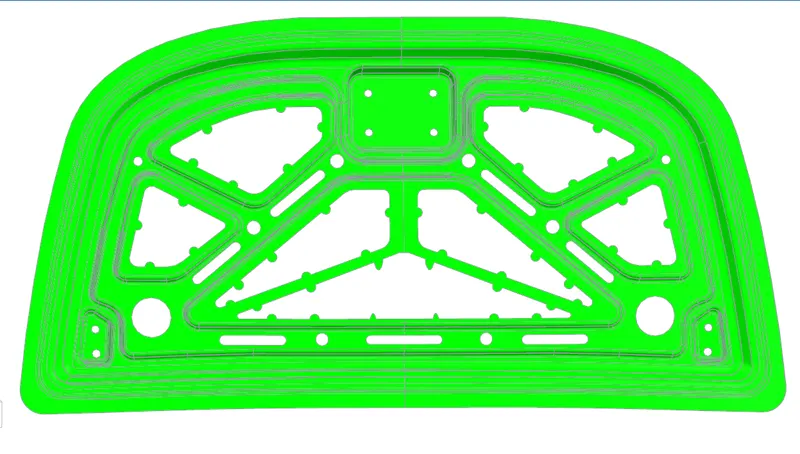
Draft analysis of Inner Panel :
Draft analysis is carried out to see that the panel can be drawn or not. Draft analysis also helps to find out the negative draft present in the componenet which can cause difficulty in manufacturability. For the inner panel minimum draft angle is 7 degree .