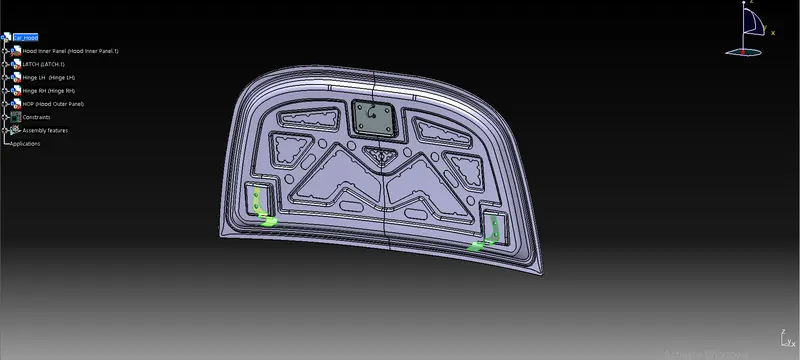
Hood design-Week 2
Aim:-
Design of Hood and its Components.
Objective:-
Design Hood outer panel, inner panel and the necessary reinforcements by following the Master section mentioned with the design parameter.
Theory:-
Hood or Bonnet is a term related to the starting point of car. It is the hinged cover over the motion of vehicle. It can open to give us access to engine compartment. It is used for many purposes and it gives aerodynamic effect to car which leads into less destruction. Bonnet is used as a cover to many parts such as Engine, Radiator, Battery and other electrical and mechanical appliances.
The hood or the Bonnet consists of the following parts.
- Hood outer panel
- Hood inner panel
- Latch and Striker re-enforcement
- Hinge re-enforcement
- Gas stay re-enforcement
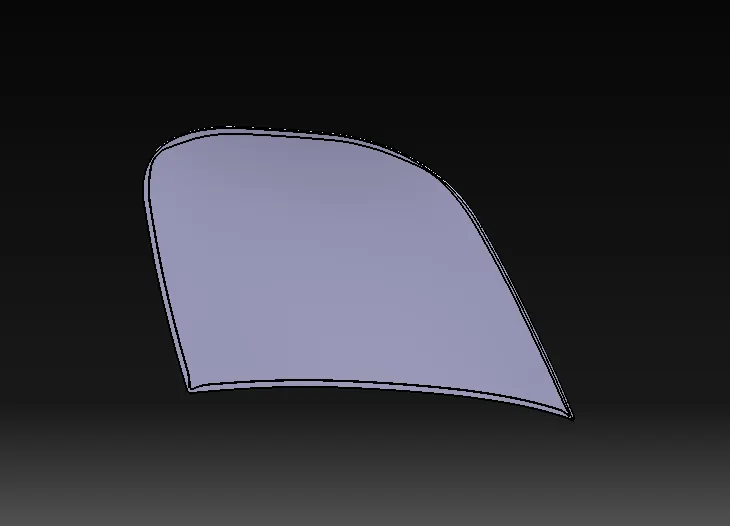
Hood Outer Panel
Outer panel of Hood is basically a Class A Styling surface which is free from errors, roughness etc. and it looks like a clean surface which attracts a lot people because of its aerodynamic and styling surface.
Outer Panel of hood is taken as reference to create the inner panel by following master section. Hemming is done on the outer panel of hood so that it joins the outer and inner panel of hood so tightly that it wont come out. This is mainly done in industry through hemming rollers placed.
Hood Inner Panel
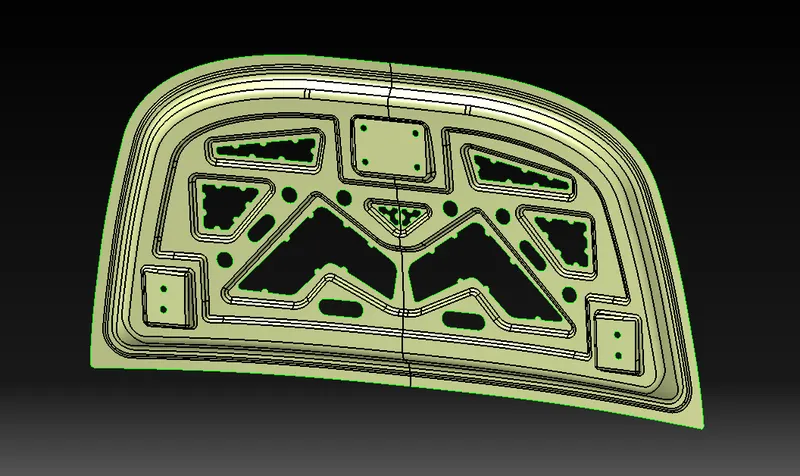
In inner panel of Hood all the design consideration takes place as when a car collides or hit something than the main purpose of hood inner panel design is to throw the forces outside so that it does not affect the people sitting inside the car. The main feature that takes place on inner panel opf hood is Emboss which are designed in such a way that it exert all the forces outside and are made of hight strength that it withstand the force easily.
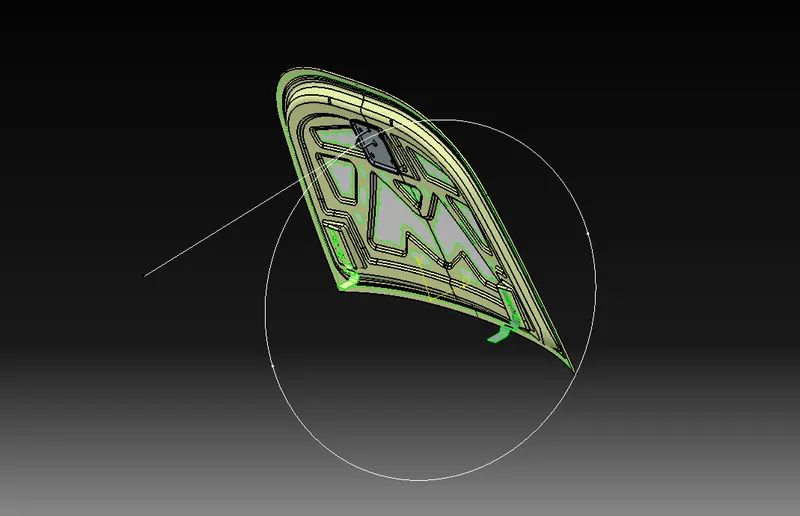
Hood Inner Panel is defined as the interior portion of hood which is not directly visible to the person untill its open. Hood inner panel consist of emboss creation, Hinges, Latch and striker. Embossing is done in inner panel in such a way that if vehicle body collides and the hood is crumbled then the force exerted to it removes out by creating a following path without giving much harm to passengers sitting inside the vehicle. Embossing is always made curvy or it should not be straight.
Latch and Striker Re-inforcement
Latch and striker is attached on the upper region of inner hood Panel. It locks the hood to the engine compartment so that the engine compartment that consist of engine, battery, wires etc. is not directly visible to people. It is placed in such a way on inner hood panel as it is perpendicular to the axis of hinges and the circular trajectory should follow it with the midle point of Hinges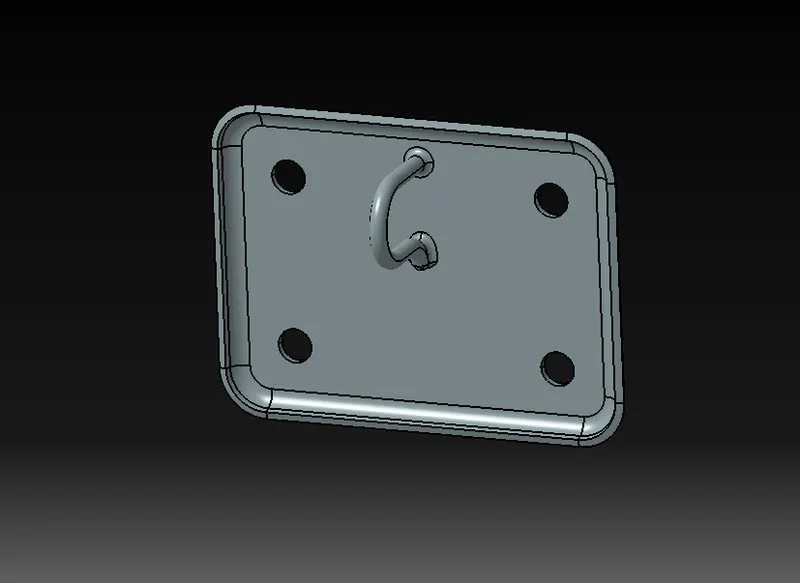
Hinge Re-inforcement
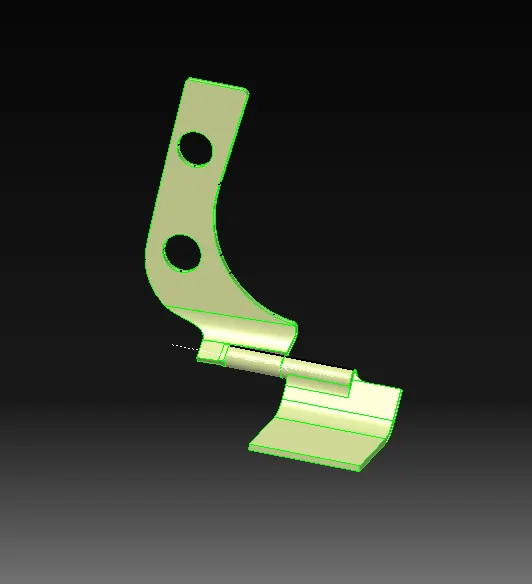
Hinges are the component that is fixed with the hood and the engine compartment. It gives support and free motion to hood while opening and closing of it. They are fixed in such a way that the axis of both hinges( left and right) should be parallel to each other and the mid point of it, draws a circle that is connected to latch and striker. This mechanism leads to easy opening and closing of hood.
Hood is designed in such a way keeping in mind the safety of pedestrian either Child or Adult and the WAP is considered as the same.
Wrap Around Distance (WAD):-
It is the distance measured from the ground to the head impact zone over the outer surface of car i.e.windshield area as the value ranging from 0mm to 2100mm. The value for child and the adult differs. It is calculated as when the pedestrian gets hitted by the car, their body wraps around the car bonnet and head impacts takes place which leads to injury so as to reduce the chance of high injury the bonnet is not made of high strength material and is made of a material which do not give a huge impact to pedestrian head.
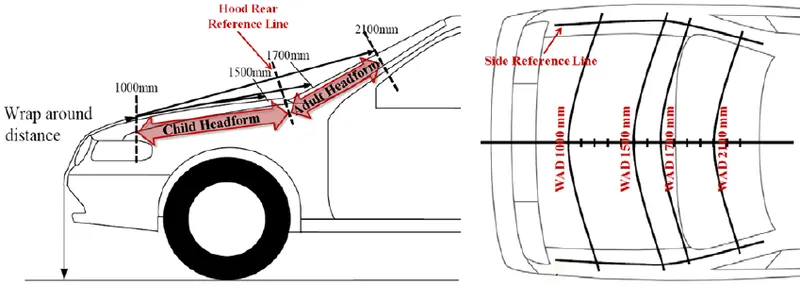
During crash test analysis, two different zones are created and the ranging values for both are:-
(1) Child head impact zone:- 1000mm - 1700mm
(2) Adult head impact zone:- 1700mm - 2100mm
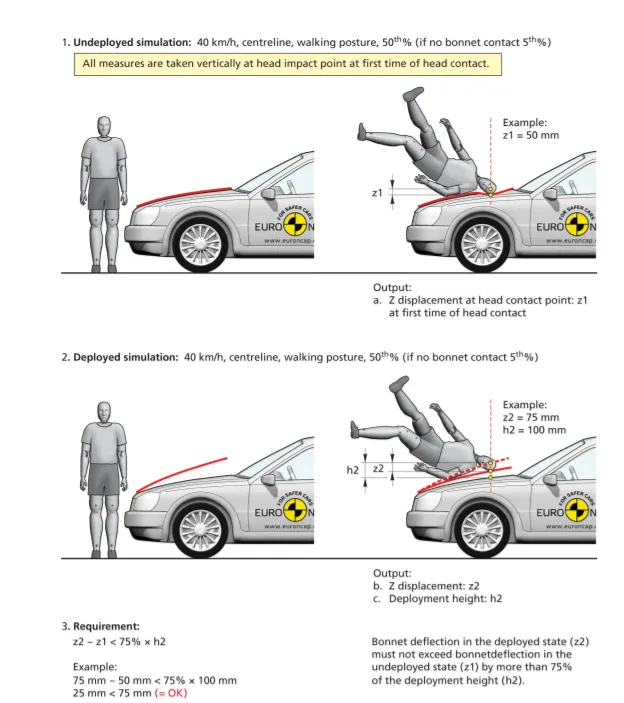
The following are the guidelines should be considered while designing the hood
Requirements:
Hood Thickness and manufacturing considerations.
- Outer Panel Thickness = 0.75mm
- Inner Panel Thickness = 0.75mm
- Reinforcement Thickness = 1.5mm
- Minimum fillet radius = 3mm+Thickness (example: When thickness of inner panel is 0.75mm we need to maintain minimum fillet radius 3+0.75=3.75mm)
- No sharp corners inside the component
- No curvatures lesser than 5mm
- Small embosses should not exceed the maximum depth of 6mm (staying on the safe side)
- Mounting areas and welding areas need to be flat
- Provide appropriate corner relief on the area of curvature
Functional and Safety Requirements:
1. The most important safety requirement to be considered while designing the Bonnet is the frontal collision requirements.
The design intention of the hood according to the frontal collision requirement is that the hood crushes and dissipates forces in the upward direction and to the hard points on the hood thereby deflecting the force on to the body and not the passengers.
The second major function of the hood is the opening and closing of the hood. This is done with the help of the latch and striker. To position the latch and striker effectively, we first position the hinge and draw the hinge axis. Now, using the hinge axis from the centre we draw a big circle to the position there we need to place the latch.
Master section creation:
The master section is created based on the requirements received from the marketability team and the manufacturing requirements that we saw before. Below is the image of the master section used for the design.
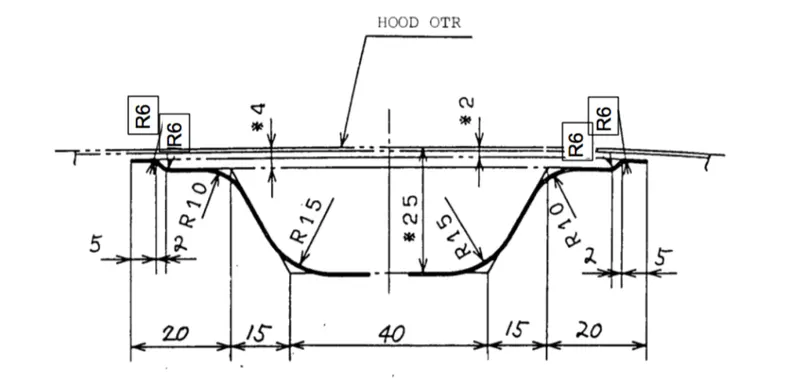
Geometry and Emboss creation:
The geometry is created based on the master section. After performing the initial stages of design, we will provide local embosses to strengthen the component. The component will be strengthened based on the master section. When a force exerted on hood from front, the force is traveled in an upward direction. The embosses are designed in the inner panel in such a way that the diversion of force takes place. The emboss depth is kept at a maximum of 4mm to be on the safer side so that the part can be manufactured without any problems.divert the impact force direction away from the passengers.
Latch and Hinge reinforcements:
After designing the hood inner panel, we need to place the Latch and hinge as explained in functional requirements section, while the development of the inner panel, we also need to develop some additional reinforcements for strengthening the area where we are going to mount the Latch and Hinge parts. These re-enforcements are made from sheet metal of thickness 1.5mm.
Latch Trajectory
Latch Trajectory is defined as the path made through circle which is made connecting the mid point, made on the axis of hinges connecting one another. This will keep the hinges and latch and striker in a position that the movement of it is restored and move properly and in link with each other.
Mastic Sealant Points:
The Mastic sealant or the Mastic point is an elastic compound that behaves like a rubber. The mastic points are defined on the hood inner panel where the hood can easily deform. They help the hood outer panel to come back to its original shape after it gets deformed. Mastic Sealant are poured between Hood Inner Pannel and Hood Outer Panel so that it sticks together and the NVH (Noise Vibration and Hardness) is reduced. The mastic has an influence area of 85mm in diameter.
Hemming and Corner Reliefs for the outer panel design:
Hemming is the process of joining both the outer and inner panel together. The hemming process roles and wraps the hood outer panel around the inner panel and holds it tightly together. The gap between the hemming flanges of hood outer panel to inner panel will be filled with sealants to make the joint as waterproof. After the hemming is done, we need to provide corner relief at the corners of the hood so that the part can be produced without defects. See the below pictures of Hemming and the reliefs provided at the corners. This hemming process is done at an angle of 180 degrees so that the hood outer and inner panel are joined in such a way that it does not come out easily.
Pedestrian -Vehicle Collision
Mastic pads:
Sealants are materials that are for one-time use only. Mastic sealants are widely used in the automotive industry.Mastic is commonly used on construction projects as an adhesive and sealant. It is a popular choice where one surface needs to be adhered to another in a durable bond, or where the area needs to be protected.
These mastic pads and used in between of inner and outer panel of hood so that it is used to reduce the noise of hood that can be heard outside very easily. As the vehicle runs on road the Noise Vibration and Hardness produced by engine can be reduced.
When a mastic sealant is poured on one place the other should be poured at a distance of 85mm diameter of first mastic sealant circle.
Embossing:
Sheet metal embossing is a stamping process for producing raised or sunken designs or relief in the sheet metal. This process can be made by means of matched male and female roller dies or by passing sheet or a strip of metal between rolls of the desired pattern. It is often combined with foil stamping to create a shiny, 3D effect. To provide strength to the inner panel and to distribute the forces produced during the impact with pedestrian or other obstacles to ensure the safety of the passengers. The forces are directed outwards through the embossing path.
Complete Hood of Car with Hinges, Latch and Striker.