Hood design-Week 2
HOOD DESIGN
OBJECTIVES
Design hood outer panel, inner panel and reinforcements with the given outer skin with master section and design parameters.
INTRODUCTION
A car hood is the metal hinged part that covers the engine of an automobile. The term car hood came from the North America which primarily used in Canada & America. Hood allows to access to the engine components for the maintenance & repair of the vehicle. It also protects from external damaging of the engine-bay components like cuts & bits of any electrical wiring/harness, water hoses & oil hoses etc, at high-speed run.
In design perspective hood has to meet some specific condition like pedestrian safety, Head impact zone A & B, Hood Trajectory, reinforcements Hemming, rolling on relief cuts at the edges, Hinge axis, Gas stay or support rod.
A basic ideology of hood assembly consists of outer panel, inner panel, hinge, hood stay, latch & Stricker. Hood stay is the hood apparatus for supporting of the hood openings, localized in the engine-bay or in the inner panel of the hood. Some common types of hood stay are the support rod & Gas stay. Support rod operates manually by manpower & for gas stay it is operated by hydraulic or gas inside the tube which is usually used in heavy weight hood. Different regions are having different opening angles of the hood according to height of the people i.e., Japan region, European region etc.
The materials used to build the hood are steel, Aluminium and some composite materials like carbon-fibre, fibre-glass & Dry carbon. The drop-down stamping process is used in sheet metal operation which gives the accurate design of the hood of manufacturing in automotive industries. In Aluminium & other composite materials are operated through moulding process.
DESIGN CONSIDERATION FOR HOOD:
- HEAD CLEARANCE ZONE:
Head clearance zone is depending on the different region zone of vehicle manufacturing unit which allows to follow by the manufacturers which is given by the official authority for Motor Transport Department. The criteria for the average human heights are consider for designing the hood to avoid head impact while opening or closing of the hood within the humans reach of the vehicles for the ease of accessibility.
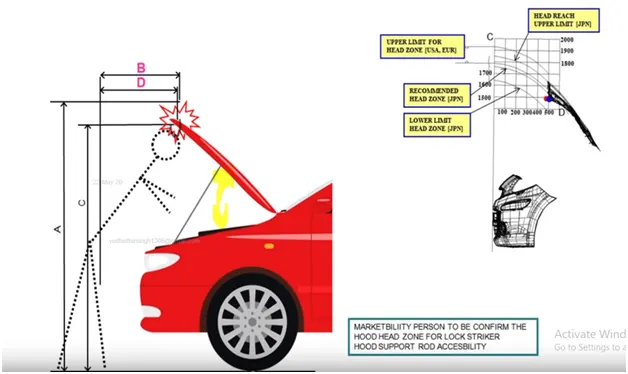
HEAD CLEARANCE ZONE
- NOISE VIBRATION HARSHNESS(NVH):
NVH plays vital roles for designing of any structural materials to study & analyse the frequency in the structural body acting in it through CFD platforms software. It helps us the output data of the excessive sound & vibration in the vehicles to design in such manner to reduce the sharpness of the NVH. Less NVH means the driving comfort of the vehicle is smooth & cause of less fatigue for the occupants.
- PEDESTRIAN SAFETY:
Pedestrian safety is important consideration for the safety for the pedestrian for the outside environment caused by frontal impact hit by the vehicle. Designing of the depend on WAD (Wrap Around Distance) which comes in to play in role of pedestrian safety. The depending on the wrap around distance is consideration on head impact zone which is localized according to the design constraints, cut-outs design structure in inner hood panel. Meanwhile windscreen is a major impact point & tested in the NCAP condition. The severity of impact of injuries caused for the pedestrians is influenced by vehicle speed impact, type of body stiffness & shapes, nature of the front (i.e., Bonnet height, bumper height & length, windscreen frame), age & body height of the pedestrians & the standing position of the pedestrians. So, WAD consider important for designing the frontal design of the vehicle & one of the important measurements for the assessment of the protection of the pedestrians. Pedestrian are the most vulnerable to accident prone on the roads, so pedestrians’ safety is to be important consideration in the frontal part of the design.
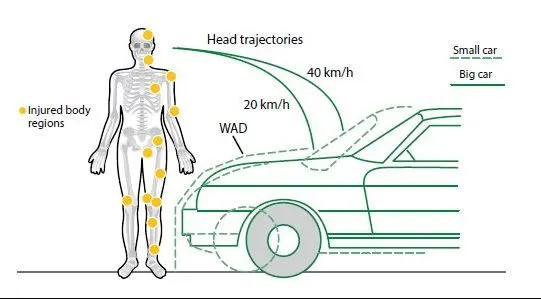
PEDISTRIAN SAFETY
DESIGN PARAMETERS
- Outer Panel Thickness = 0.75mm
- Inner Panel Thickness = 0.75mm
- Reinforcement Thickness = 1.5mm
MASTER SECTION
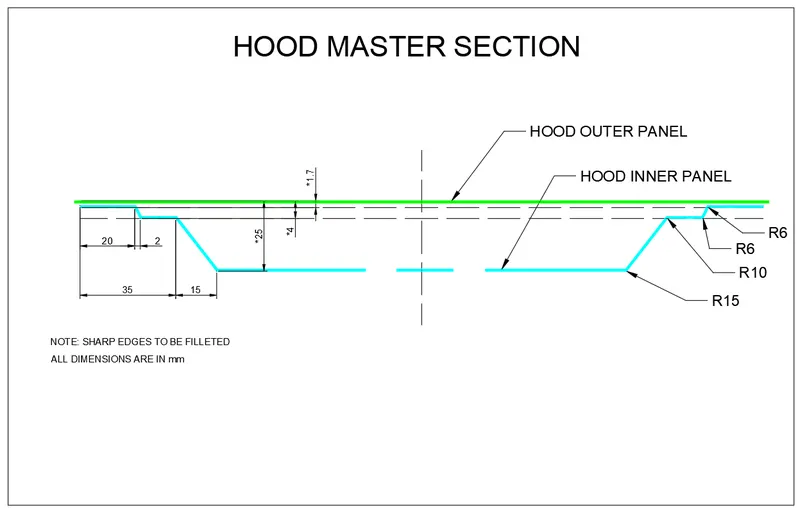
DESIGN APPROACH
- Create assembly for the hood.
- Import the styling surface of the outer panel.
- Design the inner panel.
- Import striker assembly & hinge assembly.
- Position the hinge by generating hinge axis.
- Constrain the position of latch & striker.
- Add Reinforcements.
- Create Hem flange on the outer panel.
- Thicken according to the design parameter.
COMPONENTS
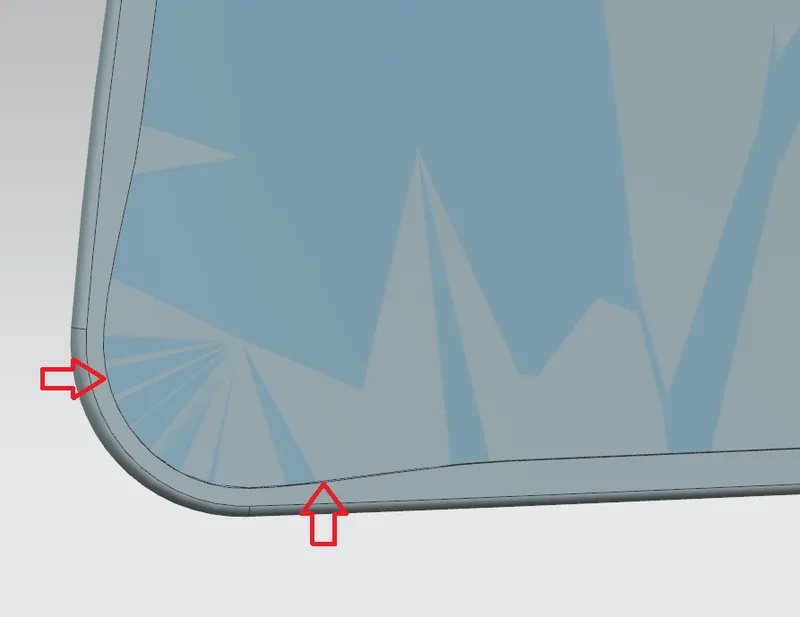
- HOOD OUTER PANEL- Outer panel is the aesthetic styling skin element of a car. Outer panel skin is provided by styling team or it can be designed by the designer from scratch. The shape, size & position are provided by the head of department to meet its requirements to satisfy the safety norms & other parameters. The outer panel is attached with the inner panel by hemming process. Cutting relief is provided at edge of the hem flange at the corner sides before rolling operation begins. This is done due to folding pocket formation which may cause the irregularity on the surface & as a final product development it won’t come with proper finishing. Mastic sealants is provided between outer panel & inner panel to reduce vibration for the engine cabin.
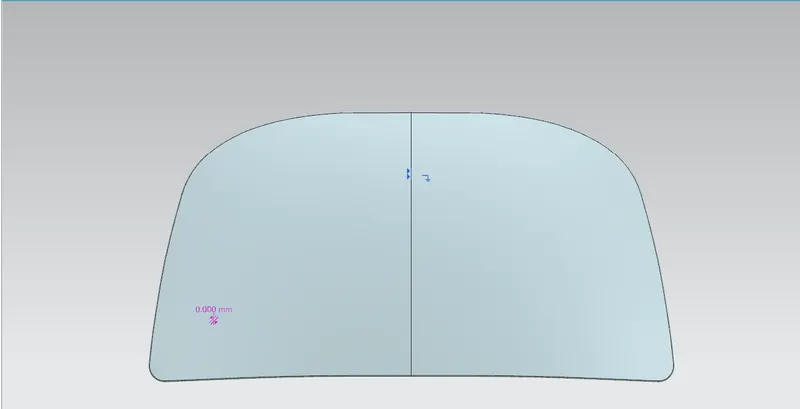
HOOD OUTER PANEL
- HOOD INNER PANEL- Inner panel is the part which gives the strength & rigidity to the hood outer panel. The master section represents the initial emboss shape & size. Cut-out is also provided in the emboss section with mastic points. A proper cut-out in inner panel is good for pedestrian safety which absorbs the kinetic energy of the impact & cause less injuries. Hinge emboss is also provided with reinforcements to strengthen the hinge assembly while opening & closing of the hood in a fixed trajectory direction. Latch & striker is provided with emboss faced after fixing the location.
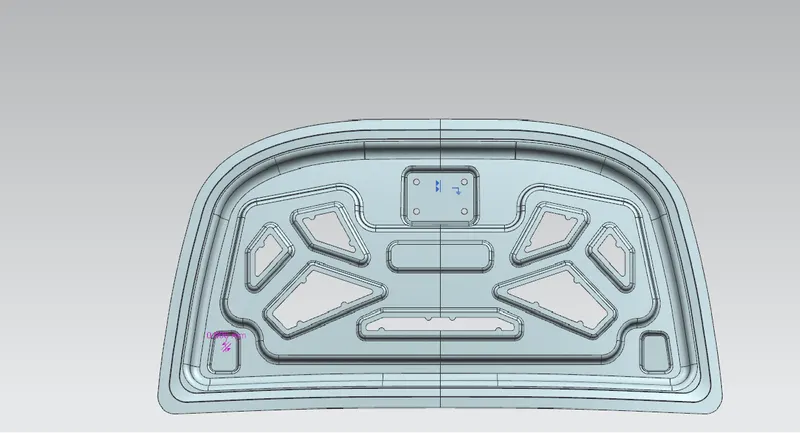
HOOD INNER PANEL
- REINFORCEMENT- Reinforcement are provided on specific areas in the body components, in this case in hinges & latch regions of the hood inner panel. It is thick metal sheet of thickness 1.5mm to enhance the strength of particular region locally & also reduce NVH of that region.
- HINGE ASSEMBLY- A hinge assembly of a hood in a vehicle is a pivot pin mechanism having a D-shaped cross-sectional shape positioned within a recess. The hood & pin are pivotal to a position whereat the D-shaped cross section is oriented to pass through a slotted opening to the recess to thereby allow the hood to be removed or installed on the vehicle.
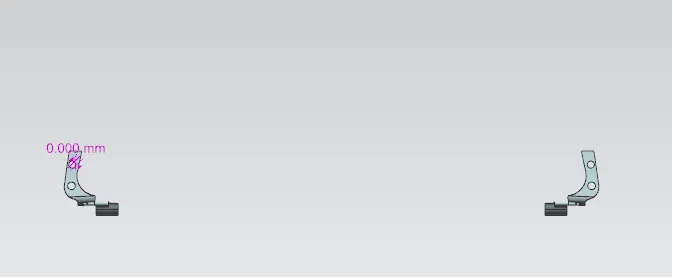
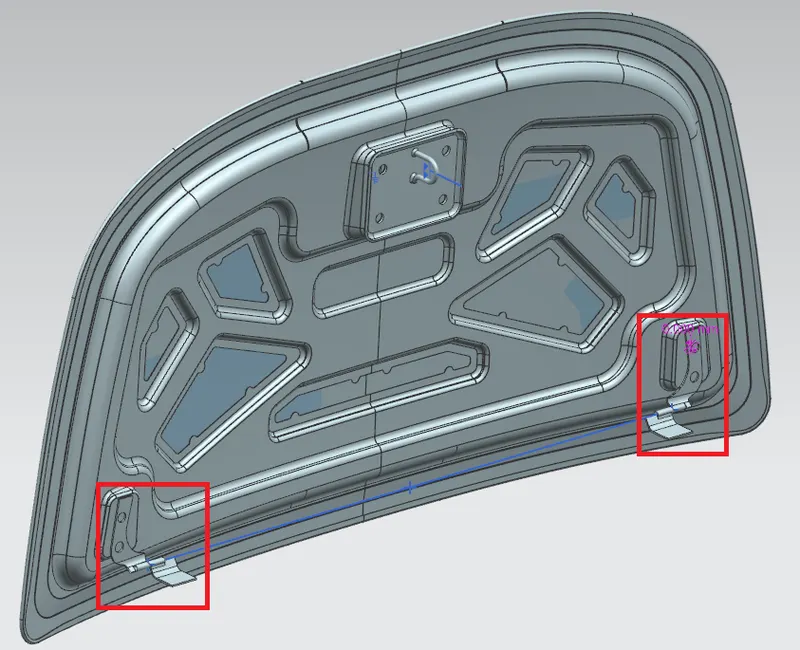
HINGE ASSEMBLY
- LATCH & STRIKER- A hood latch engages the striker for latching the hood panel movable between open & closed positions relative to a body panel. The striker is mounted on one of the panels. Housing is mounted on the other panel. A pop-up level is pivotally mounted to the housing for the movement between lowered & raised positions. A pop-up spring bias the pop-up lever to the raised position. A latch lever has a hook for latching engagement with the striker.
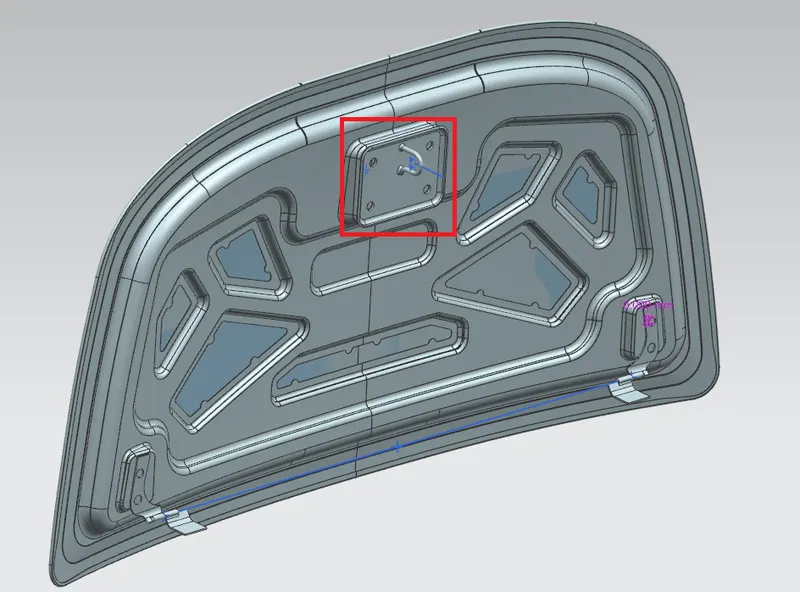
STRIKER
METHODOLOGY
- LATCH TRACJECTORY- Latch trajectory is a fixed direction where latch has to mate with the locking system in the engine bay area. In order fall at single shot, select the centre point of the both LHS & RHS hinge assembly & create hinge axis line. In side view profile, select the centre point of the hinge axis & sketch the circle & adjust it to fix the latch. Make tangent line to latch trajectory circle & give at any angle to see that tangential line is moving directly proportional to trajectory circle.
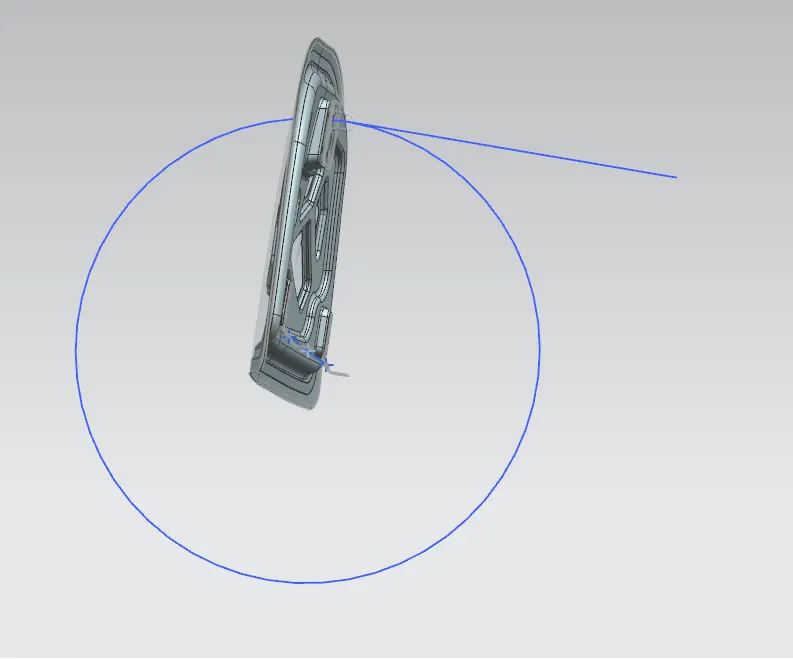
LATCH TRAJECTORY
- EMBOSS- Emboss is a forming process in which high pressure is applied to workpiece to change the surface. Depending on the shapes it can create hollow embossing & solid embossing.
- CLOSED EMBOSS- Closed embossing is an easy method to generate embossing through emboss command in NX-12 software but it can be executed only in closed surface.
- LAW EXTENSION METHOD- This method is done through offsetting the surface & later through law extension command it can be channel to the offset surface. Trim & extended is used to remove the excess portion created by law extension.
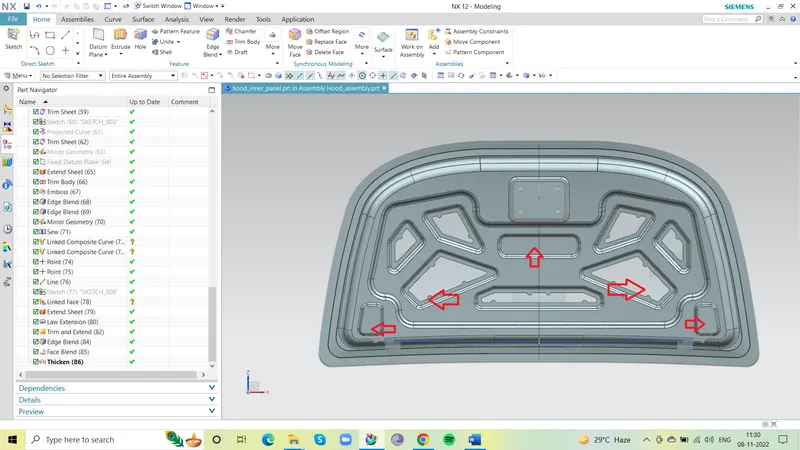
EMBOSS
- HEMMING- Hemming is a sheet metal forming process in which sheet are joining by bending to 180 degrees. It is usually used by automotive industry to join the inner panel & outer panel closure panels together.
Hemming is mainly design from the hood outer panel & gives the curvature between the hood inner panel & hem flange.
- CONVENTIONAL HEM- In conventional hemming, the flange is folded over the entire length with a hemming tool.
- ROLLING HEM- Rolling hem is a process in the automotive sheet metals. Robotic roller mechanism is used at edges of the hem flange to guide the rolling hem process. The operation carried out incrementally with hemming roller. But the operation cycle is higher to follow a defined path.
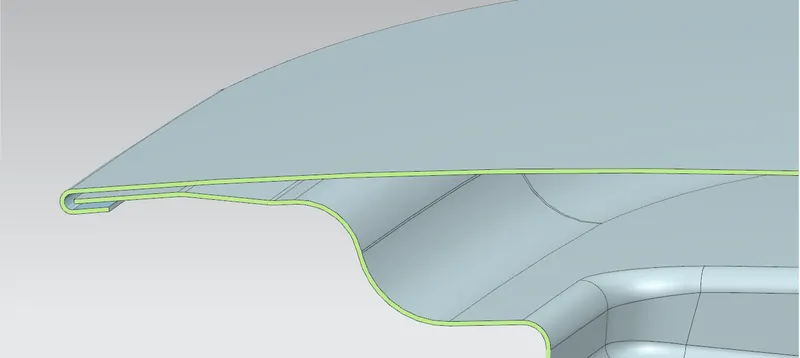
HEMMING
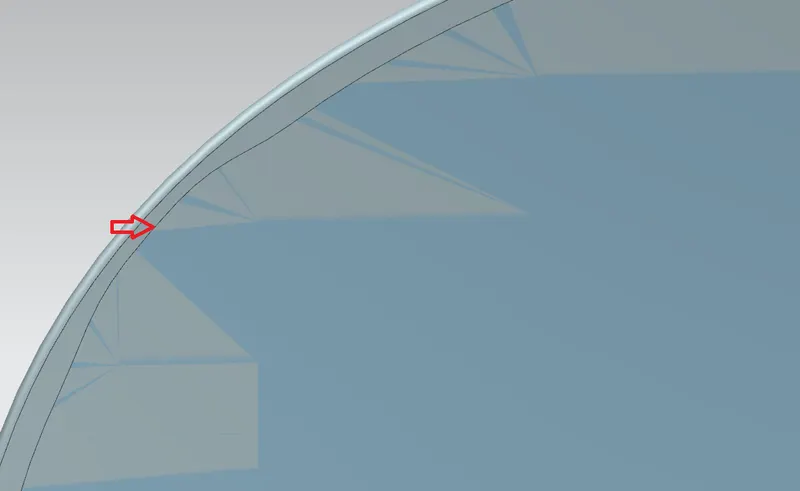
- CUTTING RELIEF-
- MASTIC POINT- Mastic point are areas where the inner hood panel is joined with the outer panel hem using a mastic sealant. This mastic glue keeps the inner panel stuck to the outer panel. The main purpose of the outer panel is for the aesthetic look thus, we cannot use bolt, welding, riveting which leaves the mark on the surface of the hood panels & spoil the appearance. Each mastic sealants have range of spreading of around 80mm due to engine heat or ambience heat. It has been placed or designed in such a way that mastic sealant spread effect touch the periphery of it.
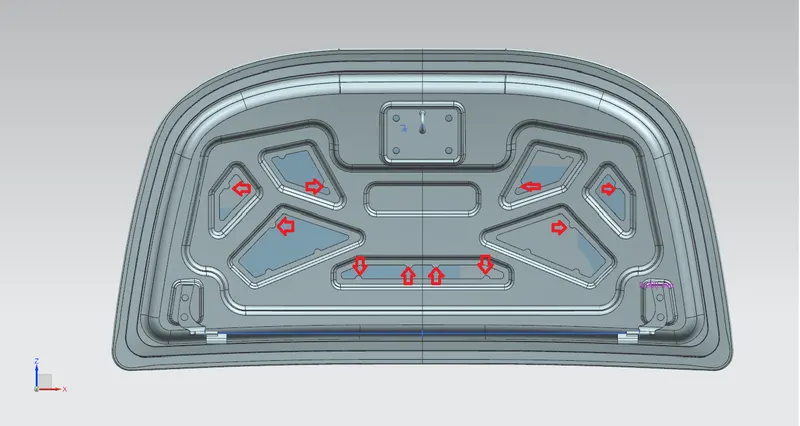
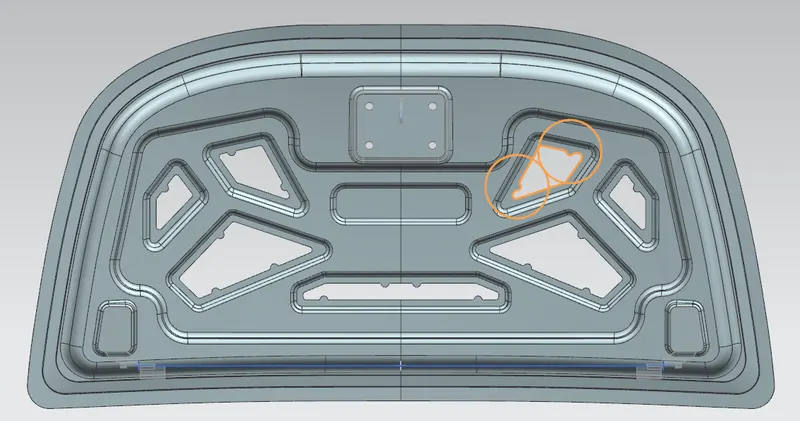
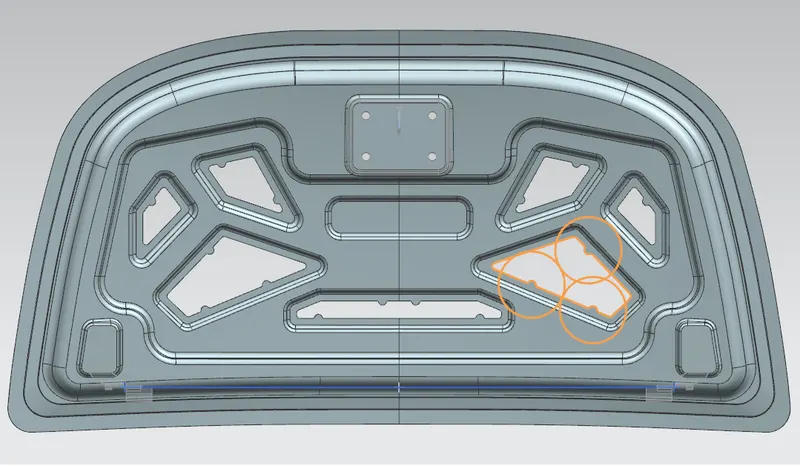
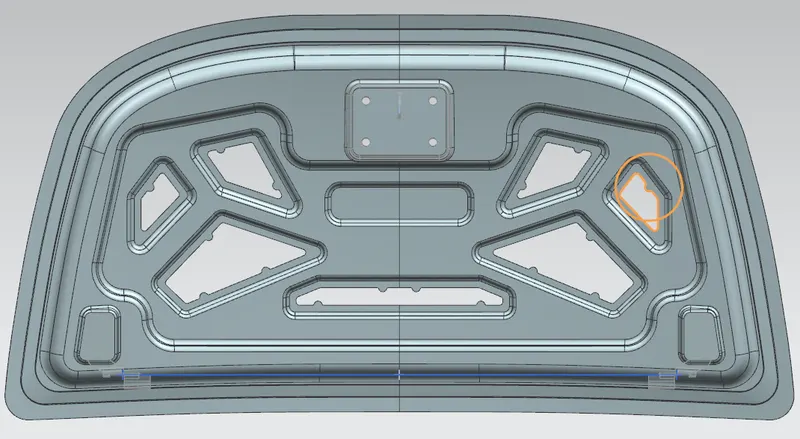
MASTIC POINTS