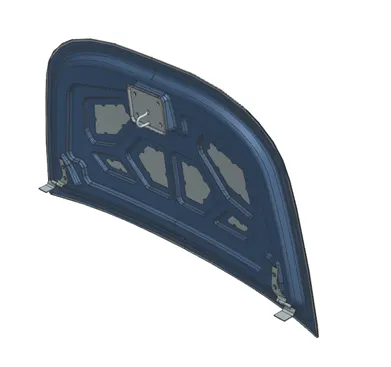
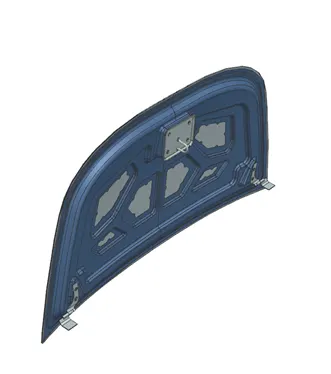
Hood design -SEIMENS NX - Sheet Metal
HOOD DESIGN

In the world of automobiles, the hood, also known as the bonnet in some regions, is an essential and iconic component that plays a vital role in both the functionality and aesthetics of a vehicle. Positioned at the front of the car, the hood covers and protects the engine compartment while contributing to the overall design language and brand identity.
First and foremost, the primary purpose of the hood is to provide access to the engine bay. Lifted effortlessly through a latch inside the cabin, the hood reveals the heart of the vehicle, allowing mechanics and owners to perform essential maintenance tasks, such as checking oil levels, refilling fluids, and replacing air filters. This accessibility ensures that the engine remains in optimal condition, enabling smooth and reliable operation of the vehicle.
Safety is another critical aspect considered in the design of hoods. Modern automotive engineering focuses on enhancing the crashworthiness of vehicles, aiming to protect occupants during collisions. Hoods are carefully engineered to crumple in controlled deformation during a frontal impact, effectively absorbing and dispersing impact energy away from the passenger compartment. Reinforcements and energy-absorbing materials are integrated into the hood's structure to ensure maximum protection for occupants in the event of a crash.
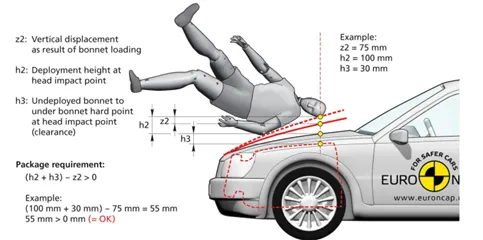
Certain regions have specific regulations and standards to consider, such as pedestrian safety requirements. Designers need to ensure that hoods are designed with pedestrian impact protection in mind, incorporating features that minimize the risk of injury to pedestrians in the event of an accident.
The materials used in the construction of hoods also contribute to their overall performance. Traditional hoods were primarily made of steel due to its strength and cost-effectiveness. However, advancements in technology have led to the use of lighter materials such as aluminum and composite materials like carbon fiber. These lightweight materials not only reduce the overall weight of the vehicle, positively impacting fuel efficiency and handling but also enhance the car's performance and agility.
Design considerations for the hood of a vehicle are as follows;
- Aerodynamics: The shape and contours of the hood should be carefully designed to reduce air resistance and improve overall aerodynamics. A well-designed hood can help improve fuel efficiency and reduce wind noise.
- Engine Cooling: The hood must allow for adequate airflow to cool the engine. Design features such as vents or grilles may be incorporated to facilitate airflow while preventing debris from entering the engine bay.
- Safety: The hood should be designed to crumple and absorb impact energy in the event of a collision. This helps protect occupants by reducing the severity of injuries in a frontal crash. Reinforcements may be added to certain areas to enhance crash protection.
- Materials: Choosing appropriate materials is crucial for the hood's strength, weight, and cost. Common materials used for hoods include steel, aluminum, and composite materials like carbon fiber. Each material has its own advantages and trade-offs.
- Hinge and Latch Mechanism: The hinge and latch mechanism should be robust and secure to keep the hood firmly closed while driving. At the same time, it should allow for easy opening and closing during maintenance.
- Noise Reduction: Proper insulation and sealing can help reduce engine noise and road noise from entering the cabin. This improves the overall comfort and driving experience.
- Aesthetic Integration: The hood design should harmonize with the overall vehicle design and branding. It plays a significant role in defining the car's front-end appearance.
- Pedestrian Safety: In some regions, pedestrian safety standards may dictate certain design elements to minimize injury risks in the event of a pedestrian impact.
- Maintenance Accessibility: The design should allow easy access to engine components for routine maintenance tasks like checking fluid levels, changing oil, and replacing air filters.
- Manufacturability and Cost: The design should be feasible for mass production, taking into consideration the manufacturing processes, assembly, and cost constraints.
- Weight Optimization: Reducing the weight of the hood can contribute to improved fuel efficiency and handling. However, this must be balanced with safety and structural integrity.
- Corrosion Resistance: The chosen materials and coatings should provide adequate protection against corrosion, ensuring the hood's durability and longevity.
- Regulatory Compliance: The hood design must comply with safety and emissions regulations specific to the target markets where the vehicle will be sold.
General overview of the manufacturing process for a car hood;
- Design and Prototyping: The manufacturing process begins with the design of the car hood. Automotive designers and engineers use computer-aided design (CAD) software to create the hood's shape, contours, and dimensions. Prototypes may be produced to evaluate the design and make necessary adjustments.
- Material Selection: The choice of material for the hood depends on factors such as cost, weight, strength, and manufacturing capabilities. Common materials include steel, aluminum, and composite materials like carbon fiber. Each material has its unique properties and requires different manufacturing processes.
- Sheet Metal Forming (for steel and aluminum hoods): For steel and aluminum hoods, the manufacturing typically starts with a large flat sheet of the chosen metal. The sheet is fed into a press, where it undergoes various forming operations, such as stamping, drawing, and stretching, to achieve the desired shape of the hood.
- Composite Layup (for composite hoods): In the case of composite hoods, the manufacturing process involves layering pre-impregnated composite materials (prepregs) onto a mold in a specific pattern. The layers are then cured under heat and pressure to create a rigid and lightweight composite structure.
- Trimming and Cutting: After the initial forming or layup process, the excess material is trimmed, and the hood's edges are cut to the precise dimensions specified in the design.
- Hemming: Hoods may require hemming, which involves folding and joining specific edges of the hood to reinforce and create a smooth surface. Hemming is commonly used for hoods with a double-wall construction.
- Surface Treatment: The hood's surface may undergo various treatments, such as cleaning, chemical treatment, and surface coating, to improve its appearance, corrosion resistance, and paint adhesion.
- Assembly and Integration: Once the individual hood components are ready, they are assembled with other parts of the front-end assembly, such as hinges, latch mechanisms, and support struts.
- Quality Control: Throughout the manufacturing process, strict quality control measures are implemented to ensure that each hood meets the required specifications and safety standards. Non-destructive testing, dimensional checks, and visual inspections are conducted to identify and rectify any defects.
- Painting and Finishing: After assembly, the hood is sent to the painting line for surface preparation, priming, painting, and clear coating. The painting process gives the hood its final color and finish.
- Final Inspection: Once the hood is painted and fully assembled, a final inspection is performed to verify its quality, fitment, and appearance.
- Shipping and Installation: Finally, the hoods are packaged and shipped to assembly plants, where they are installed onto vehicles during the vehicle assembly process.
DEEP DRAWING
Deep drawing is one of the most widely used processes in sheet metal forming. Apart from its use in many other sectors, it is applied in the automotive industry for the manufacturing of car body parts. The deep drawing process is a forming process which occurs under a combination of tensile and compressive conditions. A flat sheet metal blank is formed into a hollow body open on one side or a hollow body is formed into a hollow body with a smaller cross-section.
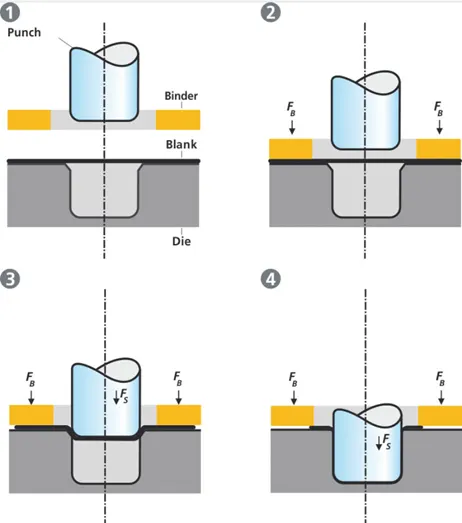
The figure illustrates the deep drawing process. The rigid tools consist of a punch, die and binder. In deep drawing, the plate holder closes after the metal sheet blank has been inserted.
Next the sheet is clamped between the die and the binder. This process slows down the flow of the sheet while it is being drawn and thereby prevents wrinkles from forming under the binder. The punch stretches the sheet over the die radius and forms it in the die. The amount of punch force necessary for forming is thereby continually increased up to the lower dead center of the punch.
Whereas in pure deep drawing there is no reduction of sheet metal thickness, forming is achieved in stretch forming purely as a result of a decrease in sheet metal thickness. Stretch forming is extensively used for the forming of only slightly curved parts with low depth of draw (e.g., roofs, doors). When drawing complex car body parts in practice, there is usually a combination of stretch and deep drawing involved. It is necessary that the sheet metal is stretched as well as possible without reaching the material’s limits (e.g., splits, wrinkles).
TRIMMING
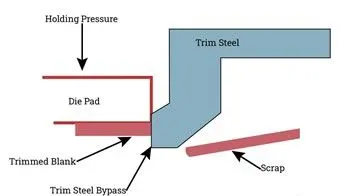
Trimming is the removal of excess metal from a stamped part to allow the part to reach the finished stage or to prepare it for subsequent operations. This article presents an analysis of parts to be trimmed and describes the selection criteria for the different types of trimming dies such as conventional trimming dies and cam trimming dies. It provides information on rough and finish trimming and construction details of trimming dies. The article reviews the selection criteria of presses for a trimming operation. It provides a discussion on the scrap and material handling processes in trimming.
FLANGING
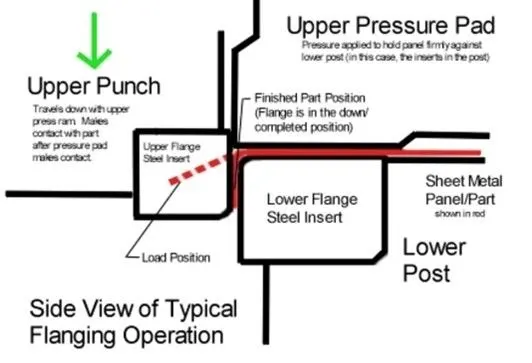
Flanging is a bonding and forming technology used in sheet-metal forming. By bending over the edge of metal sheets using a flanging machine, the process reinforces the bent edge or creates a connection consisting of multiple components.
The flanging process requires tools made from materials that have low friction properties and are capable of withstanding high mechanical loads. High mechanical loads, surface quality of the tools, dimensional accuracy and wear resistance are the challenges presented by this application.
HEMMING
Hemming is a forming operation in which the edges of the sheet are folded or folded over another part in order to achieve a tight fit. Normally hemming operations are used to connect parts together, to improve the appearance of a part and to reinforce part edges.
In car part production, hemming is used in assembly as a secondary operation after deep drawing, trimming and flanging operations to join two sheet metal parts (outer and inner) together. Typical parts for this type of assembly are hoods, doors, trunk lids and fenders.
The accuracy of the hemming operation is very important since it affects the appearance of the surface and surface quality. Material deformations, which occur during the hemming process, can lead to dimensional variations and other defects in parts. Typical hemming defects are splits or wrinkles in the flange, material overlaps in the corner areas or material roll-in. This is why it is important to use simulation tools in order to, on the one hand, better understand the hemming process and, on the other hand, significantly reduce the number of “trial and error” loops during tryout und production.
There are various types of hemming operations:
- Conventional die hemming
- Roll hemming
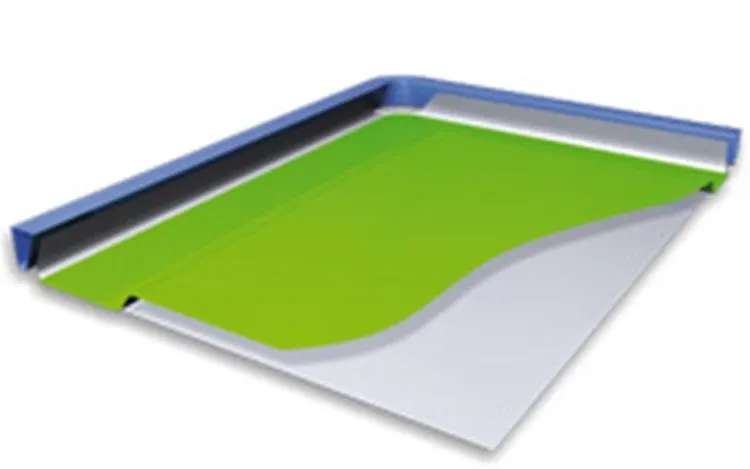

In conventional die hemming, the flange is folded over the entire length with a hemming tool. In roll hemming, the hemming roller is guided by an industrial robot to form the flange.
Design of Automotive Hood on NX CAD.
Given the styling surface of HOOD, that is the class A surface, as the designer I have to make the CAD model of the HOOD Assembly considering the master section, inner panel embosses, mastic sealants, hemming reliefs, latching and hinge constraints.
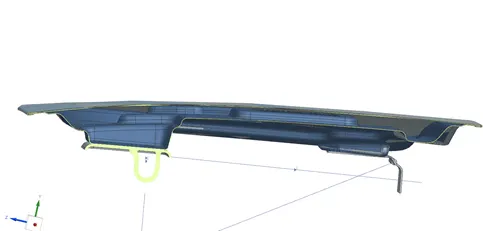
Master Section involves the design constraints of the hood in terms of dimensions. As a designer, I must adhere to master section and my product should not deviate from the master section. The given master section for my HOOD is as follows;
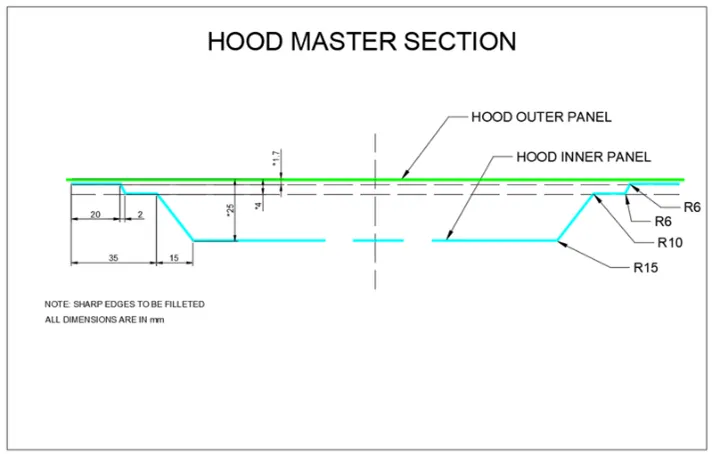
The cad model created for HOOD is as follows;
Inner Panel Embosses: Inner panel embosses refer to raised or indented areas on the inner side of the hood. These embosses are not visible from the outside but are present on the inside surface of the hood, facing the engine bay.
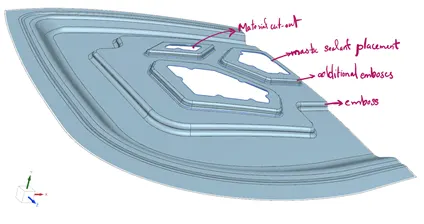
They serve several purposes:
- Structural Rigidity: Inner panel embosses add strength and rigidity to the hood, ensuring it maintains its shape and resists deformation under various loads and stresses.
- Vibration Damping: They can help dampen vibrations and reduce noise transmitted from the engine and road into the vehicle cabin.
- Heat Dissipation: Inner panel embosses can also facilitate heat dissipation from the engine bay, contributing to better engine cooling.
- Weight Reduction: In some cases, inner panel embosses are strategically placed to reduce the overall weight of the hood without compromising its structural integrity.
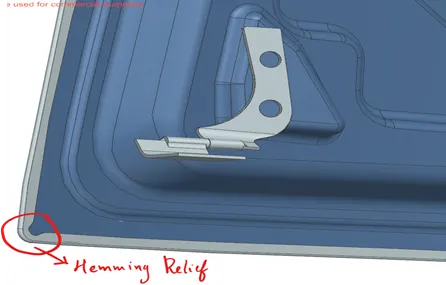
Hemming Relief: Hemming relieves are given to inner panel to reduce the spring back effect. This occurs due to sharp corners in the panel which tend to deviate from the intended shape after forming process due to local stress residual. It can be removed by proper relief at edges with less material.
Mastic Sealant: Mastic sealant is a type of adhesive material used in automotive manufacturing and repair. It is a flexible and durable sealing compound that comes in the form of a paste or a tape. Mastic sealant is applied to various joints, seams, and flanges to create a watertight and airtight seal.
- Hood Panel Sealing: In hood manufacturing, mastic sealant is applied along the edges and seams of the hood's outer and inner panels. This helps prevent water, dust, and other contaminants from entering the engine bay and also contributes to noise reduction.
- Rust Prevention: Mastic sealant can act as a barrier to protect vulnerable areas from corrosion and rust, extending the lifespan of the hood.
- Vibration Damping: Mastic sealant can also help dampen vibrations and reduce resonance, leading to improved acoustic comfort in the vehicle cabin.
- Crash Performance: In some cases, mastic sealant is used to enhance crash performance by reinforcing certain areas or creating energy-absorbing structures.
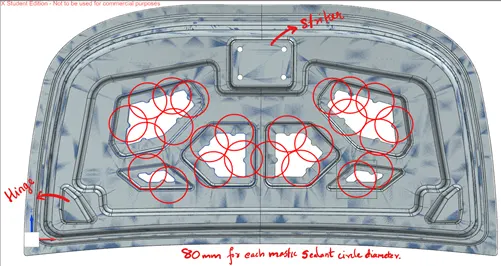
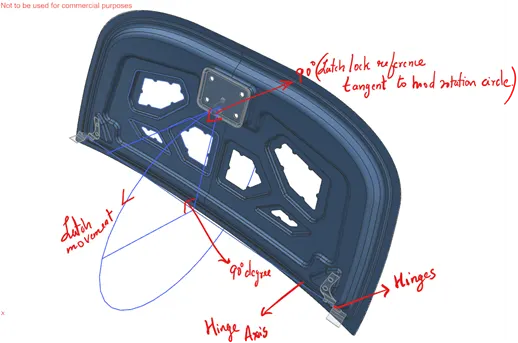
Latch trajectory refers to latch and lock placement on hood along with the hinges. It’s important that proper constraints are given to latch with respect to hinges so that there is no issue on alignment with car body and latch lock. It was designed by creating an axis from the hinges for reference and making a perpendicular till the latch hook. The reference axis is made as the center of the circle for hinge rotation and thereby fixing the hatch hook tangent to the trajectory we can be sure of the alignment.
From all these design intentions, a CAD MODEL of the HOOD Assembly is created. Screenshots of the HOOD Assembly is attached below;