FORCES ALONG THE VEHICLE
AIM
Understanding the Forces acting on a Vehicle
OBJECTIVE-1 `implies` What should be the maximum speed of the motor used in an electric scooter capable to run at 90 kmph, if the fixed gear ratio is 7 and tire size is 90/100 R10 53J and 90/90 R18 51P?
OBJECTIVE-2 `implies` Prepare a simple excel calculator to identify vehicle propulsion power based on given inputs such as Kerb Weight (kg), Payload (kg), Coefficient of rolling resistance, Air density (kg/m3), Width (m), Height (m), Drag coefficient, Acceleration (0 to top speed in specified seconds), Hill climbing angle, Speed. Also, What are the limitations of this calculation?
OBJECTIVE-3 `implies` Assuming that tire pressure reduction by 15% results in increase of rolling resistance effect by two times, how much will be the difference in total traction power keeping all other parameters same?
OBJECTIVE-4 `implies` See the video of Range rover sport dragon challenge. How much is the gradeability? What was the average speed? Which are the forces acting on car?
PRE-REQUISITE
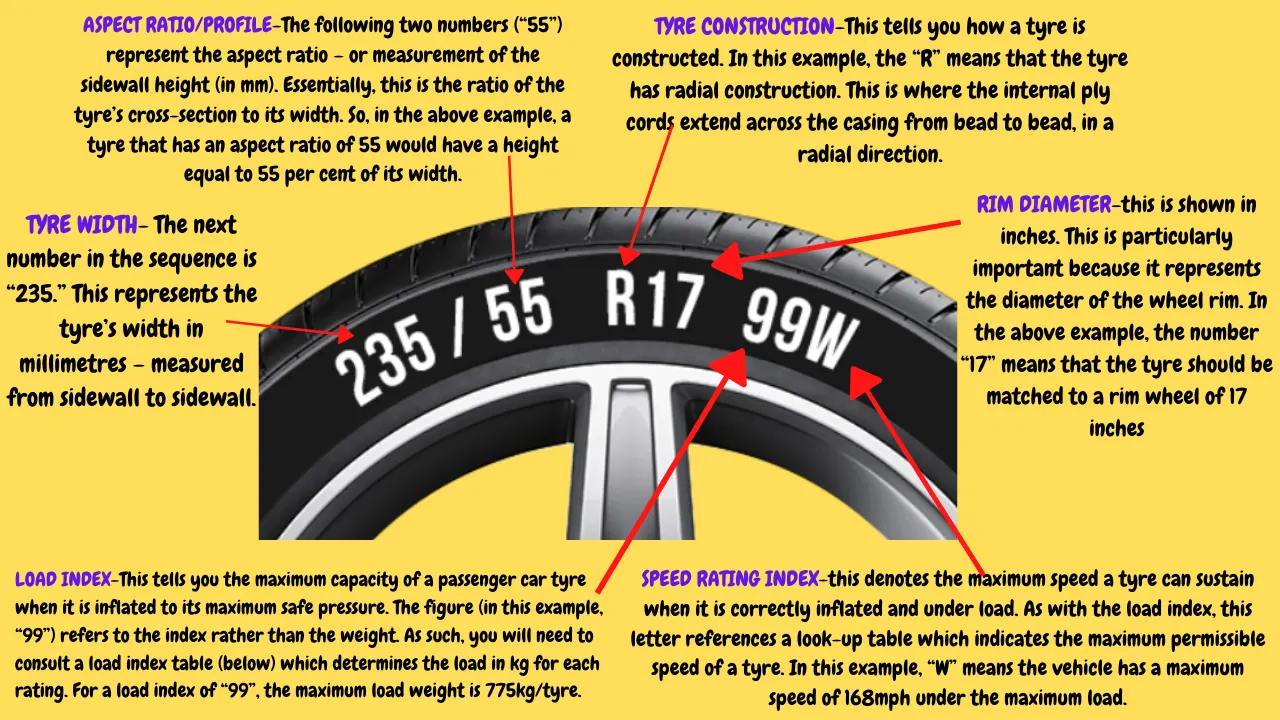
How to read tyre markings and are they important? When it comes to staying safe on the road, tyres are among the most important components of your vehicle. Whether you’re steering, braking or drifting along, they are at the epicentre of the action. After all, this is the only part of your vehicle which actually touches the ground. Thus, when it comes to tyre replacements, it’s crucial you get it right. These markings are used to identify the specifications and physical features of a tyre, so you can find a replacement which works in tandem with your vehicle. While a few of these tyre markings are of little importance, most of them have a significant effect on performance and safety – so it’s important to get right.
Where to find the tyre markings? It will probably come as no surprise that tyre labels are etched into a tyre’s sidewall (i.e. the external side facing you).
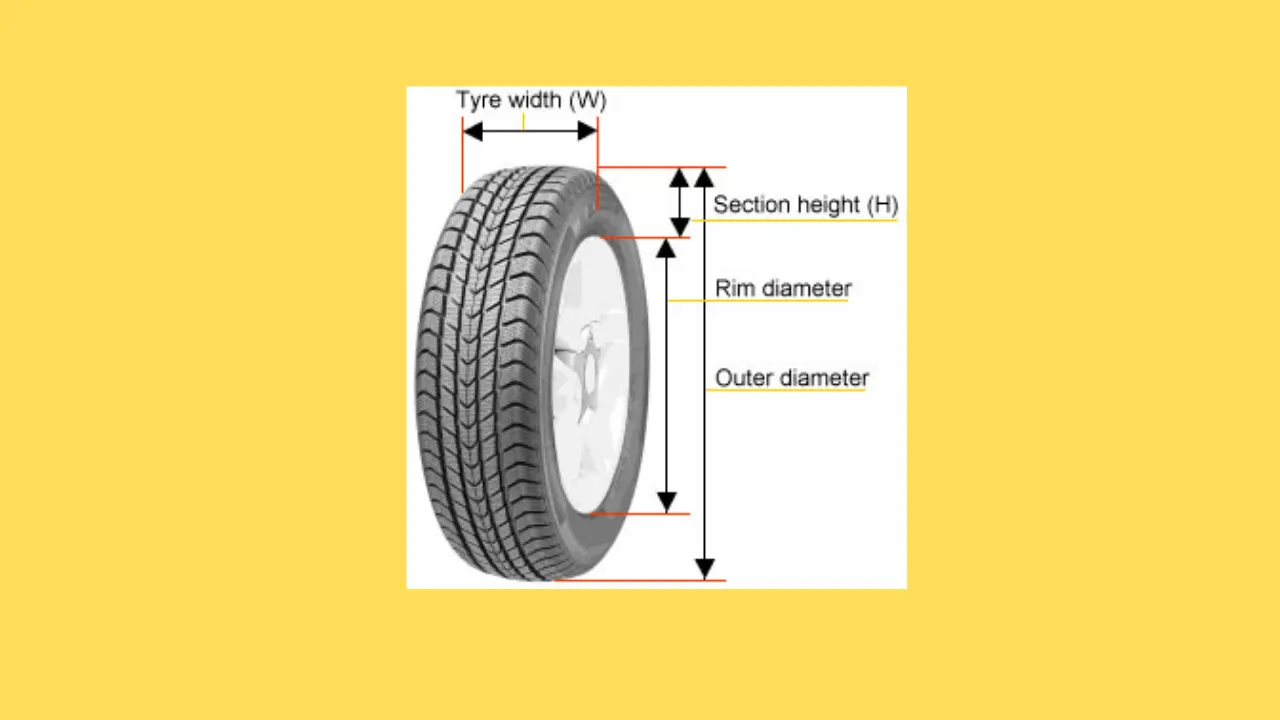
How to read the tyre sidewall markings? A tyre sidewall contains a lot of information. So, let’s start by focussing on the short sequence of letters and numbers which represent the size code.
THEORY
The important aspect while modelling an electric vehicle can be cumulatively expressed into the vehicle's performance. By performance we mean acceleration and top speed, an area where electric vehicles have a reputation of being very poor. It is necessary that any electric vehicle has a performance that allows it, at the very least, to blend safely with ordinary city traffic. Many would argue that the
performance should be at least as good as current IC engine vehicles. So the first step in vehicle performance modelling is to produce an equation for the tractive effort.
What is a Traction Force?`implies`the force propelling the vehicle forward, transmitted to the ground through the drive wheels. The force propelling the vehicle forward, the tractive effort, has to accomplish
the following:
• overcome the rolling resistance;
• overcome the aerodynamic drag;
• provide the force needed to overcome the component of the vehicle’s weight acting
down the slope;
• accelerate the vehicle, if the velocity is not constant.
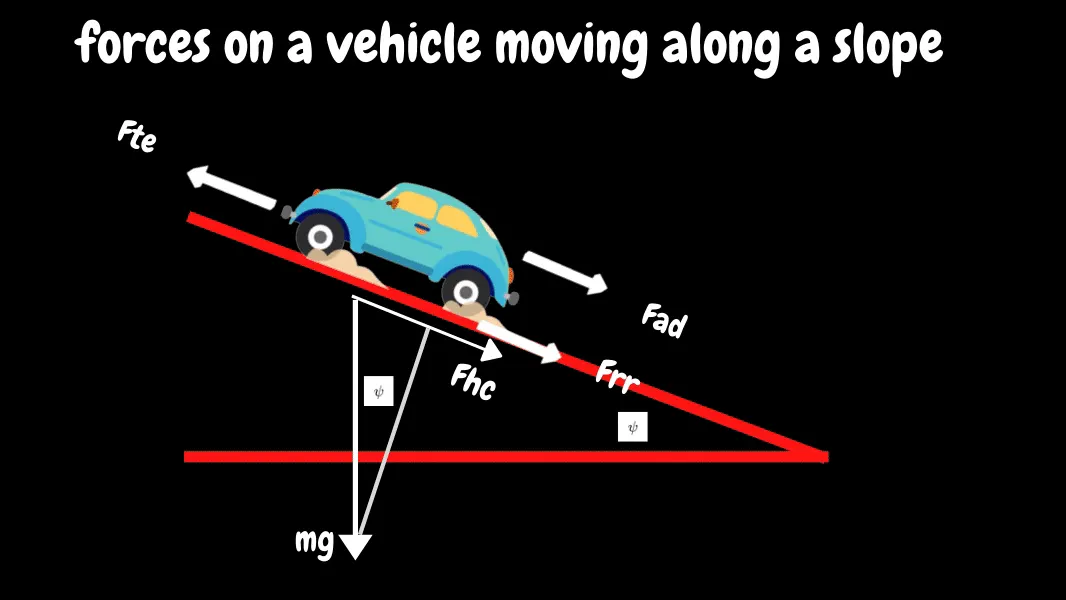
1.Rolling Resistance Force (`Funderset(rr)()`) `to`due to the friction of the vehicle tyre on the road. Friction in bearings and the gearing system also play their part. The rolling resistance is approximately constant, and hardly depends on vehicle speed. It is proportional to vehicle weight. The equation is:
`Funderset( rr) ( )=underset( )(mu) underset( rr) ( )mg`
where`underset( ) (mu )underset( rr) ( )to` coefficient of rolling resistance
2.Aerodynamic Drag Force (`Funderset(ad)()`)`to`This part of the force is due to the friction of the vehicle body moving through the air. It is a function of the frontal area, shape, protrusions such as side mirrors, ducts and air passages, spoilers, and many other factors. The formula for this component is:
`Funderset(ad)()=(1/2)(rhoACunderset(D)()V^2)`
where `rhoto`density of air, `Ato`Frontal area, `Vto`velocity, `Cunderset(D)()to`coefficent of discharge
3.Hill Climbing Force (`Funderset(hc)()`)`to`The force needed to drive the vehicle up a slope. It is simply the component of the vehicle weight that acts along the slope.The equation is:-
`Funderset(hc)()=mgsin(psi)`
4.Acceleration Force`to`This can be of two types - Acceleration due to linear velocity (`Funderset(la)()`) and Acceleration due to angular velocity (`Funderset(omegaa)()`).
Acceleration due to linear velocity (`Funderset(la)()`Fla">)`to`If the velocity of the vehicle is changing, then clearly a force will need to be applied in addition. This force will provide the linear acceleration of the vehicle, and is given by the well-known equation derived from Newton’s second law of motion:-
`Funderset(la)()=ma`
Acceleration due to angular velocity (`Funderset(omegaa)()`Fωa">)`to` for making the rotating parts run faster, we need this component too. The equation is:-
`Funderset(omegaa)()=G/rT=G/r[IGa/r]=IG^2/r^2a`
for including the losses, we have to incorporate gear system efficiency `etaunderset(g)()`, `Funderset(omegaa)()=IG^2/(r^2eta^2)a`
where `Ito`Moment of Inertia, `Gto` Gear Ratio, `rto` radius of tyre, `ato`acceleration,`etaunderset(g)()to`Gear system Efficiency
5.Total Traction Force (`Funderset(TE)()`)`to`
`Funderset(TE)()=Funderset(rr)()+Funderset(ad)()+Funderset(hc)()+Funderset(la)()+Funderset(omegaa)()`
OBJECTIVE-1
The maximum speed of the motor means the angular speed at which the motor is rotating.The angular speed of the motor is given by:-
`omega=GV/r rad.sec^(-1)`
`omega=2piN/60`
where `Gto` Gear Ratio,`rto` radius of tyre, `vto`velocity, `Nto`rpm
or 90/100 R10 53J→">`to` G=7,
V = 90Km/hr = 25m/sec,
r = (10inch/2) + 100% of 90mm
= 0.127m + (1*0.09)m
= 0.217m
`omega=7*25/0.217 rad.sec^(-1)`
`= 806.451rad.sec^(-1)`
`N=60*806.451/(2pi)`
N `=7704.951 r p m`
`Vunderset(max)()=omega*r=(806.451)* (0.217)`
`Vunderset(max)()=174.999m.sec^(-1) =629.999Km.h^(-1)`
for 90/90 R18 51P`to`G=7,
V = 90Km/hr = 25m/sec,
r = (18inch/2) + 90% of 90mm
= 0.228m + (0.9*0.09)m
= 0.3096m
`omega=7*25/0.3096 rad.sec^(-1)`
`=565.245rad.sec^(-1)`
`N=60*565.245/(2pi)`
`N=5397.696 rp m`
`Vunderset(max)()=omega*r=(565.245)*(0.3096)`
`Vunderset(max)()=174.999m.sec(-1)=629.999Km.hr^(-1)`
OBJECTIVE-2
Here i have used the Maruti Muzuki Swift facelift model and the Volkswagon Polo (comfortline plus) model for the calculation purposes. The below given input are taken directly from company website and the the values which were in ranges have considered with the extreme values:-
Given Inputs [Swift and Polo]`implies`
1.Gross weight`to`the maximum allowable weight of an entire vehicle when it's packed up and ready to go -- that includes the weight of the vehicle itself, all of the necessary fluids for operation (gasoline, diesel, oil and so on) and any cargo, passengers and tools. Here it is 1315Kg and 1500Kg.
2.Kerb Weight`to`is simply how much the vehicle weighs on its own, without any cargo or passengers. This measurement includes a full tank of gas and any other fluids that keep a car running. Here it is between 855-885 Kg. So i have taken the extreme value, i.e. 885Kg and 1030Kg.
3.Payload Capacity`to`the amount of stuff it can safely carry after you've filled up the tank with gas and topped off all of the fluids, it is just a matter of subtraction.
Payload Capacity = Gross vehicle weight rating - curb weight, Payload Capacity = Gross vehicle weight rating - curb weight
= 1315 - 885 = 1500 - 1030
Swift Payload =430Kg Polo Payload = 470Kg
4.Coefficent of Rolling Resistance`to`0.02
Now the `Funderset(rr)()` is calulated using the formula`implies` `Funderset( rr) ( )=underset( )(mu) underset( rr) ( )mg`.
The excel sheet is shown below:-

Now we will go for the aerodynamic resistance,:-
5.Density`to`1.25`(Kg)/m^3`
6.Frontal Area`to` the area where a car hits the air head on. Here i have multiplied the height and width of the vehicle to get the frontal area. I didn't bother about ground clearance as I figured that would have been taken into account while measuring drag coefficient.
Swift frontal area = height * width Polo frontal area = height * width
= 1.530m * 1.735m = 1.469m * 1.682m
=2.654`m^2` = 2.470`m^2`
6.Coefficent of Discharge`to`0.25
7.Speed`to`It is assumed to be 45Km/hr. The excel sheet is shown below
Now the (`Funderset(ad)()`) is caculated using the form`implies``Funderset(ad)()=(1/2)(rhoACunderset(D)()V^2)`.
The excel sheet is as shown below:-

Now we will find the Hill Climbing Force:-
8.Angle`to`is the iclination or slope angle at which the car is moving. It is represented as `psi`. Here i have assumed the `psi`value as `20^0`
9.Speed during hill climbing`to`This ia also another parametre which has to noted. The speed of car while moving along the slope.
Now the `Funderset(hc)()`is calculated by the equation`implies``Funderset(HC)()=mgsin(psi)`.
The excel sheet is shown below:-

Then i have calculated the total traction force excluding the acceleration forces, followed by the propulsion power. The equations are as follows:-
`Funderset(TE)()=Funderset(rr)()+Funderset(ad)()+Funderset(hc)()` and `P=Funderset(TE)()*v`

COMPLETE EXCEL SHEET

LIMITATIONS OF THE ABOVE EXCEL CALCULATION`to`Here, though we have considered the weight of the cars as per the gross weight, it is not enough for get the real time picture of the vehicles. Because in real time, there can be occasions where the vehicle is overloaded or the the slope angle is at its extreme value and simultaneously there can ve variations in the speed. All these will create huge variations in the propulsion power. Hence it is necessary that the vehicles is subjected to be designed for the extreme scenarios.
OBJECTIVE-2
Reduction in pressure by 15% causes the rolling resistance to increase by 2 times. hence the new traction force, without changing any other parametre has been shown in the below excel sheet:-
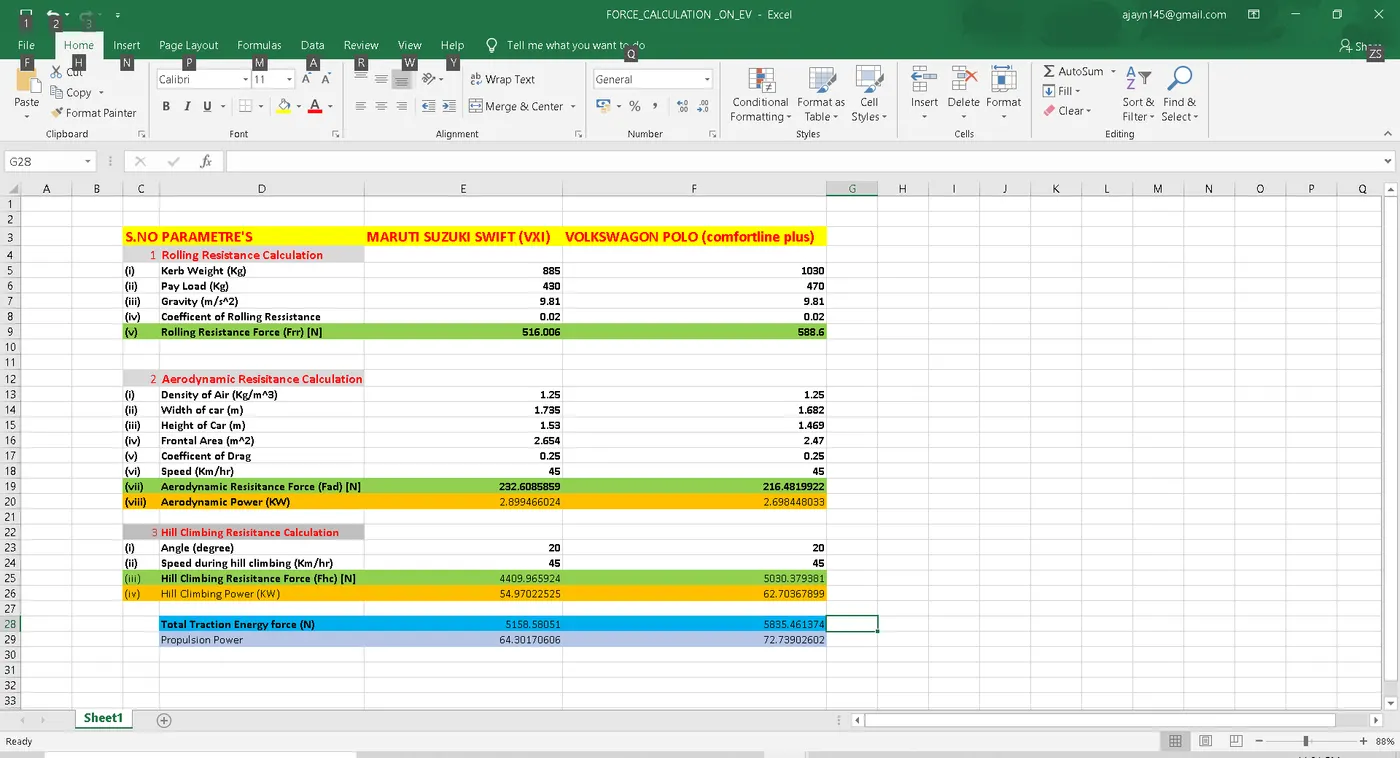
Difference in traction force from previous value to new value is:-
SWIFT`implies`64.30170606 - 61.08569867 POLO`implies`72.73902602 - 69.07057652
=3.21600739KW = 3.6684495KW
OBJECTIVE-3
The above video is the Range Rover, Sports Utility Vehicle (SUV) completed the previously unattempted drive that included 99 hairpin turns along the 7 miles of mountainside road, 999 steps OF Heaven's Gate in the Tianmen Mountain Road in the Hunan Province of China and the slow maneuvering at the bottom of the steps, in an impressive 22 minutes and 41 seconds.
It was the true power and performance of the New Range Rover Sport that allowed the team to successfully conquer The Dragon Challenge, making it the world’s first vehicle to successfully complete the 99 turns and 999 steps of Tianmen Mountain.
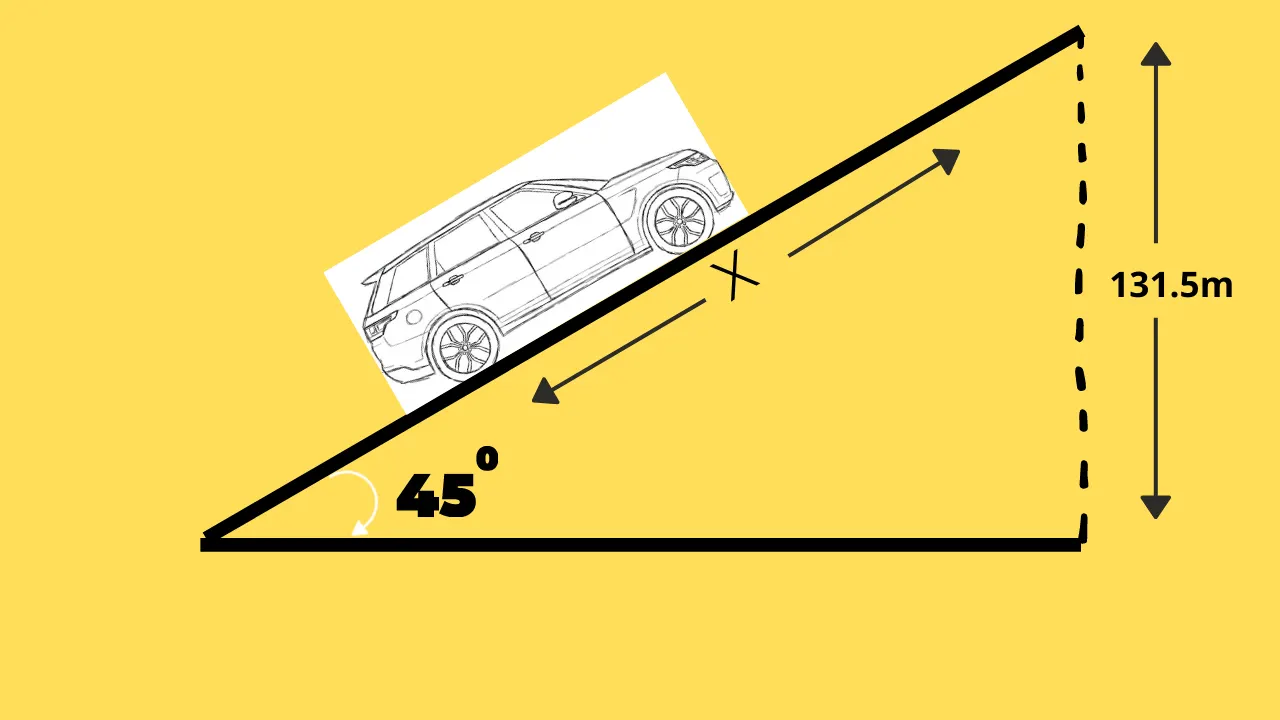
The Gradeability of the mountain is said to 450">4 or in percentage = tan(`45^0`) *100 = 100%
Given that,
`sin45^0=131.5/x implies`x=185.96m
Total distance=185.96m + distance travelled in 99 turns (i.e. 11000m)
=11185.96m
Total time taken = 22min 41seconds = 1344.6s
Average speed of the range rover = total distance travelled/total time taken
=11185.96/1344.6
= 8.319m/sec
= 29.94Km/hr
Google Drive for Excel files`implies`
https://drive.google.com/file/d/1IcwGOaMmbYFwhmg1Co3eBJDTh9seECOq/view?usp=sharing
The types of forces acting on the car are:-
- Rolling Resistance force
- Aerodynamic Force
- Hill Climbing force
- linear Acceleration force
- Angular Acceleration force
- traction force