Forces Acting on a Vehicle
Aims:
- To calculate maximum speed of the motor used in an electric scooter for given two tire sizes.
- To prepare a simple excel calculator to identify vehicle propulsion power based on given inputs and outputs. To calculate total power in KW and to explain the limitations of calculations.
- To calculate the difference in total traction power by keeping all the parameters same if the tire pressure is reduced by 15%.
- To watch the video of Range rover sport dragon challenge. To defy gradeability, average speed, and forces acting on car.
Theory:
Part 1: To calculate maximum speed of the motor used in an electric scooter.
As seen in the image below [1], the tire size terminologies are discussed further below.
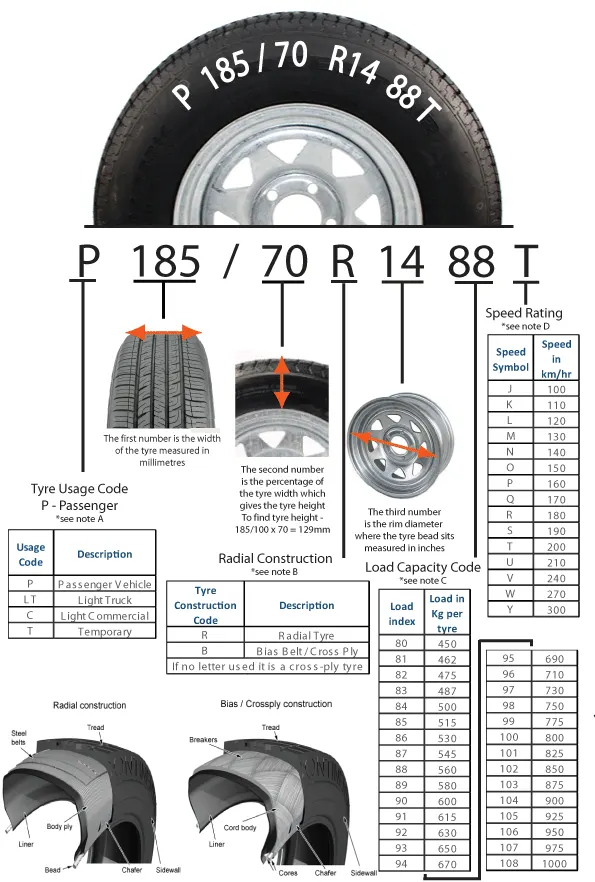
Tire Type: The first letter indicates the tire type if it is for passenger vehicle, truck, or commercial type vehicle.
Tire Width: Tire width is measured on top of tire from wall to wall, measured in mm.
Aspect Ratio: It is expressed in percent of the tire width. This is the height of the side wall of the tire.
Construction: R represents the radial construction of the tire.
Rim Diameter: The number next to R represents the tire rim diameter in inches.
Load Rating: The next number represents the load capacity in kilograms the tire can withstand when properly inflated.
Speed Rating: The last letter represents the speed rating of the tire, which expresses what will be the maximum speed the tire can run. The tyre speed rating is based on the manufacturer machine test, where the tyre is rated at that speed for 10 consecutive minutes without flying apart.
Given Data:
Tire Specification: 90/100 R10 53J and 90/90 R18 51P.
Velocity: 90 km/hr
Gear Ratio: 7
Tire size 1: 90/100 R10 53J
Here,
Tire Width: 90 mm.
Aspect Ratio (wall height): 100% i.e. 90 mm.
Construction: R Radial Type.
Rim Diameter: 10 inches.
Load Rating: 53.
Speed Rating: J i.e. 100 km/hr
For tire size 1 maximum speed calculations can be seen below.
We know the angular speed ω is:
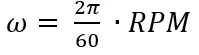
Where, ω is the angular velocity
Also,
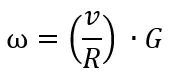
Where,
v = linear velocity = 90 km/hr = 25 m/s
R = radius of wheel
G = gear ratio
Now,
R = H + r
Where,
H = height of the side wall of tire in m = 0.09
r = rim radius = 0.127 m
Therefore,
R = 0.09+0.127 = 0.217m
Now we can calculate angular velocity ω,

To calculate RPM of the motor we know that,
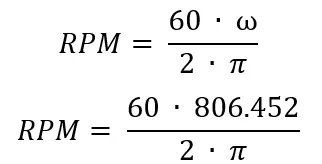
Therefore, RPM = 7701.049
7701.049 RPM is the maximum speed of the motor used in the electric scooter with tire size 1.
Tire size 2: 90/90 R18 51P
Here,
Tire Width: 90 mm.
Aspect Ratio (wall height): 90% i.e. 81 mm.
Construction: R Radial Type.
Rim Diameter: 18 inches.
Load Rating: 51.
Speed Rating: P i.e. 160 km/hr
For tire size 2 maximum speed calculations can be seen below.
We know the angular speed ω is:
Where, ω is the angular velocity
Also,
Where,
v = linear velocity = 90 km/hr = 25 m/s
R = radius of wheel
G = gear ratio = 7
Now,
R = H + r
Where,
H = height of the side wall of tire in m = 0.081
r = rim radius = 0.2286 m
Therefore,
R = 0.081+0.2286 = 0.3096m
Now we can calculate angular velocity ω,

To calculate RPM of the motor we know that,
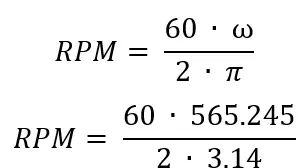
Therefore, RPM = 5400.43
5400.43 RPM is the maximum speed of the motor used in the electric scooter with tire size 2.
Part 2: To prepare a simple excel calculator to identify vehicle propulsion power.
Vehicle data assumed for calculations:
Kerb weight: 1500 kg
Payload: 600 kg
Coefficient of rolling resistance: 0.055
Air Density: 1.25 kg/m^3
Vehicle Width: 2 m
Height: 1.5 m
Drag Coefficient:
Speed: 100 km/h
Formula used for calculations:
1) Rolling Resistance Force (Frr):

Where,
µrr = coefficient of rolling resistance
m = mass
g = gravitational force
2) Air drag force (Fad):
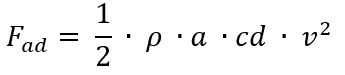
Where,
ρ = air density
a = frontal area
cd = drag coefficient
v = velocity
3) Hill Climbing Force (Fhc):

m = total vehicle mass
g = gravitational force
ϴ = slope angle (radian)
4) Total Power (P):
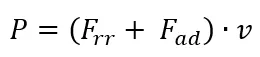
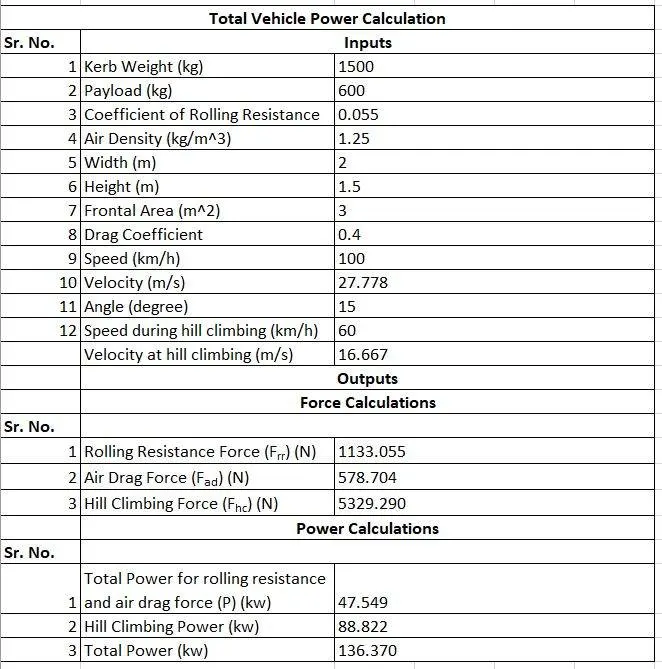
Above shown is the Microsoft Excel calculation screenshot and below mentioned is the link to Google sheets.
https://docs.google.com/spreadsheets/d/11Jo87EqL3ItemIrM6qIB3s8HgdvXN2KusE9kO7cuNrE/edit?usp=sharing
Limitation of Calculations:
- The calculations cannot be recommended for lengthy calculations.
- The formulas has to be input manually
- Not all the vehicle forces or resistances can be taken into consideration.
- Good, only for preliminary basic calculations.
Part 3: To calculate the difference in total traction power by keeping all the parameters same if the tire pressure is reduced by 15%.
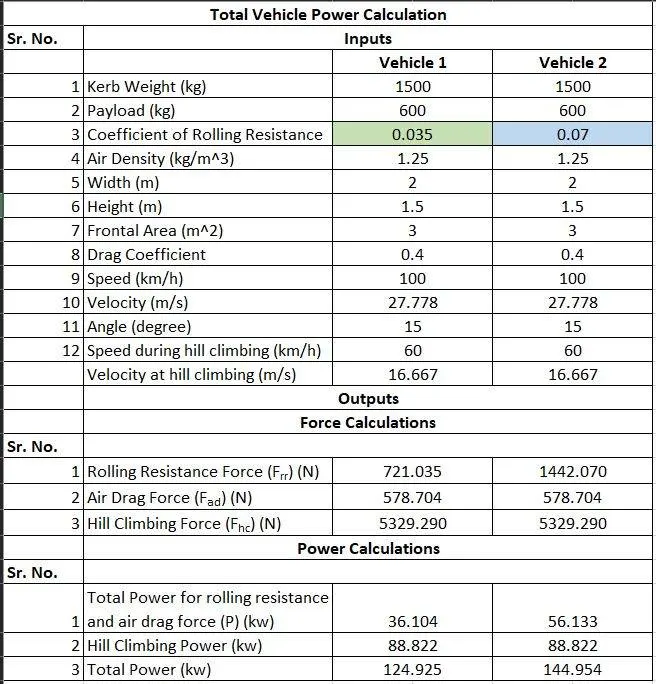
Here in this case by given conditions of reduction of 15% of tire pressure, the rolling resistance effect will increase by twice the value. Therefore, the calculations were carried out by doubling the value of coefficient of rolling resistance. The below showed Microsoft excel calculations shows us the increased value of rolling resistance and hence the values of Rolling Resistance Force, and Total Power have increased of Vehicle 2 considered for the calculations.
Part 4: To watch the video of Range rover sport dragon challenge. To defy gradeability, average speed, and forces acting on car.
The link to the video is: https://www.youtube.com/watch?v=EUwzWHD3Htg
A) How much is the gradeability?
Gradeability: A car's gradeability is its ability to climb slopes. Gradeability is measured either in degrees or percentage. A 45 degrees gradient is equivalent to 100 per cent. Gradeability is dependent on engine power, drivetrain type, gear ratio, weight, weight distribution, car's centre of gravity and traction [2].
The angle of steps/mountain where the car was driven, as mentioned in the video was 45 degrees. Therefore, the gradeability of the vehicle can be said as 100%.
B) What was the average speed?
As the data given in the Range Rover’s website [3] the total distance of 99 turns road was 11.3 kilometres and the distance travelled to top was 3.5 kilometres, which was done in 22 minutes and 41 seconds.
Therefore, the given data is
Total kilometres: 14.8 km
Time: 22min 41 sec = 0.3735 hrs
Now, we know that the average speed of the vehicle is
Average Speed = Total distance / Total time taken
= 14.8/0.3735
= 39.62 km/hr
C) Which are the forces acting on car?
The forces acting on the car in the duration of the total drive (99 turns and 999 steps) are:
- Gradient Resistance
- Aerodynamic Drag Resistance
- Hill Climb Force
- Acceleration force
- Rolling Resistance Force
- Tractive Force
- Centripetal Force
Conclusions:
- The calculations for the maximum speed of the electric scooter motor were successfully done for two different tire sizes.
- The Microsoft Excel sheet was generated to calculate the forces acting on a vehicle.
- The calculations were successful for the 15% reduction on the tire pressure on the same vehicle as done for Part 2 of this project. Thus we can conclude that the rolling resistance and the total power increases in the vehicle if the tire pressure decreases and can be suggested to check the pressure at every period of time to overcome the losses faced by the car for proper efficiency.
- The video of the Range Rover Dragon Challenge was watched and the average speed to complete the challenge was calculated the gradeability was defined for the vehicle and the forces acting on the vehicle were mentioned.
References:
[1] http://www.trailersauce.co.nz/equipment/tyres-rims/
[2] https://www.seat.com/car-terms/g/gradability.html
[3] https://www.landrover.com/explore-land-rover/onelife/adventure/dragon-challenge.html