Flow over bicycle
Aim: To calculate drag force against a cyclist.
Attachments Required:
- A plot of Velocity vs Drag force.
- A plot of Drag Co-efficient vs Drag force.
Software Used: MATLAB
Theory:
During cycling, the cyclist experiences a drag force in the direction opposite to his movement. This drag force is basically the wind's resistance. When a cyclist pedals his cycle, he has to overcome this drag force. The more the drag force the more effort the cyclist needs to apply.
The drag force can be calculated using the formula:
drag_force = 0.5*rho*a*v.^2*c_d
where, rho = the density of air, a = frontal area, v = velocity of the cyclist, c_d = drag coefficient (its value is different for different shapes)
Knowing the drag force is not enough. We also need to find out the variation of drag force with respect to velocity and drag coefficient. Program 1 below gives us information about the variation of drag force with velocity. Program 2 below gives us information about the variation of the drag force with the drag coefficient.
Program 1:
% Program to calculate the drag force against a cyclist
% In this program we plot velocity v/s drag force for various velocities

clear all
close all
clc

% Inputs

     % The value of drag coefficient for streamlined body is
          c_d=0.04;
     % The value of density of air is
         rho=1.2;
     % The frontal area is
          a=1.0;
     % The cyclist can travel with velocity between 1 and 50
          v=(1:50);

% The below formula gives us the drag force
    drag_force=0.5*rho*a*v.^2*c_d;

% Plotting velocity v/s drag force
    plot(v,drag_force)
    xlabel('velocity');
    ylabel('drag force');
    grid on
Output:
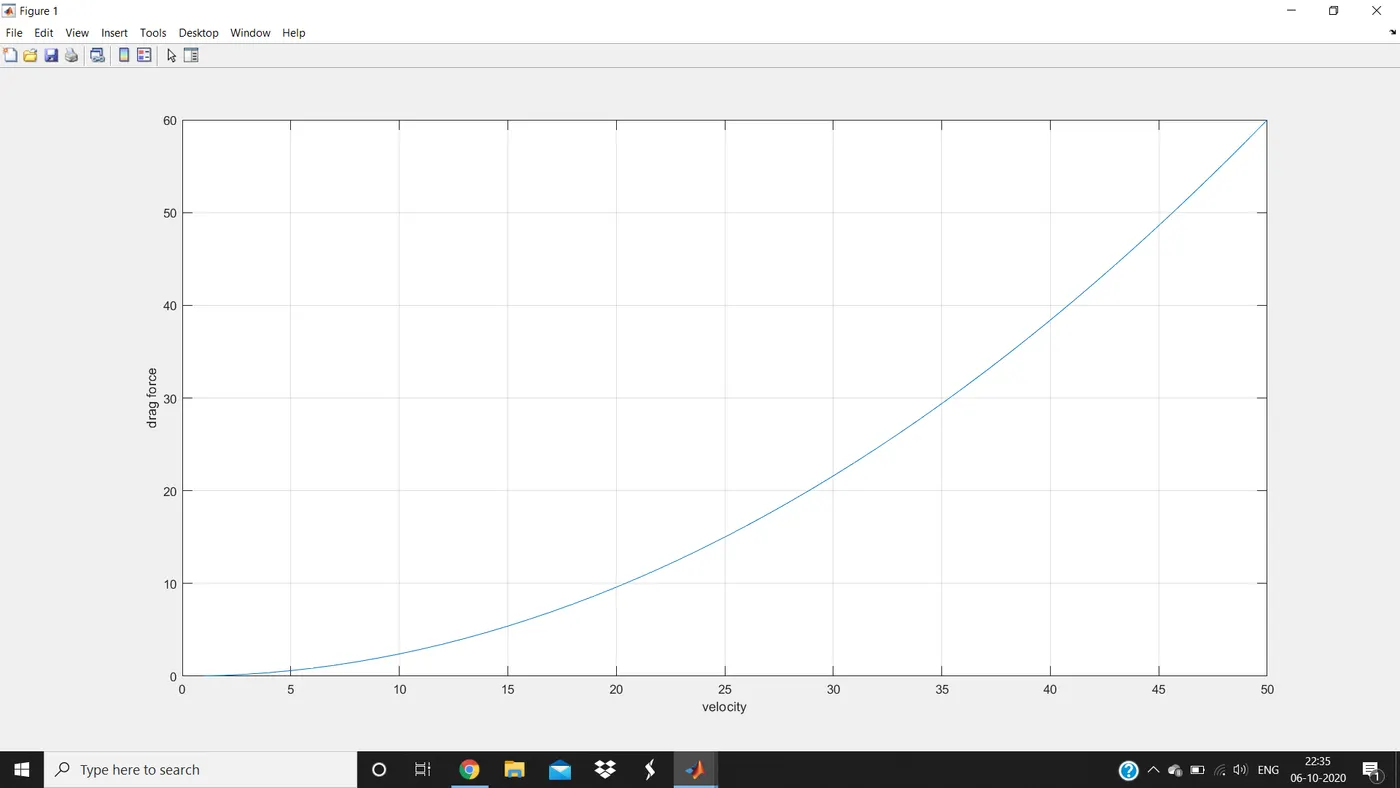
As you can see in the output above, the variation of drag force with respect to velocity is something like quadratic fashion.
Program 2:
% Program to calculate the drag force against a cyclist
% In this program we plot drag coefficient v/s drag force

clear all
close all
clc

% Inputs

     % The values of drag coefficient are
         c_d=[0.04 0.09 0.42 0.47 0.50 0.80 0.82 1.05 1.15];
                     %streamline body=0.04
                     %streamline halfbody=0.09
                     %halfsphere=0.42
                     %sphere=0.47
                     %cone=0.50
                     %angled cube=0.80
                     %long cylinder=0.82
                     %cube=1.05
                     %short cylinder=1.15
     % The value of density of air is
         rho=1.2;
     % The frontal area is
         a=1.0;
     % The velocity of cyclist is
         v=2;

% The below formula gives us the drag force
drag_force=0.5*rho*a*v.^2*c_d;

% Plotting drag coefficient v/s drag force
    plot(c_d,drag_force);
    xlabel('drag coefficient');
    ylabel('drag force');
    grid on
Output:
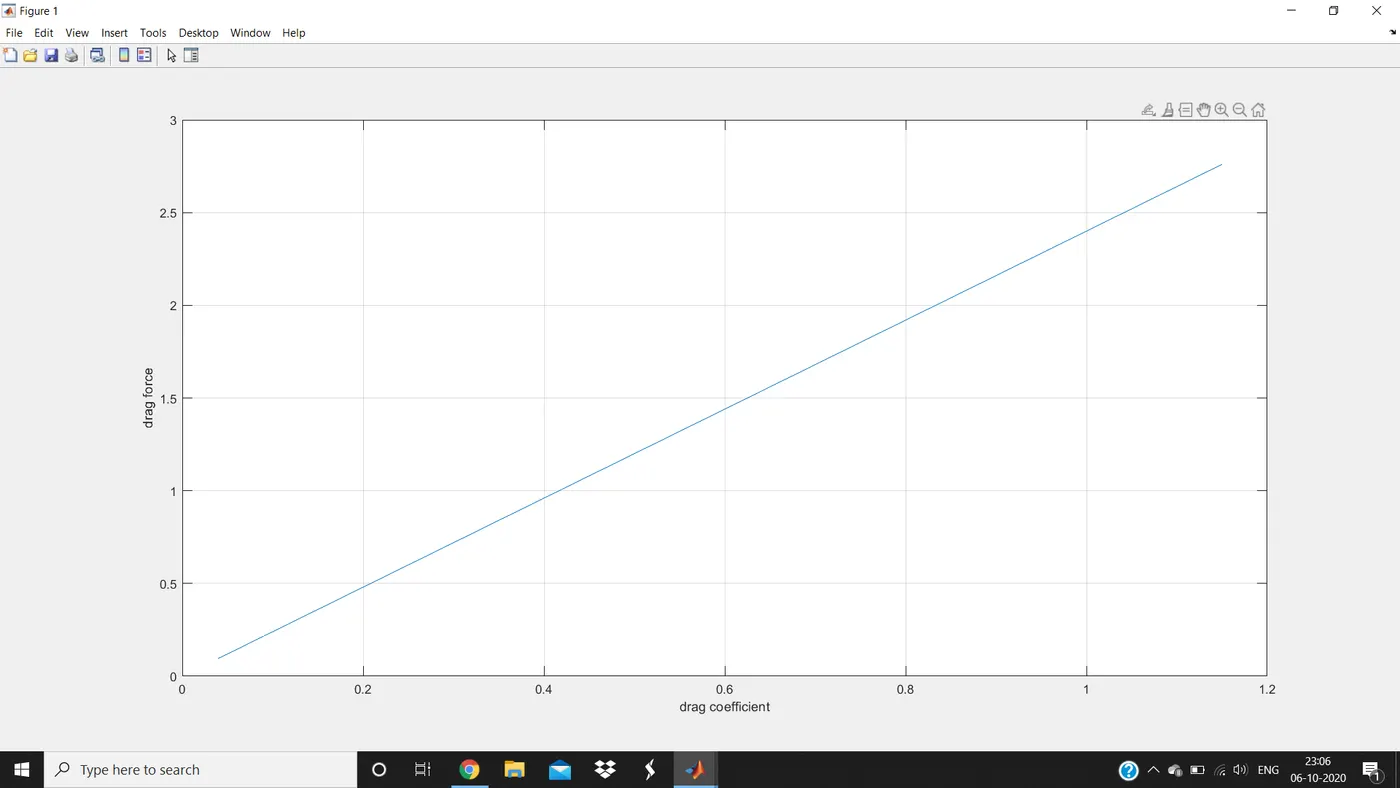
As you can see in the output above, the variation of drag force with respect to a drag coefficient is almost linear.
Conclusion:
By looking at both the plots i.e. velocity v/s drag force and drag coefficient v/s drag force, it is quite evident that both velocity and drag coefficient have a significant impact on drag force.