FINAL TEST
Questions based on PFI Engine:
Q1. What is the Compression ratio for the engine?
The compression ratio is defined as the ratio between the volume of the cylinder with the piston in the bottom position, Vbottom (largest volume), and in the top position, Vtop (smallest volume). The higher this ratio, the greater will be the power output from a given engine. It is the ratio of the volume above the piston when it is at the bottom-most position (BDC) to the volume above the piston when it is at the top-most position (TDC). It indicates the extent to which you compress the air-fuel mixture in the engine.
It is the combustion chamber volume ratio from its largest to smallest capacity. It is the ratio between the combined volume of the cylinder alongwith the combustion chamber when the piston is at BDC (bottom dead center) to the volume of the combustion chamber alone when the piston is at TDC (top dead center). This ratio is one of the fundamental specifications for all internal combustion engines.
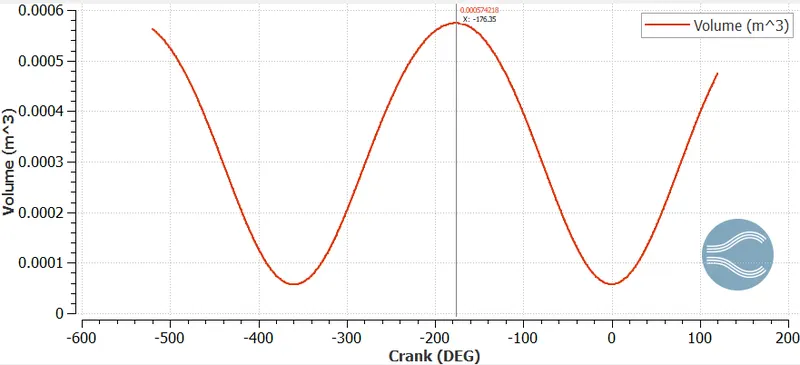
Maximum Cylinder Volume = `5.74218 * 10^(-4) m^3`
Minimum Cylinder Volume = `5.7391*10^(-5)m^3`
Compression Ratio = 10
Q2. Modify the compression ratio for this engine to 10.3 without changing geometrical parameters. Just need to show the calculation
Compression ratio is the ratio of total volume to the clearance volume.
`CR=(V_c+V_s)/V_c`
From the given input compression ratio,
`10.3=(V_c+V_s)/V_c`
`9.3 V_c=V_s`
`V_s=`Maximum Stroke volume - Minimum Stroke volume
`V_s=0.000504485`
Therefore, `V_c=0.0000545583 m^3`
So, it can be concluded that by increasing the compression ratio stroke volume and clearance volume are increased.
Q3. Calculate Volumetric Efficiency for this engine.
Volumetric efficiency in an internal combustion engine design refers to the efficiency with which the engine can move the charge of fuel and air into and out of the cylinders. It also denotes the ratio of air volume drawn into the cylinder to the cylinder's swept volume. More specifically, volumetric efficiency is a ratio (or percentage) of the mass of air and fuel that is trapped by the cylinder during induction divided by the mass that would occupy the displaced volume if the air density in the cylinder were equal to the ambient air density.
Volumetric efficiency can be improved in a number of ways, most effectively this can be achieved by compressing the induction charge (forced induction) or by aggressive cam phasing in naturally aspirated engines as seen in racing applications. In the case of forced induction volumetric efficiency can exceed 100%.
Mathematically, `eta_v=(V_a)/V_d`
The air sucked into the cylinder during the intake stroke is calculated by considering this case as ideal gas case.
`V_a=(mRT)/P`
where, P = Atmospheric pressure = 101325 Pa
T = ambient temperature = 293K
R = universal gas constant = 287 J/KgK
m = mass of the air (derived from the plot) = 0.0005001960 Kg
`V_a=4.511**10^(-4)m^3`
So, volumetric efficiency = 86.23%
Q4. Measure the air mass flow rate for this engine in kg/s.
Mass flow rate for a engine is defined as the amount of air actually entering into the engine per unit time. From the plot, the mass flo rate comes out to be 0.0005001960 kg.
In terms of mass per unit time it is written as
`m_a=0.0255kg//s`
Q5.Why is the cell count varying during the simulation?
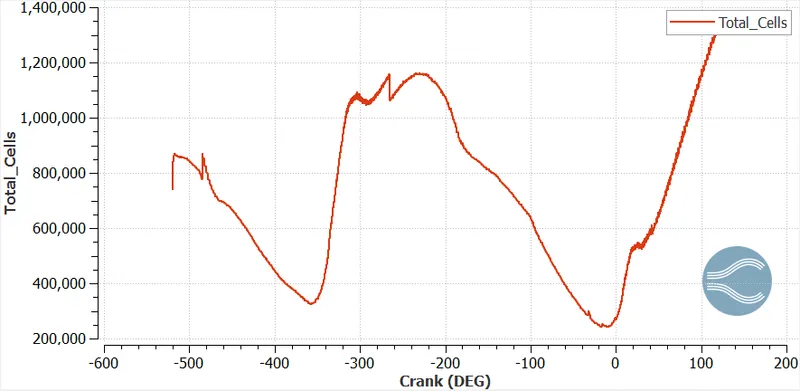
From the above plot, it evident that the cell amount is changing as the crank is moving. This is also happening due to the fixed embedding made around the profile. Also, adaptive mesh refinement in the combustion chamber for resolving sub grid scale velocity and temperature is implemented in the simulation. This finally results in variation of number of cells during simulation.
Q6. In a real engine, valves are in contact with the cylinder head but while running simulation, there is a small gap
- WHY?
- What happens if this gap is big?
1. In converge, the surfaces are formed by joining the triangles. Also it is necessary that there should be only 2 faces joined by single edge. As a result, a smaller gap is required to seperate valves and the cylinder head. During the claculation, software itself disconects those triangles for the inflow condition and also connects whenever required.
2. If the gap is too larger, this can lead to improper boundary flagging and ultimatel misleading during the calculations. And as a result it results in improper flow calculations and lesser accurate results.
Q7. How many seconds does combustion last in this case?
From the engine performance calculator, combustion retains for -120.09 to 120.11 deg.
so total crank angle = 240.199 deg.
engine speed = 18000 deg/s
`t=240.199/18000=0.01334s`
Questions based on DIESEL Engine:
Q1. What is an advantage of SECTOR Simulation?
Since engine is axisymmetric, this can be used in the calculations. So instead of solving a whole engine simulation, a part of it can be used by providing the periodic boundary conditions. This also help in reduced compuational time and cost. Converge also provides feature of sector model for the same ease.
Q2. When will the sector approach not work?
Sector approach is not applicable when there is no axisymmetric model or multi injector system. This is because there no plane of symmetry or the model canot be divided into ndividual sector which upon roataion gives us complete engine model.
Q3. How to choose Start Crank Angle (SCA) and End Crank Angle (ECA) for a sector simulation?
The sector simulation is based n the comcept of closed cycle, so it starts with the start of process and ends with the entire cycle end time. It is generally seen that compression starts at 0 and cycle ends at 540 CAD.
Q4. Can we convert the PFI case into a SECTOR case? Explain your answer?
It is impossible to convert the PFI case into the sector due to the presence of single inlet or injection system and the location of spark plug. Also the outlet is defined to be at fixed location. All these parameters are all the contributing fctors which restrict this PFI case into the sector.