FINAL TEST
- Questions Based on PFI Engine :
1] What is the compression ratio for the engine ?
The compression ratio (CR) is defined as the ratio of the volume of the cylinder and its head space (including the pre combustion chamber , if present) when the piston is at the bottom of its stroke(bottom dead centre,bdc) to the volume of the head space when the piston is at the top of its stroke (top dead centre, tdc).
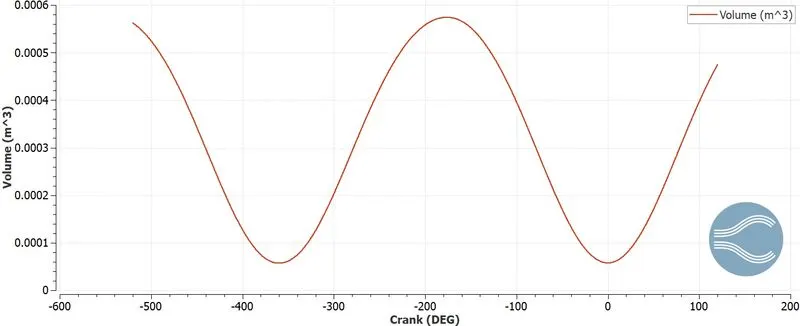
`"Compression Ratio" = "Max.volume of the combustion chamber"/"Min.volume of the combustion chamber"`
Maximumm Volume = `0.000574216 m^3`
Minimum Volume = `5.70298e^-05 m^3`
`"Compresion Ratio "= "Max.Volume"/"Min.Volume" = 0.000574216/0.0000570298`
Compresion Ratio = 10.07
The pressure and temperature at the end of compression will be affected by the compression ratio, with a higher compression ratio increasing both these parameters.it is desirable to achieve a high compression ratio to extract more mechanical energy from a given mass of air-fuel mixture. A higher compression ratio permit the same combustion temperature to be reached with less fuel, while giving a longer expansion cycle. This creates more mechanical power output and lowers the exhaust temperature. Lowering the exhaust temperature causes the lowering of the energy rejected to the atmosphere.
2] Modify the compression ratio to 10.3 without changing geometrical parameters ?
There are 2 ways to change compression ratio without changing geometrical parameters,
A] By changing clearence volume
B] By changing swept volume
A] By changing clearance volume :
`V_max = V_(swept) + V_c`
`V_(swept = V_max -V_c`
`V_max = 0.000574216 m^3`
`V_min = 5.70298e^-05 m^3`
Therefore,
`V_(swept = 0.000574216 - 5.70298e^-05`
`V_(swept = 5.17*10^-4 m^3`
Thus,
`C.R. = (V_(swept) + V_c)/V_c`
`10.3 = ((5.17*10^-4)+V_c)/V_c`
`V_c = 0.00005559 m^3`
B] By changing swept volume
`C.R. = (V_(swept) + V_c)/V_c`
`10.3 = (V_(swept)+0.0000570298)/0.0000570298`
`V_(swept )= 0.0005303771 m^3`
3] Calculate the volumetric efficiency for the engine ?
Volumetric efficiency is one of the important Engine performance parameter, which decides the performance of the engine. So this volumetric efficiency is also known as the breathing ability of the engine.It determines the amount of air utilization for a certain amount of power output in a thermodynamic cycle. Hence an engine must take the air as much as possible to give the more power output.So the volumetric efficiency is defined as the ratio of the actual amount of air that is drawn into the cylinder to the Actual amount of air that can be drawn.
`eta_v = V_a/V_t`
Where,
`V_a` = Actual Volume of intake air,
`V_t` = Theoretical volume of cylinder.
Actual volume of air can be calculated using the below formula,
`V_a = m_a/rho_a`
where,
`m_a` = air mass
`rho_a` = air density.
`rho_a = ("Air Pressure"(P_a))/("Temperature"(T_a)_*"Gas constant"(R_a)`
Thus,vollumetric efficiciency can be written as,
`eta_v = (m_a)/(rho_a*V_t)`
We know,
`R_a = 287J/(Kg*K)`
`V_t = 5.742*10^-4 m^3`
`P_a = 101325Pa`
`T_a = 313K`
Therefore,
`"intake air mass"(m_a) = 5.34*10^-4 Kg`
`rho_a = 101325/(287*(313)) = 1.128(Kg)/m^3`
`eta_v = (5.34*10^-4)*100/(1.128*5.742*10^-4) = 82.44%`
4] Measure the air mass flow rate for this engine in kg/s ?
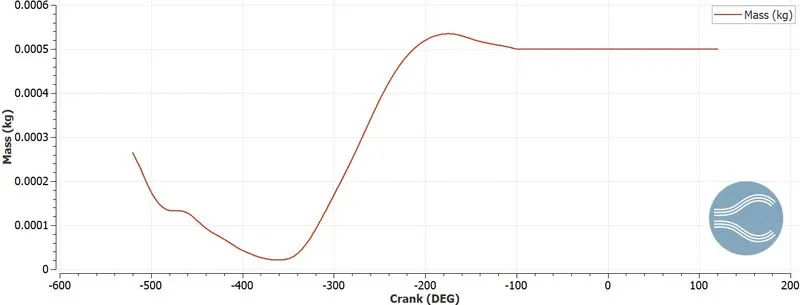
`"Mass flow rate of air" = "Intake mass of air" * "engine rpm in sec"`
`"Mass from the above graph" = 0.0005344 kg`
RPM = 3000
`"(Rounds Per second )"RPS = 50`
Therefore,
`"Mass flow rate of air" = 0.0005344 *50 = 0.0267( Kg)/s`
5] Why is the cell count varying during the simulation ?
Initially we have created a base grid,We will be using temperature AMR so that based upon curvature in the temperature field, cells will be refined.But when the spark is initially introduced ,just at that instant we don't have good refinement so that these gradience can not be calculated accurately.So we are initially creating highly refined regions which lasts only for few crank angles,so that after some time,after one or two time steps the temperature AMR is able to see that there is huge gradient or huge curvature change in temperature near the spark and then it's going to refine that region.
The AMR refines the cells in the most sensitive areas where there is a difference in between the quantities being measured among the adjacent cells.This difference is dependent on the sub grid scale criterion.If the difference is more than the sub grid scale criterion,then the cells get refined.Therefore because of this adaptive mesh refienment (AMR)cell count is varying
dynamically during the simulation.
6] In a real engine,valves are in contact with the cylinder head,but while running the simulation, there is a small gap.Why?What happens if this gap is big ?
In converge intersection of triangles is not allowed and causes error.So in order to prevent intersection small gap is provided in the simulation geometry.Instead converge creates disconnect triangles automatically to close the gap between regions.The events are created for the opening and closing of valves during different strokes.
If the gap is big,then there will be large fuel flow inside the combustion chamber,enough to produce unrealistic results from the real world conditions.Also large gap will cause reduced heat transder which can lead to issues like knocking,leakage of exhaust gas etc.
7]How many seconds does combustion lasts ?

Duration = 240.199 deg
RPM = 3000
`"(Rounds Per second )"RPS =3600/60 = 50`
`"Total angular rotation per second" = 50 * 360 = 18000 deg`
`"Combustion Duration" = 240.199/18000 = 0.01335 sec`
- Questions based on diesel engine :
1] What is an advantage of SECTOR simulation ?
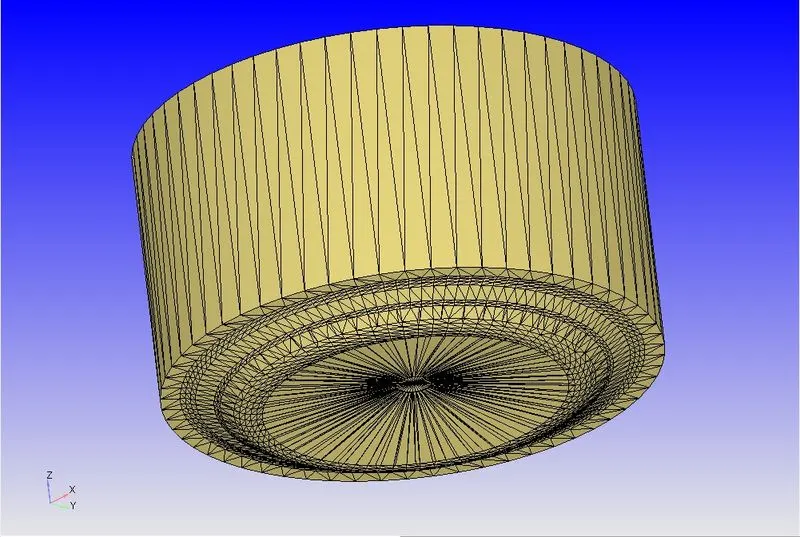
The 'make engine sector surface' option in converge helps in surface preparation.Now to understand sector surface lets first look at the given geometry.The geometry depicts the close engine cylinder(combustion chamber),where entire piston top surface,cylinder liner,and cylinder head is present.But we do not have any valves,intake or exhaust ports.This is what one can
call as a close cycle analysis,because we are doing all the analysis when valves are closed. This is done in order to increase computational efficiency. Now to increase the computational efficiency,we can consider one sector of the concerned domain,
in this case it is combustion chamber,and simulate the combustion in it.The obvious advantage of this method is that,we will require way less computational cells and simulation run time will be faster.
2] When will the sector approach not work ?
Sector approach will not work in case of axi-symmetric models.In case where,the injectors are not axisymmetric ,the sector simulation will not work.It will not work in open cycle analysis as,in this case valves are modelled and timing is set to initiate certain actions,which can not be performed in sector simulation.
3] How to choose Start Crank Angle(SCA) and End Crank Angle(ECA) for a sector simulation ?
Start crank angle should be the beginning of the compression stroke and end crank angle should be the end of the expansion stroke.
4]Can we convert the PFI case into a secctor case? Explain your answer.
PFI case can not be converted into the sector case.Because sector simulation considers piston profile and does not take valve profiles ,injectors etc into consideration.Also as the injection source is situated at the intake port which can not be divided into a sector.