Final Project: Design of an Electric Vehicle
I AM STUDENT OF LIVE BATCH-16
Create a MATLAB model of electric car which uses a battery and a DC motor. Choose suitable blocks from Powertrain block set. Prepare a report about your model including following:
Objectives:
1. System level configurations
2. Model parameters
3. Results
4. Conclusion
SOLUTION:
THEORY:
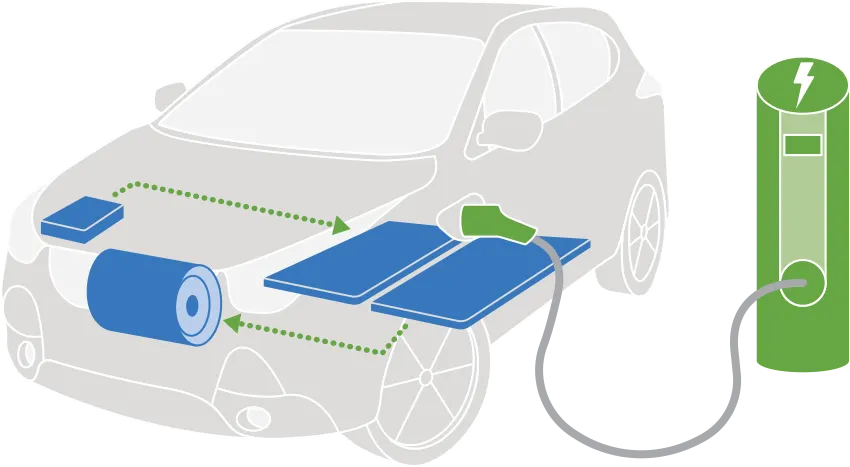
All-Electric Vehicles
- All-electric vehicles (commonly referred to as EVs or BEVs) don’t use gasoline, and instead have a large battery that powers one or more electric motors.
- Currently, all-electric vehicles have a driving range of 80 to more than 300 miles, with ranges increasing as new models are introduced.
- In addition to driving past the gas station, all-electric vehicles don’t require much maintenance (such as oil changes, smog checks, spark plug changes and replacing a catalytic converter or various other parts that wear out and break down) compared to gas cars.
- All-electric vehicles can be charged at home using standard 120-volt or 240-volt house plugs, or away from home at public or workplace charging stations.
- One benefit of all-electric vehicles over plug-in hybrids is the capability to use DC fast chargers which provide more than 100 miles of range in 30 minutes.
Plug-In Hybrid Electric Vehicles
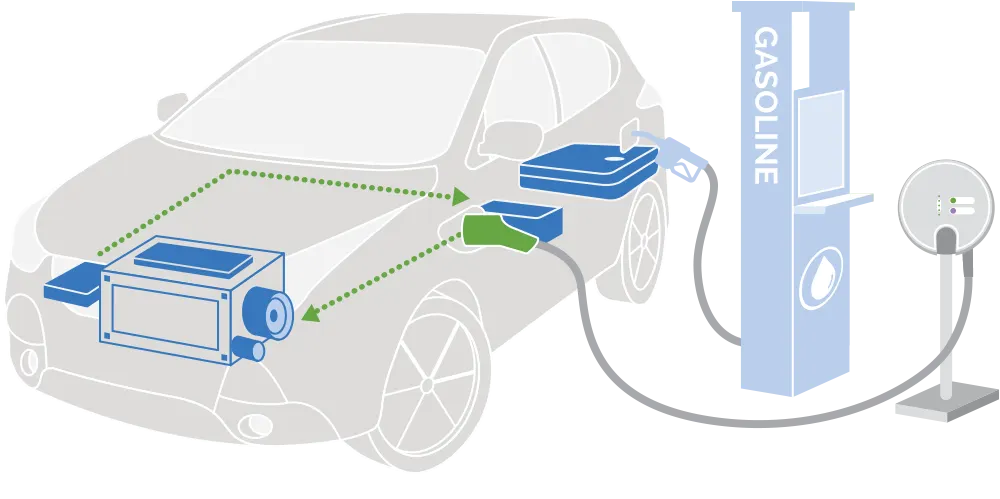
- Plug-in hybrid electric vehicles (commonly referred to as PHEVs) offer both gas-only and electric-only driving—even at relatively high speeds.
- With smaller batteries than battery electrics, plug-in hybrids achieve an electric-only range of 20-55 miles, during which they produce no tailpipe emissions.
- When the car uses up its electric range, it switches to gas and drives just like a conventional car.
Fuel Cell Electric Vehicles
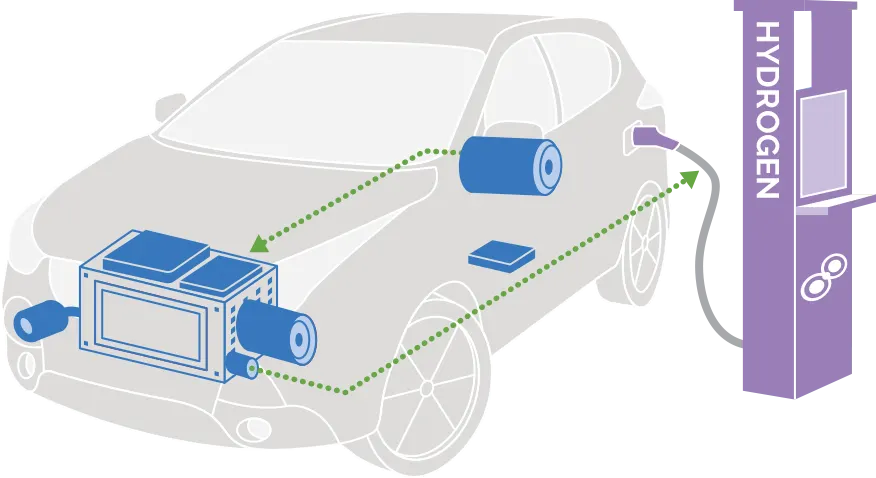
- Fuel cell electric vehicles (commonly referred to as a FCEVs) run on electricity, but do so differently than all-electric vehicles or plug-in hybrids.
- Its power system is composed of numerous cells combined into a stack that chemically combine hydrogen gas from the car’s tank and oxygen from the air to produce electricity.
- Fuel cells have a driving range of 300-400 miles on a single tank and can be refueled in about five minutes at hydrogen fueling stations, which are becoming more common in California.
- They also have all of the perks of an electric vehicle, including a smooth, quiet ride, incentives and are eligible for the carpool lane decal to help you hop in the carpool lane.
- An additional benefit for fuel cell drivers is that auto manufacturers provide three years’ worth of free hydrogen fuel.
Block Diagram Of Electric Vehicle:
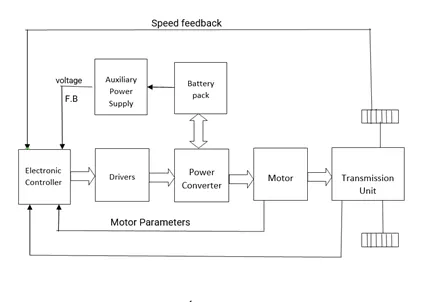
The major components of an EV are:
- Motor
- Power converter
- Electronic controller
- Auxiliary power supply
- Battery
- Transmission Unit
- Drivers
- Electri Motors:
- The electric motor is used as the prime mover in an EV.
- Its function is to convert the energy stored in the battery pack into mechanical motion.
- This motor must have a high starting torque, to ensure a quick acceleration.
- The output power of the motor is delivered to the wheels either directly or through a transaxle
Motoring and braking:
- While accelerating an EV, the electric motor operates in the motoring mode and the flow of power is from the battery to the wheels of the EV.
- Hence the battery discharges in the motoring mode. However, while braking an EV, the motor acts as a generator (regenerative braking) and the flow of power takes place from the wheels of the EV to the battery
- Hence the batteries get charged during the braking.
Types of motors:
- There are different choices of electric motors for EVs.
- It is possible to use DC as well as AC motors for an EV.
- The AC motors offer many control advantages over the DC motors.
- But they need to use an inverter for converting the DC power from the battery into AC power. A DC shunt or separately excited motor can also be used. The power rating of such motors for smaller vehicles is up to 50 kW.
- The electric car REVA uses a 13 kW DC separately excited motor which can produce a 70 Nm starting torque
2. Charger:
- The onboard charger of an EV is used for converting the AC supply to DC voltage of appropriate value.
- All these chargers are computer-controlled Therefore they are called smart chargers.
- The output of the charger is connected to the battery pack
3. DC-DC converter:
- An auxiliary battery of appropriate voltage is normally used in electric cars to supply power to all accessories like lights, horns, etc.
- There is no alternator in EVS to keep this auxiliary battery charged.
- Therefore EVS uses a DC-DC converter which takes its input from the main battery and produces a 13.5 V at its output which is used to charge the auxiliary battery.
- It is advisable to use the auxiliary battery because if the main battery is drained below its lowest value, then the auxiliary battery can be used to bring back the car home.
4. Powerpack (batteries):
- Batteries are probably the most important component of an EV because it determines the weight, cost. Range and performance of EV.
- The batteries used for EVS are rechargeable.
Types:
- The following three batteries are used in different EVs:
- Lead-acid batteries.
- Nickel-Metal Hydride (NiMH) batteries.
- Lithium-ion (Li-ion) batteries.
- All these are heavy battery spaces.
- The main advantage of using lead load batteries is that it is a matured technology accepted by the motor industry.
- However, its disadvantage is its large weight and large space requirement.
- Lithium-ion batteries are the latest ones and they have many advantages like small size, long life, quick charging, etc.
- Generally, the battery pack is housed beneath the front seats in an electric car because this lowers the center of gravity of the car and improves the safety of passengers.
5. Motor controller:
- The function of the motor controller is to regulate the power flow from the battery pack to the motor in proportion to the pressure applied on the accelerator.
- The controllers used in EVs are computer-controlled.
- They provide perfect speed control along with optimum use of energy while accelerating and braking.
- Thus controllers allow a bidirectional transfer of energy.
- The controller power rating depends on the voltage and current ranges
6. Energy management system:
The EMS can perform the following functions:
- Optimizing the energy flow in both directions.
- Prediction of available range.
- Directing the regenerative energy from wheels to battery during braking operation.
- To adjust the internal temperature by sensing the outside air temperature.
- To adjust the light brightness by sensing the external lighting conditions
- Proposing a suitable algorithm for battery charging
- Fault diagnosis in the components of the subsystems
MATLAB model of electric car:
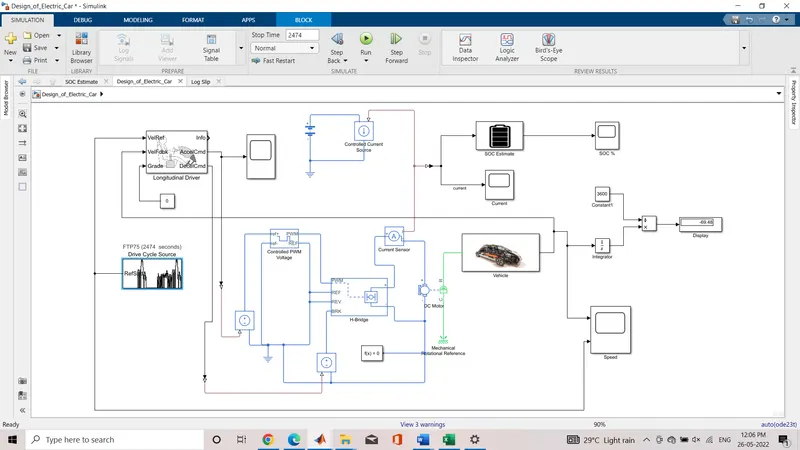
- Longitudinal Driver: it implements a longitudinal speed tacking controller. it generated=s normalized acceleration and brking commands based on the feedback velocities given.
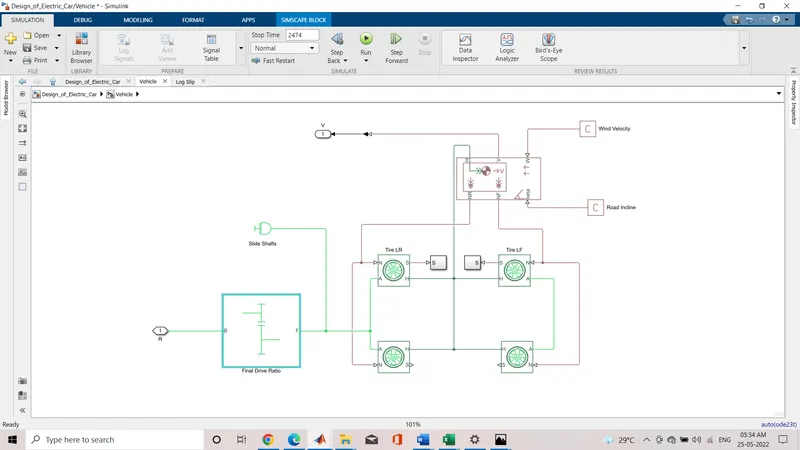
- vehicle is a subsystem
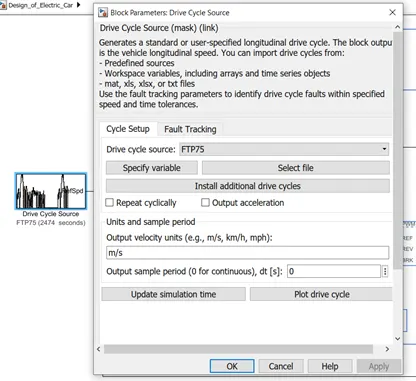
- drivecycle: it is used for generating a standard or user specified drivecycle.
- The Controlled PWM Voltage block represents a pulse-width modulated (PWM) voltage source
DRive Cycle:
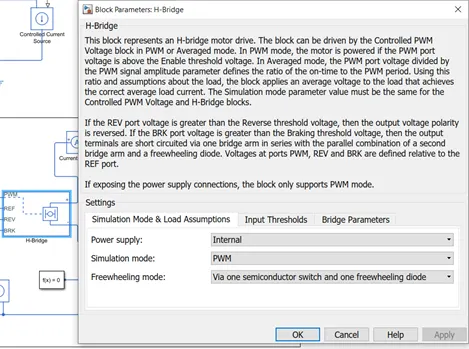
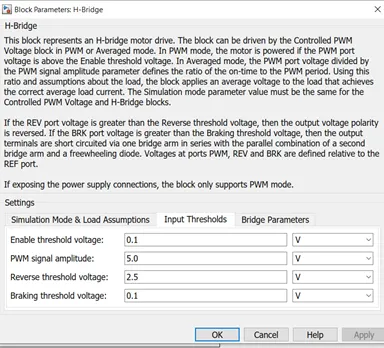
- H-bridge: The H-Bridge block represents an H-bridge motor driver. The block has the following two Simulation mode options:
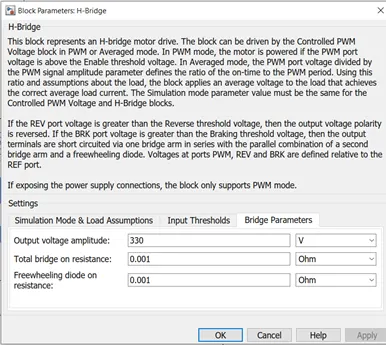
DC Motor Parameter:
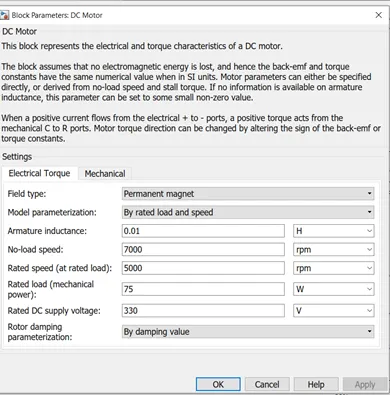
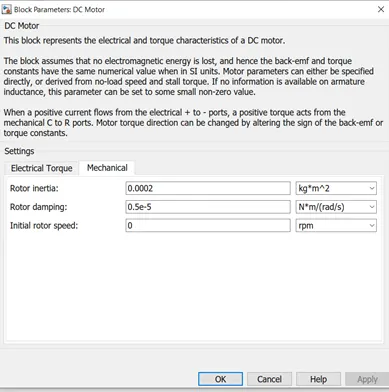
Vehicle Subsystem:
Gear Ratio Parameter:
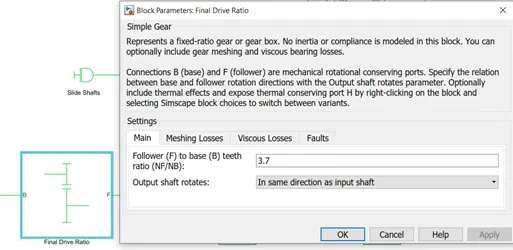
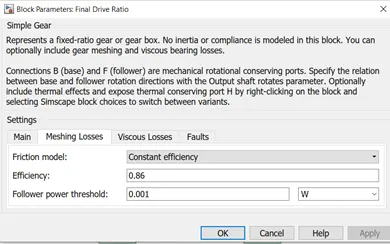
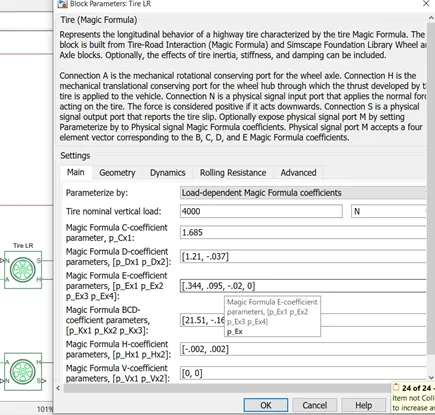
- Tire(magical formula): 4 tires are used 2acts as rear wheel and 2 acts as front wheel this is conected to gearbox and for this gearbox input is given from motor shaft.
- Rolling Resistance =0.3
-
Velocity threshold=0.1m/s
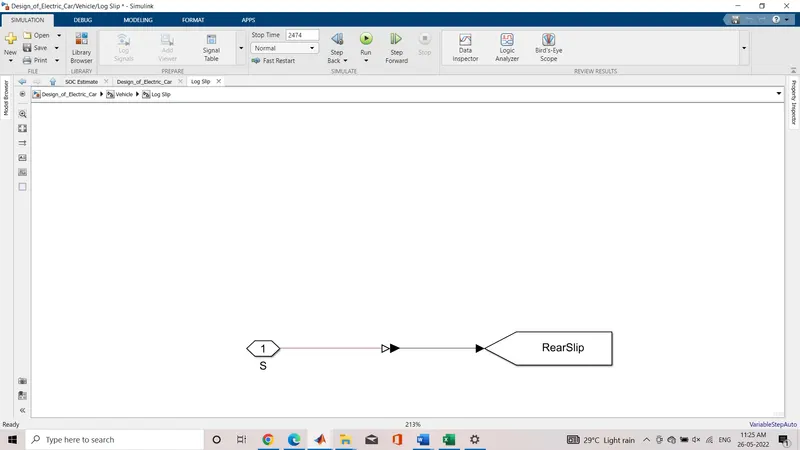
Log Slip:
3 SOC Estimate Subsystem:
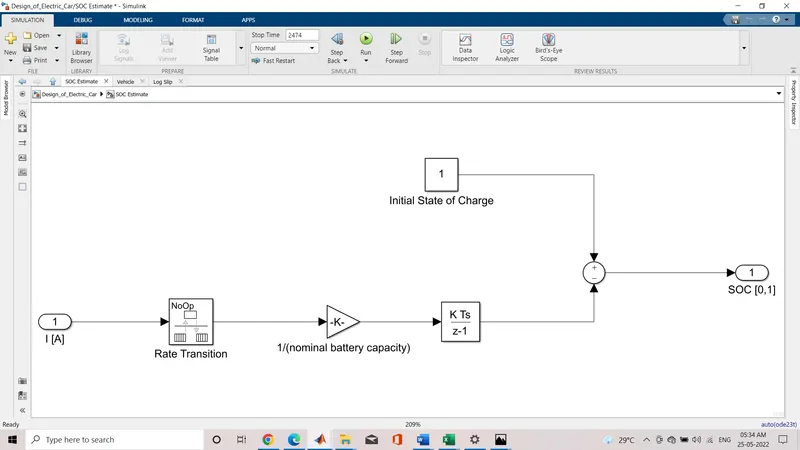
here in gain block 1/nominal battery capacity=1/(80*3600)
PLOTS:
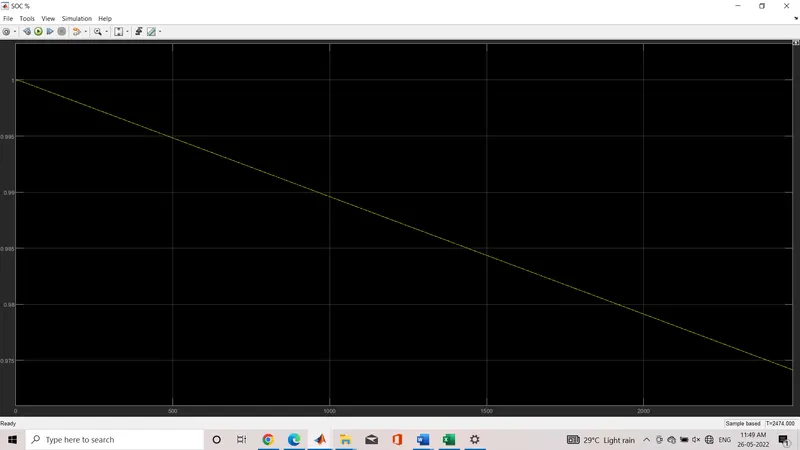
Simulation time is 2474 sec
soc% plot:
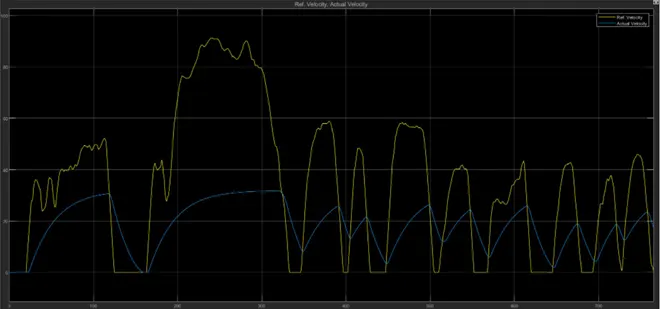
plot of drivecycle speed and actual speed output:
CONCLUSION:
studied modelling of electric vehicle
SOC of battery we studied