EVALUATION OF ENGINE PERFORMANCE PARAMETERS BASED ON CARBON CONTENT IN FUELS AT STOICHIOMETRIC CONDITIONS USING MATLAB
AIM:
To make a detailed study on how the carbon content in the fuels such as Paraffins, Olefins and Alkynes influences the engine performance characteristics like Stoichiometric Air-fuel ratio, brake specific fuel consumption, indicated specific fuel consumption, brake thermal efficiency and indicated thermal efficiency at stoichiometric conditions using MATLAB.
GOVERNING EQUATIONS:
- Air-fuel ratio = (ma)/(mf)
where ma = mass of air
mf = mass of fuel - % composition of
atomic species in fuel = (M.W of that particular atomic species in fuel)/(M.W of fuel)
where M.W = Molecular weight - Mass of O2 in air for complete combustion per kg fuel = (Air-fuel ratio)*23/100
- Mass of N2 in air for complete combustion per kg fuel = (Air-fuel ratio)*77/100
- Mass of CO2 produced
per kg combustion of fuel = (% composition of carbon in fuel)*44/12 - Mass of H2O produced
per kg combustion of fuel = (% composition of hydrogen in fuel)*18/2 - Mass of N2 produced
per kg combustion of fuel = Mass of N2 in air for complete combustion per kg fuel - Percentage composition of
products of combustion = (Mass of specific product produced per kg combustion of fuel)/(Total mass of products produced per kg combustion of fuel) - ma = PV/(RT)
where,
ma = mass of air [kg/s]
P = initial pressure condition/atmospheric pressure [kPa]
V = volume of air intake in [m3/s]
R = gas constant [generally .287 kJ/kg-K for air]
T = initial temperature [K] - Heat supplied by fuel per kg = (mf*C.V)
where,
mf = mass of fuel [kg/s]
V = Calorific value of fuel [kJ/kg] - Mechanical efficiency = (brake power)/(indicated power)
- Brake thermal efficiency = (Brake power)/(heat supplied per kg of fuel)
- Indicated thermal efficiency = (Indicated power) /(heat supplied per kg of fuel)
- Brake specific fuel consumption = (mass of fuel per kg)/(Brake power)
- Indicated specific fuel consumption = (mass of fuel per kg)/(Indicated power).
OBJECTIVES:
- To determine the stoichiometric Air-fuel ratio for Paraffins, Olefins and Alkynes fuels with different carbon contents in each fuel in terms of
- mass basis
- molar basis.
- To determine the percentage composition of each atomic species in the fuel.
- To determine the mass of products for complete combustion per kg of fuel.
- To determine the mass of oxygen and nitrogen in air required for complete combustion per kg fuel.
- To determine the % composition of each products of combustion.
- To plot a diagram for stoichiometric air-fuel ratio to each fuel with different carbon content in mass basis and molar basis.
- To plot percentage composition for each product with respect to fuel with different carbon content.
- To extract the data of standard calorific value for each fuels with its respective carbon atoms by file parsing.
- To determine brake thermal efficiency and indicated thermal efficiency for each fuel with different carbon atom at given input conditions.
- To determine the brake specific fuel consumption and indicated specific fuel consumption for each fuel with different carbon atom at given input conditions.
- To make a plot of brake thermal efficiency and indicated thermal efficiency for each fuel with variation in carbon atoms.
- To make a plot of brake specific fuel consumption and indicated specific fuel consumption with respect to different carbon atoms in each fuel.
- To display the apt fuels that satisfies the customer’s requirements which is given as inputs.
BODY OF CONTENT:
Fuels
The hydrocarbon fuels are most commonly used fuels at present in most of the automobiles. Hydrocarbon fuels are generally classified into 5 types. The essential components of fuel are as follows.
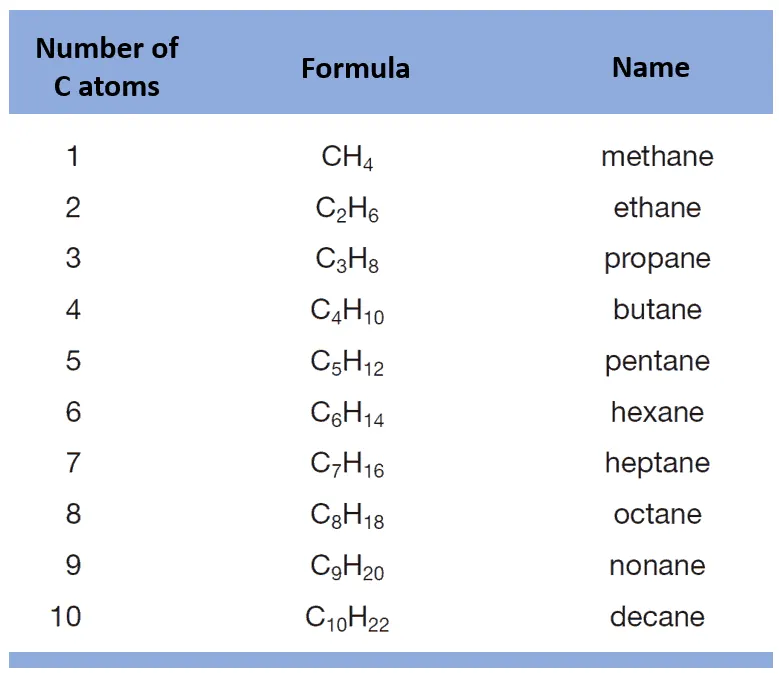
- Paraffins: They are straight chain saturated hydrocarbon fuel with general formula CnH2n+2.
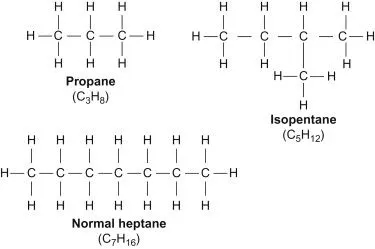
- Olefins: They are straight chain unsaturated hydrocarbon fuel with general formula CnH2n.
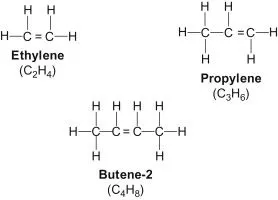
- Alkynes: They are unsaturated hydrocarbon containing at least one carbon—carbon triple bond with general formula CnH2n-2 .
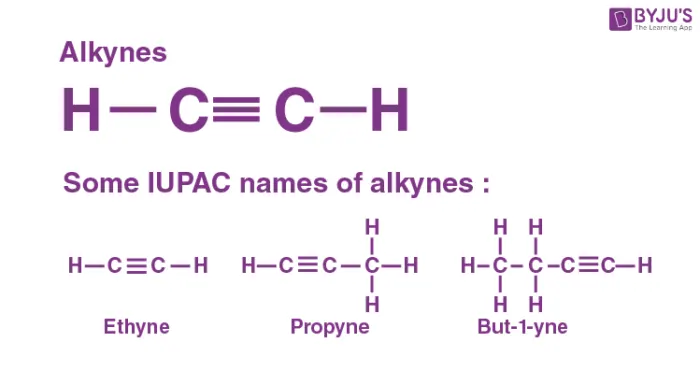
- Naphthenes: They are saturated cyclic compounds with general formula CnH2n.
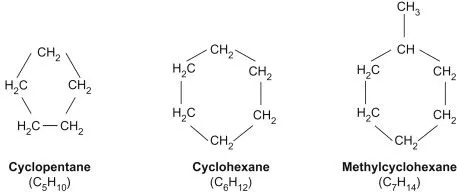
- Aromatics: They are cyclic unsaturated hydrocarbons with general formula CnH2n-6.
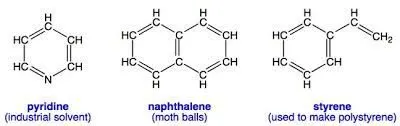
In the above fuels, ‘n’ represents the number of carbon atoms. As the ‘n’ value varies, the above hydrocarbons sub-classified into individual specific fuel types having individual properties which in turn affects engine performance parameters. Most commonly used hydrocarbon fuels are Paraffins, Olefins and Alkynes.
Paraffins table list:
Olefins table list:
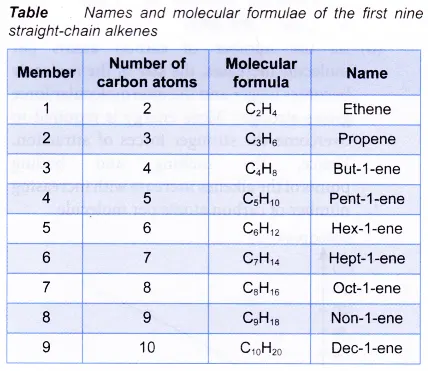
From the above list in olefins, the methylene (which has general formula CnH2n) does not have the major role to act as a fuel. It is a colourless gas that fluoresces in the mid-infrared range, and only persists in dilution, or as an adduct(occurs only in groups). It is usually detected only at very low temperatures, or as a short-lived intermediate in chemical reactions. So it is neglected in the table list.
Alkynes table list:
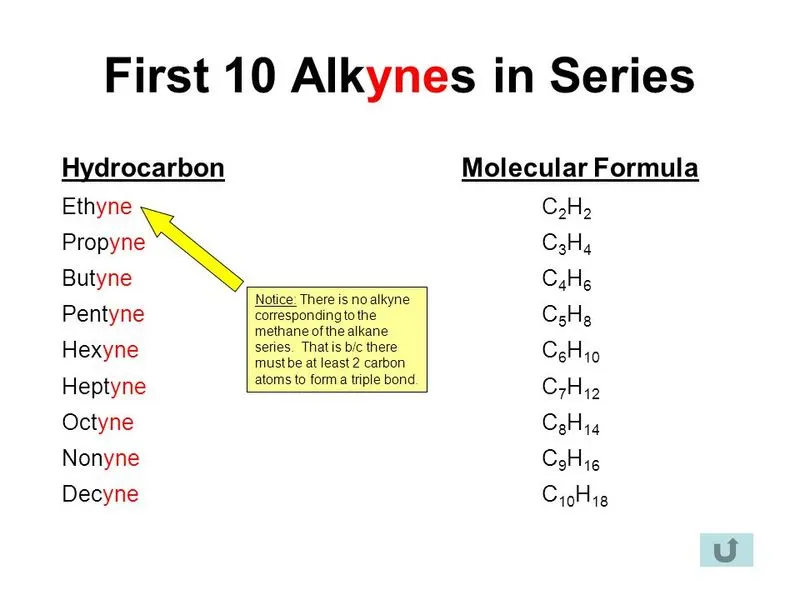
It is noted that there is no alkyne corresponding to the methane of alkane series because there must be atleast 2 carbon atoms to form a triple bond.
So a comparative study is performed for the first 10 ‘n’ values in paraffins, olefins and alkynes to determine how the carbon content in each fuel type affects the stoichiometric air-fuel ratio and products of complete combustion which in turn determines the other engine performance parameters like Indicated specific fuel consumption(isfc), Brake specific fuel consumption(bsfc), Indicated thermal efficiency(ηith) and Brake thermal efficiency(ηbth).
Combustion reaction:
A combustion reaction is a chemical reaction which a fuel undergoes oxidation by reacting with an oxidizing agent, resulting in the release of energy (usually in the form of heat). Combustion reactions are generally highly exothermic redox reactions between an oxidant and a fuel. The product formed in a combustion reaction is usually the oxidized fuel (which is mostly liberated in the gaseous state). This is often referred to as smoke.
Complete combustion:
In complete combustion, the reactant burns in oxygen and produces a limited number of products. When a hydrocarbon burns in oxygen, the reaction will primarily yield carbon dioxide and water. When elements are burned, the products are primarily the most common oxides.
Incomplete combustion:
Incomplete combustion will occur when there is not enough oxygen to allow the fuel to react completely to produce carbon dioxide and water.
Carbon monoxide is one of the products from incomplete combustion. Carbon is released in the normal incomplete combustion reaction, forming soot and dust. Since carbon monoxide is a poisonous gas, complete combustion is preferable, as carbon monoxide may also lead to respiratory troubles when breathed since it takes the place of oxygen and combines with hemoglobin.
Air–fuel ratio (AFR):
Air-fuel ratio is the mass ratio of air to the fuel present in a combustion process. In an internal combustion engine, the air-fuel ratio is an important measure for anti-pollution and performance-tuning reasons.
Molar ratio:
Molar ratio is the number of moles present in air to the fuel in a combustion process.
Stoichiometric Air-fuel ratio:
If exactly enough air is provided to completely burn all of the fuel, the ratio is known as the stoichiometric mixture, often abbreviated to stoich. Stoichiometric Air-fuel ratio is the minimum air-fuel ratio required for the complete combustion of fuel without leaving any residues.
Practical conditions:
In theory, a stoichiometric mixture has just enough air to completely burn the available fuel. In practice, this is never quite achieved, due primarily to the very short time available in an internal combustion engine for each combustion cycle. Most of the combustion process is completed in approximately 2 milliseconds at an engine speed of 6,000 revolutions per minute. So actual air-fuel ratio differs from stoichiometric air-fuel ratio to compensate according to running conditions.
Equivalence ratio:
Equivalence ratio is the ratio of stoichiometric air-fuel ratio to the actual air-fuel ratio.
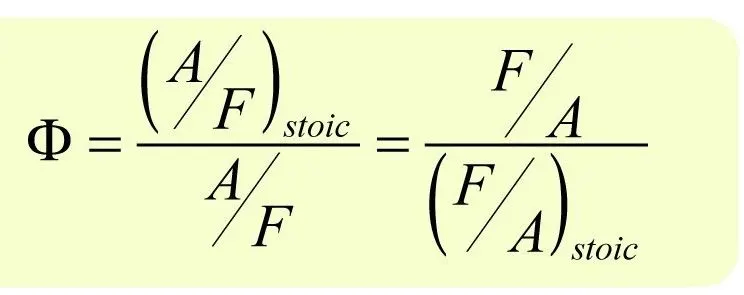
The value of equivalence ratio determines whether the fuel is rich or lean.
If Φ>1 → Rich mixture
Φ=1 → Stoichiometric mixture
Φ<1 → Lean mixture
So to determine whether the fuel is rich or lean, it is mandatory to know the equivalence ratio which requires the value of stoichiometric ratio for a particular fuel.
Combustion in S.I engines:
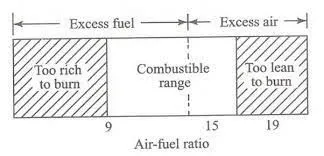
For combustion, the air fuel ratio must be in optimum range. If the mixture is lean, the combustion is not proper and similarly when the mixture is rich the combustion is not proper. Therefore the combustible range of air-fuel ratio is generally in between 9 to 30.
Carburetion:
Carburetion is the process of providing homogenous combustible mixture to the engine cylinder. Carburetor is a device which mixes air fuel thoroughly and provides homogeneous air fuel mixture.
SI engines are quantity governed engines whereas CI engines are quality governed engines. So for a SI engines, the quantity of fuel supplied to the engines has a huge role which determines the operating range. This quantity of fuel supplied depends upon fuel stoichiometric value which determines whether the fuel is rich or lean.
Requirement of air-fuel ratio under different operating conditions:
- Steady operating conditions
- Idling
- Cruising(Normal power range)
- Maximum power
Idling:
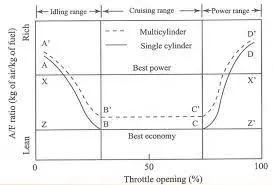
Under idling, engine operates at no load with nearly closed throttle. Under idling, the engine requires rich mixture. The amount of fresh charge brought in during idling is much less than during full throttled conditions due to very small opening of throttle. This results in much larger proportion of exhaust gases being mixed with fresh charge. Under idling conditions, the pressure in the intake manifold is less(less than atmospheric). Due to restriction of air flow, when the intake valve opens the pressure differential between the combustion chamber and intake manifold results in initial backward flow of exhaust gases. As a result, the fresh charge is diluted. This results in poor combustion. It is therefore necessary to provide more fuel particles by increasing the richness of mixture. This increases the probability of combustion. Therefore, the general air-fuel ratios under idling conditions is 12-12.5. (Φ>1)
Cruising: (20-75)%
(20-75)% of throttle opening is known as cruising. The main aim of operation in this range is better fuel economy. Therefore in cruising, slightly lean mixture is provided so that it would result in complete combustion of fuel. The general air-fuel ratio are 16-16.5 (Φ<1) in this range.
Maximum power:
Engine requires richer mixture to be provided during peak power operation for better power and also to prevent over heating of exhaust valve as the fuel acts as a coolant. General (A/F) values are around 13 (Φ>1)
Unsteady state (or) Transient conditions:
- Starting
- Acceleration
Starting:
During starting, the temperatures are low and the fuel remains in liquid form and also the fuel may undergo condensation on coming in contact with cold cylinder walls even though the air-fuel ratio is within normal combustion range. The ratio of vapourised fuel to air is less. Hence during starting, very rich mixture is supplied. The general air-fuel ratios during starting is 3 to 5.
Acceleration:
Acceleration means sudden opening of throttle. It does not always mean the speed is increasing. The throttle valve is opened suddenly to provide sufficient torque. When the throttle is opened suddenly during acceleration, the fuel lags behind (since density is high) due to large inertia compared to air and hence engine receives leaner mixture. Therefore rich mixture is provided during acceleration. This rich mixture is provided by a device known as Economizer.
Choke:
During starting, choke is used because when choke is used it temporarily restricts the flow of air and because of this there is a severe pressure drop. This results in more flow of fuel which is required during starting.
Significance of stoichiometric ratio:
The above are the significance of air-fuel ratio for different operating conditions. For different operating conditions, different values of air-fuel ratio values are used. This air-fuel ratio value for a particular operating condition is chosen depending upon that particular fuel’s stoichiometric value which is the deciding factor in designing the carburetor. It is the stoichiometric ratio of a fuel that decides the range of lean and rich mixture. So it is mandatory to know the stoichiometric values of each fuel before it can be used in engines. This stoichiometric value in hydrocarbon fuel depends upon the number of carbon atoms in it. This value even affects the engine performance parameters.
Stoichiometric combustion of a hydrocarbon in air
If the stoichiometric combustion takes place using air as the oxygen source, the nitrogen present in the air (atmosphere of earth) can be added to the equation (although it does not react) to show the stoichiometric composition of the fuel in air and the composition of the resultant flue gas. Note that treating all non-oxygen components in air as nitrogen gives a 'nitrogen' to oxygen ratio of 3.77.

Example:
For a better understanding, let’s look at the oxidation reaction of methane. This is a pretty common chemical reaction, since methane is the primary component of natural gas (in proportion of around 94 %).
Step 1. Write the chemical reaction (oxidation)
CH4+(O2+3.77N2)→CO2+H2O+N2
Step 2. Balance the equation
CH4+2(O2+3.77N2)→CO2+2⋅H2O+7.54 N2
Step 3. Write down the standard atomic weight for each atom
Hydrogen=1.008 amu
Carbon=12.011 amu
Oxygen =15.999 amu
Step 4. Calculate the mass of fuel, which is 1 mol of methane, made up from 1 atom of carbon and 4 atoms of hydrogen.
mf=12.011+4⋅1.008=16.043 g
Step 5. Calculate the mass of air, which consists of 2 moles, each mol made up from 2 atoms of oxygen and Nitrogen
ma=2*15.999⋅2+2*3.77*14*2=275.12g
Step 6. Calculate the air-fuel ratio using equation (1)
AFR=ma/mf=275.12/16.043=17.19
The calculated AFR for methane is not exactly as specified in the literature. The difference might come from the fact that, in our example, we made several assumptions (air contains only 21 % oxygen, the products of the combustion are only carbon dioxide and water).
Engine Nomenclature:
- Bore:
The nominal inside diameter of the engine cylinder is called bore. - Top Dead Center:(TDC)
In a reciprocating engine the piston moves to and fro motion in the cylinder. When the piston moves upper direction in the cylinder, a point at which the piston comes to rest or change its direction known as top dead center. It is situated at top end of cylinder. - Bottom dead center (B.D.C.)
When the piston moves in downward direction, a point at which the piston come to rest or change its direction known as bottom dead center. It is situated in bottom side of cylinder. - Stroke (L)
The distance travelled by the piston from TDC to BDC is called stroke. In other words, the maximum distance travelled by the piston in the cylinder in one direction is known as stroke.
It is equal to twice the radius of the crank.
- Total volume of cylinder (Vtotal)
It is the volume of cylinder when the piston is at bottom dead center. Generally, it is measure in centimeter cube (c.c.).
- Clearance volume of cylinder (Vclearance)
It is the volume of cylinder when the piston is at top dead center.
Clearance volume: the space above the piston head at the TDC, and is denoted by Vc:
Volume of the cylinder: V = Vc + Vs
- Swept or displace volume (Vswept)
It is the volume which swept by the piston. The difference between total volume and clearance volume is known as swept volume.
Swept volume = Total volume - Clearance volume
- Compression ratio:
The ratio of maximum volume to minimum volume of cylinder is known as the compression ratio. It is 8 to 12 for spark ignition engine and 12 to 24 for compression ignition engine.
Compression ratio = Total volume / Clearance volume
R= (Vc + Vs) / Vc
- Stroke bore ratio
Stroke bore ratio is the ratio of bore (diameter of cylinder) to length of stroke. It is generally equal to one for small engine and less than one for large engine.
Stroke bore ratio = inner diameter of cylinder / length of stroke
- Piston area: (A)
The area of circle of diameter equal to the cylinder bore is called as piston area. It is denoted by the letter ‘A’ and is expressed in cm2. - 11. Mean effective pressure
The average pressure acting upon the piston is known as mean effective pressure. It is given by the ratio of the work done by the engine to the total volume of engine.
Mean effective pressure = Work done by engine / Total volume of cylinder
Engine Performance Parameters:
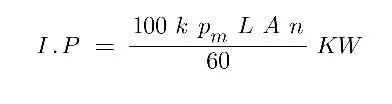
Indicated Power (ip) is defined as the power developed by combustion of fuel in the cylinder of engine. It is the sum total of the brake power and the friction power of an engine. In short it is the maximum power available from the expanding gases developed by combustion of fuel within the cylinder; neglecting frictional losses, mechanical losses and loss due to heat and enthalpy. Indicated power of an engine can be measured by using the indicator diagram or power card diagram.
where,
k = Number of cylinders or factor ( 1 for 2 stroke and 1/2 for 4 stroke )
Pm = Mean effective pressure in bar.
A = Area of the piston in meter square.
n = Rotational speed of the engine or RPM speed.
L = Length of stroke in meters,
Brake power: The brake power on the other hand is the power available at the crankshaft for the actual application. Since brake power is always less than the indicated power. Mathematically you can say this as it is the result of indicated power minus the friction power. This can then be mechanically represented as:
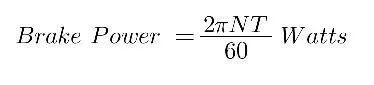
where,
N = Speed of the engine in RPM
T = Turning moment which can also be given by W x L. Where W represents the brake load in newtons and L represents Length of arms in meters.
Friction Power: It is the difference of indicated power and brake power.
Mechanical efficiency: It is the ratio of brake power to the indicated power. It is usually the ratio of the power delivered by a mechanicalsystem to the power supplied to it, and, because of friction, this efficiency is always less than one.
ηmech = B.P/I.P
Indicated thermal efficiency: Indicated thermal efficiencyis the ratio of indicated power (ip) and energy in fuel per second.
η ith= ip (KJ/s)/ energy in fuel per second (KJ/s)
Brake thermal efficiency:
Brake thermal efficiency can be defined as the ratio of brake power (bp) to input fuel energy in appropriate units.
η bth= bp (KJ/s)/ energy in fuel per second (KJ/s)
Volumetric efficiency
Volumetric efficiency can be defined as the ratio actual volume of air-fuel mixture sucked by the engine to the actual volume of cylinder.
η v = actual volume of air-fuel mixture sucked by the engine/ actual volume of cylinder
Indicated specific fuel consumption:
Specific fuel consumption (sfc) can be defined are the fuel consumption per unit time per unit indicated power produced by the engine.
isfc = fuel consumption per unit time/ power produced by the engine.
Brake specific fuel consumption: (bsfc)
Specific fuel consumption (sfc) can be defined are the fuel consumption per unit time per unit brake power produced by the engine.
bsfc = fuel consumption per unit time/ power produced by the engine.
Project motive :
- The main motive of this project is to evaluate the engine performance parameters such as brake thermal efficiency, indicated thermal efficiency, brake specific fuel consumption and indicated specific fuel consumption with the given input conditions for 3 main hydrocarbon fuel types such as paraffins, olefins and alkynes.
- Each type is sub-classified into number of fuel types depending upon the number of carbon atoms present in it and they posses individual fuel properties.
- For each individual fuel, composition of the product of combustion differs depending upon the number of carbon atom present in it. The product mass calculated, plotted and compared with different fuels in each types.
- So with respect to each fuel the engine performance characteristics is evaluated, compared and plotted in a graph and a case study is performed at stoichiometric conditions.
- With respect to customer’s needs, the appropriate fuel for the respective application is evaluated and chosen from the 28 varieties of fuels at total and displayed in the command window as per the input condition at stoichiometric condition.
close all
clear all
clc

%input conditions
t1 = input('Enter the initial temperature in Kelvin n')
p1 = input('Enter the initial pressure in kPa n')
Va = input('Enter the volume of air intake in m3/s n')
bp = input('Enter the brake power of the engine required in kW n')
meff = input('Enter the mechanical efficiency n')
req_bsfc = input('Enter the required bsfc value in kg/kW-hr')
req_beff = input('Enter the required brake thermal efficiency value')


%calculating stoichiometric (A/F) ratio for paraffins
%chemical formula for paraffins = CnH2n+2
%CnH2n+2 + m*(O2 + 3.76N2) = a*CO2 + b*H2O + c*N2
% a = n, b = n+1, m = (2a +b)/2, c = 3.76*m
%molecular weight of fuel = 12*n + 1*(2n+2)
%mass of air = (32+3.76*28)*m = 137.28*m
%A/F = mass of air/mass of fuel

 f1 = fopen('paraffins1.txt','r');
 skip = fgetl(f1);
 n = linspace(1,10,10);

 for i = 1:length(n);
 a1(i) = n(i);
 b1(i) = n(i)+1;
 m1(i) = (2*a1(i)+b1(i))/2;
 c1(i) = (79/21)*m1(i);
 mf1(i) = 12*n(i) + 1*(2*n(i)+2);
 ma1(i) = 137.3333*m1(i);
 af1(i) = (ma1(i))/(mf1(i));

 %composition of atomic species in fuel
 C_1(i) = 12*n(i)/(mf1(i));
 H2_1(i) = 1*(2*n(i)+2)/(mf1(i));

 %For complete combustion of 1kg of fuel 'af1' kg of air is required
 %determination of mass of O2 & N2 in air required for complete-combustion per kg fuel

 %100 kg air contains 23 kg O2, 'af1' kg air contains af1*23/100 kg O2
 mO2_1(i) = (af1(i))*23/100;

 %100 kg air contains 77 kg N2, 'af1' kg air contains af1*77/100 kg N2
 mN2_1(i) = (af1(i))*77/100;

 %mass of CO2 produced per kg of fuel
 %12 kg of C produces 44 kg of CO2,
 %so 'C_1' kg of C produces (C_1*44/12)CO2
 m_CO2_1(i) = (C_1(i))*44/12;

 %mass of H2O produced per kg of fuel
 %2 kg of H2 produces 18 kg of H2O,
 %so 'H2_1' kg of H2 produces (H2_1*18/2) kg H2O
 m_H2O_1(i) = (H2_1(i))*18/2;

 %mass of N2 in product
 m_N2_1(i) = mN2_1(i);

 %Determination of percentage composition of products of combustion
 total_mass_1(i) = (m_CO2_1(i))+(m_H2O_1(i))+(m_N2_1(i));
 p_CO2_1(i) = 100*(m_CO2_1(i))/(total_mass_1(i));
 p_H2O_1(i) = 100*(m_H2O_1(i))/(total_mass_1(i));
 p_N2_1(i) = 100*(m_N2_1(i))/(total_mass_1(i));

 %Extracting calorific value
 line1 = fgetl(f1);
 qq = line1(end-8:end);
 CV1(i) = str2double(qq);


 %Determining mass of air for given input
 %PV = mRT
 Ma(i) = ((p1)*(Va))/(.287*t1);

 %determining mass of fuel
 Mf1(i) = (Ma(i))/(af1(i));

 %Determining heat supplied
 Q1(i) = (Mf1(i))*(CV1(i));

 %Determinig indicated power [kW]
 ip = bp/meff;

 %Determinig brake thermal efficiency
 beff1(i) = 100*bp/(Q1(i));

 %determining indicated thermal efficiency
 ieff1(i) = 100*ip/(Q1(i));

 %Determining brake specific fuel consumption [kg/kW-hr]
 bsfc1(i) = (Mf1(i))*3600/bp;

 %Determining indicated specific fuel consumption [kg/kW-hr]
 isfc1(i) = (Mf1(i))*3600/ip;

 %Apt fuels for the required conditions
 if bsfc1(i)<req_bsfc;
     fprintf('This fuel C%dH%d is satisfied for the required bsfc conditions in paraffins ',n(i),2*n(i)+2);
     fprintf('n with bsfc value as %f kg/kW-hr n',bsfc1(i));
 else
 end

 if beff1(i)>req_beff;
     fprintf('This fuel C%dH%d is satisfied for the required brake thermal efficiency conditions in paraffins ',n(i),2*n(i)+2);
     fprintf('n with brake thermal efficiency of %f n',beff1(i));

 else
 end

 if bsfc1(i)<req_bsfc;
     if beff1(i)>req_beff;
         fprintf('n n THE FUEL BEST SUITED FOR THE REQUIRED CONDITION OF APPLICATION IN PARAFFINS IS C%dH%d  n n',n(i),2*n(i)+2)
     else
     end
 end
 end


f2 = fopen('olefins1.txt','r');
skip1 = fgetl(f2);
n = linspace(1,10,10);

%calculating stoichiometric (A/F) ratio for olefins
%chemical formula for olefins = CnH2n
%CnH2n + m*(O2 + 3.76N2) = a*CO2 + b*H2O + c*N2
% a = n, b = n, m = (2a +b)/2, c = 3.76*m
%molecular weight of fuel = 12*n + 1*(2n)
%mass of air = (32+3.76*28)*m = 137.33*m
%A/F = mass of air/mass of fuel

for i = 1:length(n);
 a2(i) = n(i);
 b2(i) = n(i);
 m2(i) = (2*a2(i)+b2(i))/2;
 c2(i) = (79/21)*m2(i);
 mf2(i) = 12*n(i) + 1*(2*n(i));
 ma2(i) = 137.3333*m2(i);
 af2(i) = (ma2(i))/(mf2(i));

  %composition of atomic species in fuel
 C_2(i) = 12*n(i)/mf2(i);
 H2_2(i) = 1*(2*n(i))/mf2(i);

  %For complete combustion of 1kg of fuel 'af2' kg of air is required
 %determination of mass of O2 & N2 in air required for complete-combustion per kg fuel

 %100 kg air contains 23 kg O2, 'af2' kg air contains af2*23/100 kg O2
 mO2_2(i) = (af2(i))*23/100;

 %100 kg air contains 77 kg N2, 'af2' kg air contains af2*77/100 kg N2
 mN2_2(i) = (af2(i))*77/100;

 %mass of CO2 produced per kg of fuel
 %12 kg of C produces 44 kg of CO2,
 %so 'C_2' kg of C produces (C_2*44/12)CO2
 m_CO2_2(i) = (C_2(i))*44/12;

  %mass of H2O produced per kg of fuel
 %2 kg of H2 produces 18 kg of H2O,
 %so 'H2_2' kg of H2 produces (H2_2*18/2) kg H2O
 m_H2O_2(i) = (H2_2(i))*18/2;

  %mass of N2 in product
 m_N2_2(i) = mN2_2(i);

 %Determination of percentage composition of products of combustion
 total_mass_2(i) = (m_CO2_2(i))+(m_H2O_2(i))+(m_N2_2(i));
 p_CO2_2(i) = 100*(m_CO2_2(i))/(total_mass_2(i));
 p_H2O_2(i) = 100*(m_H2O_2(i))/(total_mass_2(i));
 p_N2_2(i) = 100*(m_N2_1(i))/(total_mass_2(i));

 %Extracting calorific value
 line2 = fgetl(f2);
 qqq = line2(end-8:end);
 CV2(i) = str2double(qqq);

 %Determining mass of air for given input
 %PV = mRT
 Ma(i) = ((p1)*(Va))/(.287*t1);

 %determining mass of fuel
 Mf2(i) = (Ma(i))/(af2(i));

 %Determining heat supplied
 Q2(i) = (Mf2(i))*(CV2(i));

 %Determinig indicated power [kW]
 ip = bp/meff;

 %Determinig brake thermal efficiency
 beff2(i) = 100*bp/(Q2(i));

 if beff2(i) == Inf;
     beff2(i) = 0;
 else
 beff2(i) = 100*bp/(Q2(i));
 end

 %determining indicated thermal efficiency
 ieff2(i) = 100*ip/(Q2(i));

 if ieff2(i) == Inf;
     ieff2(i) = 0;
 else
 ieff2(i) = 100*ip/(Q2(i));
 end

  %Determining brake specific fuel consumption [kg/kW-hr]
 bsfc2(i) = (Mf2(i))*3600/bp;

 %Determining indicated specific fuel consumption [kg/kW-hr]
 isfc2(i) = (Mf2(i))*3600/ip;


  %Apt fuels for the required conditions
 if bsfc2(i)<req_bsfc;
     fprintf('This fuel C%dH%d is satisfied for the required bsfc conditions of olefins ',n(i),2*n(i));
     fprintf('n with bsfc value as %f kg/kW-hr n',bsfc2(i));
 else
 end

 if beff2(i)>req_beff;
     fprintf('This fuel C%dH%d is satisfied for the required brake thermal efficiency conditions of olefins ',n(i),2*n(i));
     fprintf('n with brake thermal efficiency of %f n',beff2(i));

 else
 end

 if bsfc2(i)<req_bsfc;
     if beff2(i)>req_beff;
         fprintf('n THE FUEL BEST SUITED FOR THE REQUIRED CONDITION OF APPLICATION IN OLEFINS IS C%dH%d  n n',n(i),2*n(i))
     else
     end
 end

end


f3 = fopen('alkynes1.txt','r');
skip2 = fgetl(f3);
n = linspace(1,10,10);

%calculating stoichiometric (A/F) ratio for alkynes
%chemical formula for alkynes = CnH2n-2
%CnH2n-2 + m*(O2 + 3.76N2) = a*CO2 + b*H2O + c*N2
% a = n, b = n-1, m = (2a +b)/2, c = 3.76*m
%m = 1.5*n-.5 (by substituting 'a' & 'b' values in 'm')
%molecular weight of fuel = 12*n + 1*(2n-2)
%mass of air = (32+3.76*28)*m = 137.33*m
%A/F = mass of air/mass of fuel

for i = 1:length(n);
    m3(i) = 1.5*n(i)-.5;
    c3(i) = (79/21)*m3(i);
    mf3(i) = 12*n(i) + 1*(2*n(i)-2);
 ma3(i) = 137.3333*m3(i);
 af3(i) = (ma3(i))/(mf3(i));

%composition of atomic species in fuel
 C_3(i) = 12*n(i)/mf3(i);
 H2_3(i) = 1*(2*n(i)-2)/mf3(i);

 %For complete combustion of 1kg of fuel 'af3' kg of air is required
 %determination of mass of O2 & N2 in air required for complete-combustion per kg fuel

 %100 kg air contains 23 kg O2, 'af3' kg air contains af3*23/100 kg O2
 mO2_3(i) = (af3(i))*23/100;

 %100 kg air contains 77 kg N2, 'af3' kg air contains af3*77/100 kg N2
 mN2_3(i) = (af3(i))*77/100;

  %mass of CO2 produced per kg of fuel
 %12 kg of C produces 44 kg of CO2,
 %so 'C_3' kg of C produces (C_3*44/12)CO2
 m_CO2_3(i) = (C_3(i))*44/12;

  %mass of H2O produced per kg of fuel
 %2 kg of H2 produces 18 kg of H2O,
 %so 'H2_3' kg of H2 produces (H2_3*18/2) kg H2O
 m_H2O_3(i) = (H2_3(i))*18/2;

  %mass of N2 in product
 m_N2_3(i) = mN2_3(i);

  %Determination of percentage composition of products of combustion
 total_mass_3(i) = (m_CO2_3(i))+(m_H2O_3(i))+(m_N2_3(i));
 p_CO2_3(i) = 100*(m_CO2_3(i))/(total_mass_3(i));
 p_H2O_3(i) = 100*(m_H2O_3(i))/(total_mass_3(i));
 p_N2_3(i) = 100*(m_N2_3(i))/(total_mass_3(i));

  %Extracting calorific value
 line3 = fgetl(f3);
 qqqq = line3(end-8:end);
 CV3(i) = str2double(qqqq);

 %Determining mass of air for given input
 %PV = mRT
 Ma(i) = ((p1)*(Va))/(.287*t1);

 %determining mass of fuel
 Mf3(i) = (Ma(i))/(af3(i));

 %Determining heat supplied
 Q3(i) = (Mf3(i))*(CV3(i));

 %Determinig indicated power [kW]
 ip = bp/meff;

 %Determinig brake thermal efficiency
 beff3(i) = 100*bp/(Q3(i));

 if beff3(i) == Inf;
     beff3(i) = 0;
 else
 beff3(i) = 100*bp/(Q3(i));
 end

 %determining indicated thermal efficiency
 ieff3(i) = 100*ip/(Q3(i));

 if ieff3(i) == Inf;
     ieff3(i) = 0;
 else
 ieff3(i) = 100*ip/(Q3(i));
 end

  %Determining brake specific fuel consumption [kg/kW-hr]
 bsfc3(i) = (Mf3(i))*3600/bp;

 %Determining indicated specific fuel consumption [kg/kW-hr]
 isfc3(i) = (Mf3(i))*3600/ip;


  %Apt fuels for the required conditions
 if bsfc3(i)<req_bsfc;
     fprintf('This fuel C%dH%d is satisfied for the required bsfc conditions of alkynes ',n(i),2*n(i)-2);
     fprintf('n with bsfc value as %f kg/kW-hr n',bsfc3(i));
 else
 end

 if beff3(i)>req_beff;
     fprintf('This fuel C%dH%d is satisfied for the required brake thermal efficiency conditions of alkynes ',n(i),2*n(i)-2);
     fprintf('n with brake thermal efficiency of %f n',beff3(i));

 else
 end

 if bsfc3(i)<req_bsfc;
     if beff3(i)>req_beff;
         fprintf('n THE FUEL BEST SUITED FOR THE REQUIRED CONDITION OF APPLICATION IN ALKYNES C%dH%d  n n',n(i),2*n(i)-2)
     else
     end
 end


end


%plotting and comparing results

 figure(1)
 plot(n,af1,'r',n,af2,'b',n,af3,'g')
 title('Air-fuel ratio in mass basis')
 legend('paraffins','olefins','alkynes')
 xlabel('Number of carbon atoms')
 ylabel('Air-Fuel ratio')
 hold on

 figure(2)
 plot(n,m1,'r',n,m2,'b',n,m3,'g')
 title('Air-fuel ratio in molar basis')
 legend('paraffins','olefins','alkynes')
  xlabel('Number of carbon atoms')
  ylabel('molar ratio')
 hold on

figure(3)
 plot(n,C_1,'r',n,C_2,'b',n,C_3,'g')
 title('Proportion of carbon content in fuels')
 legend('paraffins','olefins','alkynes')
  xlabel('Number of carbon atoms')
  ylabel('Propotion of carbon in fuels')
 hold on

 figure(4)
 plot(n,H2_1,'r',n,H2_2,'b',n,H2_3,'g')
 title('Proportion of hydrogen content in fuels')
  legend('paraffins','olefins','alkynes')
   xlabel('Number of carbon atoms')
   ylabel('Proportion of hydrogen content in fuels')
 hold on

 figure(5)
 plot(n,mO2_1,'r',n,mO2_2,'b',n,mO2_3,'g')
 title('Mass of oxygen in air intake per kg combustion of fuel')
 legend('paraffins','olefins','alkynes')
  xlabel('Number of carbon atoms')
  ylabel('Mass of oxygen [kg]')
 hold on

 figure(6)
 plot(n,mN2_1,'r',n,mN2_2,'b',n,mN2_3,'g')
 title('Mass of nitrogen in air intake per kg combustion of fuel')
 legend('paraffins','olefins','alkynes')
  xlabel('Number of carbon atoms')
  ylabel('Mass of nitrogen [kg]')
 hold on

  figure(7)
 plot(n,m_CO2_1,'r',n,m_CO2_2,'b',n,m_CO2_3,'g')
 title('Mass of CO2 in the products for per kg combustion of fuel')
 legend('paraffins','olefins','alkynes')
  xlabel('Number of carbon atoms')
  ylabel('Mass of CO2 [kg]')
 hold on

   figure(8)
 plot(n,m_H2O_1,'r',n,m_H2O_2,'b',n,m_H2O_3,'g')
 title('Mass of H2O in the products for per kg combustion of fuel')
 legend('paraffins','olefins','alkynes')
  xlabel('Number of carbon atoms')
  ylabel('Mass of H2O [kg]')
 hold on

  figure(9)
 plot(n,p_CO2_1,'r',n,p_CO2_2,'b',n,p_CO2_3,'g')
 title('Percentage composition of CO2 in products of combustion')
  legend('paraffins','olefins','alkynes')
   xlabel('Number of carbon atoms')
   ylabel('Percentage composition of CO2 [%]')
 hold on

  figure(10)
 plot(n,p_H2O_1,'r',n,p_H2O_2,'b',n,p_H2O_3,'g')
  title('Percentage composition of H2O in products of combustion')
  legend('paraffins','olefins','alkynes')
   xlabel('Number of carbon atoms')
   ylabel('Percentage composition of H2O [%]')
 hold on

 figure(11)
 plot(n,p_N2_1,'r',n,p_N2_2,'b',n,p_N2_3,'g')
  title('Percentage composition of N2 in products of combustion')
  legend('paraffins','olefins','alkynes')
   xlabel('Number of carbon atoms')
   ylabel('Percentage composition of N2 [%]')
 hold on

 figure(12)
 plot(n,beff1,'r',n,beff2,'b',n,beff3,'g')
 title('Brake thermal efficiency with respect to fuels')
 legend('paraffins','olefins','alkynes')
  xlabel('Number of carbon atoms')
  ylabel('Brake thermal efficiency [%]')
 hold on

 figure(13)
 plot(n,ieff1,'r',n,ieff2,'b',n,ieff3,'g')
 title('indicated thermal efficiency with respect to fuels')
 legend('paraffins','olefins','alkynes')
  xlabel('Number of carbon atoms')
  ylabel('indicated thermal efficiency [%]')
 hold on

 figure(14)
 plot(n,bsfc1,'r',n,bsfc2,'b',n,bsfc3,'g')
 title('Brake specific fuel consumption with respect to fuels')
 legend('paraffins','olefins','alkynes')
  xlabel('Number of carbon atoms')
  ylabel('Brake specific fuel consumption [kg/(kW-hr)]')
 hold on

 figure(15)
 plot(n,isfc1,'r',n,isfc2,'b',n,isfc3,'g')
 title('Indicated specific fuel consumption with respect to fuels')
 legend('paraffins','olefins','alkynes')
  xlabel('Number of carbon atoms')
  ylabel('Indicated specific fuel consumption [kg/*(kW-hr)]')
 hold on
Explanation:
- The input parameters such as initial temperature, initial pressure, volume of air intake, brake power of the engine required, mechanical efficiency of the engine and expected bsfc value and brake thermal efficiency value by the fuel are given as input using ‘input’ command.
- In this program, the calorific value of fuels which is the independent property of that respective fuel is required to get the required output. The calorific value data of 3 types of fuel category is listed in the word document individually for paraffins, olefins and alkynes. These data are extracted from them by file parsing.
- The word document containing the calorific value of paraffins list is opened using ‘open’ command. ‘fgetl’ is used to skip the line.
- Then ‘linspace’ command is used to create 10 values between 1 to 10 for creating iteration using ‘for’ loop for the fuels in paraffins with different carbon atoms. The ‘for’ loop is created up to length of carbon atoms in paraffin fuel.
- For the respective hydrocarbon fuel, the equation is balanced for the combustion with air which contains oxygen and nitrogen as its major components to produce the combustion products such as CO2 , H2O and N2 using the following steps.
- chemical formula for paraffins = CnH2n+2
- CnH2n+2 + m*(O2 + 3.76N2) = a*CO2 + b*H2O + c*N2
- a = n, b = n+1, m = (2a +b)/2, c = 3.76*m
- molecular weight of fuel = 12*n + 1*(2n+2)
- mass of air = (32+3.76*28)*m = 137.28*m
- A/F = mass of air/mass of fuel
- The composition of each atomic species in fuel calculated by dividing molecular weight of the species to the entire molecular weight of the fuel.
- For complete combustion of 1kg of fuel 'ma' kg of air is required where 'ma' is the mass of air for which its value is air-fuel ratio of that respective fuel. The mass of O2 & N2 in air required for complete-combustion per kg fuel is 23% and 77% of mass of air.
- Now in order to find the mass of combustion of products, the following steps are to be followed.
12 kg of C produces 44 kg of CO2,
so 'C_1' kg of C produces (C_1*44/12)CO2
so 'H2_1' kg of H2 produces (H2_1*18/2) kg H2O
m_H2O_1(i) = (H2_1(i))*18/2;
- To find the percentage composition of the specific product, divide the mass of the product to the total mass
- To get the mass of air that is taken for the combustion to complete, use ideal gas equation to find mass from the input parameters. From the mass of air, find mass of fuel with respect to stoichiometric conditions.
- The heat that is generated from the fuel is the product of mass of fuel per unit time and calorific value per unit mass.
- The brake specific fuel consumption, indicated specific fuel consumption, brake thermal efficiency and indicated thermal efficiency are calculated from the above given formulas.
- This same procedure is repeated for the next two fuel types olefins and alkynes. But in olefins and alkynes it should contain minimum 2 carbon atoms to come under its category otherwise the parameters values are considered as zero.
- In order to display the fuels that meets the customer’s requirements in performance parameters such as bsfc and brake thermal efficiency, each fuel is compared to the given expected performance value using ‘if’ statement and comment is displayed on the command window. If both the performance parameters gets satisfied, ‘THE FUEL BEST SUITED FOR THE REQUIRED CONDITION OF APPLICATION’ is displayed on the command window.
- Finally the plots for the 3 category of fuel types which has number of fuels in it is done for each each parameters with respect to carbon atom present in the fuel. Totally 13 performance parameters and emission parameters plots is shown as a comparative study for fuels types and result are analyzed.
- Now the program is performed and the values are evaluated. If the obtained value satisfies the condition of the customer’s needs, then the output is displayed in the command window commenting the suitable fuel for respective application and the plots for the respective values is shown as a comparative study for different fuels and its category.
RESULTS:
The following are the results for the respective input conditions:
Input conditions:
Initial temperature in Kelvin = 300 K
Initial pressure in kPa = 100 kPa
Volume of air intake in m3/s = 0.015 m3/s
Brake power of the engine required in kW = 15 kW
Mechanical efficiency = .9 (90%)
Expected bsfc value in kg/kW-hr = 0.29 kg/kW-hr
Expected brake thermal efficiency value = 28.5 %
- Variation in air-fuel ratio for various fuels with respect to carbon atoms:
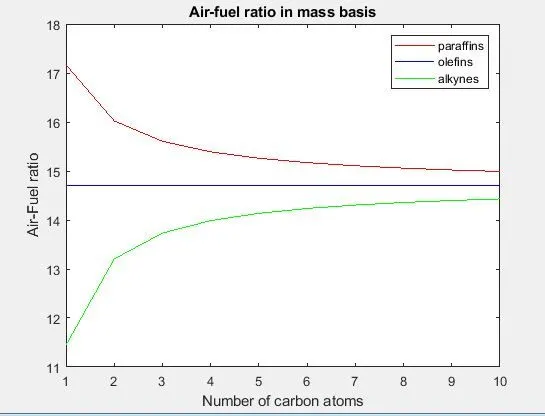
The air-fuel ratio is constant (14.71) for olefins irrespective to the number of carbon atoms. It increases as the number of carbon atom increases in case of alkynes and it decreases as the number of carbon atoms increases in case of paraffins with both curves similar to exponential form.
From the above curves we can conclude that for complete combustion per unit mass of fuel, more quantity of air is required for paraffins and lesser for olefins and least for alkynes with respect to number of carbon atoms in fuels.
2. Variation in molar ratio for various fuels with respect to carbon atoms:
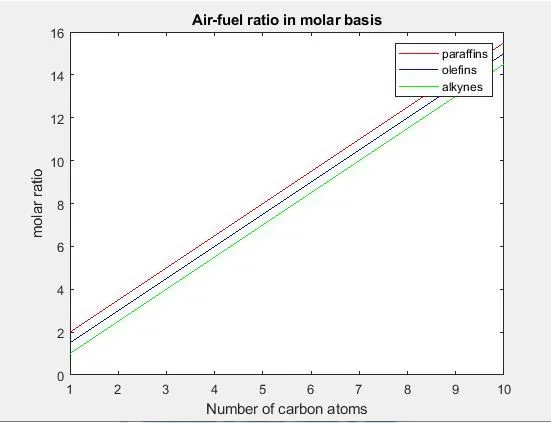
From the above graph, the molar ratio is a straight line increasing with same and constant slope for all the three varieties of fuel with respect to carbon atoms in fuels. The molar ratio is least for alkynes, more for olefins and greater for paraffins since it has more number of hydrogen atoms bonded with carbon atoms.
3. Proportion of carbon content in fuels:
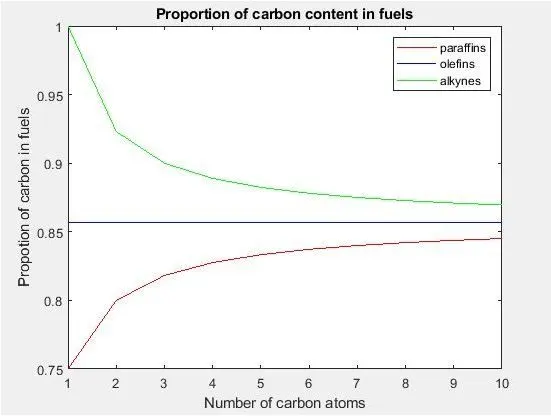
The carbon proportion is constant (85.7%) for olefins with respect to the carbon atoms. It increases for paraffins and decreases for alkynes resembling to exponential curve as the carbon atoms increases. Since carbon has higher molecular weight compared to the hydrogen in the fuel it has more composition in the fuel holding minimum percentage starting from 75%.
4. Proportion of hydrogen content in fuels:
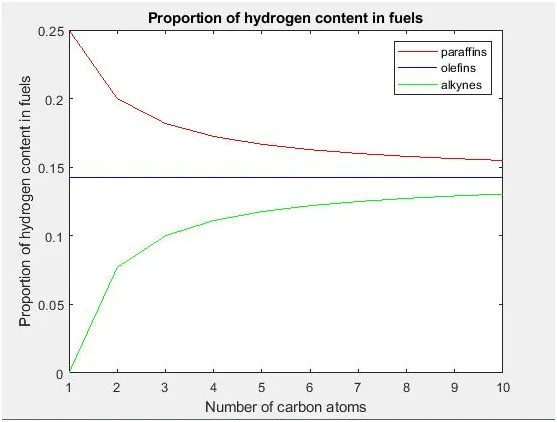
The hydrogen proportion is constant (14.28%) for olefins with respect to the carbon atoms. It increases for alkynes and decreases for paraffins resembling to exponential curve as the carbon atoms increases. Since carbon has higher molecular weight compared to the hydrogen in the fuel, the hydrogen composition is less in the fuel.
5. Mass of oxygen in air intake per kg combustion of fuel with respect to carbon atom in fuels:
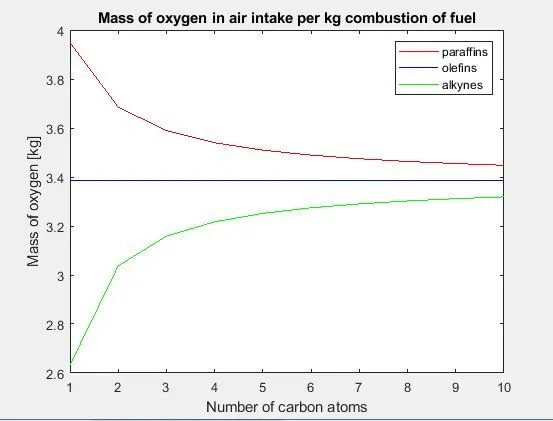
The mass of oxygen in air that is required for complete combustion of fuel per kg remains constant (3.3842 kg) for olefins with respect to the carbon atoms. It increases for alkynes and decreases for paraffins resembling to exponential curve as the carbon atoms increases.
For complete combustion of fuel per kg how much quantity of air required is termed as stoichiometric air fuel ratio. In air generally it has 77% of nitrogen and 23% of oxygen in mass basis. So 23% of AFR is mass of oxygen present to combust per kg of fuel.
6. Mass of nitrogen in air intake per kg combustion of fuel with respect to carbon atom in fuels:
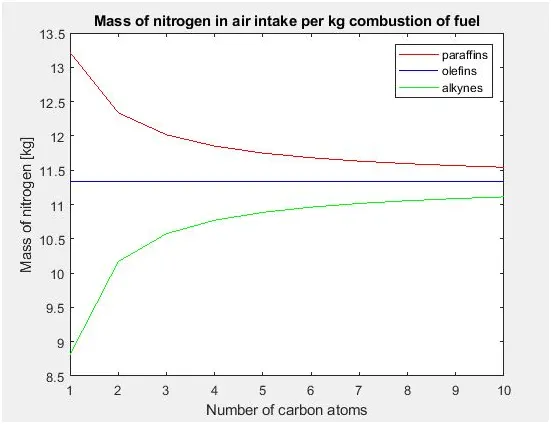
The mass of nitrogen that is present in air for complete combustion of fuel per kg remains constant (11.33 kg) for olefins with respect to the carbon atoms. It increases for alkynes and decreases for paraffins resembling to exponential curve as the carbon atoms increases.
7. Percentage composition of CO2 in products of combustion in fuels with respect to carbon atoms:
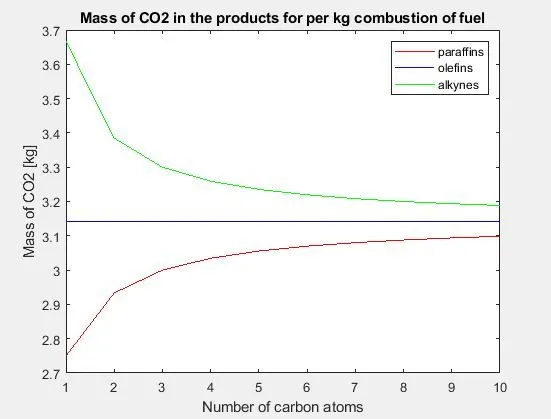
The products of combustion of a hydrocarbon fuel with air are CO2,H2O and O2. From the total mass of combusted products, how much proportion of CO2 is present in the product mass is displayed in the graph here. Percentage composition of CO2 in products increases for paraffins, remains constant for olefins and decreases for alkynes with respect to number of carbon atoms.
8. Percentage composition of H2O in products of combustion in fuels with respect to carbon atoms:
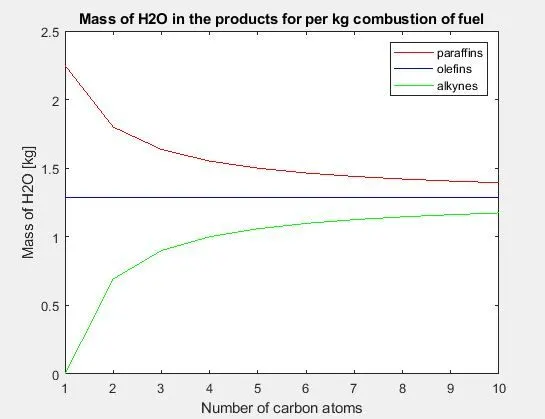
From the total mass of combusted products, how much proportion of H2O is present in the product mass is displayed in the graph here. Percentage composition of H2O in products decreases for paraffins, remains constant for olefins and increases for alkynes with respect to number of carbon atoms.
9. Percentage composition of N2 in products of combustion in fuels with respect to carbon atoms:
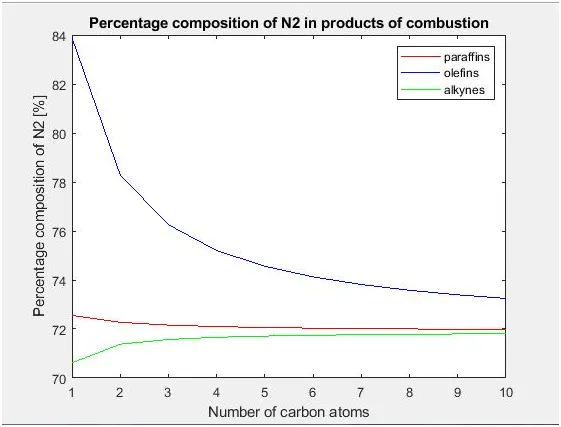
The curve pattern is different from the rest of other emission parameters in case of nitrogen emission. Here the olefins Nitrogen content decreases as the carbon content increases but the percentage composition is higher than the other two fuels and it ranges from (74-84)% approximately.
In paraffins, it decreases slightly initially and becomes almost linear on later part. In alkynes, the nitrogen composition in products increases initially and then becomes nearly linear. The main reason for this change is that the mass of nitrogen in the reactants and products remains same.
The following are the variation of engine performance parameters with respect to carbon atoms in fuels represented in plot.
10. Variation in Brake thermal efficiency with respect to carbon atoms in fuels
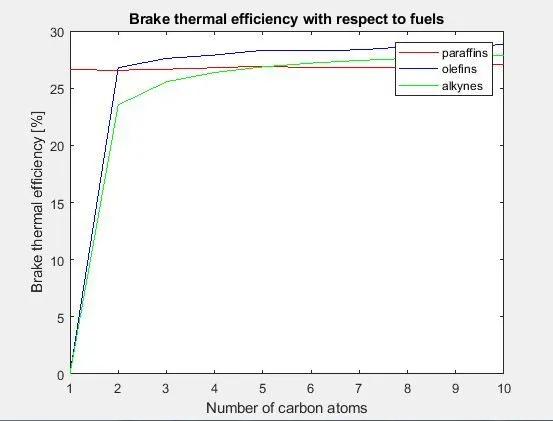
The previous plots show the emission characteristics and from now the performance characteristics are analysed.
Here the brake thermal efficiency values of olefins and alkynes for single carbon atom is not applicable since in these categories it should contain minimum 2 carbon atoms so it is approximated to zero. The brake thermal efficiency curve does not follow a regular pattern because the calorific value of each individual fuel is independent property which is a function of brake thermal efficiency.
It is higher for olefins and the value increases with respect to carbon atom.
For paraffins, the curve is nearly horizontal which only slight variation is observed with respect to carbon atoms. The brake thermal efficiency values are lesser than olefins.
In case of alkynes, for the first 5 carbon atoms the efficiency is lesser than paraffins and for the last 5 carbon atoms the efficiencies are higher than paraffins and the values of alkynes increases as the carbon atom increases.
11. Variation in indicated thermal efficiency with respect to carbon atoms in fuels
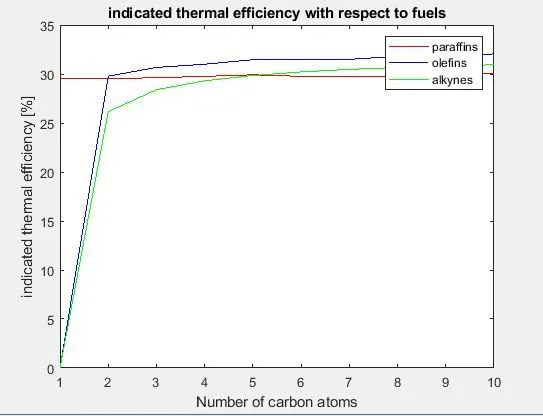
The curve pattern is similar to the brake thermal efficiency plot but values are slightly higher since the frictional loss is not considered in indicated power.
12. Variation in Brake specific fuel consumption with respect to carbon atoms in fuels
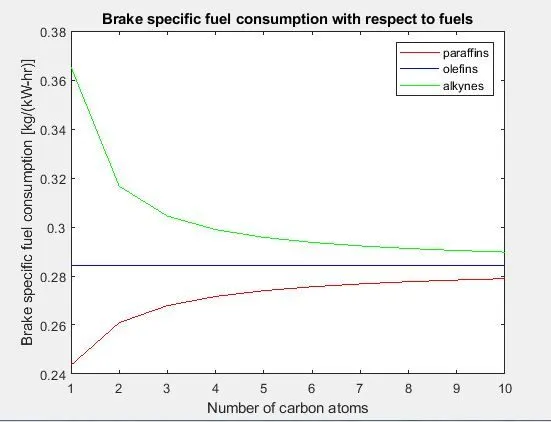
The bsfc values of olefins remains constant irrespective of the number of carbon atoms present in the fuel and irrespective to the input condition. The value may vary with input condition but the pattern of the curve remains same.
The bsfc values of paraffins increases with carbon atoms and for alkynes it decreases with carbon atom.
The bsfc values for alkynes are higher, lesser for paraffins and for olefins it is in between them.
13. Variation in indicated specific fuel consumption with respect to carbon atoms in fuels
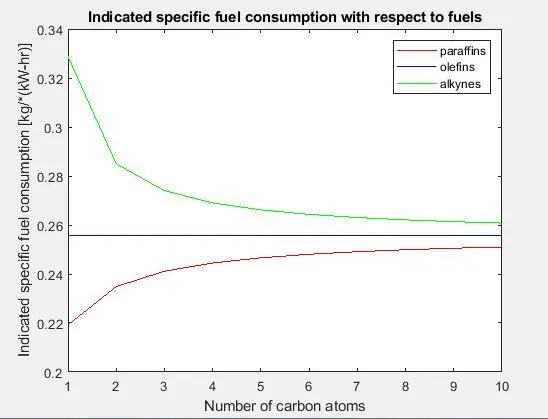
The isfc value plot pattern is similar to bsfc but the values are lesser than bsfc since it is related with respect to indicated power.
Apt fuel selection from the given list as per the desired condition from the user:
For the given set of input values, the minimum expected performance parameters by the fuel are requested to enter by the user. If the fuel performance meets the minimum expected value of performance by the user, the respective fuel is listed in the command window.
The expected brake thermal efficiency and brake specific fuel consumption is entered by the user.
If the obtained brake thermal efficiency is greater than the expected brake thermal efficiency, then it is considered as suitable fuel.
Similarly, if the obtained bsfc value is lesser than the expected bsfc value, then it is considered as good fuel.
A good fuel is one which produces higher value of brake thermal efficiency and lower bsfc.
The following are the results that satisfies the expected input condition.
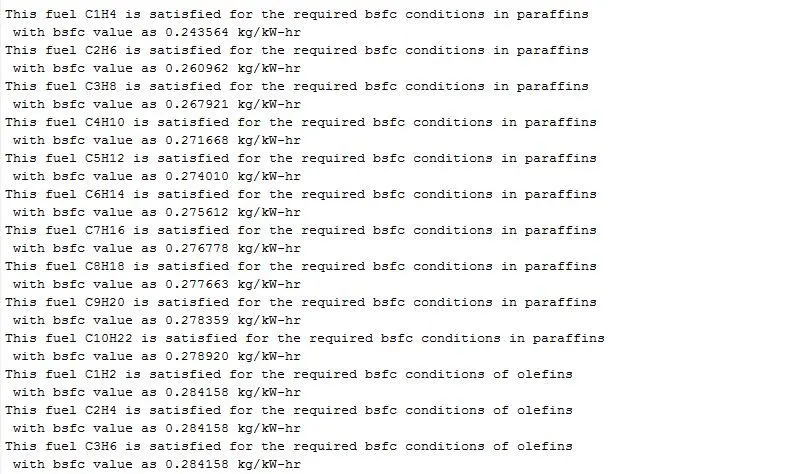
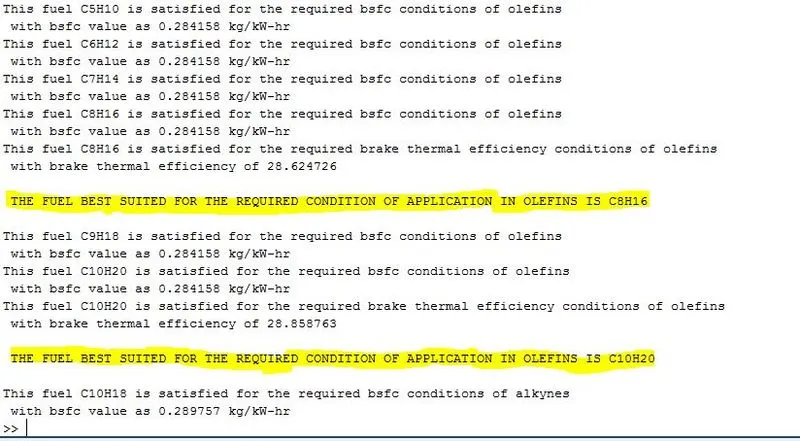
The fuel that satisfies both the conditions, are highlighted in capital letters to identify easily among the rest of fuels.
CONCLUSION:
From the above results, the following conclusion can be made.
- When the bsfc is the primary criteria for fuel selection, then paraffins is the best choice since paraffins takes minimum quantity of fuel to produce per kW of power per unit time. The best fuel which produces minimum bsfc value is methane (CH4), second comes ethane(C2H6) and so on. As the carbon content in paraffins increases, the bsfc values also increases.
So paraffins with lesser value of carbon atom is selected to get an efficient fuel. - If brake thermal efficiency is the primary criteria for fuel selection, then olefins is better choice compared to the other two category fuels since it has higher brake thermal efficiency than rest two category.
- For the given input condition, the best suited fuels as per the customer’s expectations are C8H18(non-1-ene) and C10H20(dec-1-ene) since it satisfies both the condition of bsfc and brake thermal efficiency of the customer.
- From the above study it can be concluded that paraffins and olefins are better fuels compared to alkynes in terms of performance. Though olefins brake thermal efficiency is slightly higher than paraffins, paraffins show very good results in bsfc values. Thus paraffins is best among all.
REFERENCES:
https://www.engineeringtoolbox.com/paraffins-alkanes-combustion-d_1430.html
https://pubchem.ncbi.nlm.nih.gov/compound/Decane
https://math.stackexchange.com/questions/1743261/how-to-convert-kj-kmole-to-kj-kg
https://en.wikipedia.org/wiki/Combustion
https://web.mit.edu/8.13/8.13c/references-fall/aip/aip-handbook-section4l.pdf