Fender Design - Wheel Arch Challenge
Wheel Arch is a section of the Fender in a vehicle that shelters the car's wheel and has a curvature to it. The wheel arch is designed in such a way that the wheel is inside the fender as well as the wheel arch to prevent chipping of the fender and also to protect the pedestrian.
Chipping occurs when sand, mud, rocks, liquids, and other debris are thrown into the air by the rotating tyre and strike the fender.
Important points to be considered while designing Wheel Arch
- Type of Fender being used
- Wheel Arch Area
- Size of the fender
- Clearance between Wheel arch and wheel
- Safety regulations to be followed depending upon the region (e.g.: US Regulation, Indian Regulation, Japan Regulation).
Type of Fender:
Full bumper type
- More wastage of material in the form of metal
- Used quite often in old cars
- Increases the weight on the vehicle
- The performance also reduces
- If bumper gets damage costly for replacement and maintenance
Half bumper types
- Less wastage of material
- Used in modern cars
- Reduces the weight on the car
- Performance increases and hence mileage increases
- Allows using plastic on the bumper side and helps in easy replacement and maintenance if damage occurs.
Clearance between the wheel and wheel arch:
The distance between the wheel and the wheel arch is critical for avoiding fender damage and ensuring pedestrian safety. The standard and standards for wheel arch differ from one location to the next. In order to market their vehicle, an OEM must adhere to the standards imposed by the country's government authority.
Various Standards of Wheel Arch in Different Regions:
JAPAN REGULATIONS REQUIREMENT
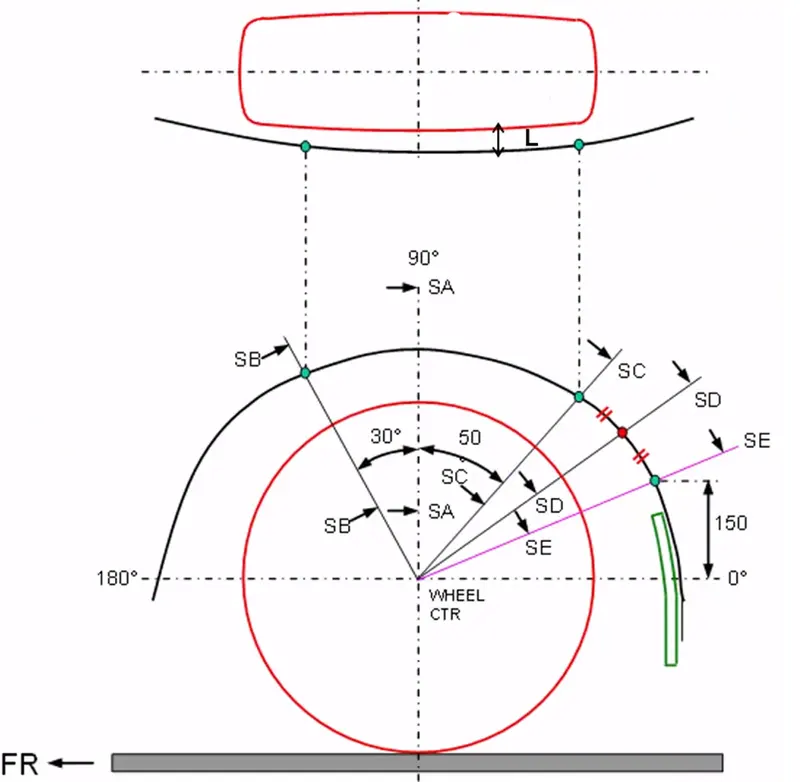
Within region K, measure clearance L of tyre, hub, cap, and fender in three different locations and create a clearance check chart to verify. In all three positions, the clearance must be larger than 5 mm. Wheel guards are required: The value of 'a' must be greater than 5 mm at lines 30' forward and 50' back from the wheel's centre vertical axis.
EUROPEAN REGULATIONS REQUIREMENT:
Clearance should be measured. To validate the lat sections SA-SA, SB-SB, SC-SC, SD-SD, and SE-SE, create a CL check chart. To comply with European rules, the Clearance L value should be larger than 10 mm in all five areas. Wheel guards are required: At line 30" forward and 50 backwards from the centre vertical axis of the vehicle, the value of 'a' must be more than 5 mm.
US REGULATIONS REQUIREMENT:
Make the clearance check table and record the clearance check details for all positions from -100* to 100*. To comply with the rules, all values must be more than 5 mm. At lines 30* forward and 50 backwards from the wheel's centre vertical axis, the value of 'a' must be greater than 5 mm.
The wheel arch of the specified fender must now be confirmed for European Standards, as per the challenge. According to European standards, the wheel arch of the fender has over 5 pieces that must maintain a 10 mm clearance gap from the wheel's outermost component. SA-SA, SB-SB, SC-SC, SD-SD, and SE-SE are the sections used to calculate a 10 mm clearance gap.
In order to measure the clearance,
- From line O' on the fender to line 180* on the wheel.
- Place a perpendicular at the wheel's centre, and this line will be the SA section.
- Mark SB and SC portions 30" forward and 50* back from the vertical line, accordingly.
- Above 150mm, draw a line parallel to the horizontal wheel centre line and mark the location on the wheel arch with E; this part is SE.
- When the angle formed by SC and SE is bisected, the bisector line becomes the SD section.
- Once you have all five parts SA, SB, SC, SD, and SE, project them onto the fender to measure the 10 mm clearance gap at each section.
Obtaining Results:
Sketch is drawn on the wheel face as per the European standards provided and projected on the wheel arch at sections SA, SB, SC, SD and SE to measure "L", "a" and wheel arch area.
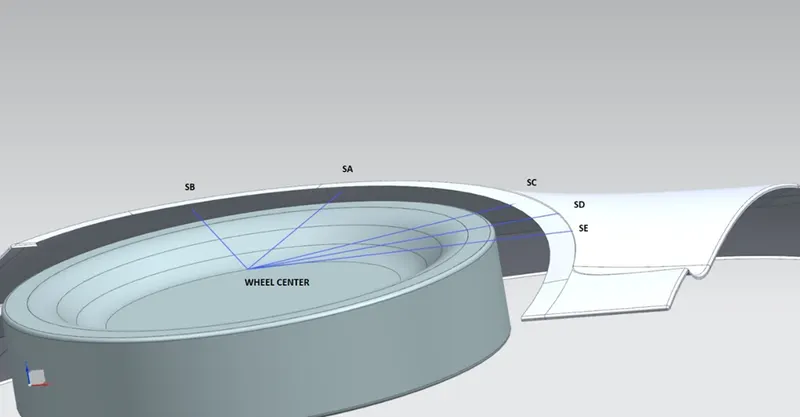
Obtaining the value of clearance "L"
Measuring "L' for the given wheel and fender at SB:
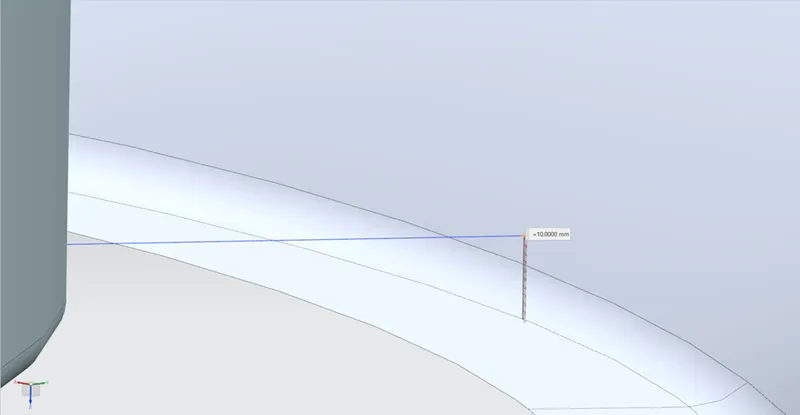
The value of “L” at SB = 10.000mm
Measuring “L” for the given wheel and fender at SA:
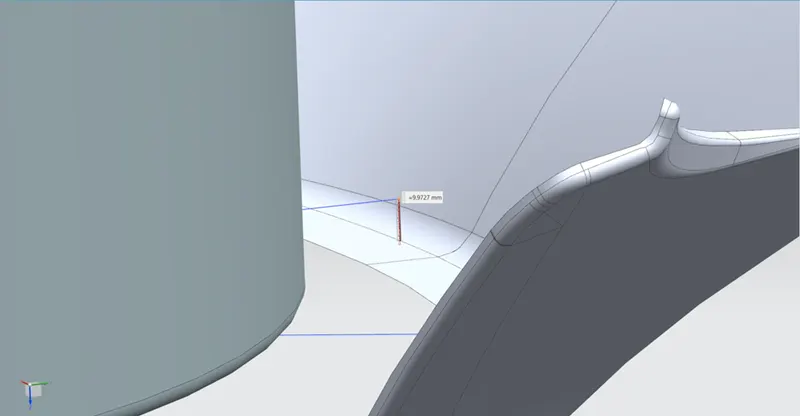
The value of “L” at SA=9.9727mm
Measuring “L” for the given wheel and fender at SC:
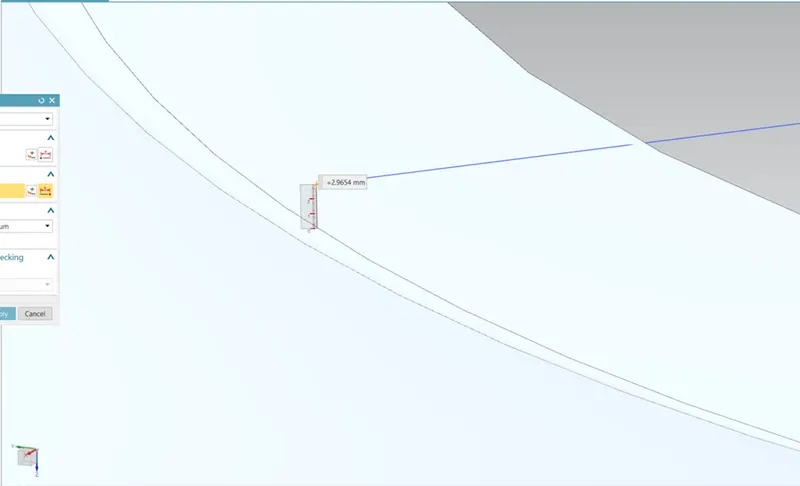
The value of “L” at SC =2.9654mm
Measuring “L” for the given wheel and fender at SD:
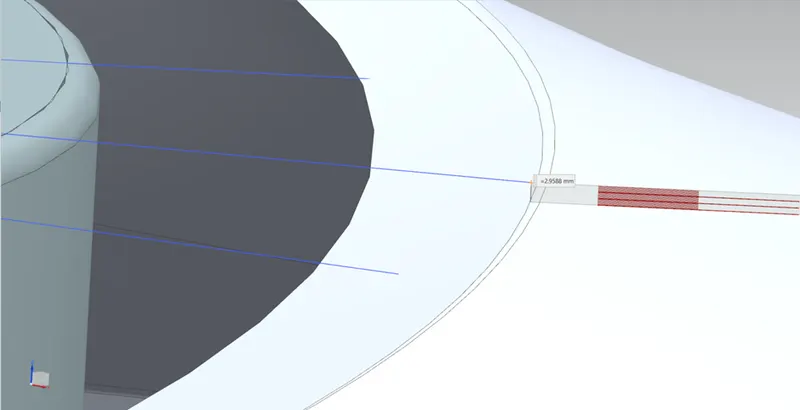
The value of “L” at SD = -2.9588mm
Measuring “L” for the given wheel and fender at SE:
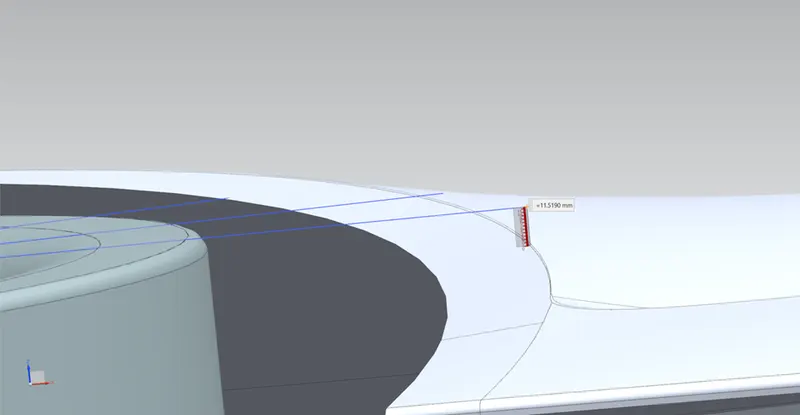
The value of “L” at SE = -11.5190mm
Clearance “L” obtained at sections SA, SB, SC, SD and SE.
|
Section |
Clearance “L” (in mm) |
Comments |
|
SA |
9.9720<10 |
Fail |
|
SB |
10.000=10 |
Pass |
|
SC |
2.9654<10 |
Fail |
|
SD |
-2.9588<10 |
Fail |
|
SE |
-11.5190<10 |
Fail |
Conclusion:
We can deduce from the foregoing findings that the supplied fender does not meet European Wheel Arch Area Standards.