Fender Design - Wheel Arch Challenge
Fender Desing-Wheel Arch Challenge
Aim: Calculate the wheel arch gap at required point and check whether the car passes the European standard.
Wheel Arch:
- The wheel arch is the semicircular part positioned above the wheel of a vehicle.
- The most important body change was that the front wheel arch was cut higher into the fender.
- Corrosion had occurred around the splash plate at the back of the wheel arch.
- The car was large in size, high-definition headlights that extend to the wheel arch.
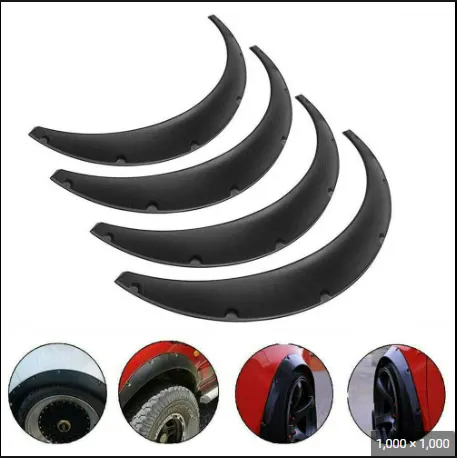
Fender:
- Fender is the US English term for the part of an automobile (vehicle body) that frames a wheel weel (the fender underside).
- Its primary purpose is to prevent sand, mud, rocks, liquids and other road sprays from being throw into the air by the rotating tire.
- When a vehicle is moving, tyres pick up stones and other hurl them in all directions. Fender is basically present to prevent any injuries to pedestrians and the motion of these particles.
- Most passenger automobiles have four fenders, one over each wheel. For vehicles with an arrow car body that exposes the tyres, the fender is an exposed curve over the top of the tyres. For wide body vehicles that cover the tyres, the fender forms the wheel well surrounding the tyres and is not directly visible from above the car body.
- Wheel wells tend to be much larger than the diameter of the tire because they do not move with the tyre's suspension and consequently must be large enough to allow the full range of tire motion on the suspension without touching the interior of the wheel well.
- More elaborate designs include fender for exposed fenders.
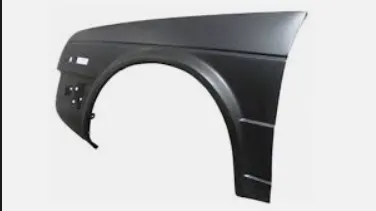
Material Used:
The most commonly used wheel well is of plastic material. In the olden days, the inner fender or wheel well was made of sheet metal. If the vehicle with metal inner fenders is used ther is good chance that winter salt and moisture have caused them to develop some rust in hard-to-spot areas. Improper reairs after an accident can accelerate corrosion here as well.
Fender Safety:
- The fender is a part of car, it is also used a protect the side of the engine compartment.
- Pedestrian safety is also considered while designing a wheel arch in a fender since the debris in the wheel shouldn't hit them in the motion of the car.
- Fender is also reduced pedestrian injury when there is a pedestrian-vehicle crash and prevents the throwing up of debris vehicles.
Type of Fender:
The type of fender is based upon the area covered
1. Full fender type.
2. Half fender type.
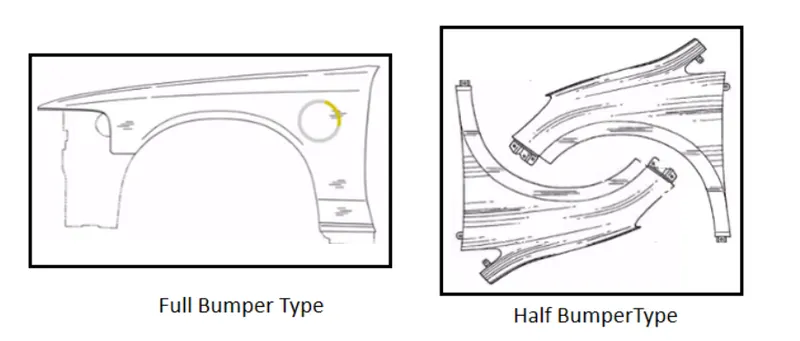
Full Fender type:
The full fender type is the traditional type of fender where more material consumption is observed. This type is used in the old designs of automobiles where it increases the overall weight and thus reduces performance. The maintenance is also relatively more due to more surface.
Half fender type:
Half fender type is a modern design where less material consumptions is observed, so productivity increases by reducing the size of the blank and thus providing more performance. The maintenance is also relatively low compared to the full bumper type.
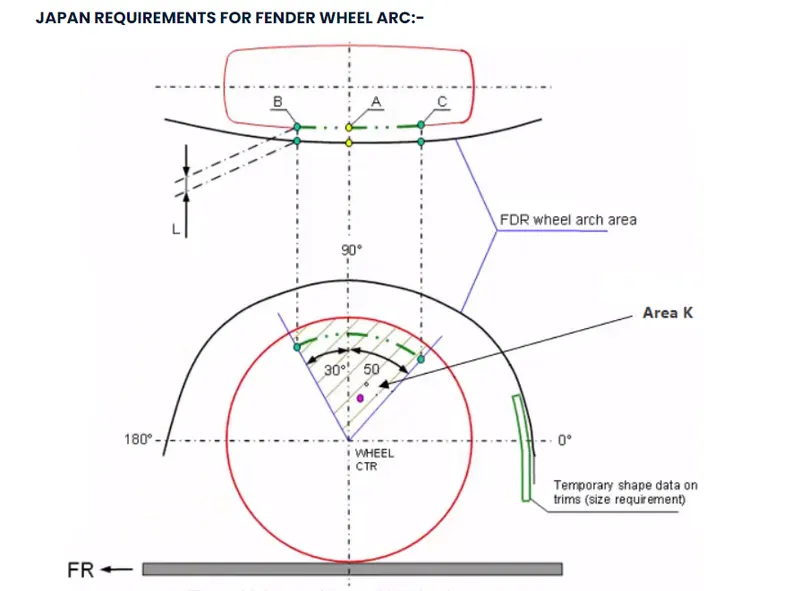
1. Measure clearance L of tyre, hub, cup and fender in three different positions within area K and produce a clearance check chart to validate.
2.Clearance must be greater than 5mm in three positions.
3. Wheel guard requirement: the value shall be more than 5mm at a line 30* forward and 50* rearward from the central axis of the wheel.
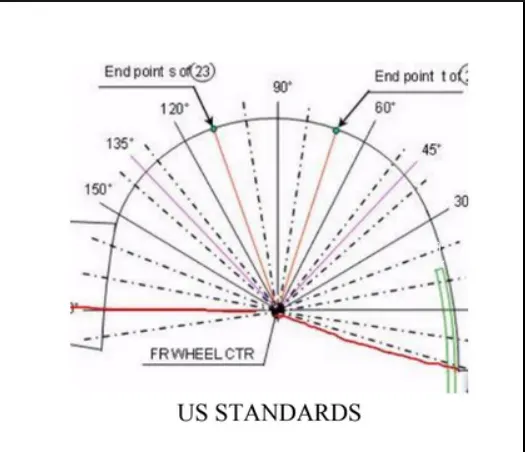
1. Make clearance check details on all position from -100* to 100* and make the clearance check table.
2. All values should greater than 5mm to satisfy regulation.
3. The value of 'a' shall be more than 5mm at line 30* forward and 50* rearward from the central vertical axis of wheel.
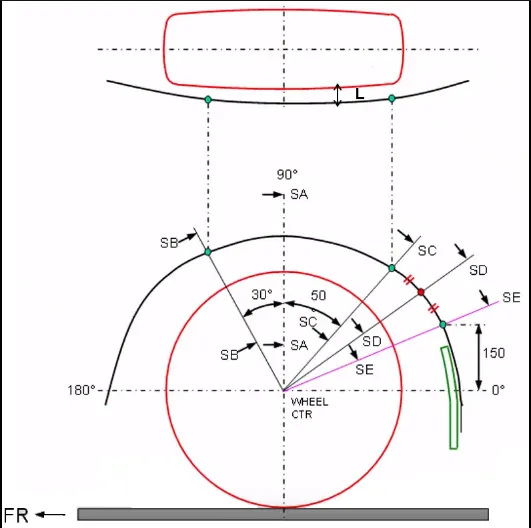
Measure CL l at section SA-SA-SB-SB-SC-SC-SD-SD-SE-SE and produce a CL check chart to validate.
1. In all five sections, the CL L value should be greater than 10mm satisfy European regulations.
2. Wheel guard requirement the value of 'a' shall be than 5mm at a line 30* forward and 50* rearward from the centical axis of the wheel.
PROCEDURE:
1.According to European standards, the design fender and wheel are should pass the wheel guard requirement procedures.
2.To start the test, first, create a plan with the face wheel arc.
3. Then sketch using lines along with given dimensions as SA, SC, SD and SE.
4. After sketching the project, the intersection points into the fender face.
5. Then use the measure distance tool and calculate the clearance between sketch lines and wheel arc.
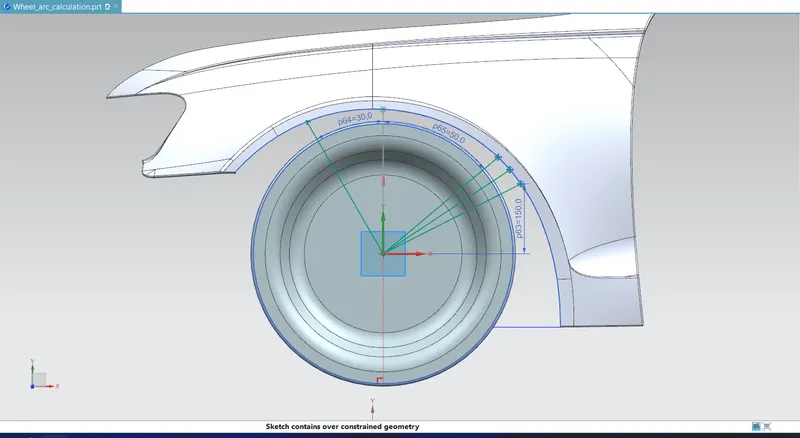
6. The clearance between the SA line and wheel arc is 9.9489mm also the line SA lies outside the fender so it is a negative value.
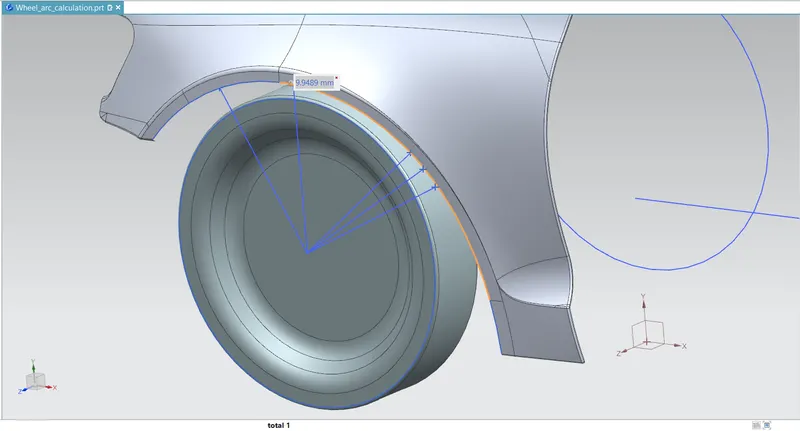
7.The clearance between SB line and wheel arc is 10mm also the line SB lies inside the fender so it is a positive value.
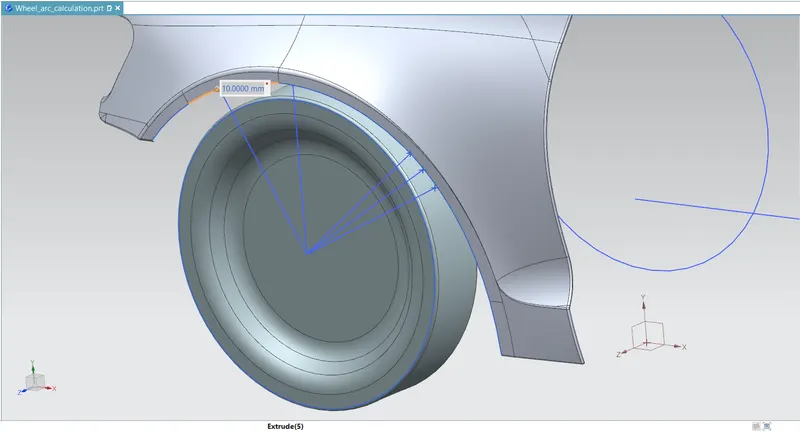
8.THe clearance between the SC line and wheel arc is -0.1137mm also the line SC lies outside the fender so it is a negative value.
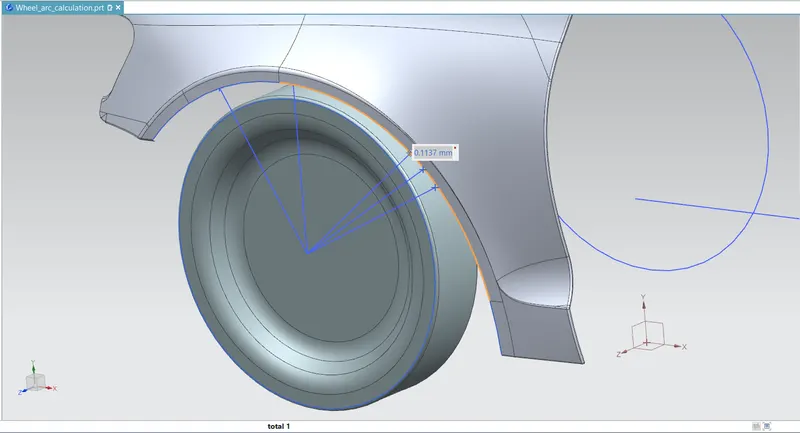
9.The clearance between the SD line and wheel arc is -2.8573mm also the SD lies outside the fender so it is a negative value.
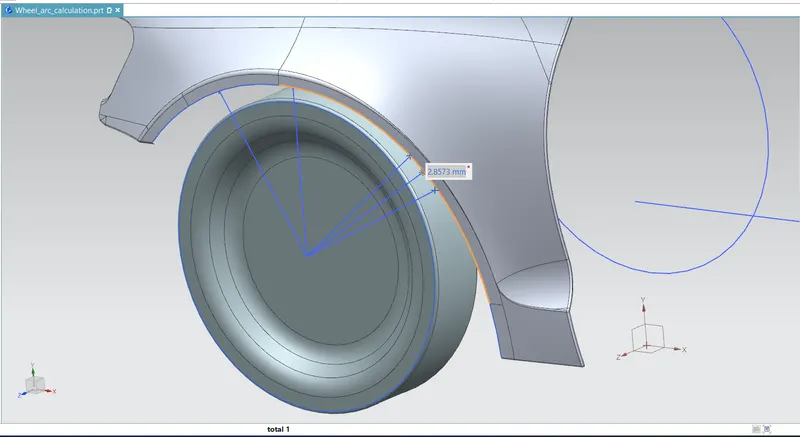
10. The clearance between the SE line and wheel arc is -5.9755mm also the line SE outside the fender so it is a negative value.
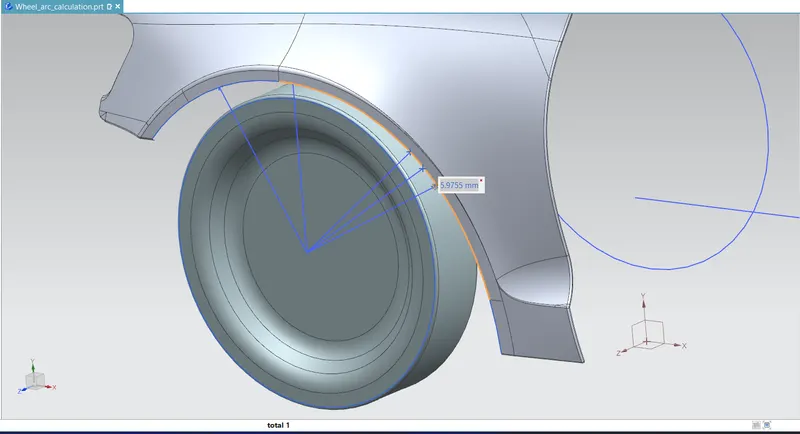
| Region | Required Clearance(mm) | Actual Clearance(mm) | Result |
| SA | 10 | 9.9489 | Fail |
| SB | 10 | 10 | Pass |
| SC | 10 | -0.1137 | Fail |
| SD | 10 | -2.8573 | Fail |
| SE | 10 | -5.9755 | Fail |
Conclusion: From the above results we can conclude that the fender dose not pass the European regulations. as the minimum clearance L between the fender wheel arc and wheel for vehicle and pedestrian safety is 10mm and this design does not meet the requirement.