Fender Design - Wheel Arch Challenge
Aim:- Calculate the Wheel Arch gap at the required points and check whether the car passes the European standard.
Objectives:-
- Brief information about Fender.
- Different standards for wheel arch gap measurements.
- Calculate the Wheel Arch gap at the required points and check whether the car passes the European standard.f
Fender:
In a car, a fender is a panel that covers the wheel well and is located on the exterior of the vehicle, typically above the tire. The main purpose of fenders is to protect the car's body from dirt, rocks, and other debris that can be kicked up by the rotating wheels.
Fenders also help prevent water and mud from splashing onto the car's body, which can cause corrosion over time. In addition to protection, fenders can also enhance the aesthetic appearance of a car by giving it a sleek, streamlined look.
Fenders can be made from a variety of materials, including steel, aluminum, and plastic. Some high-performance cars feature carbon fiber fenders, which are both lightweight and strong. Overall, fenders are an important part of a car's design and functionality, providing both protection and style.
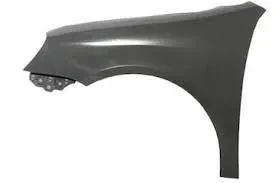
What is a wheel arch gap and what are the different standards for wheel arch measurement?
Wheel arch gap refers to the distance between the top of a vehicle's tire and the underside of the fender or wheel arch. This measurement can vary depending on the make and model of the vehicle, as well as the size of the wheels and tires.
Wheel arch gap value can vary from country to country and its value depends on the road infrastructure of that specific country.
Japanese Standard:-
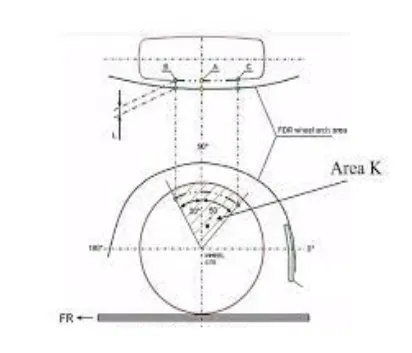
If we see the car from the side view, Then we can see a wheel and fender clearly, and let's consider this as the front view.
Now, first of all, find the center of the wheel and create axes of 0, 180, and 90 degrees from the center point. Create lines at 30 degrees on the left side of the vertical axis and 50 degrees on the right side of the vertical axis. Mark the Intersection points of these lines with the wheel's outer radius and fender arch. After that project it on top view perpendicularly and measure the gap between the point on the wheel radius and the fender arch.
According to Japanese standards, this gap value must be 5mm or more.
European Standard:-
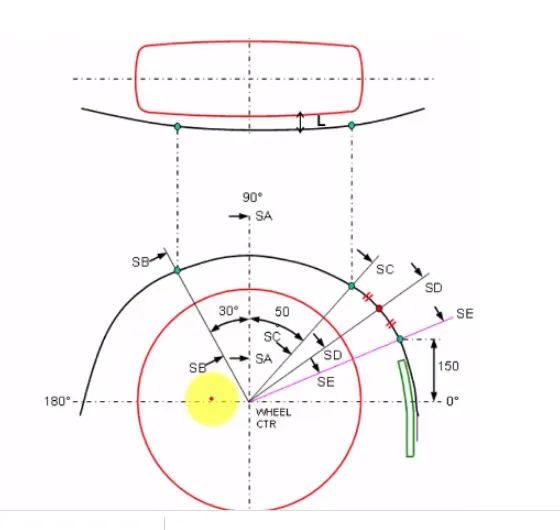
- All the initial process of making axes and marking points on 30, 50, and 90 degrees lines.
- In this measurement, we have to create an axis parallel to a 0-degree line at a distance of 150 mm and mark the intersection point of this axis with a fender arch.
- Create a line between the center point of the wheel and the intersection point of the 150mm axis with the fender arch.
- Now create a midpoint between the intersection point of the 50-degree line and the 150mm axis line on the fender arch and join it with the center point using a line.
- Now measure the gap at each point.
According to European standards, The gap value must be more than or equal to 10mm.
American Standards:-
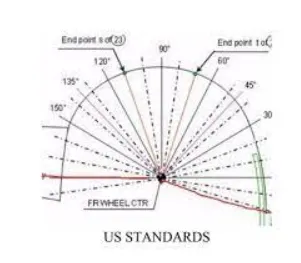
In USA standards, we measure the wheel arch gap value in each 10-degree gap, and at every point, this value should be equal to or more than 10mm.
The following are the steps required for creating the sketch required for European standards:-
- Create a sketch on the outermost face of the wheel and draw a vertical "SA" and horizontal axis line. After that create a 30-degree line "SB" on the left side and a 50-degree line"SC" on the right side of the vertical axis. At a distance of 150 mm from the central horizontal axis line, draw a line 'SE', and a line 'SD' at midpoint bisecting the 'SC' and 'SE'.
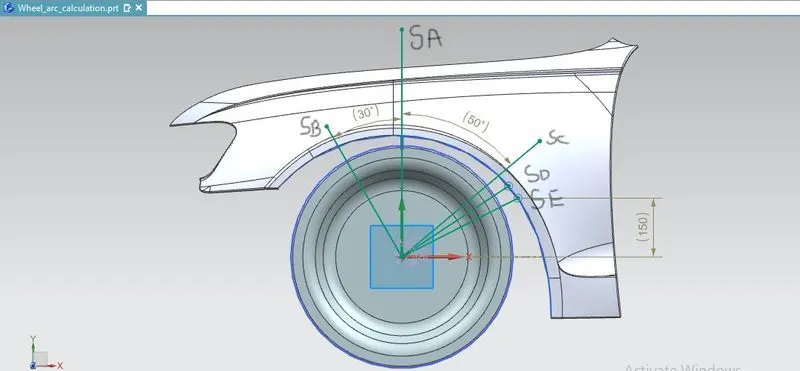
- Now using the measure option the distance was measured from the points intersecting the arch by the lines SB, SA, SC, SD, and SE to check and validate as per the European standard.
- Clearance 'L' at SB = 10mm
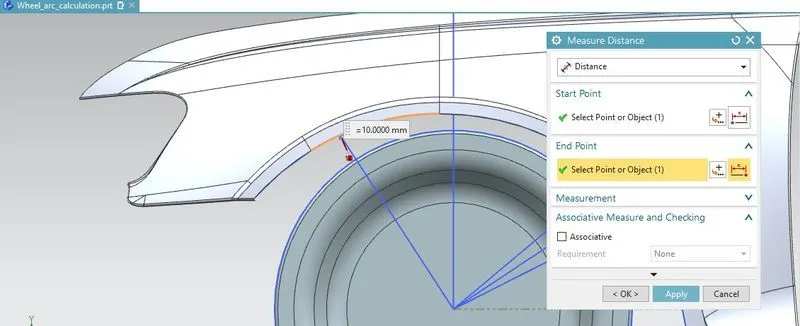
- Clearance 'L' at SA = 9.9513mm
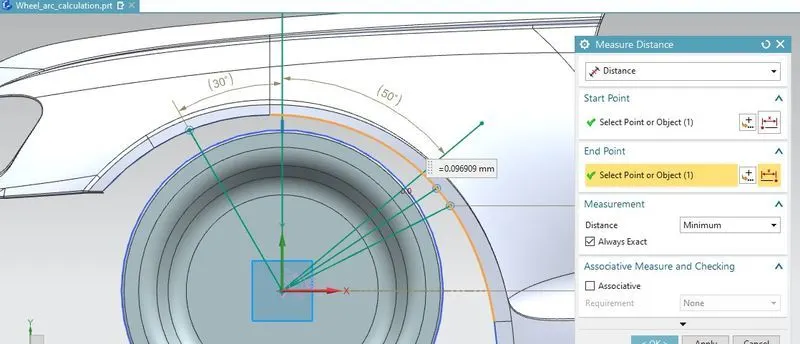
- Clearance 'L' at SC =-0.096909mm
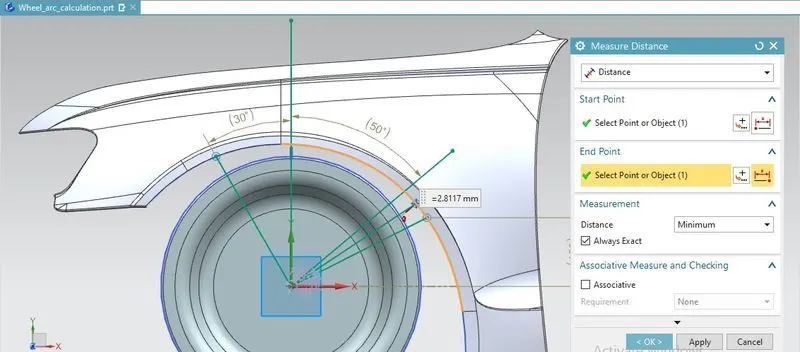
- Clearance 'L' at SD = -2.8117
- Clearance 'L' at SE = -5.9894
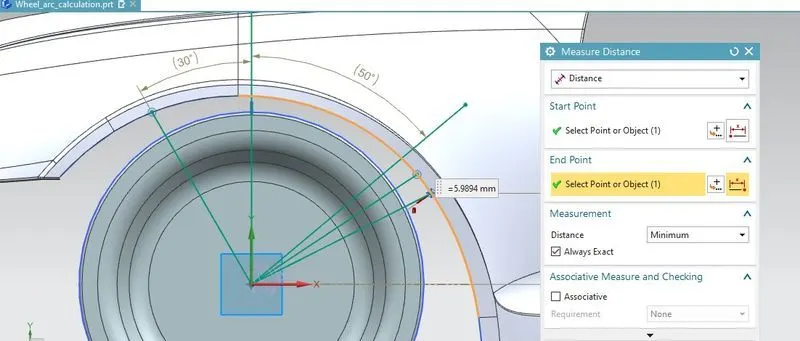
Observation:-
| POINTS | MEASURE | REMARKS |
| SA | 9.9513mm | FAIL |
| SB | 10mm | PASS |
| SC | -0.096909 | FAIL |
| SD | -2.8117 | FAIL |
| SE | -5.9894 | FAIL |
Conclusion:-
From the above study, we can conclude that only the SB line pass the standard value while the SA, SC, SD, and SE lines failed to meet the criteria.
Hence, we can say that the above design failed to comply with European standards.