Fender Design Challenge
Report on Fender Design
Fender or Quarter panel of a car is a BIW component of a car. It's purpose is to keep engine bay or engine compartment protected from debris and foreign materials such as dust, rain, sand, snow. As the wheel/Tyre rotates a lot of such components get thrown around due to centrifugal force so the fender needs to be designed such that none of the debris land dangerously on the cars body or the pedestrians.
Consideration for the design of a fender includes:
- Safety of occupants.
- Safety of pedestrians.
- Sealing the engine compartment from outside elements.
- Styling and aesthetics of the body.
- Crash safety
- Mounting areas and clearances.
The fixture of a fender is done using nut-bolt, screws instead of welding or adhesives. The fender is usually fixed at 4 to 5 locations to keep the vibrations and noise due to debris and wind low. Thefixture locations are:
- Drip area. (Fixing with the engine compartment)
- Bumper Mounting Area.
- Sill Mounting area. (The lower, side component of chassis)
- 'A' - Pillar Mounting area.
- Chassis mounting area.
A baffle or plastic guard like part is joined to the fender in the wheel arch area. It helps with keeping the vibrations and noises to a minimum. The mud flaps are usually mounted in the same area. the fender needs to be designed considering the mounting points of these parts and their clearances.
Drip area:
It is the part of the fender where the fender is fixed to the engine compartment of the car chassis. It is usually in the middle of the edge along the engine compartment to provide clearance for the headlight assembly in the front and cowl area (Wipers, Wiper motors ets) in the back. To keep the aesthetics of the whole car better, all the fixtures, aesthetically unpleasant parts, welds, sealants etc are kept hidden such that they are only visible when one actually looks for it such as opening the hood, removal of plastic covers, panels etc. This philosophy holds good for the drip area too.
Drip area master section:
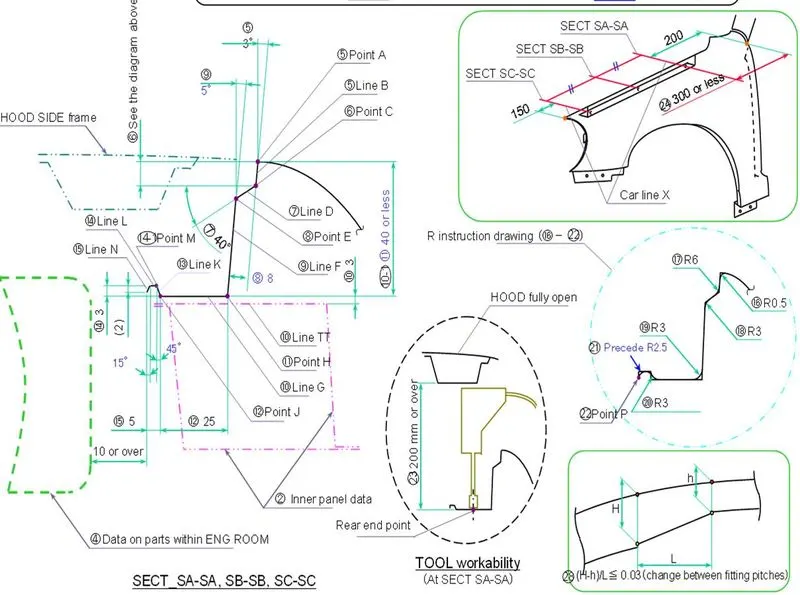
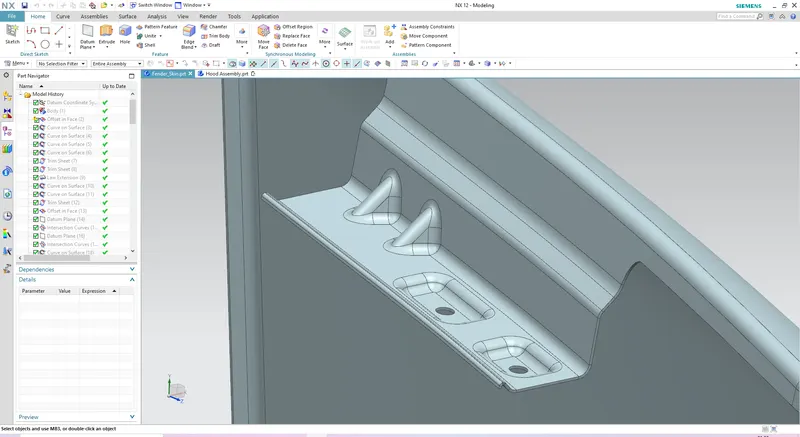
Considering the ease of manufacturing using press and die's sharp corners and sudden changes in dimension is avoided, if not possible, Relief cuts are added where necessary. Corner reliefs are provided to avoid intersection on bending. Embosses, fillets, bends are given to increase the local strength. Darts are also added to strengthen the drip area.
Drip area:
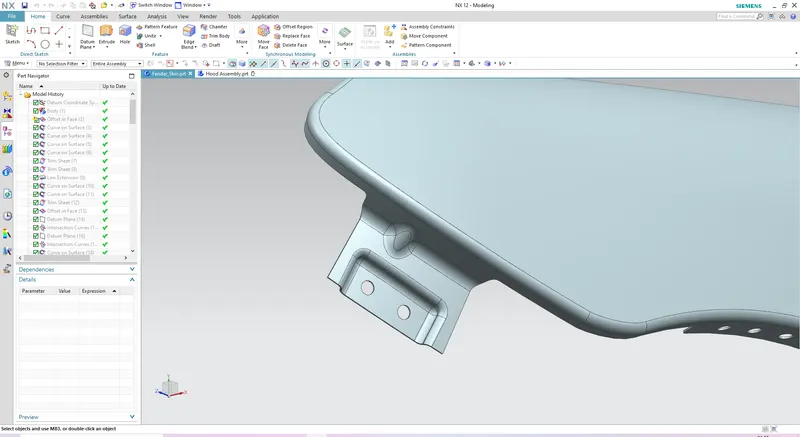
Bumper mounting area:
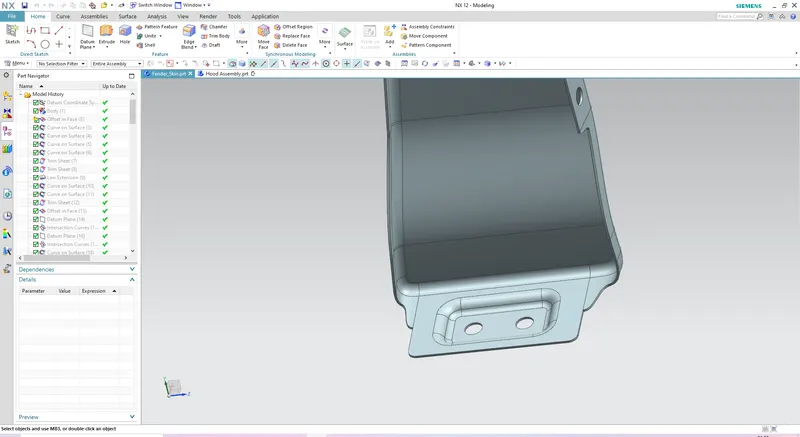
Sill mounting area:
A-pillar mounting:
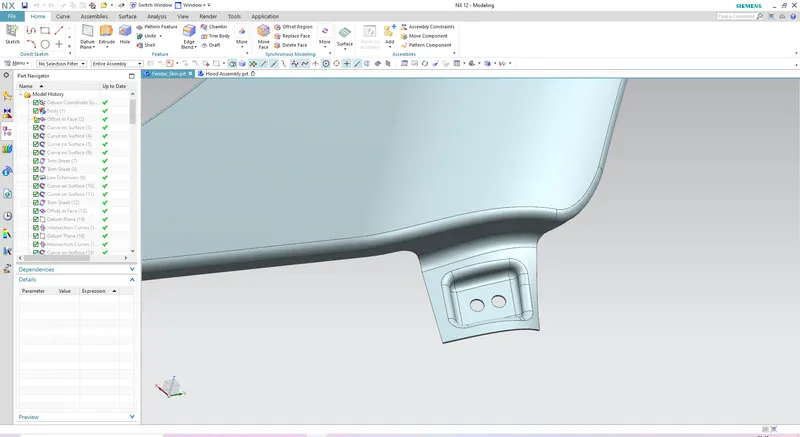
Baffle mounting area:
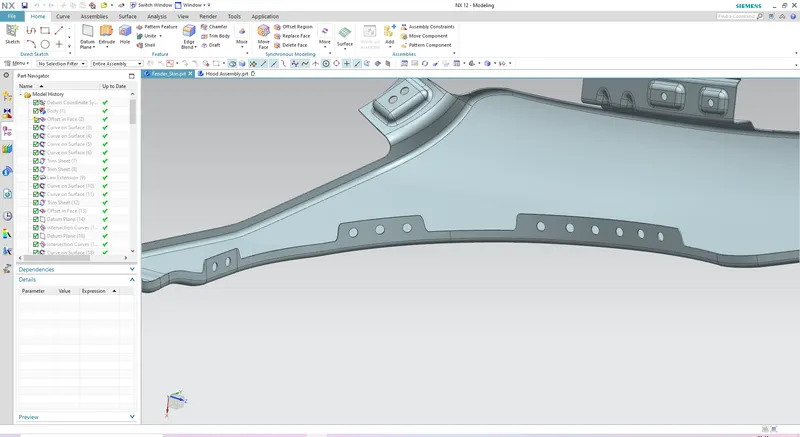
To keep the material waste or scrap to minimum, unnecessary features are avoided. The edges are kept clean and straight forward wherever possible. Considering the weight and cost of production, the design is kept as simple and clean as possible without comprimising on the safety aspect of the part.