Fender Design
Fender Design
OBJECTIVE: - The main objective of this project is to learn the basic tools, commands, and Surface modeling of the Fender Design using Siemens NX CAD. To design a Fender mounting on the given model by using Master sketch by considering the safety and manufacturing feasibility for possible mounting region.
1. Drip Area
2. Pillar Mounting Area
3. Sill Mounting Area
4. Bumper Mounting Area
5. Baffle Mounting Area
INTRODUCTION: - A fender is a piece of a vehicle, cycle, or some other vehicle Its fundamental job is to prevent sand, mud, rocks, liquids, and other road sprinkles from being thrown into the air by the turning tire. In extra to fender various parts like internal mount, side, and cowl mounts that are joined with well nuts' help. They give satisfactory protection to the engine room portions and suspension, etc. In like manner, the fender keeps all the debris from the road from throwing into the air. Despite the fender, Fender skirts are given to give better protection.
Fender is the American English articulation for the piece of a vehicle, cruiser, or other vehicle body that traces a wheel well. Its essential job is to hinder sand, mud, rocks, liquids, and various roads shower from being thrown into the air by the turning tire. Fenders are customarily unbendable and can be hurt by contact with the road surface. Crude materials, similar to mud, may adhere to the smooth outside tire surface, while smooth free articles, similar to stones, can end up being unexpectedly embedded in the track grooves as the tire turns over the ground. These materials can be jump-started out from an external perspective of the tire at fast as the tire gives engine energy to the joined things. For a vehicle pushing ahead, the most noteworthy place of the tire is turning upward and progress and can throw Objects into the air at various vehicles or individuals by walking before the vehicle. A fender is a front outer side individual from a vehicle, which covers the wheel side. It has such innumerable little features with great and terrible occasions.
USES OF FENDER: -
- Get other vehicles or pedestrians on the road side dirty.
- Hurt pedestrians.
- Scratch the bodies of other vehicles.
- Cause minor, and even major damage to other vehicles.
- It is designed to provide resistance against wind, muds, and roadside partials.
- It is the sheet of metal covering of the car.
- Fender has a plastic part called Baffle or fender Liner which fits underside the fender to protect the metal from corrosion by stopping the flow of mud and water inside from different road conditions.
TYPES OF FENDERS: -
There are two main types of fenders-
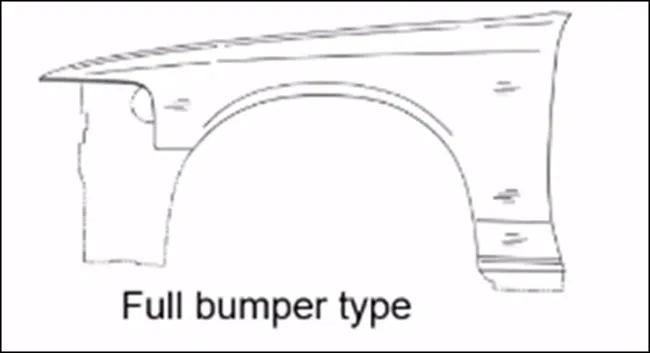
The Full Fender type: The full fender type is the standard sort of fender where more material use is observed. This sort is utilized in the old designs of vehicles where it manufactures the general weight and suitably lessens execution. The upkeep is besides modestly more because of more surface.
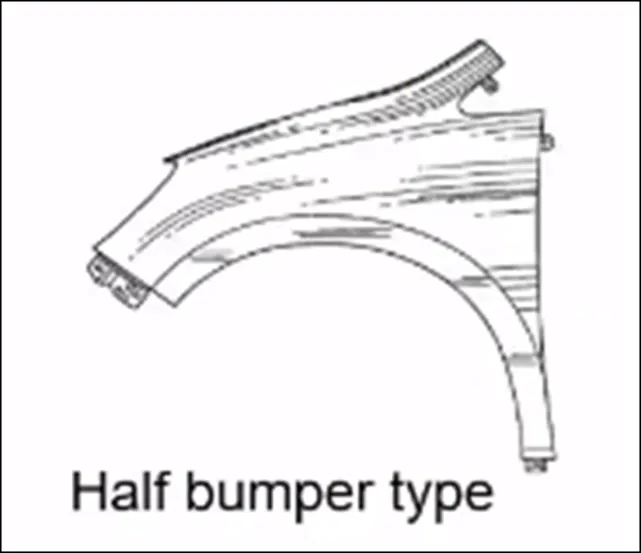
The Half Fender type: Half fender type is a forefront design where less material use is seen, so capability increments by decreasing the indisputable size and giving more presentation. The assistance in like way unassumingly low stood apart from the full guard type.
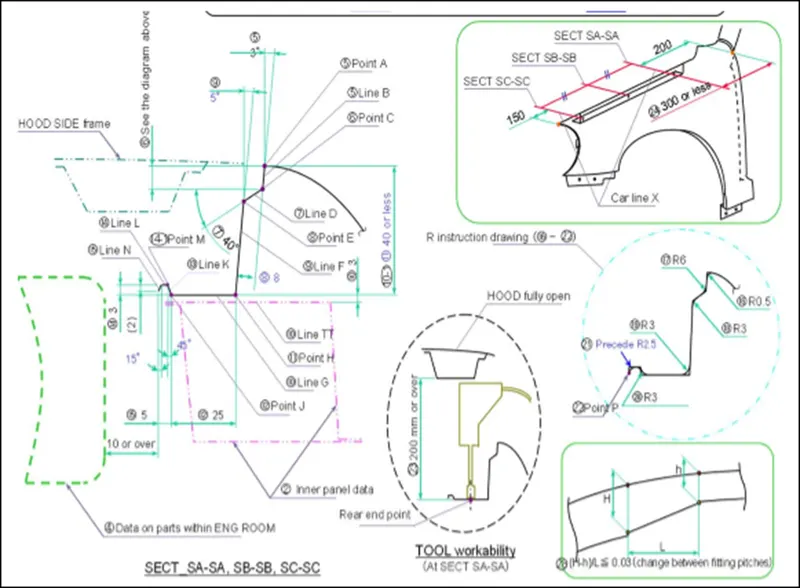
DESIGN PARAMETER:-
Manufacturing process:-
The manufacturing of the fender majorly involves these operations.
- Embossing
- Bending
- Cutting and Blanking
Embossing:-
Embossing is a metal forming process for producing raised or sunken designs or relief in sheet material using matched male and female roller dies, theoretically with no change in metal thickness, or by passing sheet or a strip of metal between rolls of the desired pattern.
Bending:-
Metal bending is a process by which metal can be deformed when applying force to the subject, which causes it to bend at an angle and form the anticipated shape, which often results in it being in a ‘V’ or a ‘U’ shape. This is done through the application of force on a work piece. The force on the work piece can be mechanical, pneumatic or hydraulic.
Cutting and Blanking:-
Cutting processes are those in which a piece of sheet metal is separated by applying a great enough shearing force to cause the material to fail.
Blanking is a steel manufacturing process in which a flat, geometric shape is created by feeding a coil of sheet metal into a press and die. In this process, the blank is punched out from the large metal sheet.
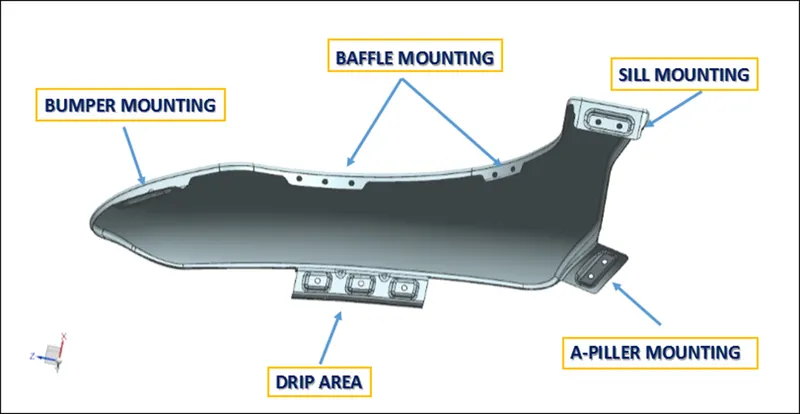
Drip Area:-
The area at which the fender gets attached to the engine housing through fasteners. It is the major mounting for the fender. Mountings at the drip area are designed leaving a clearance of 200mm from the back of the fender for the cowl setup. And clearance of 150mm from the front of the fender for a headlamp housing unit.
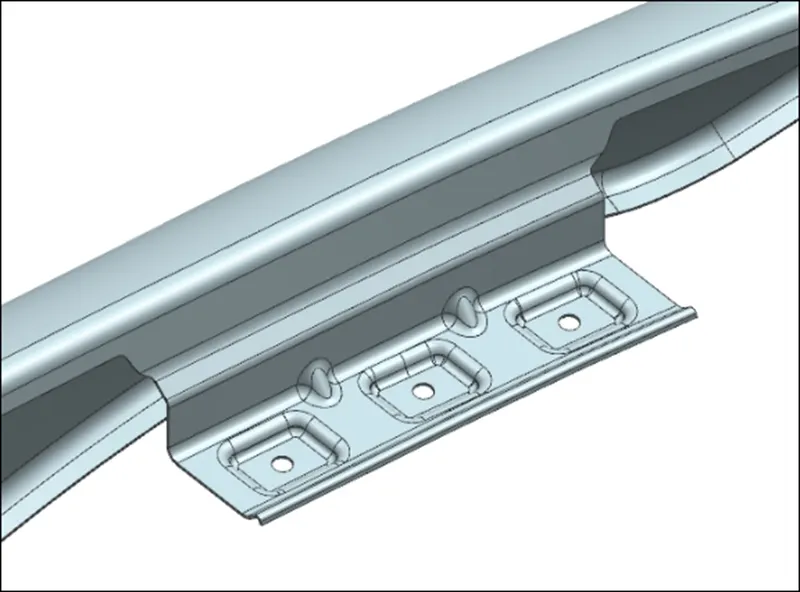
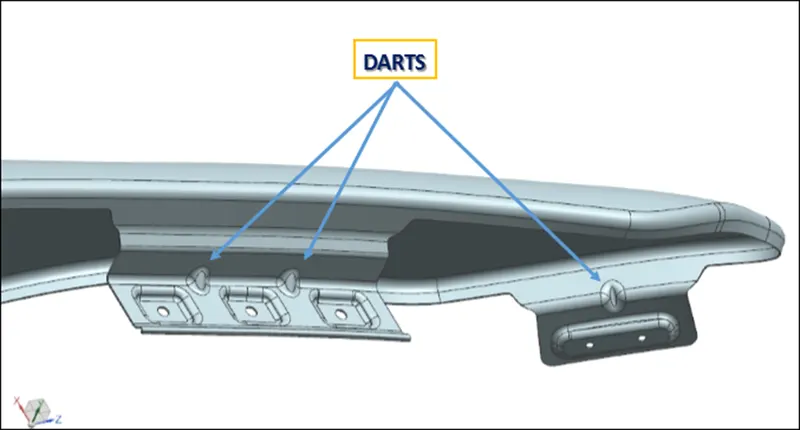
Darts are provided at the bends to stiffen the sheet metal at that region.
A-Pillar Mounting Area:-
This Mounting region is located near the cowl of the vehicle where the fender is fastened with the bottom edge of the windshield. This mounting is covered with the side rear-view mirror.
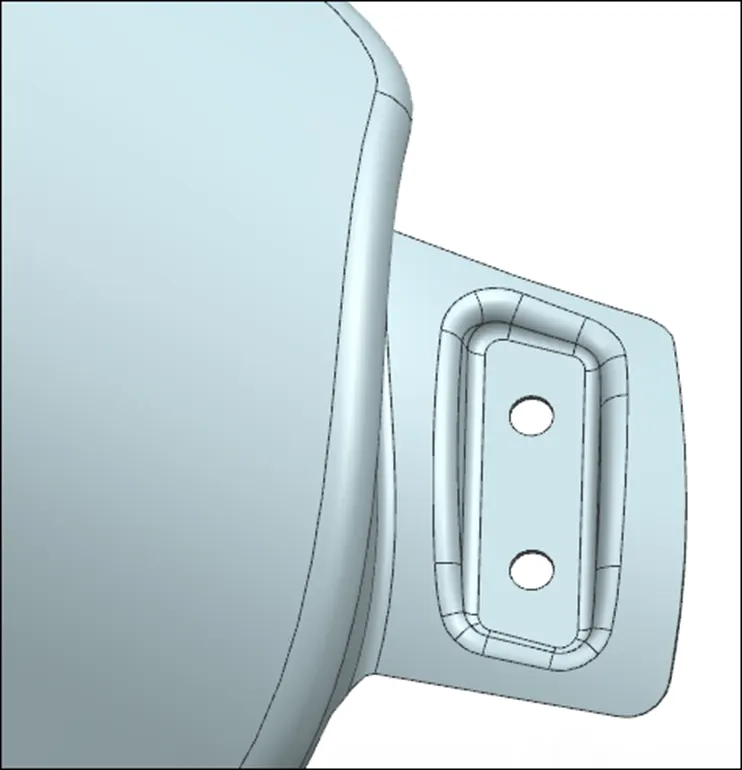
Sill Mounting Area:-
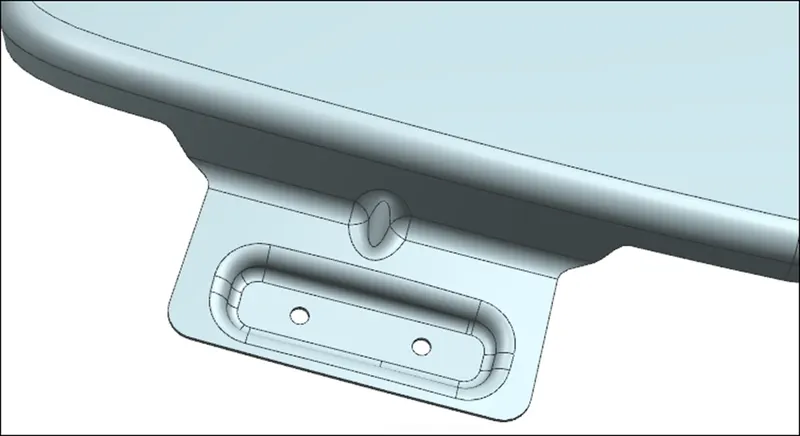
The area at which the bottom of the fender gets connected to the floor near the bottom edge of the door. The Embossed sill mounting of the fender is attached with the fasteners.
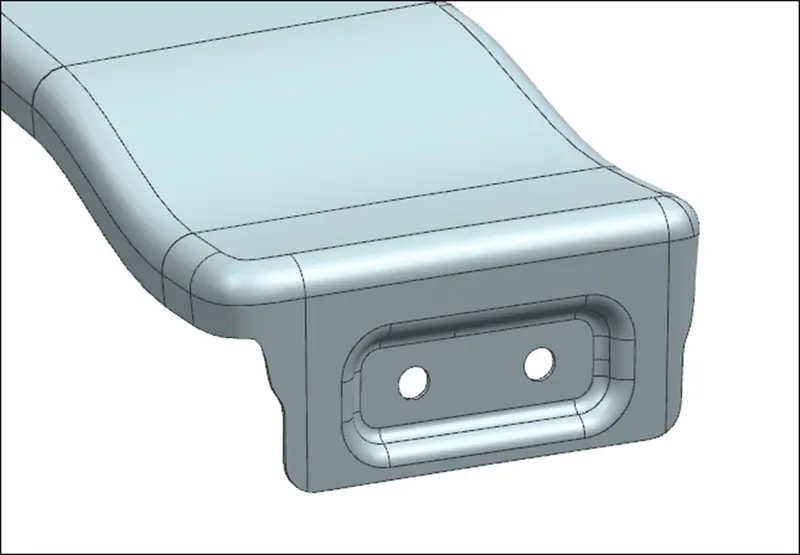
Bumper Mounting Area:-
The bumper mounting region is located beneath the bumper. The fender gets attached before the installation of the bumper. After fixing the fender with fasteners the bumper will cover the bumper mounting.
Baffle Mounting Area:-
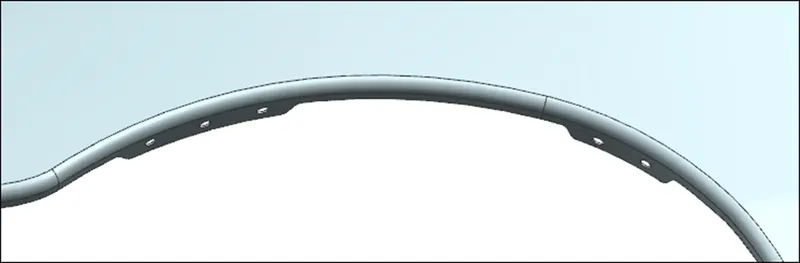
In this region, the baffle gets installed to the fender with the help of clips which holds the baffle with the fender along the wheel arch.
Conclusion:-
The Fender is designed with the necessary mounting points considering the design parameters.