Design of backdoor
BAck Door Design
Santhosh sivan. G
Introduction
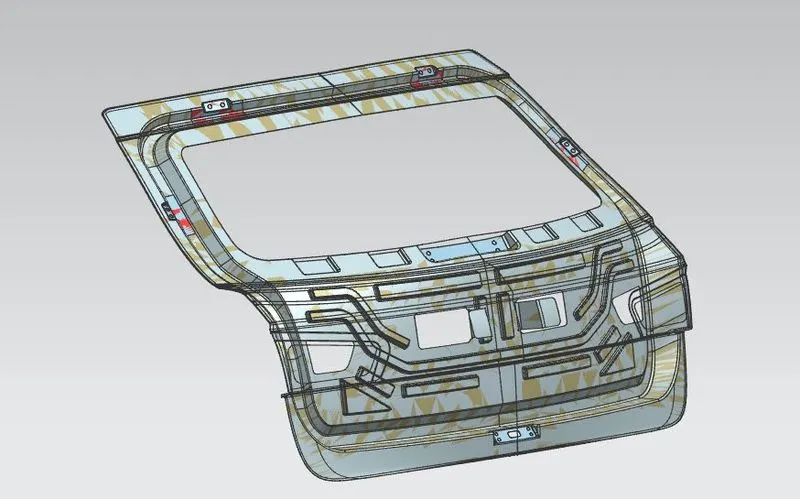
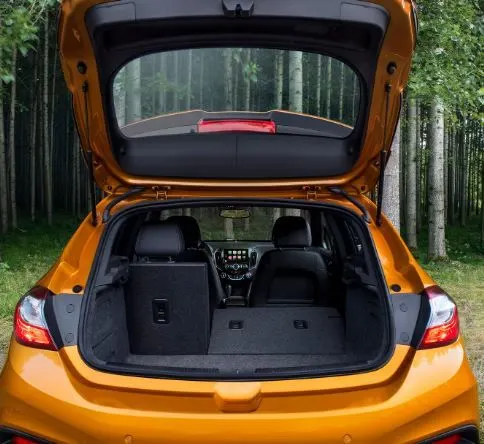
The Back Door of a car is the rearmost part of the vehicle which gives access to the trunk space of the vehicle. The rear door also supports the reinforcements and added weights of the Wiper Motor, Gas Stay, Tail Lamp, and Latch and Striker.
The Backdoor/tailgate is one of the closure commodities in BIW sheet metal design. The backdoor has a lot of components inside and is designed to incorporate them easily. It affects the rear visibility and luggage area.
The material used for door manufacturing depends on the budget and performance of the vehicle. Mostly Aluminum and Steel will be used whereas low-budget vehicles use Steel which makes the manufacturing process easy and cost-efficient since it follows the Stamping of Molds. The backdoor consists of some basic components as following below.
- Back door Outer panel (Upper portion)
- Back door Outer panel (Lower portion)
- Hinge Reinforcement
- Wiper motor reinforcement
- Hinge and striker reinforcement
This are some basic components in back door
BAck Door Design
Santhosh sivan. G
Introduction
The Back Door of a car is the rearmost part of the vehicle which gives access to the trunk space of the vehicle. The rear door also supports the reinforcements and added weights of the Wiper Motor, Gas Stay, Tail Lamp, and Latch and Striker.
The Backdoor/tailgate is one of the closure commodities in BIW sheet metal design. The backdoor has a lot of components inside and is designed to incorporate them easily. It affects the rear visibility and luggage area.
The material used for door manufacturing depends on the budget and performance of the vehicle. Mostly Aluminum and Steel will be used whereas low-budget vehicles use Steel which makes the manufacturing process easy and cost-efficient since it follows the Stamping of Molds. The backdoor consists of some basic components as following below.
- Back door Outer panel (Upper portion)
- Back door Outer panel (Lower portion)
- Hinge Reinforcement
- Wiper motor reinforcement
- Hinge and striker reinforcement
This are some basic components in back door
Operation for creation Back door as following below:
For Back door Inner panel:
- Wave geometry linker
- Offset surface
- Curve on face
- Sketch
- Law extension
- Thru curve mesh
- Trim sheet
- Extend sheet
- Face bend
- Mirror geometry
- Sew
- Thicken
For Back door outer panel (upper portion):
- Wave geometry linker
- Offset curve on face
- Trim sheet
- Bridge curve
- Through curve mesh
- Swept
- Sew
- Mirror geometry
- Thicken
For Back door outer panel (Inner portion):
- Wake geometry linker
- Offset curve on face
- Offset surface
- Swept
- Trim sheet
- Sew
- Thicken
- Mirror geometry
For Hinge reinforcement:
- Wave geometry linker
- Offset surface
- Offset curve on face
- Trim sheet
- Thicken
- Bridge curve
This are some common operations for creation back door in UG NX 12.
Tooling direction:
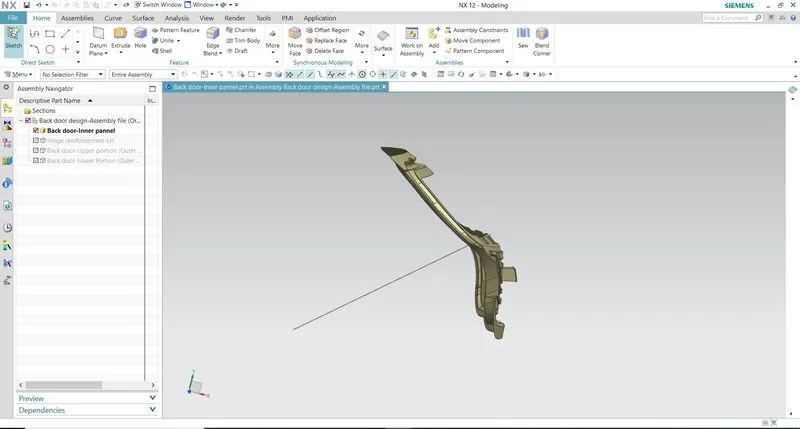
Before starting to design we should create tooling direction then the inner panel of the back door for Deep Drawing purpose should be created. After that the styling surface needs to be checked and analyzed since it might have irregularities, hence it must be fixed first. Then the back door was designed using the top-down approach.
Inner Panel:
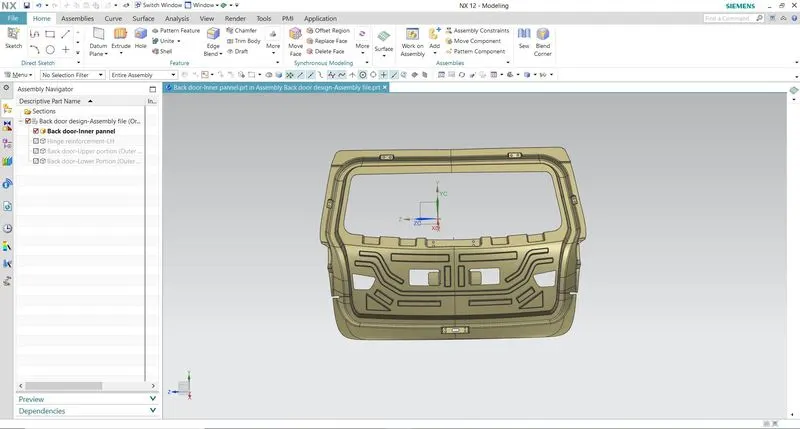
Inner panel, is the inner part of the door. It is where most of the reinforcements and components are mounted like wiper motor, gas stay, hinge, etc. It is manufactured either by aluminum or sheet steel. Thickness of inner panel is 0.75 mm.
After creating the tooling direction, the design of the inner panel will begin. where we will first develop an effective sealing flange by checking all the boundaries and by following the shape of the inner panel design. Creating multiple flanges and the design of the inner panel. After that create the inner panel, then the child components like a hinge, latch, gas-stay locations, and their reinforcements must be designed. Which completes the overall design of the back door. The embosses were created in ‘V-Shape or Y-Shape’ so that if the vehicle undergoes the crash, then the force dissipates over it which reduces the damage transferred to the trunk space.
Back door outer panel:
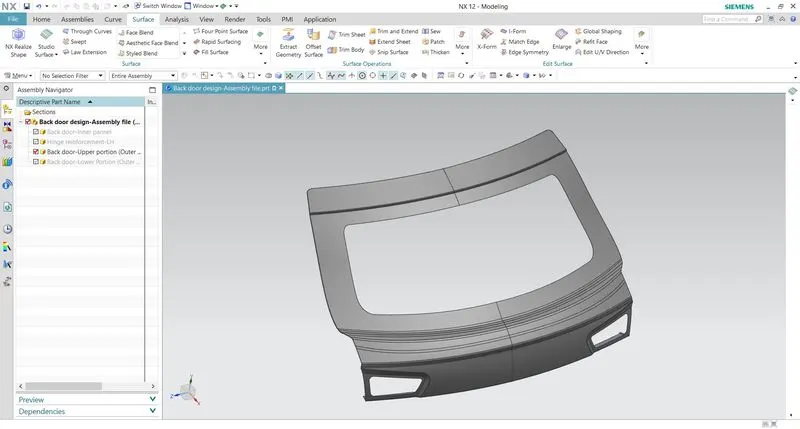
The outer part of the rear door and is mostly responsible for aesthetics of the vehicle. Outer and inner panels are connected by mastic sealants in center and by hemming process at edges. The outer door handle and in some cases, the number plate may also be installed on the outer panel of the back door. We have considered a 2-part outer panel for our design, outer upper panel and outer lower panel. Outer panel is manufacture by stamping sheet metal. Thickness for outer panel is 0.75 mm.
Reinforcement:
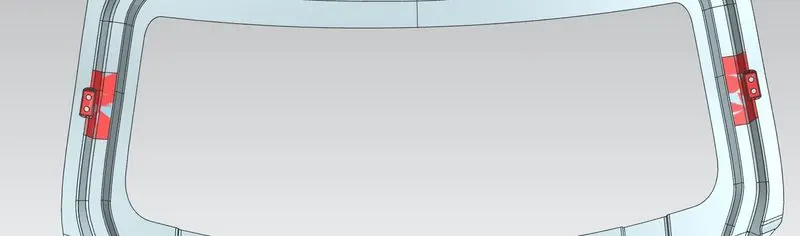
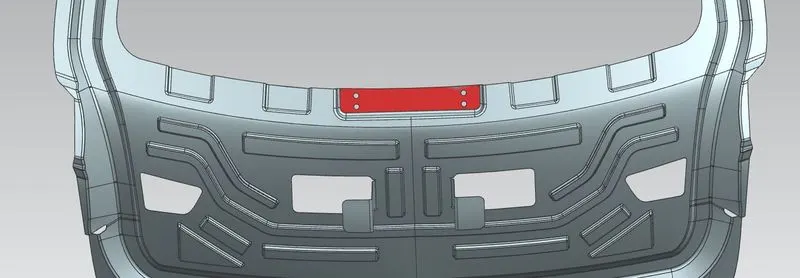
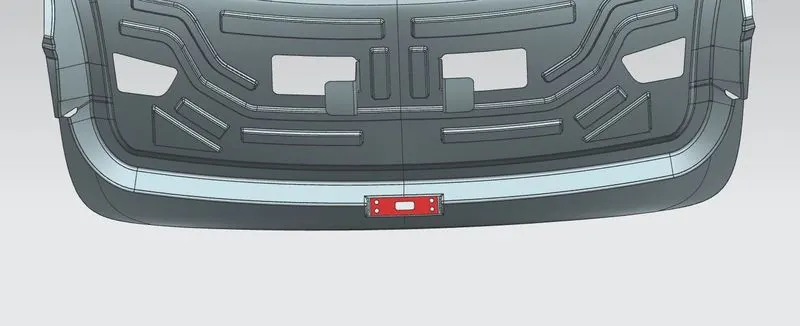
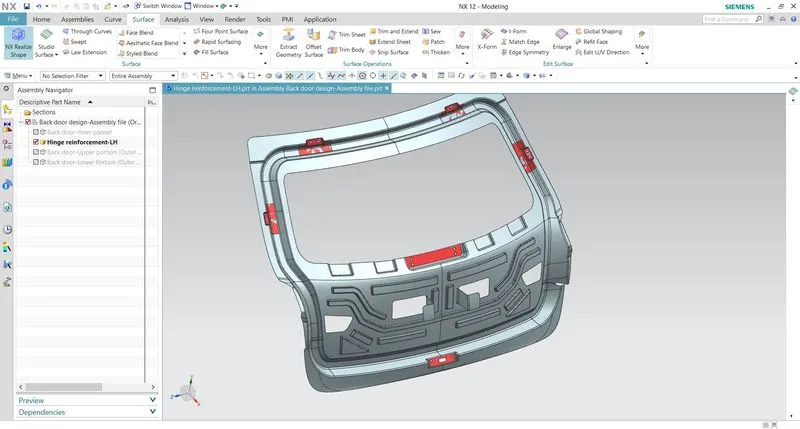
Reinforcements are provided to provide support and add extra material to the sheet metal part to increase its strength near component installation areas and minimize the impact while collisions. We have considered following reinforcements during our design. The reinforcements maybe manufactured by stamping. Thickness of all reinforcements is 1.5 mm.

Operation for creation Back door:
Wave geometry linker:
You can create, associative or linked copies of any entity of a part into other parts. It may be a surface, edge, curve, body, sketch etc. The changes made to the original model it will be reflected in the copy of the model.
Offset surface:
You can offset the surface of particular distance
Offset curve on face:
This command will allow you to offset particular edge or a cure on selected face
Trim sheet:
It will allow you to remove or modify your surface by select the sketch or projected curves
Bridge curve:
It will help to create a tangent curve between to selective edges
Law Extension:
It means to create a surface in desire angel and length by selecting cure or edges in the face
Face blend:
It will help to remove corners by filleting
Extend sheet:
It will allow you to extend the created surface of particular distance by selecting sheet edge or a curve
Sew:
It will combine two entities (Two surface or sheet) by single entities (single surface)
Thicken:
This is most common used in NX. It will convert sheet into solid body by giving value. It will used after completing the design
Mirror Geometry:
Which means to create a selected surface in selected plane
Swept:
It will create a body by sweeping one or more curve and guide curves
Design Methodology:
S tart with the styling surface that is provided to us, and consider top-down approach for assembly modeling. First, we should create the assembly and then create the components like inner panel, outer panel and reinforcement in assembly file itself. Inner and outer panel are the largest parts and all other parts depend on them. So now we start with inner panel. Before creating assembly file, we need to create or modify our styling surface. We have 2 parts for outer panel, one is outer upper portion and another one is outer lower panel and we can create reinforcement separately. They will be spot welded with each other. Inner and outer panels are connected by hemming process so we can come back to outer panel and do that that after completion of inner panel.
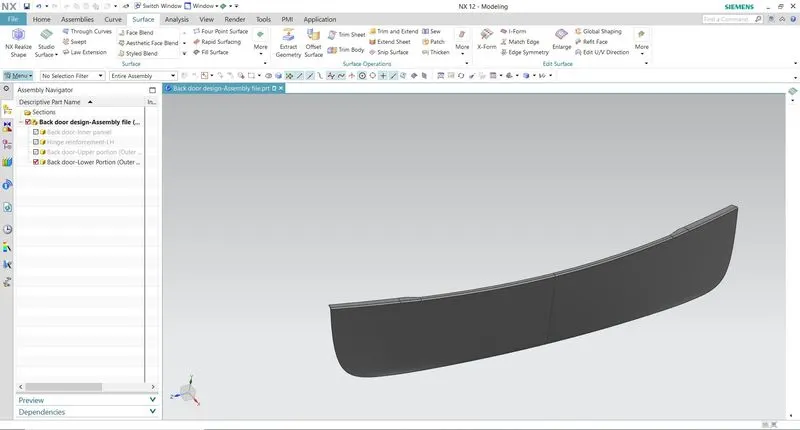
After creating outer panel, now, we need to create inner panel, as we know inner panel is at a particular distance from outer panel, so we offset the outer panel surface at particular distance and design inner. Inner panel is important why because all mountings like wiper, glass, etc will be done on inner panel only. Before starting inner panel, we need to define the tooling direction as a reference for manufacturing. Then we design the inner panel. While designing the inner panel we need to consider various factors like the mounting point positions, mastic sealant application positions. As the bottom center part of inner panel is not connected to outer panel, we need to create a surface that comes out and connects to outer panel. This part will be connected to outer panel using mastic sealant. Also, the hinge embosses must be taken by considering proper directions. The emboss surface must be parallel to z-axis to get proper geometry for the latch striker path curve. Then we draw a line connecting the hinges, such that it forms the hinge axis (axis around which the door rotates while opening or closing). Then we can draw a circle with center at the hinge axis and circumference passing somewhere around the emboss endcap. As the inner and outer panel are connected by hemming, we can complete the hemming after completion of inner panel. Now, as major parts are reinforcement. After creating inner and outer panel we should create a surface with help of wave geometry linker. After that, with help of offset surface, offset curve on surface, trim sheet and thicken we can design the reinforcement. Finally thicken and sew it.
Draft Analysis:
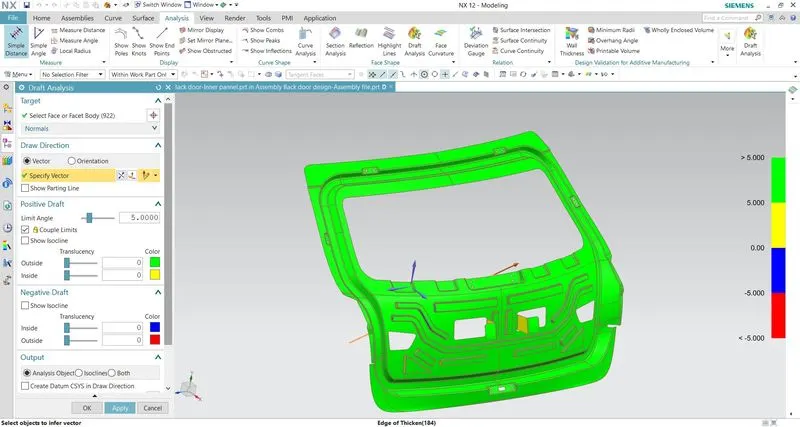
Draft analysis means is to make sure the drawing of inner panel body is proper. We need to define the drawing direction and select the inner panel body. The limit angle as 5 degrees. The result of the draft analysis is as follows below.
Conclusion:
Back door as created with help of given stylish surface in UG NX 12. All given parameters are ok as per design regulations.