Design of backdoor
BACK DOOR DESIGN
Aim:
To design the Back Door of a Car ( Tail Gate) with the provided styling surface using appropriate design methodologies and provide the necessary reinforcements and embosses by using Siemens NX CAD.
Back Door :
The back door panel, the d-pillar, is the outermost component of the car and a part of the 5-door hatch. The design is made up is for a tailgate a coin termed for the back door assembly for SUVs' and hatchbacks. Interior of it is the car speakers, luggage housing facilities etc while the car exterior has the tail lights, indicator lights, registration plates, gas stay and the rear windshield.
Pic.1
Types of the Back door :
The door or opening of a cargo area may be hinged at the top, side. bottom. If the door Hinged in the bottom it is called as a tailgate.
Based on working position it can be classified as
- Top Mounted
- Side Mounted
- Bottom Mounted
Top Mounted
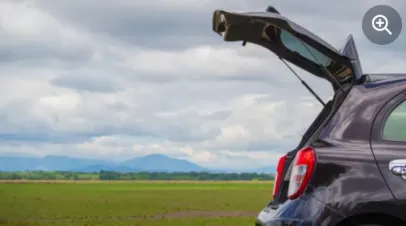
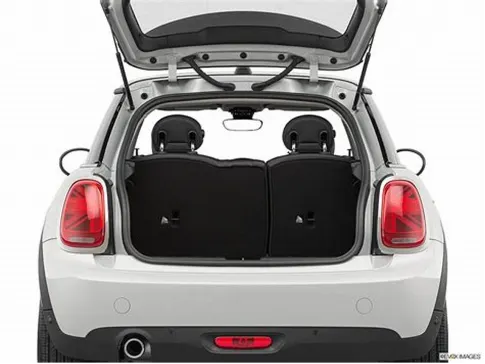
This type of back doors is used in a station wagon, pickup truck and same of the sport utility vehicles.Today's modern cars use top-mounted tallgating systems which are both pouvered and also gas stay supported These top mounted tailgates provide greater eye visibility compared to side-mounted or bar doors which have center pillars in it.
Pic.2
Side Mounted
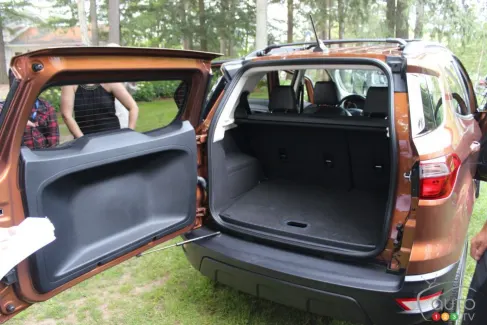
As the name signifies side-mounted doors are the one which is used in the van type: MPV, SUVs, pickup truck vehicles These side-mounted doors or barn doors are a lot easier compared to top-mounted doors.These doors are generally smaller in size and can be easily accessed. These doors are more convenient for the goods handlers for long pipe and lengthy components where one door is kept open. These doors also save accidental head impacts. It is a lot easier to load and unload items in the side-mounted doors.
Pic.3
Bottom Mounted
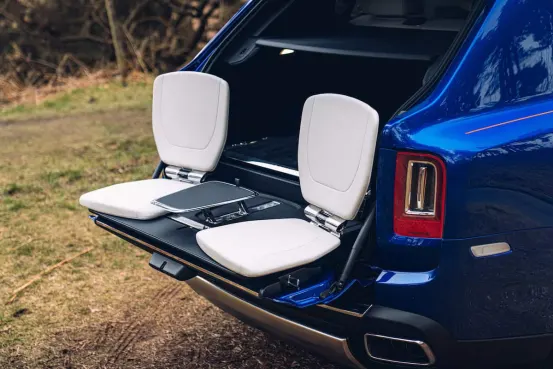
This bottom type or split type backdoor system are used in the car type such as estate type car, pickup trucks and some lury SUVs.These are the most convenient type of back door in which the bottom split is used as a support or even as a table for the tour going people.
Pic.4
Based on working mechanism as
- Gas Stay
- Powered lift type
Gas stay type:
Gas stay type backdoor/liftgate/tailgate is an ideal and most commonly used tailgate mechanism from lower segment car to luxury car segment. The ideal components of tailgate consist of a hinge, door, gas stay and some rubber beadings for sealing of door.
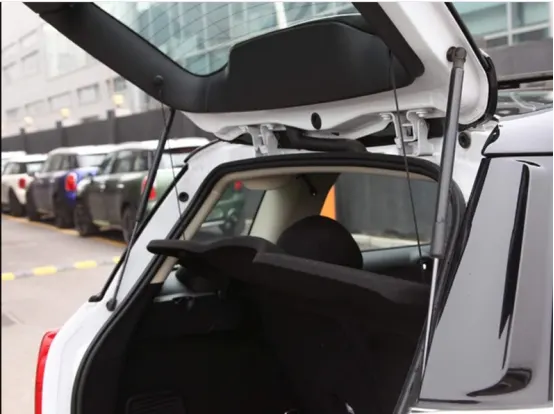
Pic.5
Powered lift type:
Power trunk lid system is another sophisticated way of trunk/liftgate opening mechanism which is to automatically open and close of the trunk/liftgate and release of the latch by the touch of a button. The following image shows the component as used in the powered trunk/back doorlift system.Powered trunk lift system consists of a power latch, anti-pinch switch, PTG assy. PTG main switch. When the switch is pressed in the compartment or outside the power latch releases the latch and the entire backdoor is opened. The anti-pinch switch is located in order to avoid accidental hand insertion during the operation of the door.
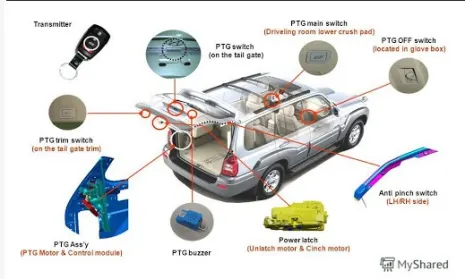
Pic.6
Major Factors to Consider:
- Material selection
- Stiffness and strength and weight of the part
- Rear visibility criteria
- Hinge position
- Latch position
- Distance from the outer panel to mastic points Should maintained in between 4-6 mm
- Drawability ( Minimum 7 degrees open)
- Hemming parameters
- Holes (to drain the primer from the cavities
Material selection
Tail gate BIW is expected to possess a number of significant properties. It must have high tensile strength as well as high stiffness—bending, torsional, static, and dynamic. It must also provide good quality safety both to the car body and to its occupants against crashes of all kinds—front, rear, side, or even rollover, meeting the Federal Motor Vehicle Safety Standard No. 208 [44]. It should also be able to protect occupants from noise, vibration, and/or harshness (NVH) by absorbing or reducing these conditions. Also, it should be easy to weld and form, as well as be highly paintable and easy to design. It should provide a good surface finish that is smooth, and should also be corrosion resistant. Improvement of fuel economy also necessitates the use of lightweight materials in BIW, as it constitutes a significant share of car’s weight; in addition, given environmental concerns in recent times, it is also expected to be recyclable. Given such extensive requirements, only steel and aluminum have been used for making BiW; the former is preferred for its high strength and low cost, while the latter is preferred for its lower density that helps reduce car weight
Here we are assuming Stainless steel as the material for the Designing of Back Door
Stiffness , strength and weight of the part
As the Back door protects the passengers from rear collisions , it should have enough strength and stiffness .Stiffness ,strength and weight of the part depends up on major two factors .The first is the material selection ,which is discussed above and the second one is the Design of the part.
A Design engineer can easily increase and reduce the stiffness of the part through his or her designs. The methods of increasing stiffness and strength of the parts are adding Embosses in the models.
Embossing
Sheet metal embossing is a stamping process for producing raised or sunken designs or relief in sheet metal. This process can be made by means of matched male and female roller dies, or by passing sheet or a strip of metal between rolls of the desired pattern .Adding of embosses to a sheet metal part , drastically increase the strength of the part.
Rear visibility criteria
This criteria deals with the visibility of passengers backwards through the rear wind shield glass.it mainly depends up on the Wind glass area .Here in this case as we already have a styling surface wind already included the wind shield area we need not to worry about the Rear visibility criteria
Hinge position
Hinges are the part which helps to open the Back Door to the luggage space. One part of the hinge is connected to the inner panel of the Back Door while the other is connected with the Roof
There are a few things to consider while the positioning of hinges i
The surface where the hinges to be mounted must be flat in order to keep the hinge tightly in touch with the inner panel , otherwise it leads to loosening of the nuts and bolts resulting in NVH ( Noise ,Vibration and Harshness)
Reinforcements must be provided on both hinges .Because in sheet metals adding another solid body or a sheet body on it ,will results in decreasing the strength of the part. To overcome this problem Reinforcements are used
The central line or the axis of each hinges must be colinear
Latch position
Placing Latch/striker is on of the major factor to take care of .As a Latch/striker is separate body and itself a reinforcement , there is no need to add extra reinforcements. But like in hinges its compulsory to have a flat surface to mount it.
The striker in the Body and the Latch in the back door must be normal to a trajectory path to have a smooth locking and unlocking .
Distance from the outer panel to mastic points
The Mastic sealant or the Mastic point is an elastic compound that behaves like a rubber. The mastic points are defined on the hood inner panel where the hood can easily deform. They help the hood outer panel to come back to its original shape after it gets deformed .The distance from mastic points to the outer panel must be 2-8 mm
Hemming parameters
Hemming is a sheet metal forming process in which sheets are joined by bending it usually to 180°. Automotive body panels and automotive parts such as deck-lids, trunk-lids, doors, hoods and tailgates are formed by hemming process.
While hemming the gap between two sheet metals must be in between .2 to .5 mm and the distance bend of the outer sheet metal to the edge of the inner sheet metal must be 2 mm.
Drawability (Draft Analysis)
To understand what is drawability , first we should know what is deep drawing
Deep drawing
Deep drawing is a sheet metal forming process in which a sheet metal blank is radially drawn into a forming die by the mechanical action of a punch. It is thus a shape transformation process with material retention. The process is considered "deep" drawing when the depth of the drawn part exceeds its diameter. This is achieved by redrawing the part through a series of dies. The flange region (sheet metal in the die shoulder area) experiences a radial drawing stress and a tangential compressive stress due to the material retention property. These compressive stresses (hoop stresses) result in flange wrinkles (wrinkles of the first order). Wrinkles can be prevented by using a blank holder, the function of which is to facilitate controlled material flow into the die radius. The feasibility of this deep drawing is called Drawability.
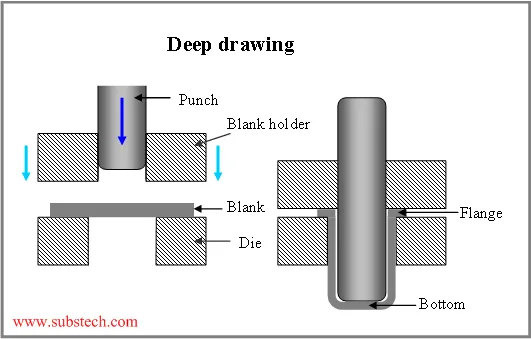
Pic.7
Draft analysis in Siemen NX is one of the tool used to study the deep drawing feasibility easily through checking draft angle in the various faces .The Designer should Define a tooling direction in-order to check the draft angles
Holes (to drain the primer from the cavities)
In the inner side of the Tail gate we can see several holes in the hood. Every holes in it have its purposes. Apart from the holes for the fasteners ,these holes allow e-coating, surface prep, and primer to drain from the cavities in between the tail gate skin and tail gate skeleton after the chassis is dipped into these during production.
Tooling Direction:
Before starting to design the inner panel of the back door the tooling direction for Deep Drawing purposes should be created.
Then the styling surface needs to be checked properly and analyzed since it might have irregularities, hence it must be fixed first.
The back door was designed using a top-down approach.
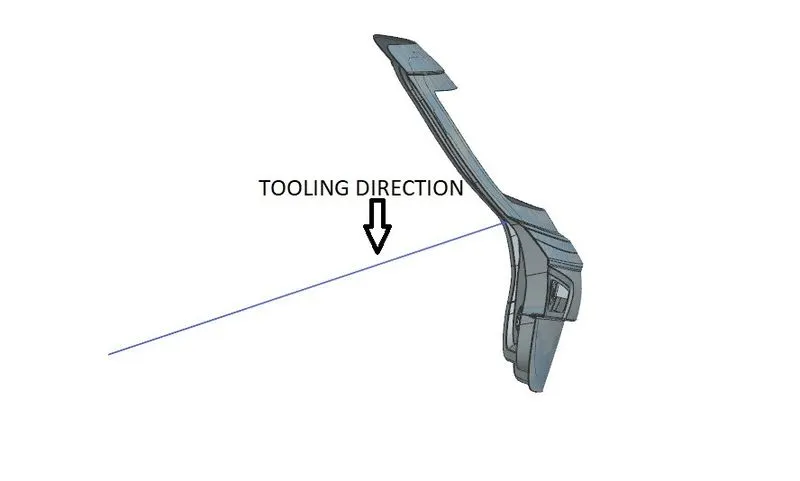
Pic.8
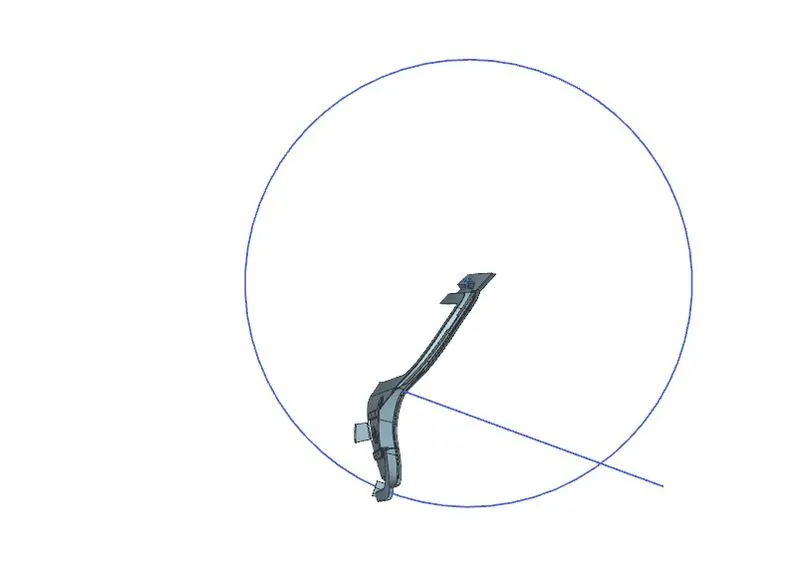
Trajectory:
The position of the hinge should be perpendicular to the latch at the time of latch and striker meets. The circle is drawn from the centre of the hinge axis to find the path of the striker and perpendicular to the path.
Pic.9
Back Door Assembly :
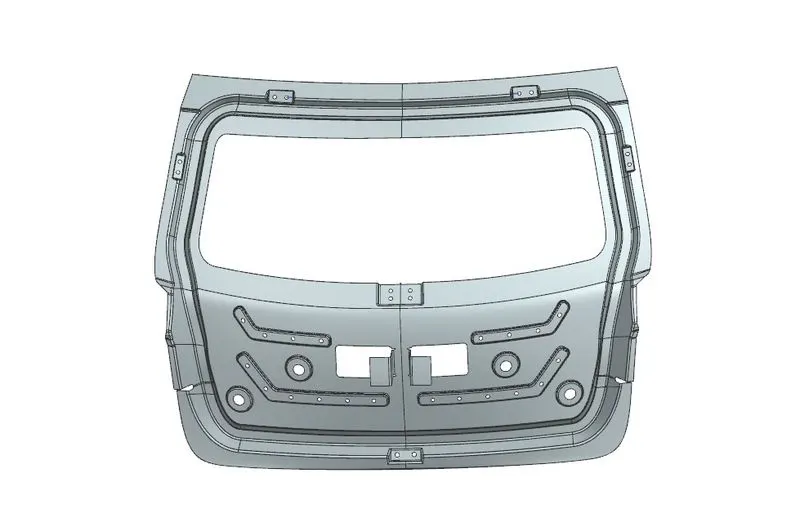
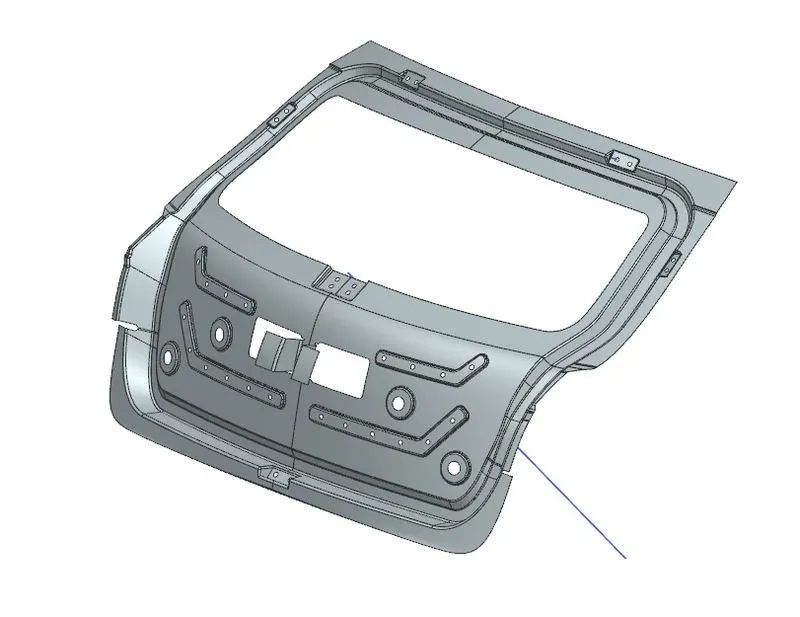
As in general for any BIW fixture rear hatch also has an inner panel and an outer panel. In the inner panel the Hinge reinforcement, Gas stay reinforcement , Wiper motor Reinforcement, Latch striker reinforcment and embosses etc. The inner and outer panels are joined together through a mechanical process called hemming. So in general, there are
- Inner panel
- Outer panel
- Hinge reinforcement
- Gas stay reinforcement
- Wiper reinforcemnt
- Latch striker reinforcement
Inner Panel :
The inner door panel is a component which is used for strengthening the door assembly and it is one of the most important components on which all accessories are mounted like hinges, glass guide channel moulded trim latch etc. The possible method is the integration method. In the integration method, the part is stamped out of a single blank. This reduces the number of tools needed, the assembly cost and eliminates any fit ability problem.
Pic.10
Pic.11
Outer Panel:
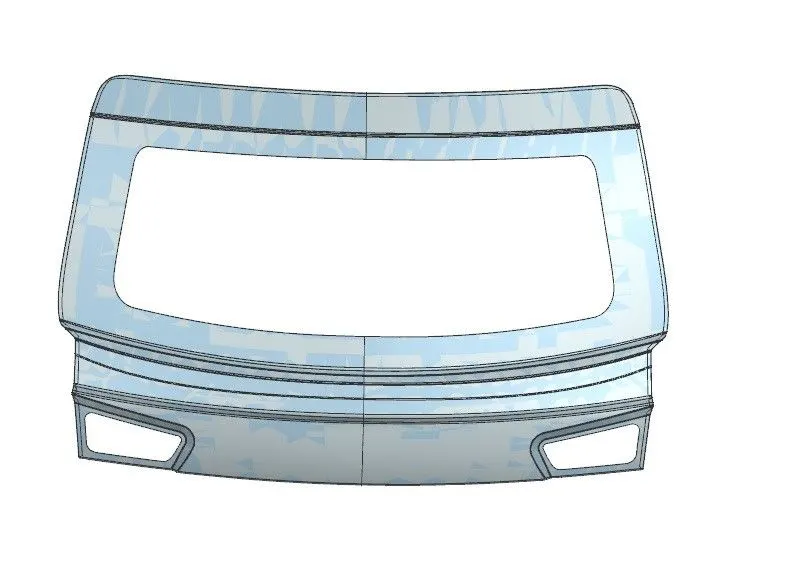
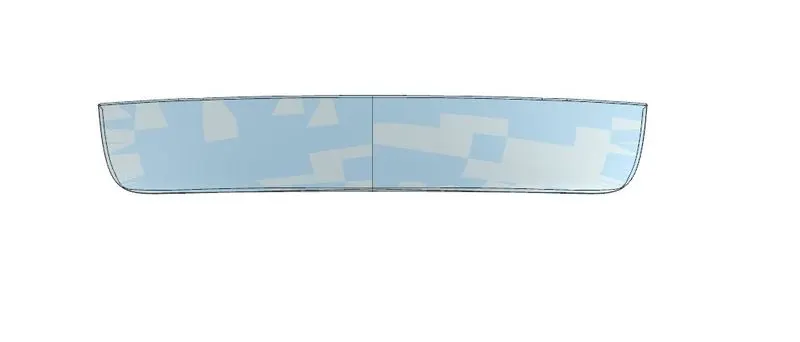
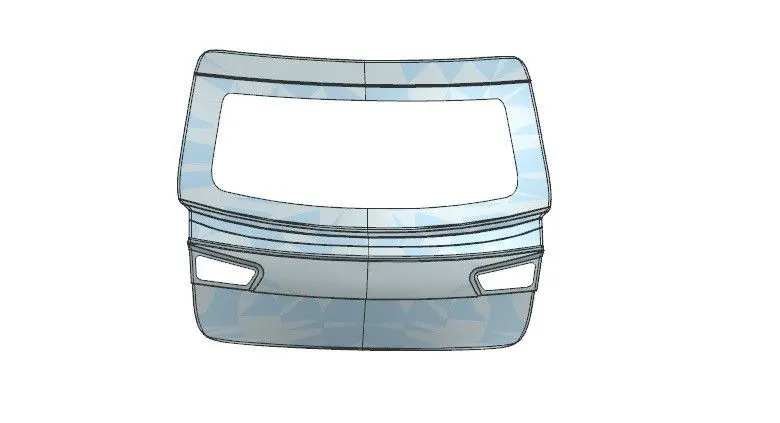
The outer panel of the back door is similar to other BIW components where it is the aesthetic part of a vehicle. The coating provided is of multi-stage which has the property of scratch resistance, rust prevention and smooth and attractive finishes. The outer panel also has the provisions for the tail lamp, rear fog lamp and also has the provision for licence plate mountings. Most of the hatchback cars have the provision for wipermotor.Here Outer panel can be classified in to two parts,that is Outerpanel upper & outerpanel lower.
Pic.12 (Outer Panel Upper)
Pic.13 (Outer Panel Lower)
Pic.14
Reinforcements:
The reinforcement provided is of 4 numbers which consist of hinge reinforcement gas stay reinforcement, wiper motor reinforcement and latch/striker reinforcement.
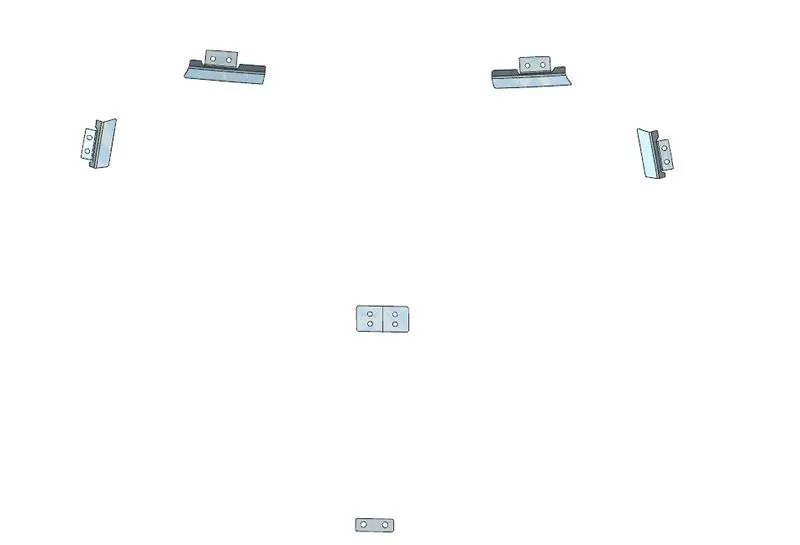
Pic.15
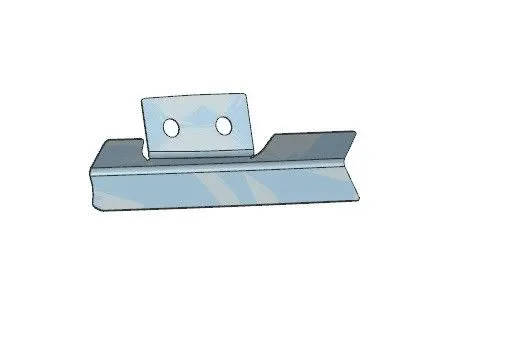
Pic.16 (Hinge Reinforcement)
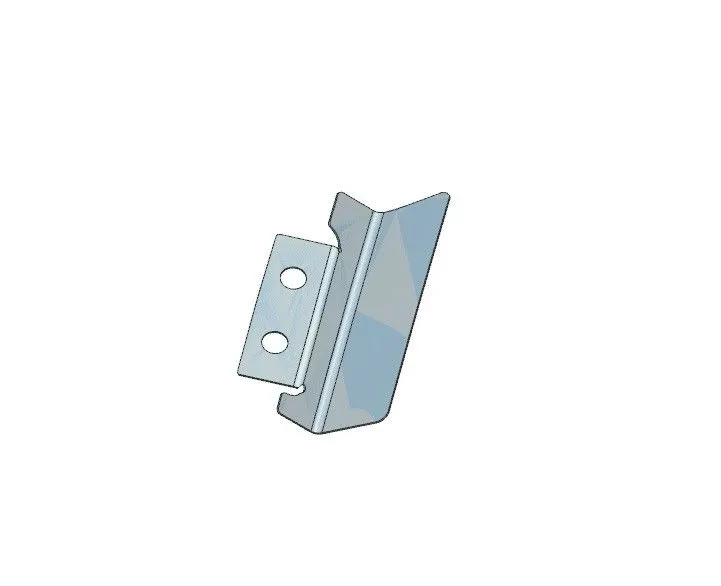
Pic. 17 (Gas stay Reinforcement)
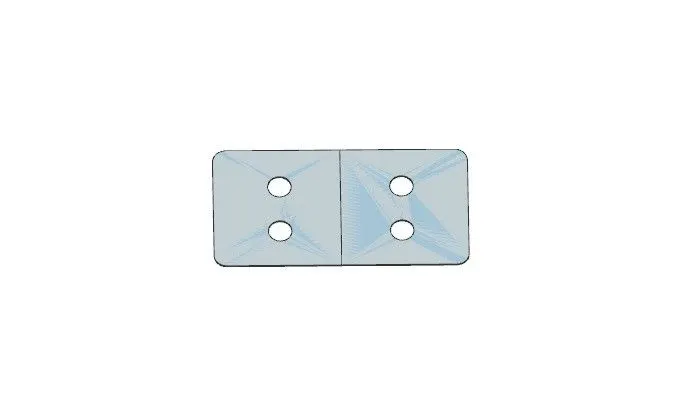
Pic. 18 (Wiper motor Reinforcement)
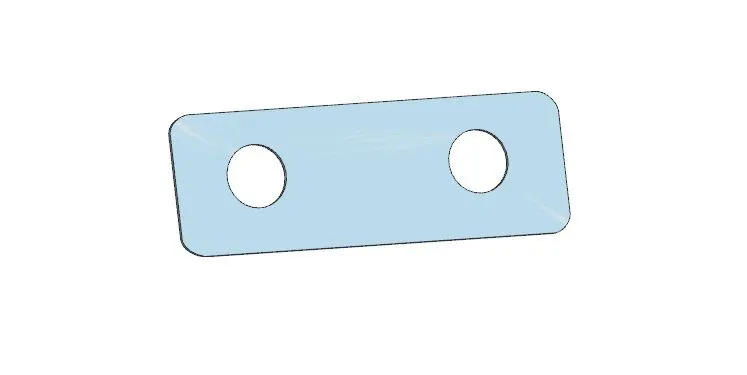
Pic.19 (Latch & Striker Reinforcement)
Manufacturing Methods
Recently, there have been two approaches to reducing automobile weight. One is by using material lighter than steel and the other is by redesigning the steel structure. Although the former seems very effective, it is very expensive so that it may only be used for an expensive automobile. Therefore, the automobile industry is trying to use steel which is not costly and recyclable Lightweight steel can be achieved by improving the performance of the structure or adopting new manufacturing techniques. One of the efforts is the ULSAB (ultra-light steel autobody) concept.
ULSAB suggests three main weight reduction techniques such as hydro-forming and the tailor welded blank (TWB).
Tailor welded blank
A tailor-welded blank is a blank that is comprised of two separate pieces of sheet metal that have been welded together prior to stamping, Tailor welded blanks allow the welding of the different grades, different thickness or different corrosion coatings together in order to give the properties needed in different areas, without increasing the number of tools needed to form the part and eliminating the fit ability concerns. They also allowa high degree of flexibility in designing parts and large blanks can be formed from much smaller sheets. The use of tailor-welded blanks would reduce the weight of the car. Having the ability to selectively place different thickness of material would result in weight reductions. An example of this used in production is the door inner panel. The only strength requirement on a door inner is in the region where the hinges attach to the panel.
Hemming Operation :
Hemming is a mechanical joint design which is used for joining inner and outer closure panels as found indoors, hoods, bonnets and lift gates. To increase crash resistance the gap between the hemmed panels is filled with a high-strength adhesive which also prevents from corrosion.
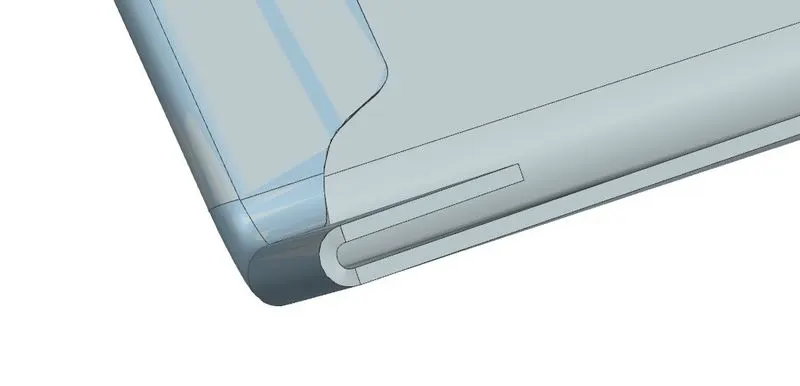
Pic.20
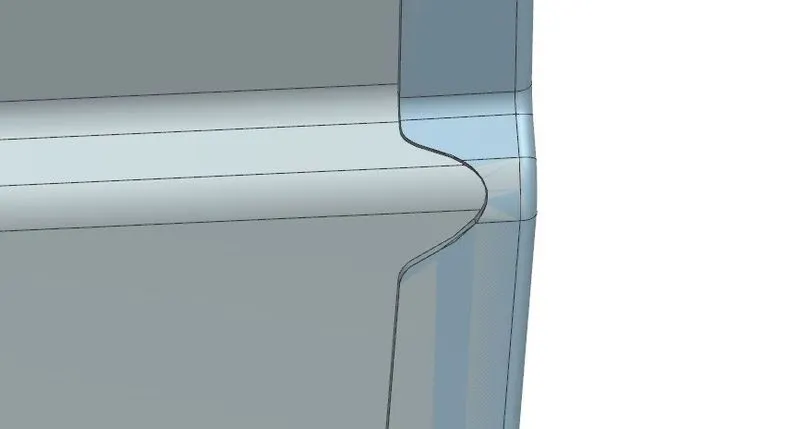
Hemming relief :
Hemming reliefs are cut-outs which are provided on the hemmed corner of the panel assembly which in turn to avoid some of the hemming defects such as wave-like OR wrinkle formed surface
Pic.21
Latch/striker rotation angle:
This rotation angle of the line denotes the line of action of backdoor when hinged to the body of the car.
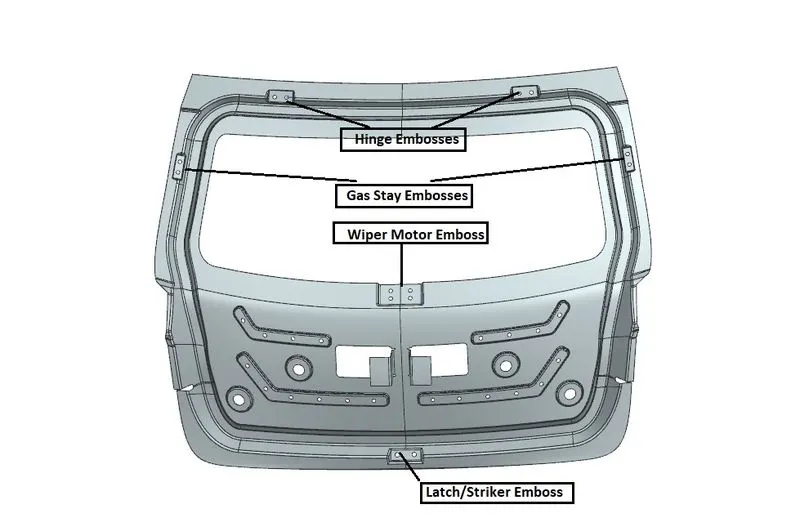
Embosses :
These are the embosses used for the reinforcement of Hinge,Gast stay,Wiper motor and latch/Striker.
Pic.22
Load Case Analysis:
- Bend Test
- Torsion Test
- Abuse cases
- Dent test
- Assembly Load Cases
- Endurance test
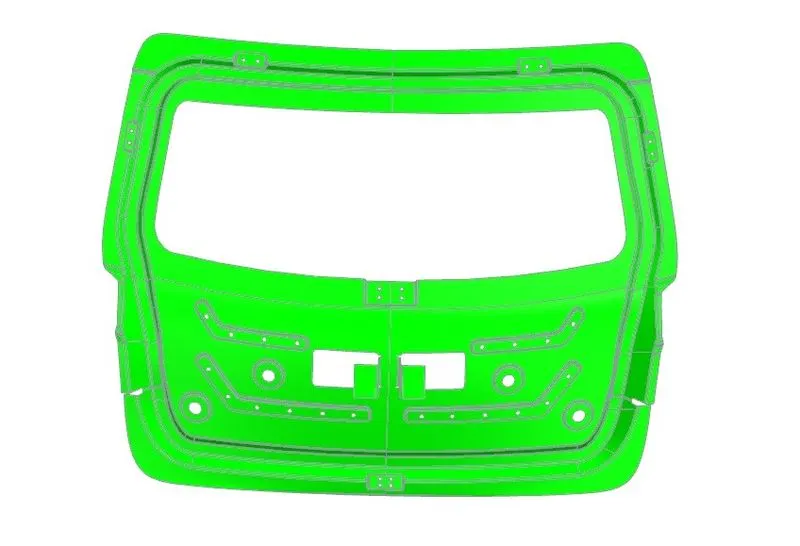
Draft Analysis:
I have created a line for the tooling direction and after draft analysis I could find some embosses with negative draft. But in this case its negligible as all the embosses cannot be deep drawn in a single stretch.
Pic.23
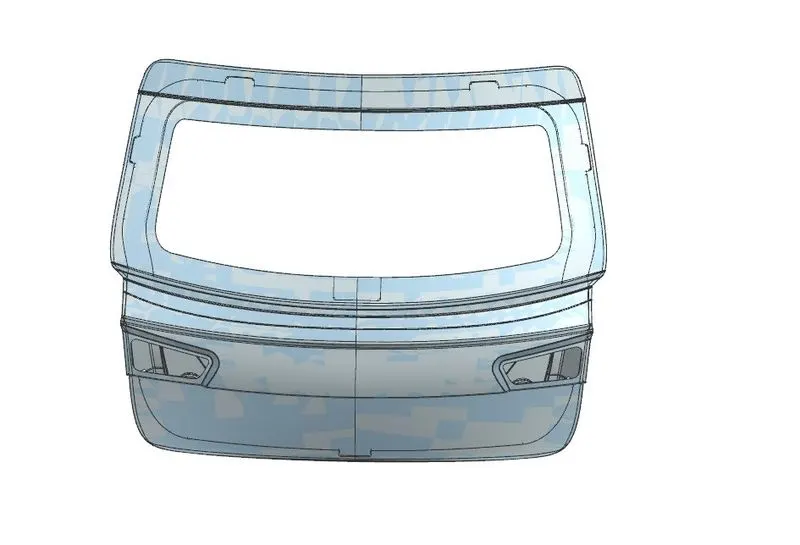
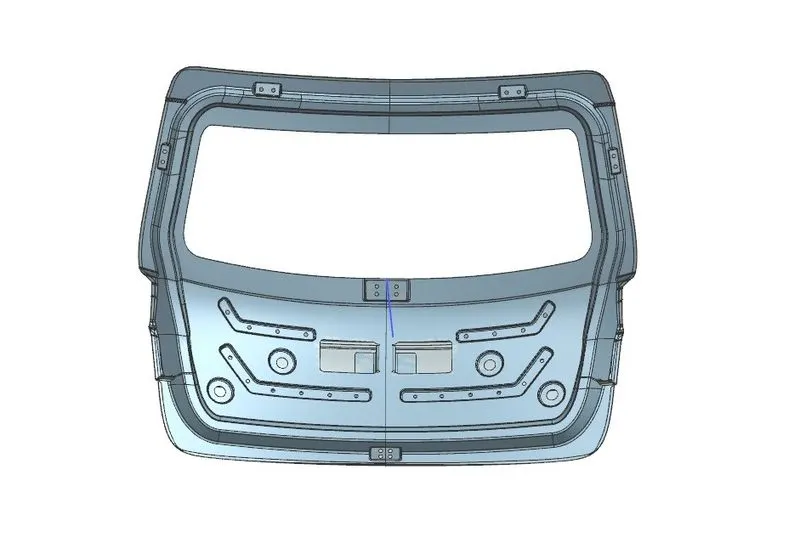
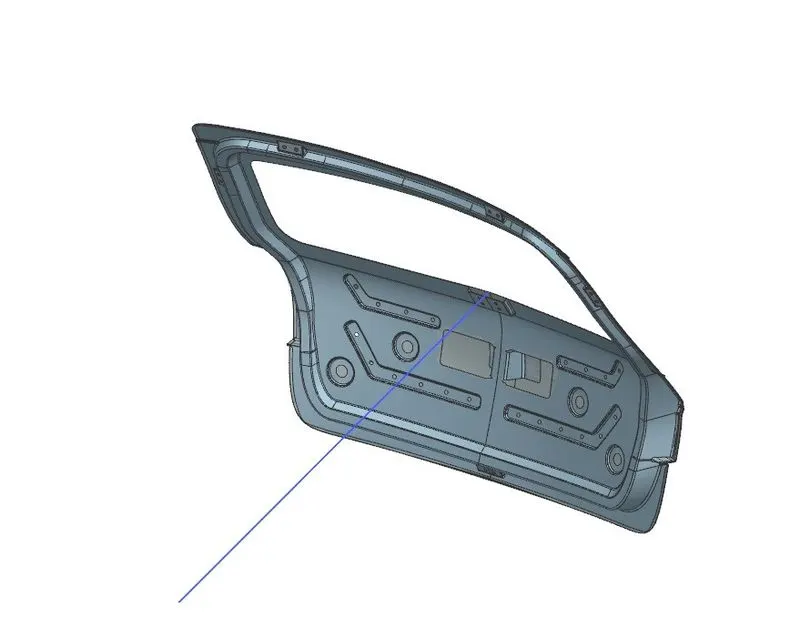
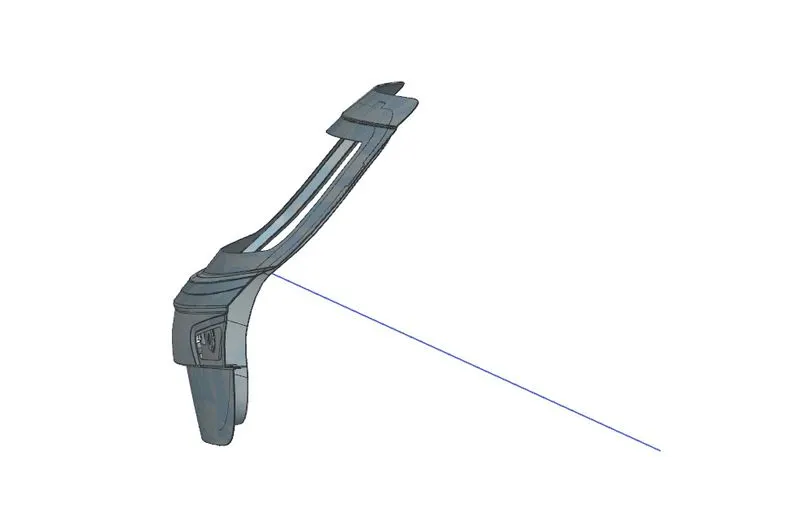
Final Design :
Pic.24
Pic.25
Pic.26
Pic.27
Conclusion:
Therefore,Back door has been designed successfully by following all the design and engineering considerations using Siemens NX CAD.