Design of backdoor
Problem Statement: Design of the Back door with necessary reinforcements and embosses following design methodologies from the given styling surface.
Introduction
Back Door
The door is the hinged part of the vehicle which provides easy access to the vehicle interior components. The back door is one of the types of doors which is situated in the rear end of the vehicle which gives access to the luggage compartments. It also houses components like outer panel, inner panel, hinges, gas stay, wiper motor, striker, and other wiring harnesses.
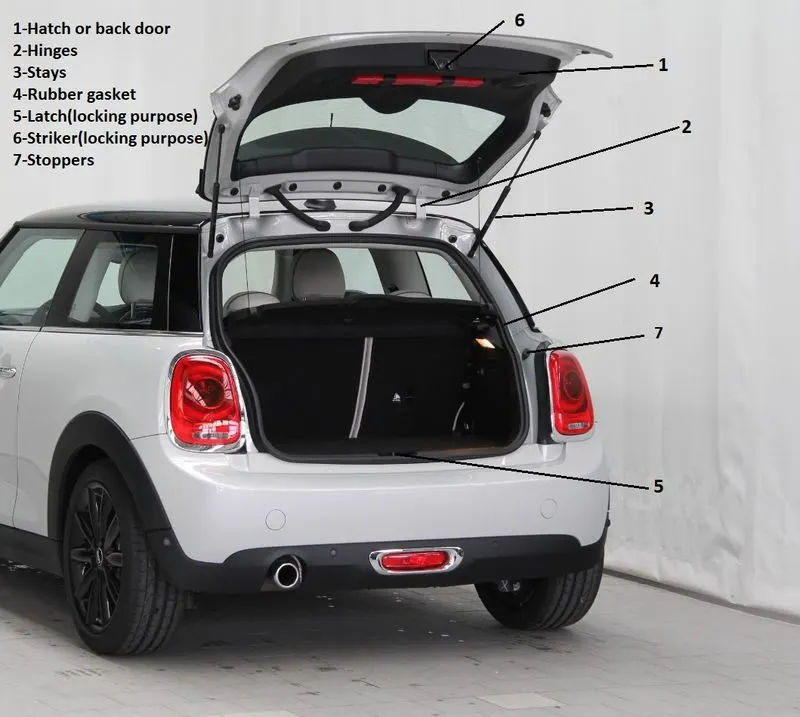
Material
Steel was majorly used in the automotive industry for sheet metal components due to the manufacturability and cost. In recent times the use of Aluminium has increased for sheet metal components.
Advantages of Aluminium over Steel are:
- Lighter in weight
- Thickness can be varied locally.
- Reinforcements are not necessary.
Design Considerations:
The back door design should be such that there should be enough space to accommodate all the mountings and also provide sufficient space for the luggage area.
The design of the inner panel for the back door should be in accordance with the side body panel and roof as the back door comes in contact with the side body panel and roof in its closed position.
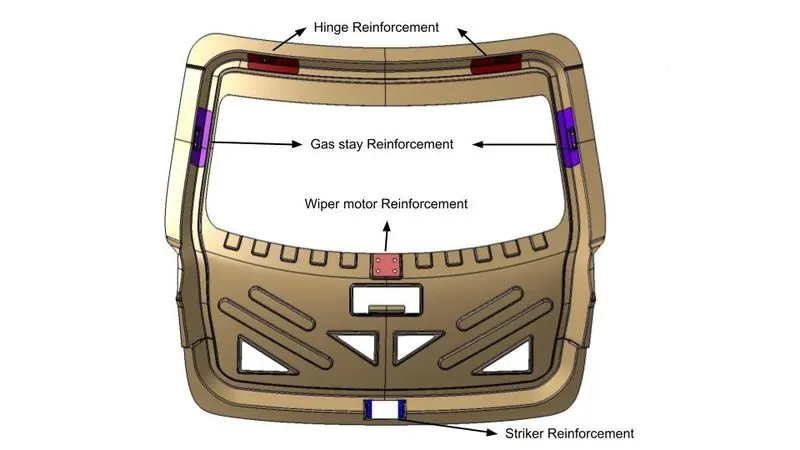
Since there are hinges, gas stay, wiper motor, and striker gets attached to the inner panel sufficient reinforcements should be given locally in order to strengthen the part locally.
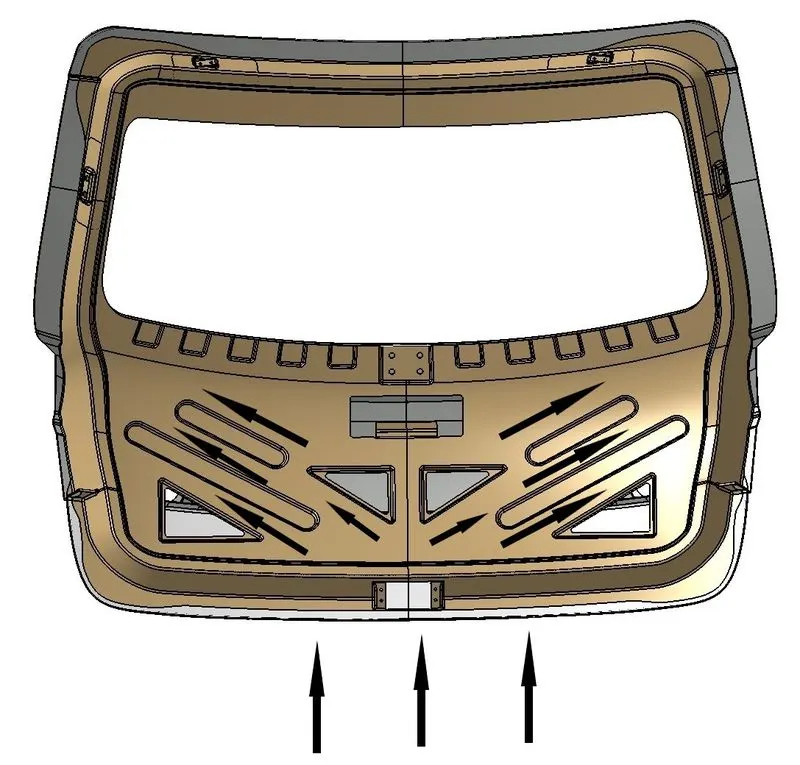
In order to increase the section modulus of the inner panel embosses should be given and the embosses created should be such that when force is acted upon the back door panel it should be directed outwards.
In order to fix the striker position, an axis is drawn connecting both the hinges and from the midpoint, a circle is drawn and the U clamp of the striker is placed such that it is tangent to the trajectory circle.
Sealing Flange:
The sealing flange is part of the back door inner panel where it comes in contact with the weatherstrip which provides leak proof to the luggage compartment.
The design of the sealing flange should be in accordance with the side body panel and roof as the sealing flange rests on the sealant in its closed position.
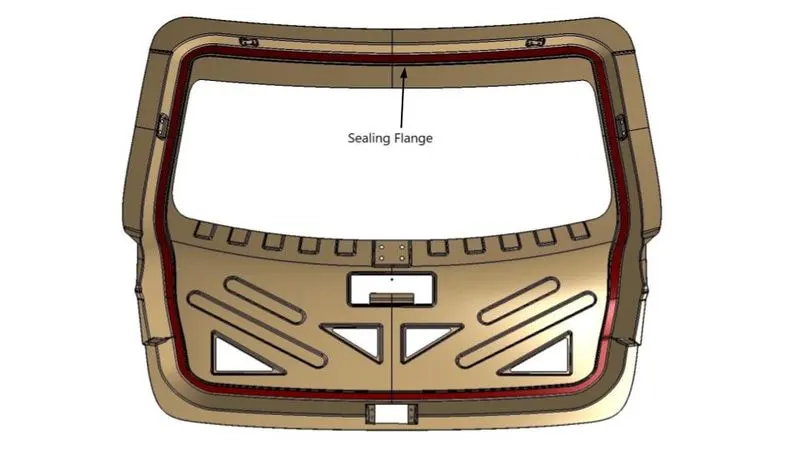
Emboss
Sheet metal embossing is the stamping process to obtain raised or sunken edges for the desired design pattern on the sheet metal. This is done with help of male and female dies between which sheet metal is placed and the dies are pressed against the sheet metal to obtain the designed pattern. In some cases, roller dies are used to get the raised edges in the sheet metal.
Diabolo Emboss is created for the hinge mounting point. This type of embossing is done to reduce the depth of hinge emboss.
Requirements:
1. Seat Surface: The starting surface of the emboss.
2. Base Surface: The surface on which embossing should be done.
Manufacturing considerations for the emboss creation
- The distance between the outer edges of the emboss should be a minimum of 5mm.
- Draft angle should be provided to the emboss with 7`degree` - 9`degree` for the easy removal of the part from the die.
- No sharp corners to be provided in the emboss which would lead to inefficient manufacturing.
- The height of the emboss should not be more than 5mm.
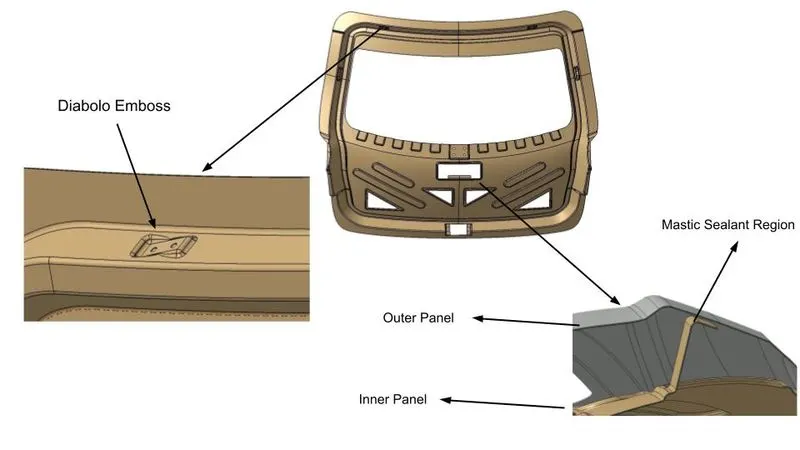
Sealants
Sealants are used to close the gap between two or more substrates. It also acts as a leakproof between the components. It forms a barrier through the physical properties of the sealant itself and by adhesion to the substrate.
Mastic Sealants are used to join one surface to another or protect the area to which it is applied. It has heat-resistant properties and the ability to form a strong bond which is applied using a mastic sealant gun.
Mastic Sealants have an influence area of 80mm diameter.
Reinforcements:
Whenever there is an addition of material to the component there is a loss of strength locally. In this case, the additional material is the striker and hinge where additional reinforcements had to be attached due to loss of strength locally in the attachment areas.
Reinforcement for Striker, Hinge, Gas Stay, and wiper motor.
The thickness of the reinforcements should be in the range of 1-5mm. This parameter can be obtained from the CAE team or with carry over study.
Force Representation
The arrows point in the direction of the force and from the figure it can be observed that the embosses are created such that the force is directed towards the side body panel rather than towards the passenger compartment.
Load Cases
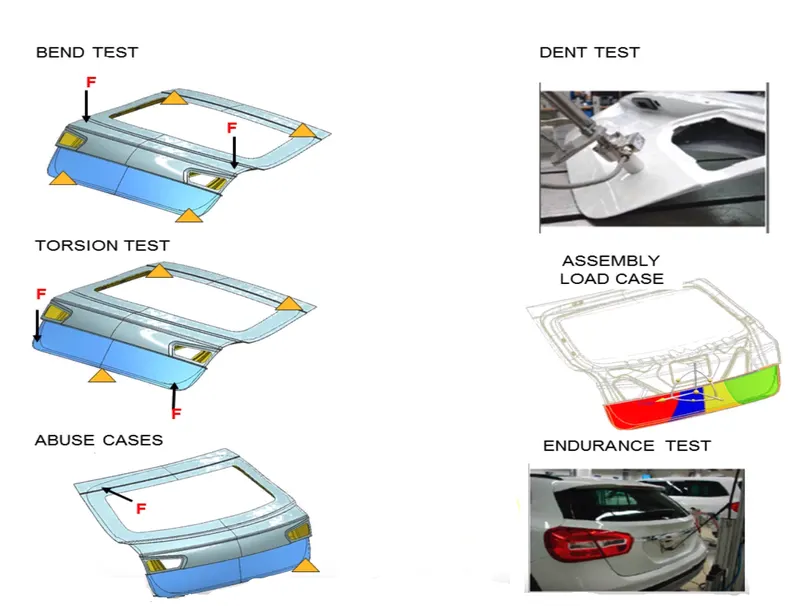
From the above test load-bearing capacity for the inner panel is found out for different situations and then necessary reinforcements and embosses are modified or added if necessary.
Hemming:
Hemming is a technology used in the automotive industry to join inner and outer closure panels together (hoods, doors, tailgates, etc.). It is the process of bending/folding the flange of the outer panel over the inner one. The accuracy of the operation significantly affects the appearance of the car’s outer surfaces and is, therefore, a critical factor in the final quality of a finished vehicle
Different types of hemming methods are
- Die hemming method.
- Table-top hemming method.
- Robotic Roller hemming method.
Types of Hemming:
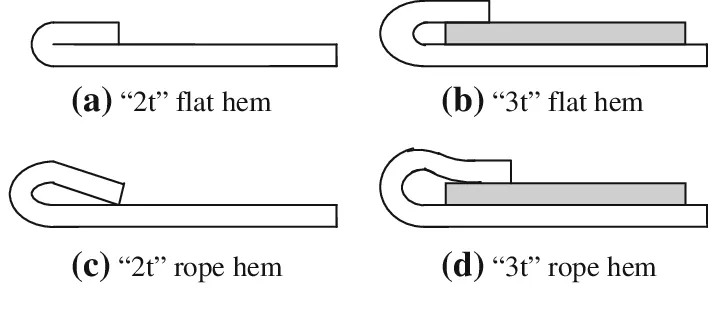
3t flat hem is used to join the outer and inner panel of the hood.
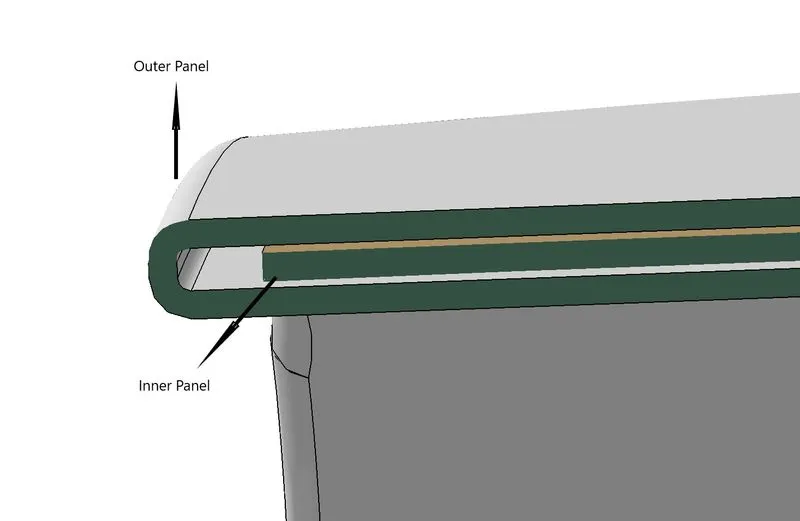
Cross-Sectional View for hemming.
Distance between the outer panel and the inner panel is maintained at 0.2mm for the mastic sealants to attach between them.
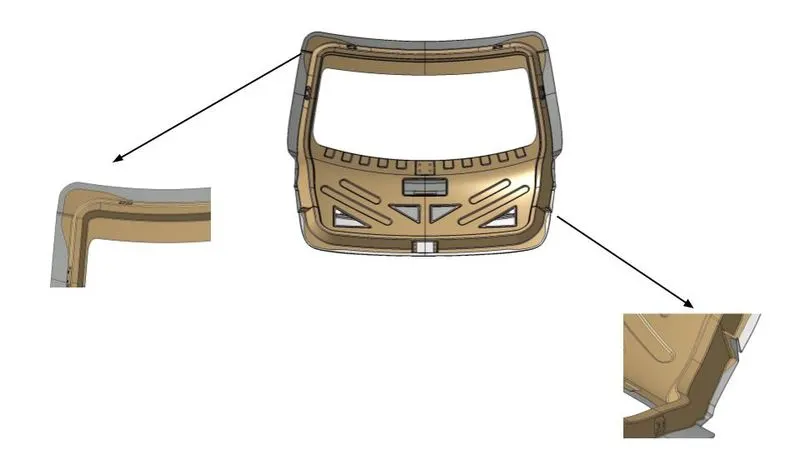
Corner Relief
Corner relief has to be provided for sheet metal bending. In this case, before the hemming process to control the deformation of the sheet metal and to avoid any tear of the sheet metal during bending.
Position of the hinge and Striker.
The hinges should be positioned on the hinge tentatively such that they lie on the same plane. The position of the hinge can also be decided based on the carry-over study.
From the axis of the hinges create a midpoint, from that midpoint draw a circle with a radius from the midpoint to the center of the striker. The circle created is called the trajectory circle. With the trajectory circle, it is to be checked that the striker is tangent to the trajectory circle if not then the position of the hinge should be moved accordingly such that the striker is tangent to the trajectory circle.
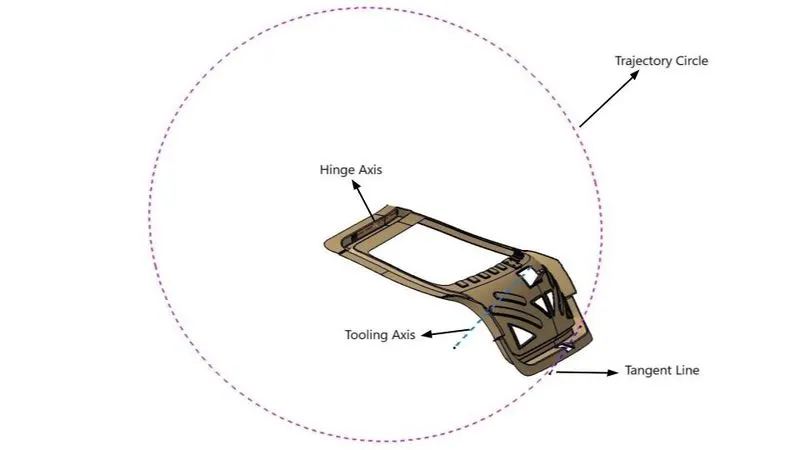
This is done because the latch where the striker strikes and locks the hood is positioned with respect to the trajectory circle. If the striker is not positioned accordingly then there will be difficulty in locking the hood.
Note: For all the closure components the position of the hinge and hinge axis is important and it influences the position and orientation of the striker.
Draft Analysis for the inner panel
Draft Analysis is done for the minimum draft angle i.e., 6 degrees.
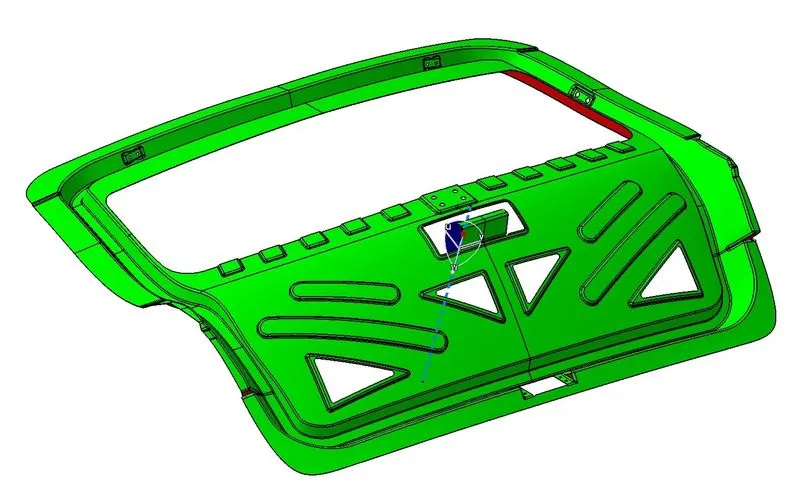
Outer Panel
Top Part:
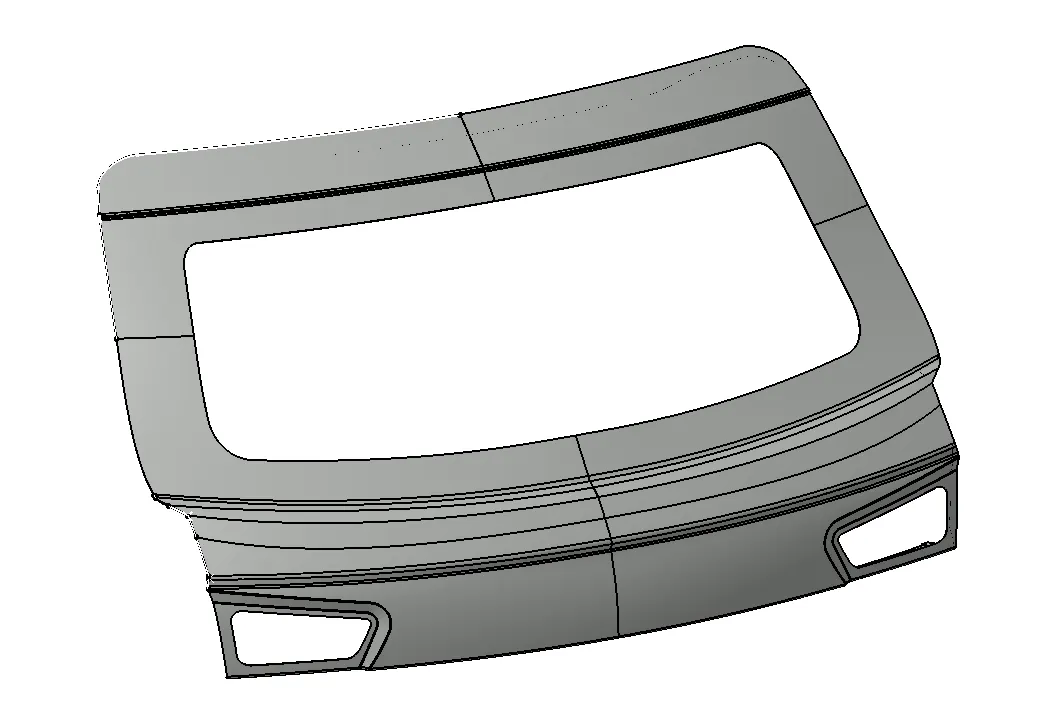
Bottom Part:
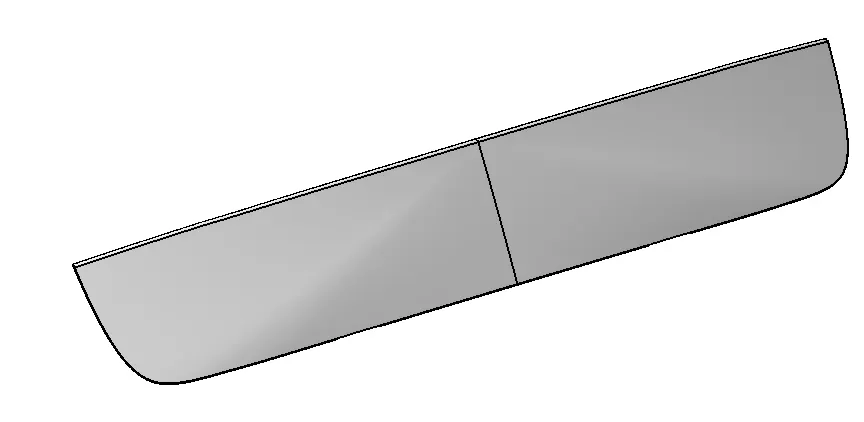
Outer Panel Assembly
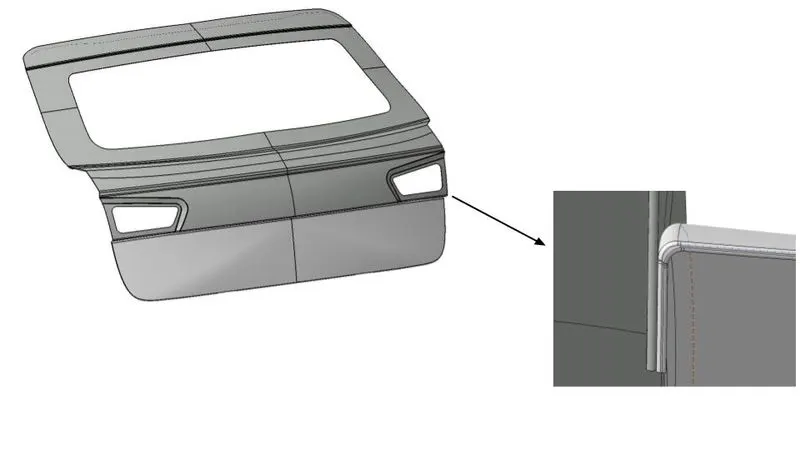
The top and the bottom part are joined using laser brazing.
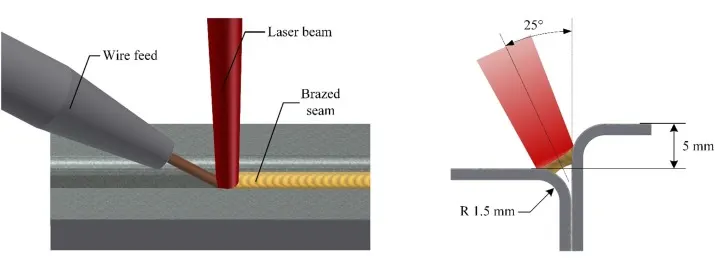
Laser Brazing
Laser Brazing is a joining process for sheet metals where the filler material with a low melting point is melted with a laser beam while the base material with a higher melting point does not melt. In laser brazing, the working temperature is above 450 °C while another process is laser soldering, where the working temperature is below 450 °C. Laser soldering is used especially in the electronics industry in soldering the circuit board.
Back Door Assembly
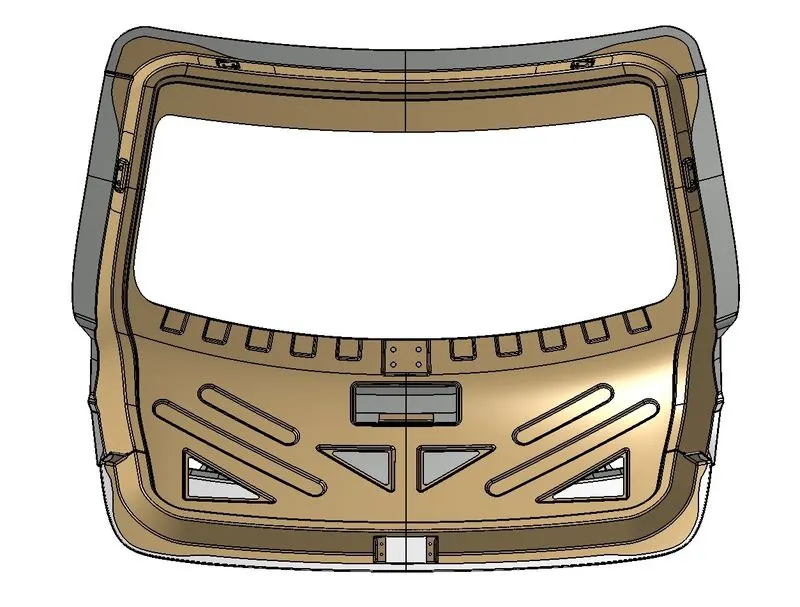
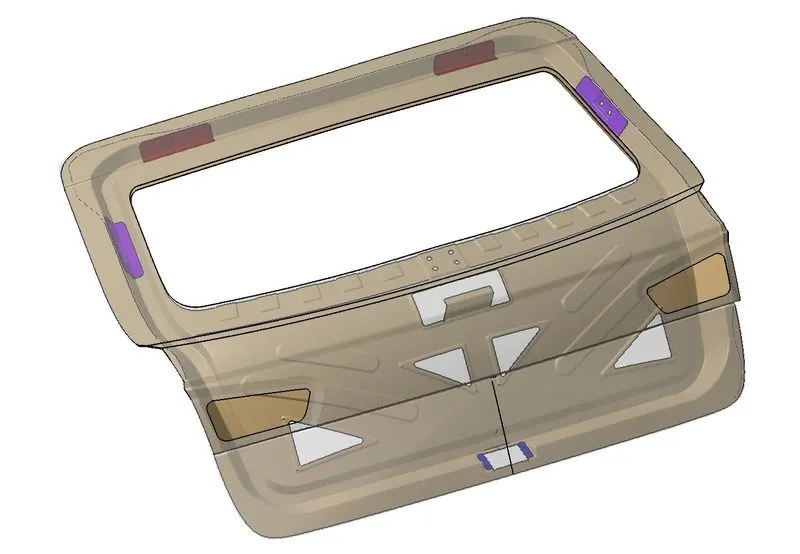
Conclusion:
The back door assembly is modeled following the engineering standards from the given styling surface.
1. Sealing Flange of length 25mm is maintained throughout.
2. Thickness for the reinforcement is 1.5mm.
3. Emboss are drawn with respect to the tooling axis so that they clear the minimum draft angle.
4. Corner relief is given to prevent unwanted deformation of the sheet metal at the corners while hemming.