Design of backdoor
#7 SKILL LYNC
COURSE: Automotive Sheet Metal Design using Siemens NX CAD / CATIA V5
NAME: SRI RAGUL P CHALLENGE: Backdoor Design Challenge
BACK DOOR:
- A backdoor is one of the types of doors of the vehicle which are located next to the passenger seat. Using the back door, you can access the luggage compartment. Gas stays are used to lift these back doors in most cars, which reduces the effort required to lift them.
- Some other automobile cars have automatic backdoor opening using electric gas to stay with sensors almost this feature in a luxury car.
- Most cars have a gas stay because of their low cost, less maintenance, and easy replacement.
- The back door is made of a material aluminum and steel.
- Dickeys (also spelled dickey and Diggy) are called storage areas in Indian English and compartments in South-East Asia. A car's trunk (North American English) or boot (British English) is its main storage or cargo compartment, often a hatch at the rear. Alternatively, it is called a tailgate.
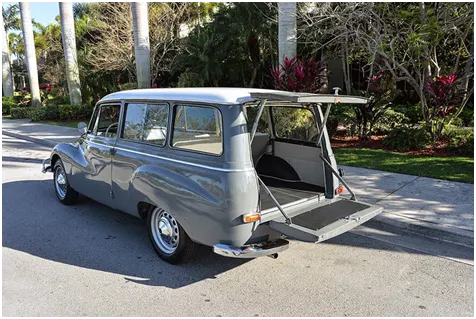
- A cargo area's door or opening may be hinged at the top, side, or bottom. If the door is hinged at the bottom it is called a tailgate.
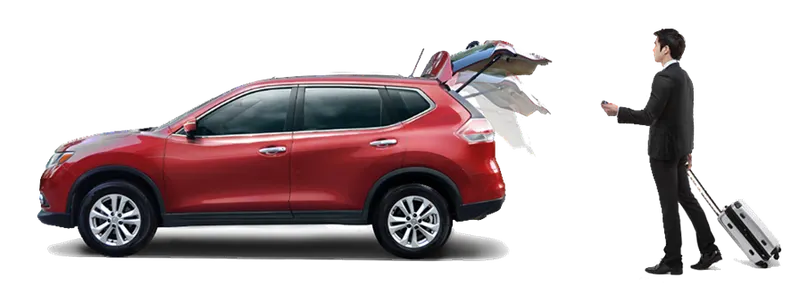
The backdoor opening symbol in Automobile: sign

TYPE OF BACKDOOR:
It’s based on working process positions of the door are mount the hinged
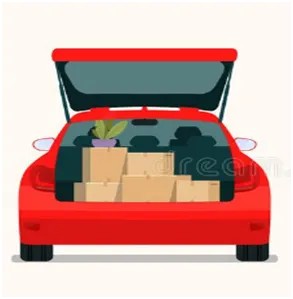
- Top mount.
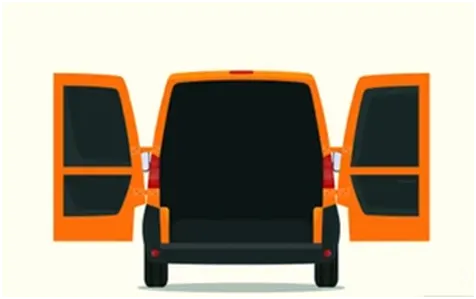
- Side mount.
- Bottom mounts.
|
Top mount working process positions of the door are mounted in the hinged towards upward, so backdoor opening in the top Most side backdoor opening vehicles used in domestic car Easy access to store luggage. |
 |
|
Side mount working process positions of the door are mounted in the hinged towards the side, so the backdoor opening inside Most side backdoor opening vehicles are used in vans, school buses, and heavy-duty vehicles. |
 |
|
Bottom mount working process positions of the door are mounted in the hinged towards the bottom, so backdoor opening in bottom
|
 |
MAIN PART IN BACKDOOR:
- Inner panel
- Outer panel
- Hinge reinforcement
- Wiper reinforcement
- Gas stay reinforcement
- Latch and striker reinforcement.
|
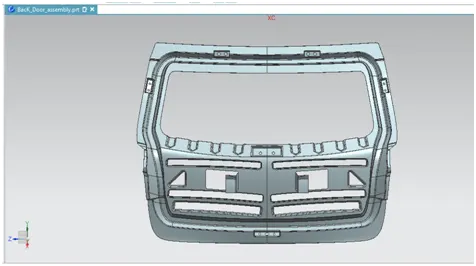
INNER PANEL The inner panel is Skelton of backdoor. Its acts as a reinforcement of the backdoor outer panel. The inner panel will increase the durability of the structure.
|
|
|
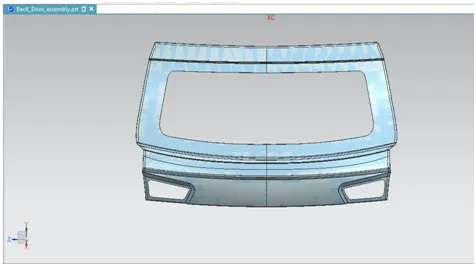
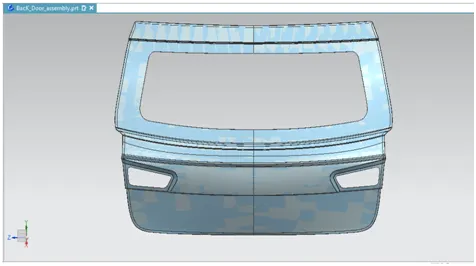
OUTER PANEL The outer panel is the styling surface of the backdoor and visible structure.
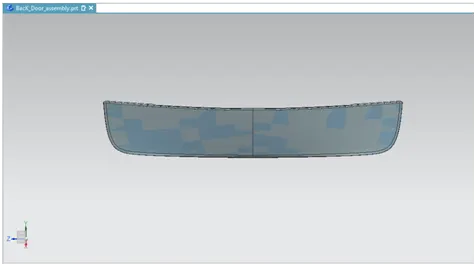
They are two types: 1. Upper outer panel 2. Lower outer panel |
Upper outer panel
Lower outer panel
Upper & lower outer panel assembly
|
|
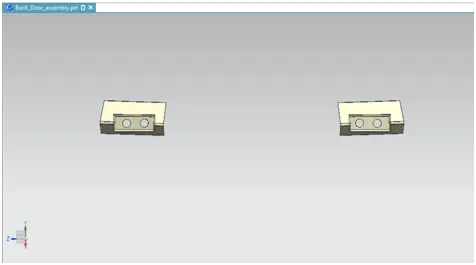
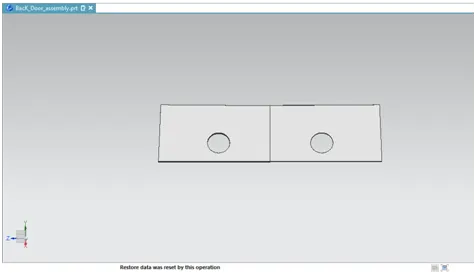
HINGE REINFORCEMENT Extract material adds to the local area of the hinge to support the weight of the backdoor. |
 |
|
WIPER REINFORCEMENT The wiper motor creates NVH so we provide reinforcement to the wiper area. |
|
|
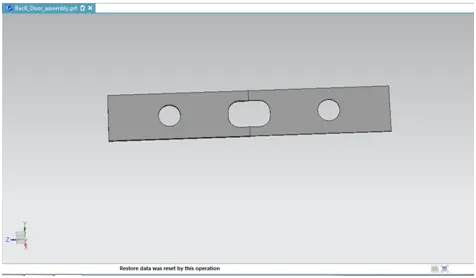
GAS STAY REINFORCEMENT Gas stay is used to lift the backdoor and the total weight of the backdoor impact the gas stay mount area due to load provide reinforcement. |
|
|
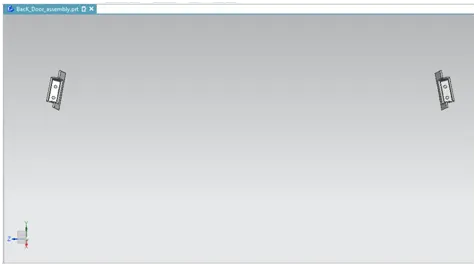
LATCH AND STRIKER REINFORCEMENT. The purpose of this latch and striker is to keep the backdoor closed. We often open and close the door frequently so add reinforcement. |
|
DESIGN METHODOLOGY:
A trunk in the rear will often contain a spare tire. The main storage compartment is normally provided at the end of the vehicle opposite which the engine is located.
Thicken of the backdoor is 0.75mm to all parts of the backdoor.
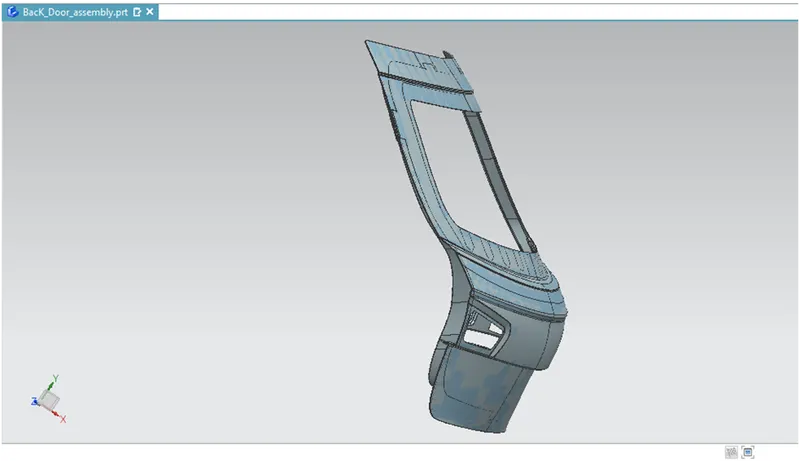
- Given skin surface has rework to the smooth surface and then the surface of backdoor is divided into two parts
- Outer panel upper
- Outer panel lower
- Create the tooling direction for an operation like emboss in that vector and select the tool direction.
- Offset the outer panel at a specific distance to create a sealing flange of the inner panel.
- After creating the sealing flange, also inner panel flange is created and connected the two flanges.
- Create the windshield panel for the inner panel backdoor.
- In the windshield of the inner panel backdoor to improve the strength, create emboss.
- And create a wiper mount area, gas stay mount area, hinge mount area, and latch & striker mount area in the inner panel of the backdoor.
- Assembly inner and outer panel of backdoor use hemming process and take relief in hemming.
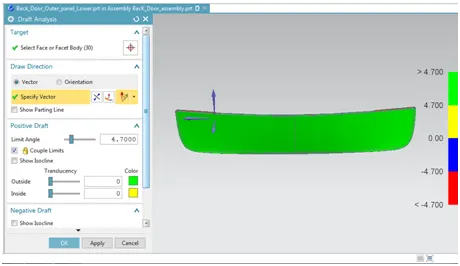
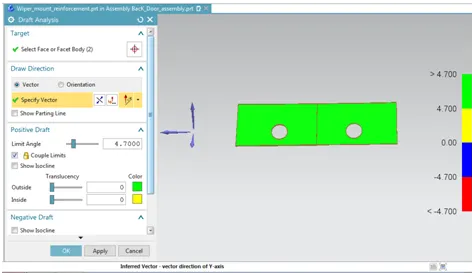
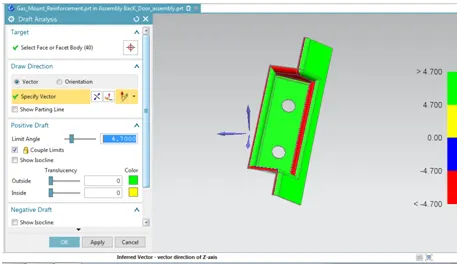
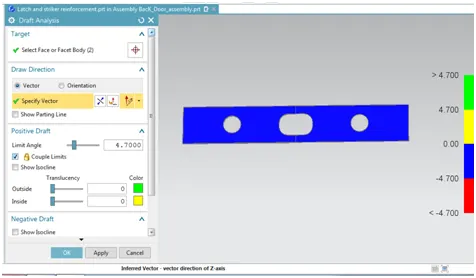
DRAFT ANALYSIS:
|
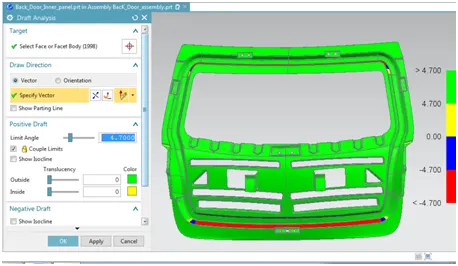
INNER PANEL
|
|
|
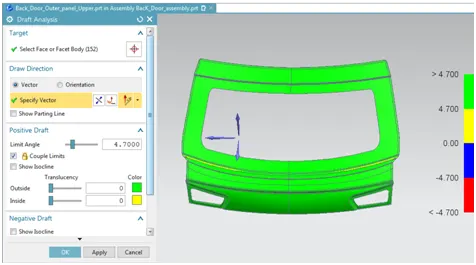
OUTER PANEL
|
Upper outer panel
Lower outer panel
|
|
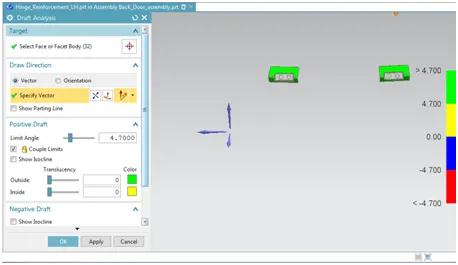
HINGE REINFORCEMENT . |
 |
|
WIPER REINFORCEMENT
|
|
|
GAS STAY REINFORCEMENT
|
|
|
LATCH AND STRIKER REINFORCEMENT.
|
|
MANUFACTURE TECHNIQUE:
- Bending: The act of bending involves applying force to a sheet metal workpiece to produce a curvature. In general, bends are used to produce simple curved surfaces instead of complex ones. In a mechanical press, a punch forces sheet metal into a simple die under enough pressure to permanently change its shape. The amount of pressure is important.
- Drafting: The sheet metal is pressed against a die that has been specially shaped to take on the three-dimensional, frequently curved shape in which the sheet metal is designed to behave. In principle, the metal is melded using the die. This method can create rather intricate shapes. A hydraulically or mechanically driven punch is used to apply pressure to the workpiece once more. Although the process is entirely automated, there are a lot of risks involved, mostly for the metal itself rather than for people. It may break from excessive pressure or may wrinkle from contact with the die. The probability of wrinkling can be reduced by using lubricant to make the metal slide against the die more smoothly as an alternative, the rough edges.
- Stamping: Stamping is the process of cutting and forming metal using a stamping press and a series of dies. The material is commonly used to make auto parts like hubcaps and fenders.
- Extrusion: Extrusion is a process that is used to create long metal shapes. To make a rod, for example, the metal is pushed into a steel tube. The rod is then "extruded" through the tube to make it longer.
CONCLUSION:
As result, to determine a back door strength using draft analysis. Consider all of the parameters and generated the automobile back door.