Design of backdoor
BACKDOOR DESIGN
OBJECTIVES:-
1. Use the provided styling surface to come up with a back door design, use appropriate design methodologies, and provide the necessary reinforcements and embosses.
INTRODUCTION
A car backdoor is also known as Tailgate or Rear door or Hatchback or Trunk. Backdoor are one of the doors of the vehicle which are located next to the passenger seat which provides access to the luggage compartment. In the most of the cars, these backdoors are operated with the help of gas stay which in turn to reduce the effort required to lift the door. Some luxury cars have powered backdoor which in turn is driven by a power spindle automatically accessed by remote control. This kind of system is also called a powered trunk lid system hatchback or station wagons are sold as 3 doors or 5 doors models. In this case, the rear hatch is classified as door, this is because it enters the passenger compartment. The naming is mainly used in European countries. In case of safety, the backdoor design should meet the safety requirement of the rear collision.
Types of Mechanism used to lift backdoor:
-
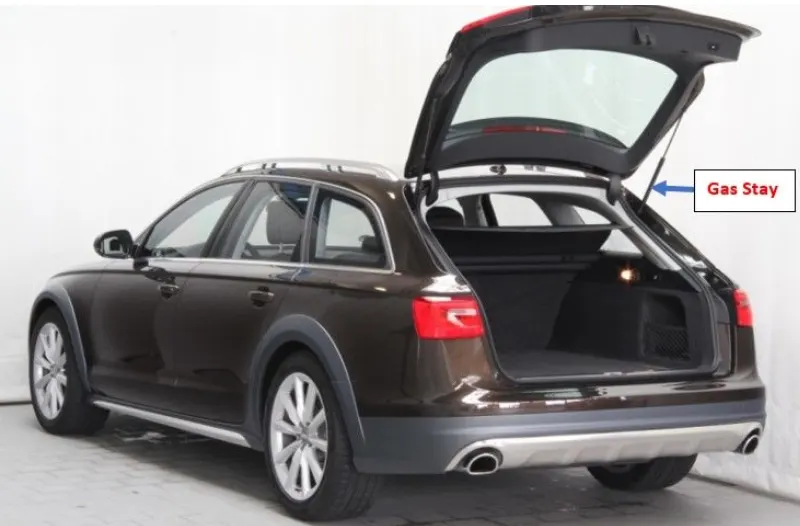
Gas Stay Type
-
Power Spindle System
Gas Stay Type:
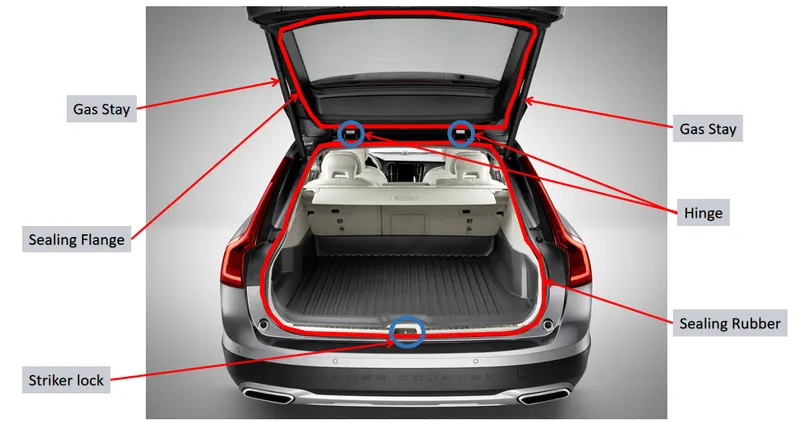
Gas Stay type backdoor is an ideal and most commonly used tailgate mechanism from lower segment cars to luxury segment cars. The ideal components of tailgate consist of hinges, door, gas stay, rubber beadings or rubber sealants to seal the doors without any gap between door & body in white structure.
Power Spindle System:
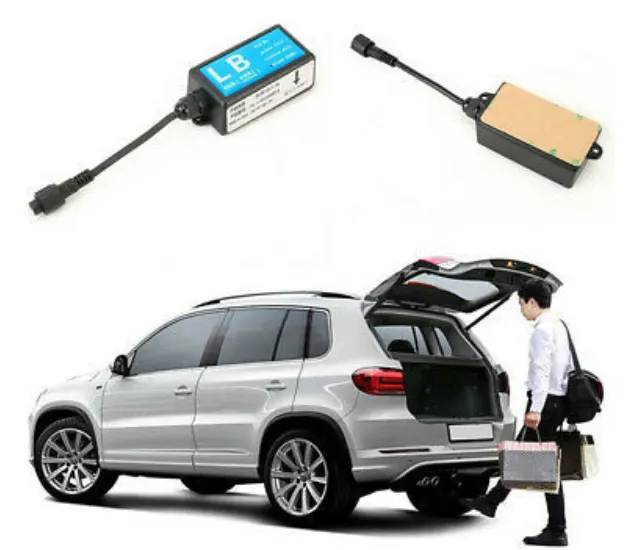
Power spindle system is another sophisticated way of trunk or tailgate opening mechanism which is automatically open and close the hatchback and release of the latch by the touch of a bottom. Power spindle system consists of a power latch, anti-pinch switch, PTG assembly, PTG main switch. When the switch is pressed in the compartment or outside the power latch releases the latch and the entire backdoor is opened. The pinch switch is located in order to avoid accidental hand insertion during the operation of the door.
DESIGN CONSIDERATIONS OF A BACKDOOR:
-
Functional requirement of Hinge and gas stay
-
Rear visibility criteria
-
luggage volume
-
crash analysis
-
bend test, Dent test, torsion test, and Endurance test
-
rear Crash regulation
-
gap and flushness requirements.
Manufacturing Process:
Recently, there have been two approaches to reducing automobile weight. One is by using material lighter than Steel and the other is by redesigning the steel structure. Although the former seems very effective, it is very expensive so that it may only be used for an expensive automobile industry is trying to use steel, which is not costly and recyclable. Light weight steel can be achieved by improving the performance of the Structure or adopting by improving the performance of the structure or adopting new manufacturing techniques. One of the efforts is the ULSAB (Ultra-Light Steel Auto Body) concept.
ULSAB suggests three main weight reduction techniques such as hydro forming and Tailor Welded Blank (TWB).
Tailor Welded Blank:
A Tailor Welded Blank is a blank that is compared of two separate pieces of sheet metal that have been welded together prior to stamping. TWB allows the welding of the different grades, different thickness or different corrosion coating together in order to give the properties needed in different areas, without increasing the number of tools needed to form the part and eliminating the fit ability concerns. They also allow a high degree of flexibility in designing parts and large blanks can be formed from much smaller sheets. The use of TWB would reduce the weight of the car. Having the ability to selectively requirement on a door inner is in the region where the hinges attach to the panel.
Deep drawing:
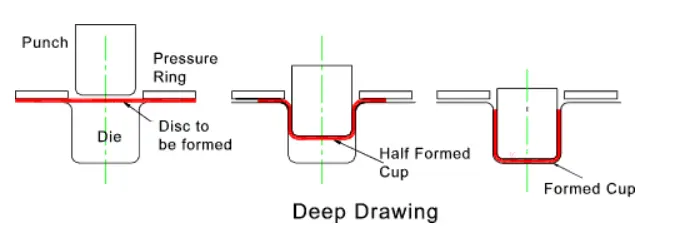
It is a sheet metal forming process in which a sheet metal blank is radially drawn into a forming die by the mechanical action of a punch. It is thus a shape transformation process with material retention. The process is considered "deep" drawing when the depth of the drawn part exceeds its diameter.
-
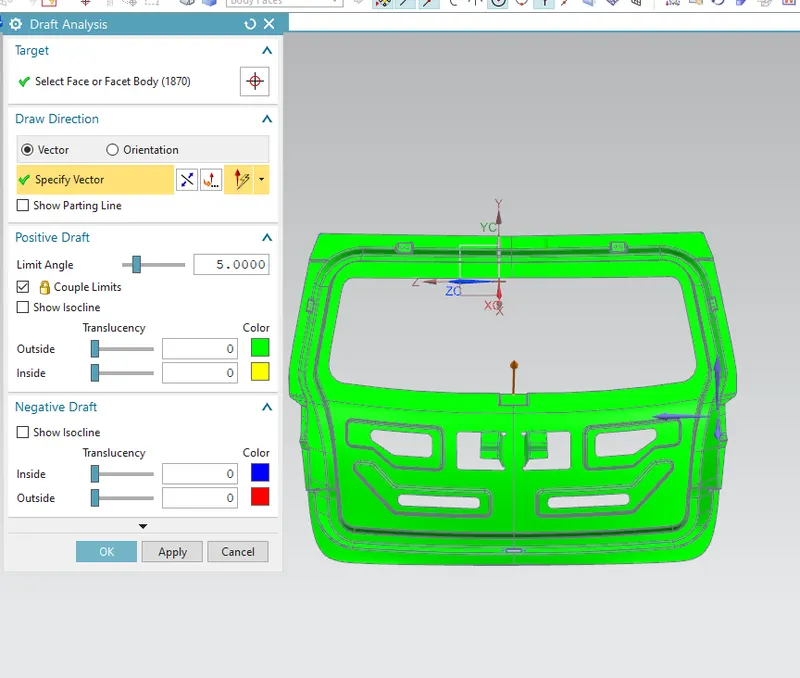
We give a positive draft or an angle for a better drawing process.
-
Deep drawing processes are divided into three types:
-
Deep drawing with tools
-
Deep drawing with active means
-
Deep drawing with active energy
Hemming
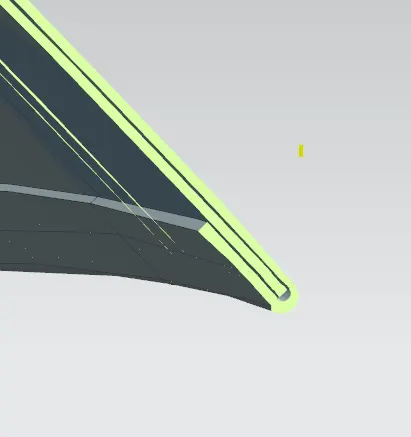
At the corners the outer panel and the inner panel are joined together by hemming. No type of welding is done because it leaves a mark on the outer panel and damages the aesthetic beauty of the car.
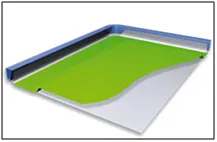
Hemming is a forming operation in which the edges of the sheet are folded or folded over another part in order to achieve a tight fit. Normally hemming operations are used to connect parts together, to improve the appearance of a part and to reinforce part edges.
There are various types of hemming operations:
Conventional Die Hemming: In conventional die hemming, the flange is folded over the entire length with a hemming tool.
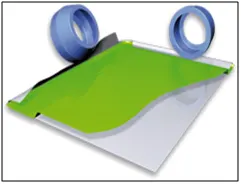
Roll Hemming: Roll hemming is carried out incrementally with a hemming roller. An industrial robot guides the hemming roller and forms the flange.
General Analysis Tests:
The following load cases were under gone after manufacturing the Backdoor. They are
-
Bend Test
-
Torsion Test
-
Abuse Case
-
Dent Test
-
Assembly Load case
-
Endurance
Bend Test:
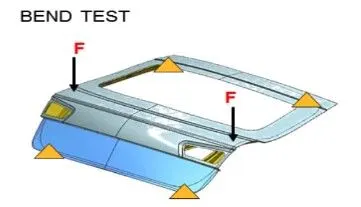
The bend test is a simple and inexpensive qualitative test that can be used to evaluate both the ductility and soundness of a material. It is often used as a quality control test for butt-welded joints, having the advantage of simplicity of both test piece and equipment.
Torsion Test:
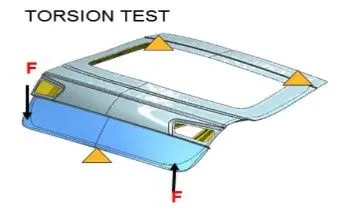
The torsion and beaming test are designed to check modified vehicles for the two main strength requirements of any chassis: torsional rigidity and beam strength.
Torsional rigidity is a vehicle’s backdoor ability to resist twisting under applying load to the backdoor. Beam strength is the strength of the backdoor along its length. To conduct torsional test, hinges and striker position were constrained and the gradual load is applied at the down end of corners.
Abuse Cases:
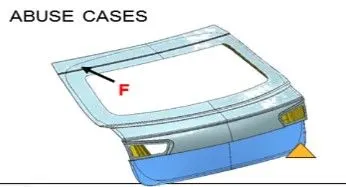
Abuse cases are Over slamming and hanging when the door is in open condition.
Dent Test:
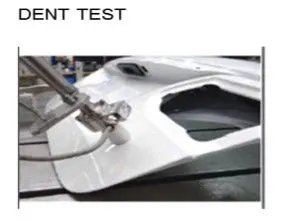
Dent test is a test, when the load applied to backdoor and after some point checking the door retracts to its original position or not.
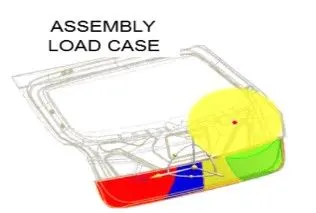
Assembly Load Case:
Assembly load case is a case, while assembling the vehicle the force is applied to the backdoor and checking whether the load is withstanding or not.
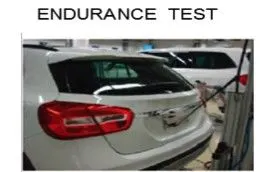
Endurance Test:
Endurance test is a workability test. This test is conducted by open and closing of backdoor to ‘n’ number of cycles, where at last we check the door behaviour at the end of the cycles.
DESIGN METHODOLOGY:
1. Outer panel
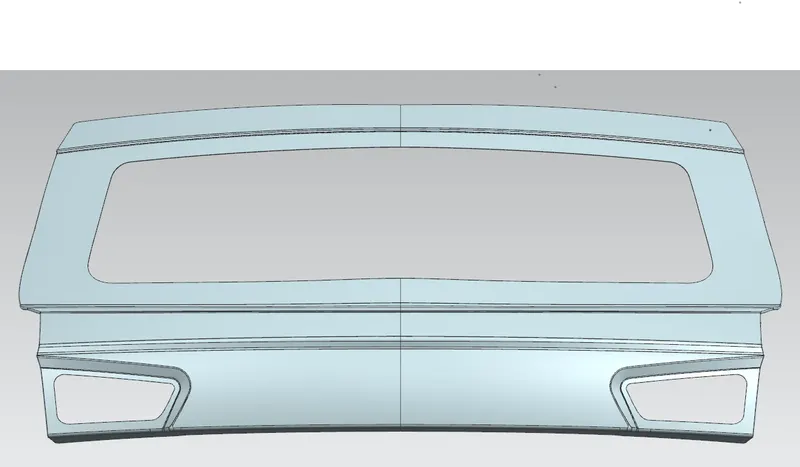
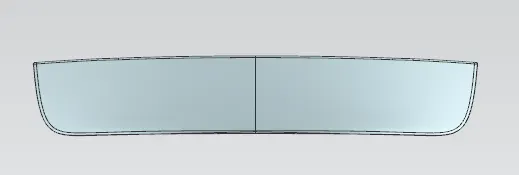
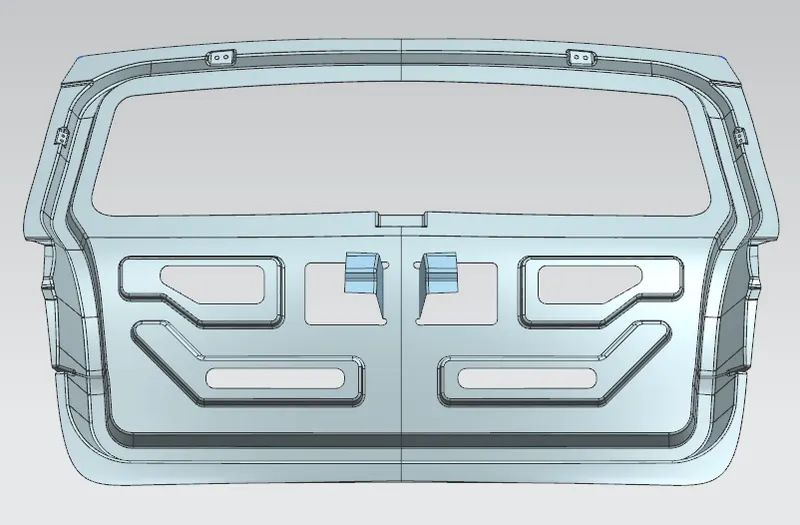
The Outer Panel is the styling surface of the back door. It is the source of design of other parts of the back door, primarily the Inner Panel. It acts as the outer cover and deals with the aesthetics of the car. Its thickness is in the range of 0.65-0.75 millimetres.
It has two-part.
1. Outer Upper Panel
2. Outer lower Panel
2. Inner panel
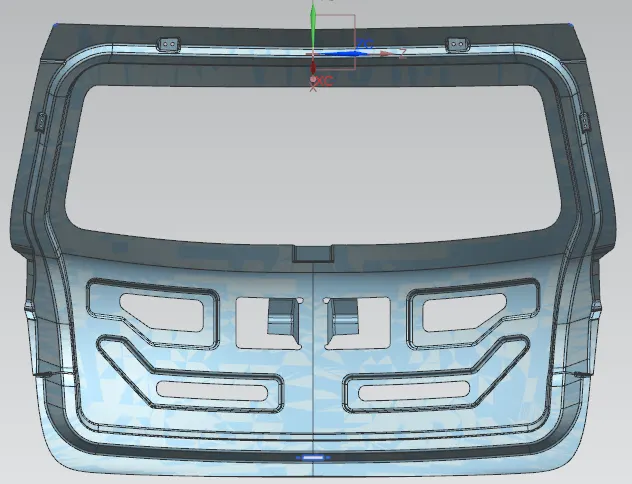
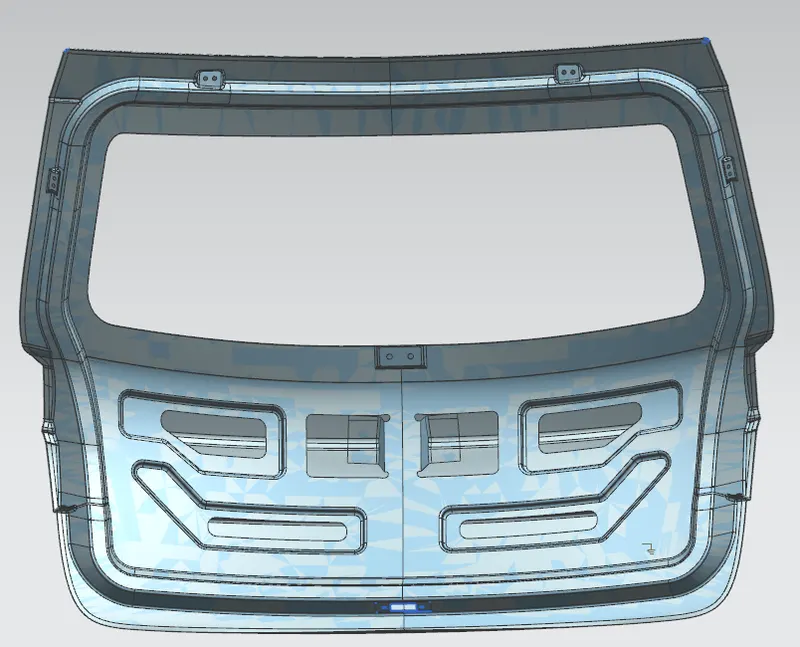
The Inner Panel provides strength to the back door. They are of 0.65-0.75 millimetres (mm) thick. It is the Inner Panel where reinforcements and embosses are provided to justify its function.
There are many cases where the Inner panel is subjected to stress due to frequent opening and slamming. These stress and depression factors are compensated by features like embosses and reinforcements. The inner panel accommodates the Latch and Striker actuator, Wiper motor actuator, Trims mounting, Hinge and Gas Stay embosses, V-Emboss, Latch, etc and therefore the necessary cut outs are provided. Various reinforcements are also spot welded to the inner panel.
Mastic sealant
The mastic sealant is used to fix the inner panel to the outer panel which maintains the NVH factor and stiffness of the back door, Mastic Sealants are preferred over Spot Welding to join the inner and outer panel due to the fact that the weight can be reduced.
3. Gas Stay reinforcement
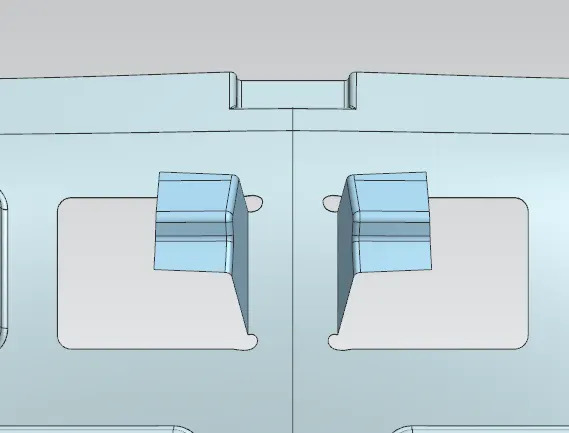
Gas Stay is a device used for supporting the back door in its open position. Gas stay requires no man power and is engaged into support position automatically as the back door opens. One end of the Gas Stay is fixed on the backdoor and the other end on the Body Side or on the Back door stationary area. Embossing is provided at the Gas Stay mounting area to compensate for the functional holes punched.
Various simulation tests like Bend test, Torsion test, Abuse test performed on the back door as shown above reveals that there a very weak zone developed at the Gas stay region. To compensate that, a reinforcement is added in that region.
4. Hinge Reinforcement
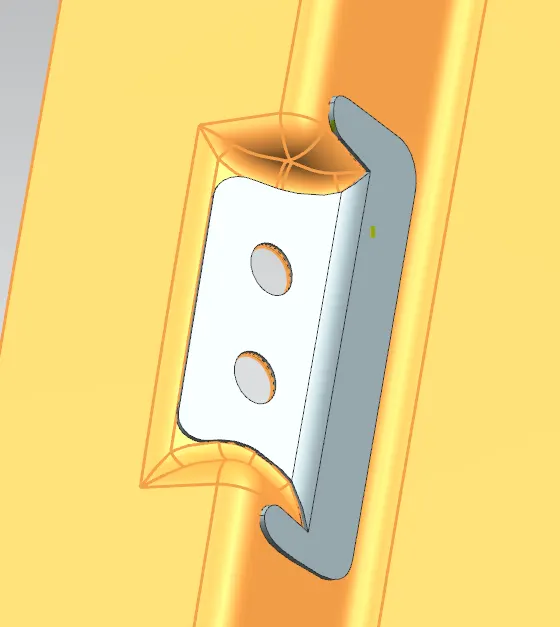
Hinges enable the opening and closing of the back door. One end of hinge is fixed on the backdoor and the other end on the Roof, on both sides. Hinges can be placed outside or inside the backdoor. Similar to Gas Stay, Hinge reinforcements are added in this region to compensate for the weak zone developed due to the load acting while opening and closing the backdoor.
The position of the hinges are determined by the midpoint of axis of the Hinges called the Hinge Axis point, which should be aligned with the Latch and Striker through the trajectory of the back door opening and closing. If the Striker is exactly perpendicular to the trajectory, then the Hinges can be fixed accordingly on the inner panel.
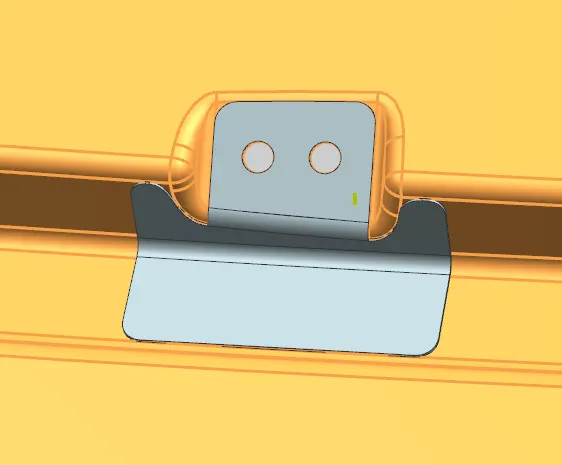
5. Latch and Striker reinforcement
The Latch & Striker forms the locking mechanism of the backdoor with the car. Due to regular opening, closing and over slamming of the backdoor, there is stress developed in the Latch and Striker area. Further, during a rear collision this area will be the first point of contact. To handle the same, reinforcements are added in this area.
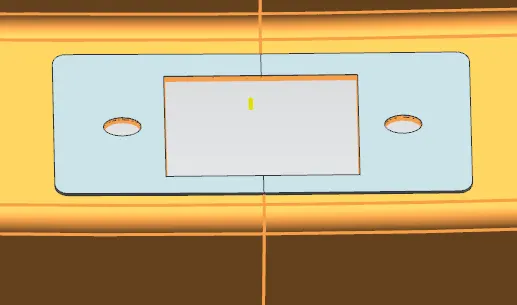
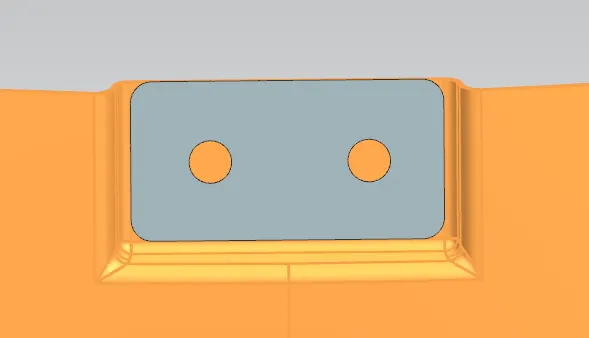
6. Wiper Motor reinforcement
Wiper motor reinforcement is created to mount the wiper motor assembly.
Final Assembly Views
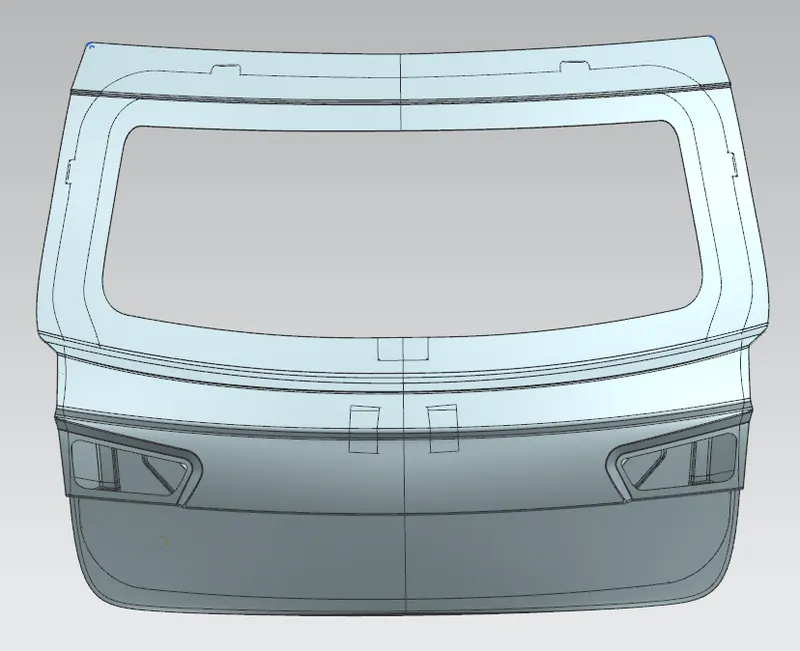
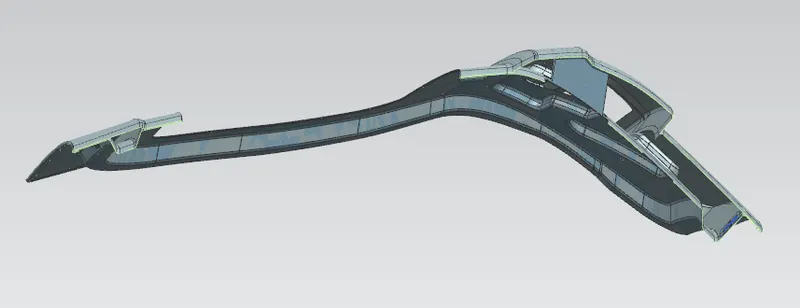
Draft Analysis