Design of backdoor
Title: Design and Development of Backdoor Design
Objective
Developing a back-door design based on the styling surface with given information and to position the latch reinforcement striker, hinge and wiper mountings.
Introduction
Backdoor is also known as tail gate. Backdoor is also has a swinging or closure commodity. First deciding the hinge axis then the latch & striker point join the trajectory to decide the motion of swinging. Also, at right side doors the sealing flange is also important. Preparing the master in the OY top, bottom, hinge area both sides. Developing the sealing surface, corners since gas stay at top and bottom mounting point and also to develop the sealing flanges w.r.t to styling surface. After develop sealing flange then follow the conditions like rear visibility, luggage area thinner. The backdoor section is better for luggage area and the area cannot make a straight surface because need some strength to the panel for rear crash purpose and maintain the space to accommodate the latch and striker, wiper motor. Luggage area or sealing is contact with rear floor at the bottom, roof at the top and body side or tail gate.
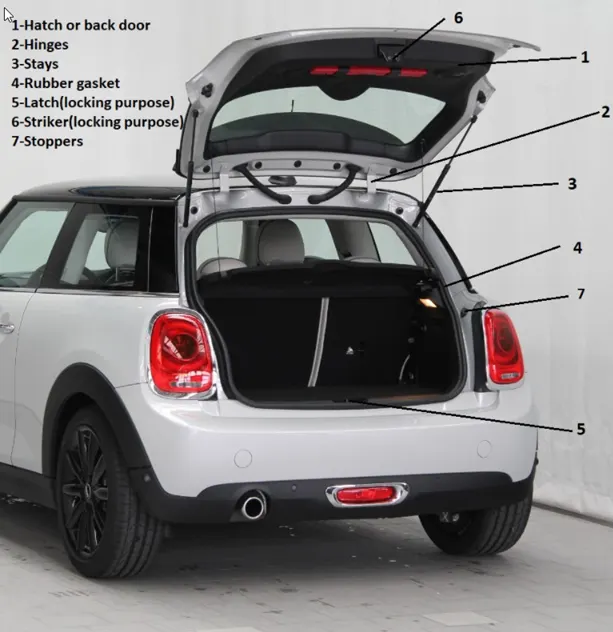
Figure: Car back door
Backdoor parts consist:
- Upper outer panel
- Lower outer panel
- Inner panel
- Hinge reinforcement mounting points
- Gas stay reinforcement mounting points
- Latch and striker reinforcement mounting point
- Wiper motor reinforcement mounting point
Outer panel
Outer panel is the styling part of the back door and it is developed in different way of structures to attractive the customers, not only back door but every portion of the car outer panel is designed very fine.
Inner panel
Inner panel is most important part in car to give strengthen by adding some features like embosses, reinforcements etc, to avoid harm to passengers from environmental conditions, accidents, and forces etc.
Hinge reinforcement part
Hinge reinforcements are used to open and close the doors of the car and it also gives strengthen at hinge areas. So that no need of extra reinforcements in inner panel at hinge area.
Gas stay reinforcement
The purpose of gas stay reinforcement is to lift the back door of the car.
Gas stay reinforcement are two types and they are
- Manual system
- Power lift system
Manual system
The door is opened manually by man.
Power lift system
The door is opened with the help of sensors (automatically).
Latch and striker reinforcement mounting point
The Latch and striker reinforcement mounting point is developed with the help of axis from hinge position and it is taken approximately then created emboss at bottom of the panel to mount latch and striker assembly.
Wiper motor reinforcement mounting point
Wiper motor reinforcement mounting point is the purpose of windscreen wiper and it is used to remove rain water, snow, ice, washer fluid etc to visible at backside. A wiper generally consist of a metal arm- one end pivots and other end has rubber blade. The arm is powered by a wiper motor and then the rubber blade swing back and forth over the windscreen or glass.
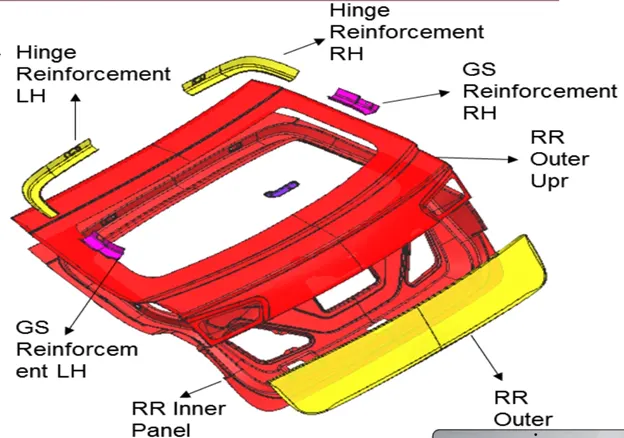
Figure: Back door parts
Difference between aluminium and steel parts
|
Aluminium |
Steel |
|
Parts are casted |
Parts are stamped |
|
Reinforcements can be neglected |
Reinforcements are necessary |
|
Thickness is varied |
It has uniform thickness |
|
Lighter in weight and a smaller number of components |
Heavier in weight and a greater number of components |
Assembly sequence for Steel and Aluminium
Assembly sequence for steel
- Hinge reinforcement - RH
- Hinge reinforcement – LH
- Wiper motor reinforcement
- Gas stay reinforcement – RH
- Gas stay reinforcement - LH
- BG outer upper panel
- BG outer lower panel
- Latch and striker reinforcement
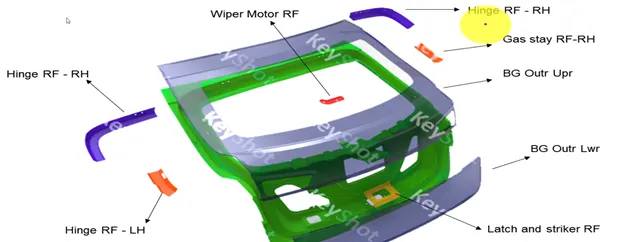
Figure: Assembly sequence for steel
Assembly sequence for aluminium
- Back door inner panel
- Back door outer panel
- Back door outer upper panel
- Back door outer lower panel
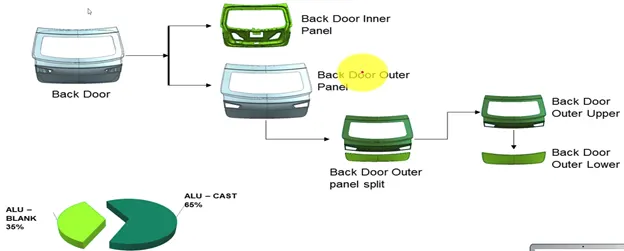
Figure: Assembly sequence for aluminium
Weight difference between the aluminium and steel
|
Density |
Aluminium – 2700kg/m^3 |
Steel – 7860kg/m^3 |
||
|
Commodity |
Inner panel back door cast |
Inner panel back door assembly steel concept |
||
|
Weight |
Commodity |
Kg |
Commodity |
Kg |
|
Inner panel |
5.56 |
Wiper motor RF (2.25mm) |
0.15 |
|
|
Latch RF (1.25mm) |
0.15 |
|||
|
Hinge RF LH (2.25mm) |
0.95 |
|||
|
Hinge RF RH (2.25mm) |
0.95 |
|||
|
Gas stay RF LH (1.5mm) |
0.4 |
|||
|
Gas stay RF RH (1.5mm) |
0.4 |
|||
|
Inner panel (0.75mm) |
4.8 |
|||
|
Rear door outer upper panel (1.25mm) |
1.65 |
Rear door outer upper panel (0.75mm) |
2.95 |
|
|
Connecting sheet (1.5mm) |
0.2 |
Connecting sheet (0.75mm) |
0.35 |
|
|
Rear door outer lower panel (1.25mm) |
1.2 |
Rear door outer lower panel (0.75mm) |
2.30 |
|
|
Total in kilograms |
8.7 |
13.4 |
||
The difference between aluminium and steel are 13.4-8.7 = 4.7 kg.
Load cases – General analysis
Bend test
Torsion test
Abuse test
Debt test
Assembly load cases
Endurance test
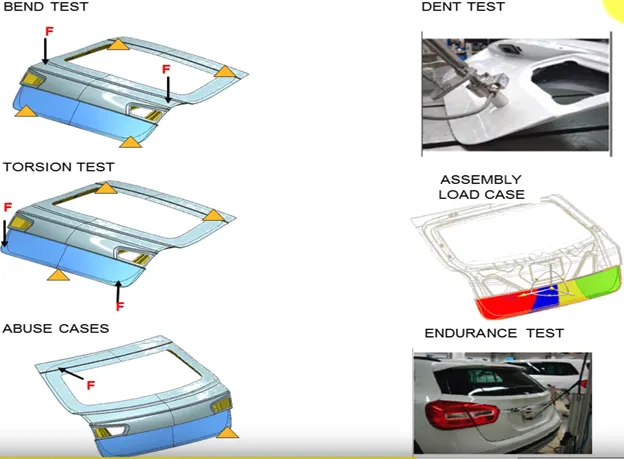
Figure: Different load case analysis on back door
CAE team members will test these cases on car back door because of forces or loads at different areas and different ways effected to back door.
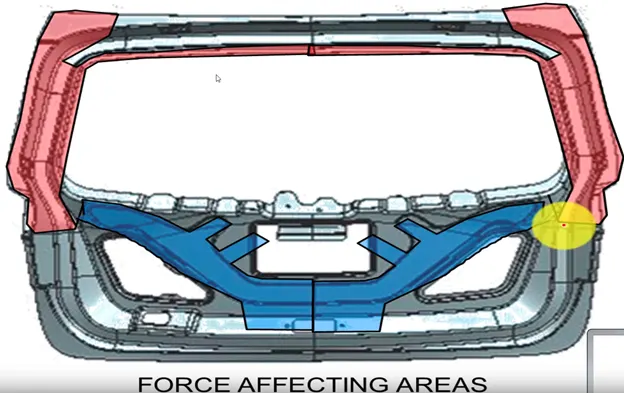
Figure: Forces effecting areas
Manufacturing effects over spindle type and positioning
Gas stay relation
- Hinge inside back door
- Gas stay socket body mounting
- Gas stay back door mounting
Power spindle relation
- Hinge outside back door
- Gas stay socket body mounting
- Gas stay back door mounting
Design methodology
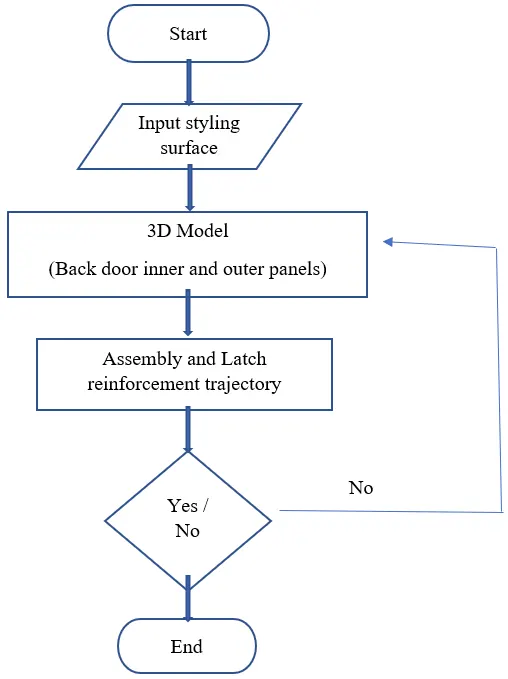
Figure: Flow chart
Inner panel
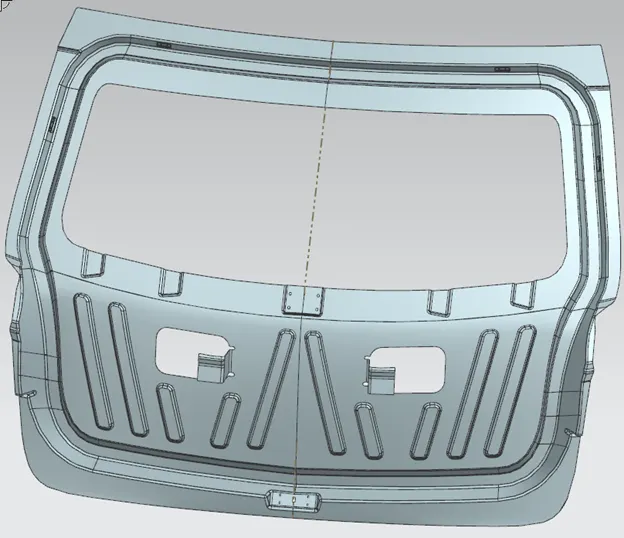
Figure: Inner panel
The inner panel is developed with the help of styling surface of outer panel upper and lower and created necessary embosses to give strength to the inner panel and also added reinforcement like hinge reinforcement, gas stay reinforcement and latch striker reinforcement at edges. Supports between inner panel and outer panel by mastic reinforcement point to avoid non vibrations.
Outer panel
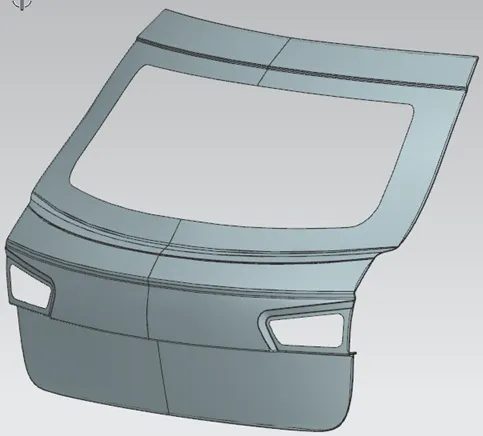
Figure: Outer panel
Outer panel is a styling portion to look good design the surface is created different curvatures. It should be designed according to customers point view and main reason to attract the customers.
Assembly
Hinge reinforcement, Gas stay reinforcement and latch striker reinforcement
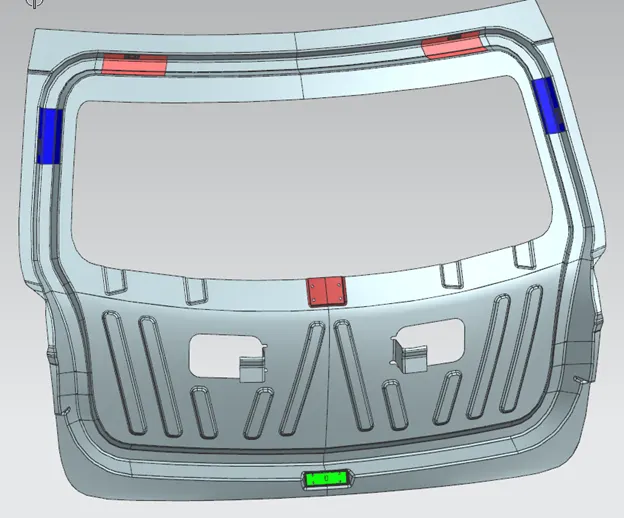
Figure: Inner panel reinforcement
Reinforcement assembled to give strengthen and supporting purpose like hinges are used to open and closing the doors, gas stay are used to give support for open door not to close, wiper motor and used to swing wind shield blade with the help of motor and latch and striker are used to close the doors for locking purpose.
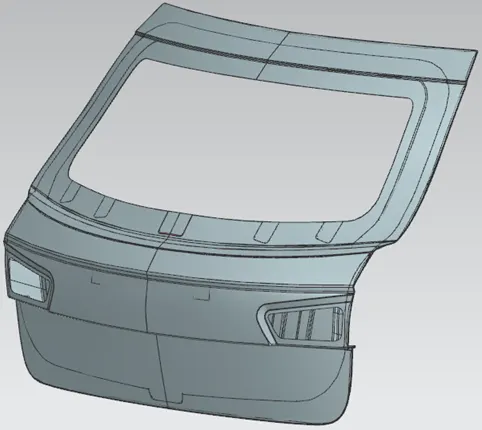
Figure: Back door assembly
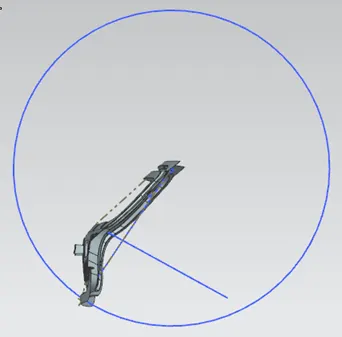
Figure: Latch and striker reinforcement
Draft analysis
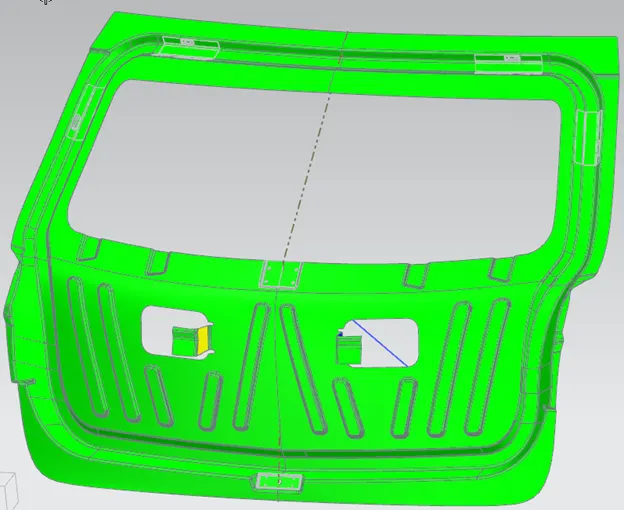
Figure: Draft analysis
Draft analysis is done w.r.t to tooling direction and draft angle maintained 7 degrees.
Conclusion:
The car back door is developed with the help of styling surface and developed essential embosses, reinforcement to give strength to back door. Draft analysis done for inner panel w.r.t to tooling direction.