Design of backdoor
Objective :-
- To design the back door of a car from the given styling surface.
- To design essential reinforcements for back door inner panel.
- To perform draft analysis.
Introduction :-
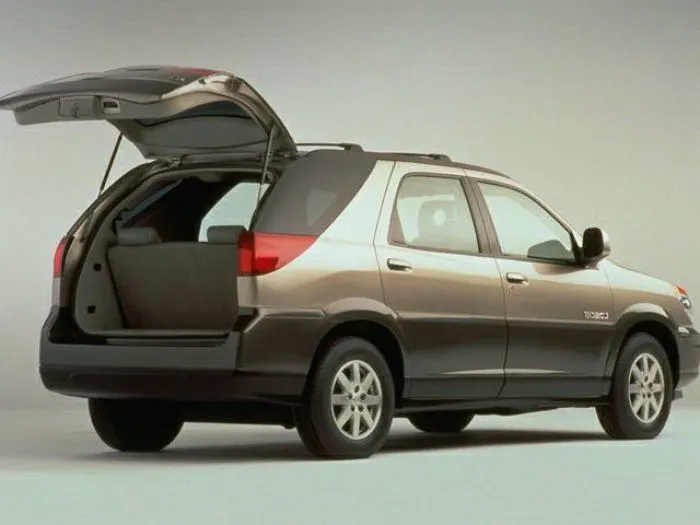
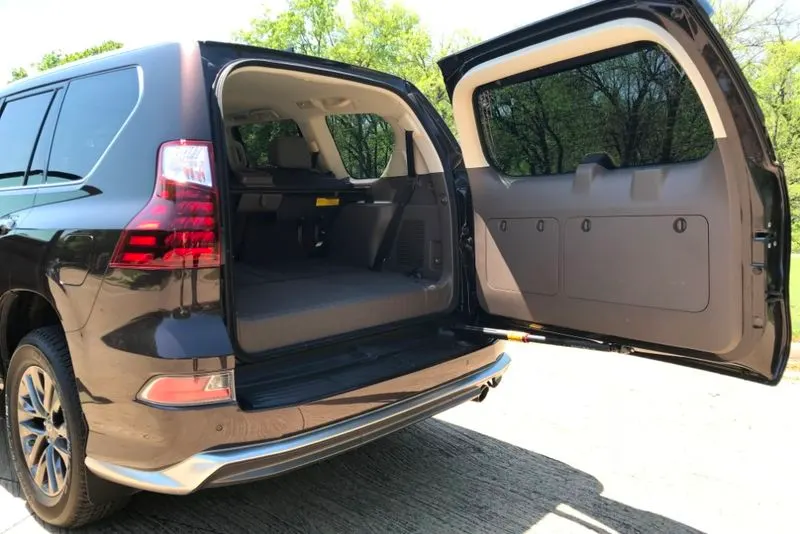
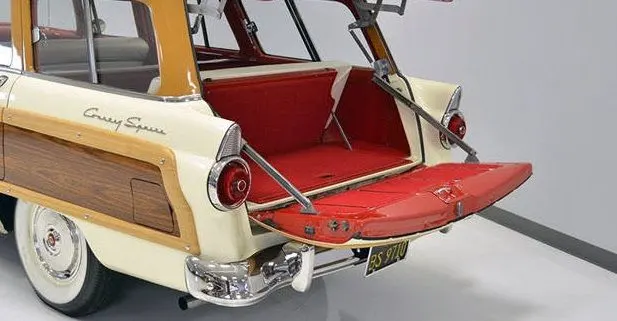
A back door of a car also known as a tail gate mainly used to cover the car from rear side. Luggage compartment is most often at the rear of the vehicle so back door allows access to the main storage or luggage compartment. It also protects the car from rear collision or impact. Hinges allow the backdoor to be raised. The backdoor may be hinged at the top, side, or bottom. Gas stays also used to help elevate and hold open the back door.
Types of back door based on mounting position are as follows
1) Top mounted door :-
2) Side mounted door :-
3) Bottom door :-
Design consideration :-
- Material selection
- Space availability
- Visibility criteria
- Force dissipation
- Hinge position
- Latch and striker position
- Gas stay position
- Rear crash regulations
- Gap and flushness requirements
Material selection :-
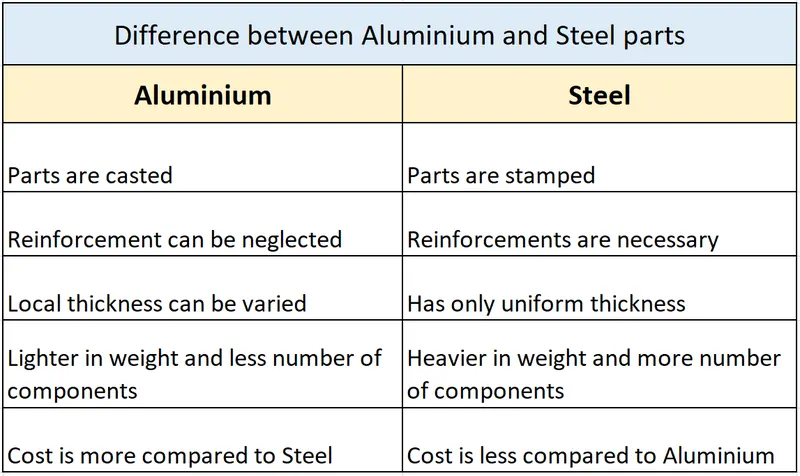
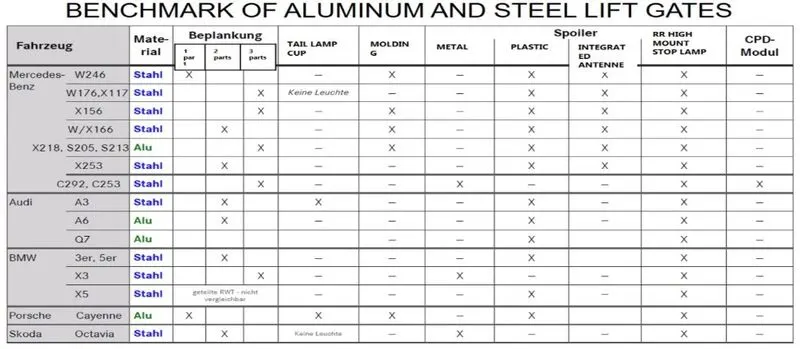
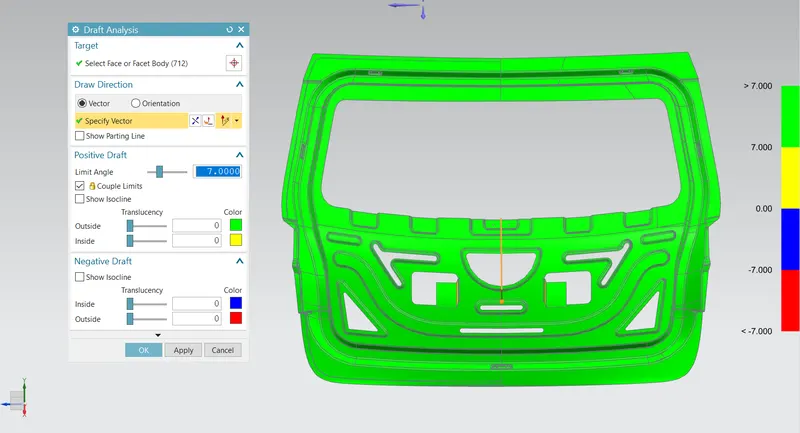
The main material used for manufacturing of back door is steel but nowadays aluminium is also used for making the panels of backdoor. The density of steel is higher than the aluminium therefore weight of the steel backdoor is more. Aluminium panels also provides variation in local thickness so there is no need of extra reinforcements. Minimum draft angle requirement for aluminium is 3 to 5 degrees and for steel is 7 degrees. Only drawback is Aluminium is costlier than steel. In higher end models of componies like Audi, BMW, Porshe etc. we can find aluminium is used instead of steel resulting in reduced weight of the vehicle and ultimately it improves the performance of the vehicle.
Difference between Aluminium and Steel parts
Main components of back door :-
- Outer panel
- Inner panel
- Hinge reinforcement
- Gas stay reinforcement
- Wiper motor reinforcement
- Latch and striker reinforcement
1) Outer panel :-
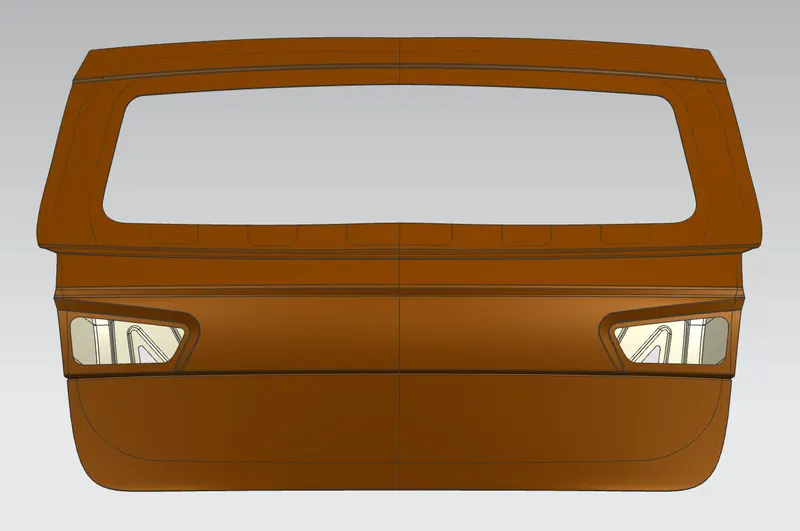
Outer panel is extracted from the given styling surface. It act as a outer cover of the back door. Outer panel is responsible for the asthetic look of the back door.
Hemming operation is done to connect outer panel with inner panel as well as mastic sealant is also applied between these two panels.
The thickness provided to the outer panel is 0.75mm.
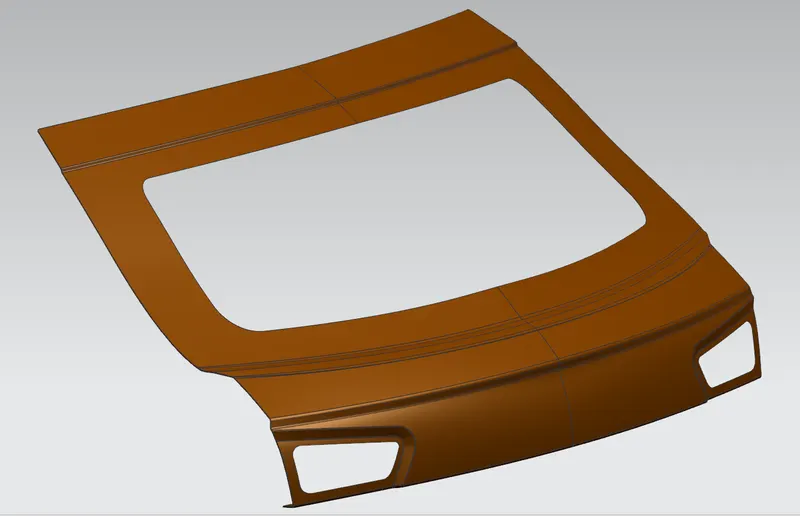
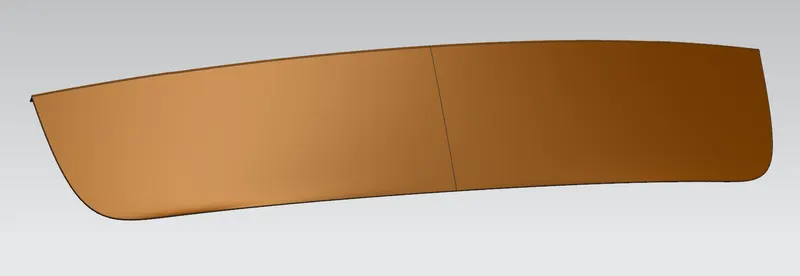
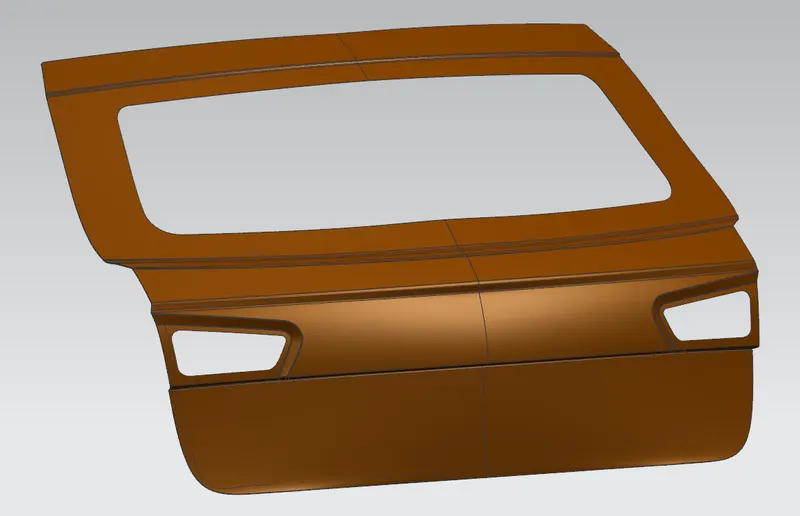
Outer panel is divided into two parts
- Outer panel upper
- Outer panel lower
Outer panel upper :-
Outer panel lower:-
Outer upper and lower panels :-
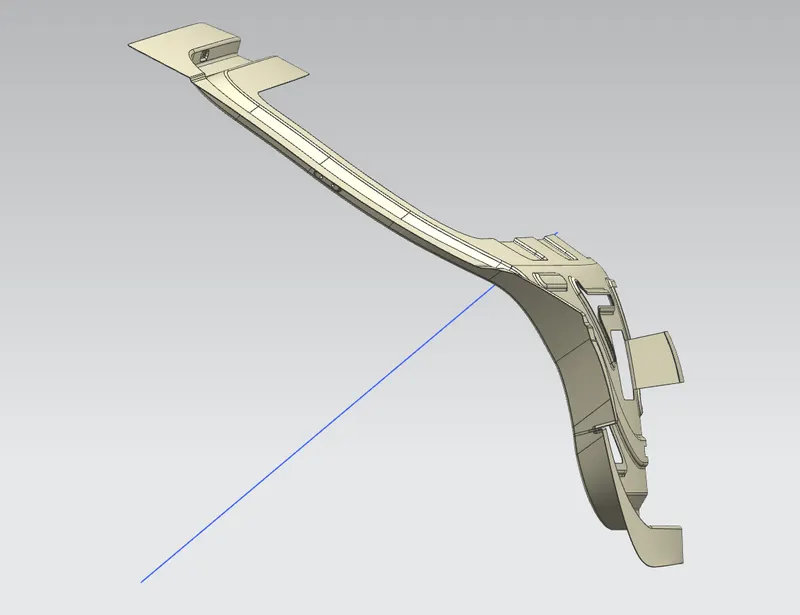
Tooling direction :-
Tooling direction is defined as a reference for manufacturing processes like deep drawing and embossing. Draft angles are given with respect to this tooling direction.
2) Inner panel :-
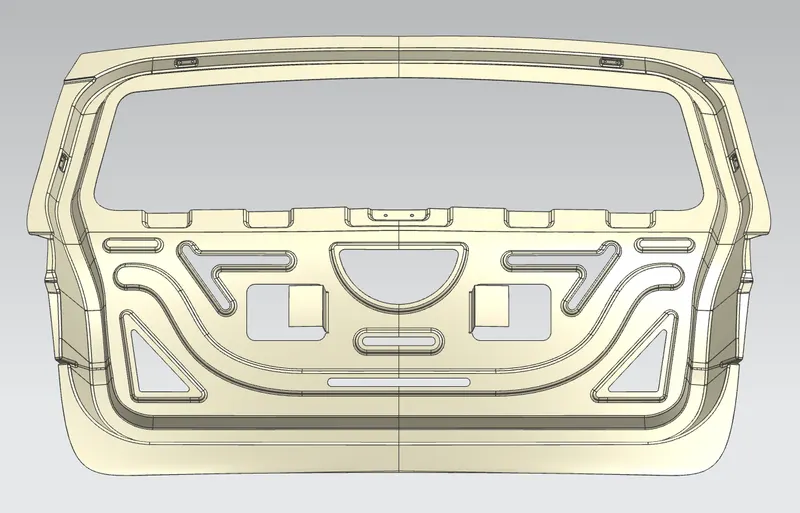
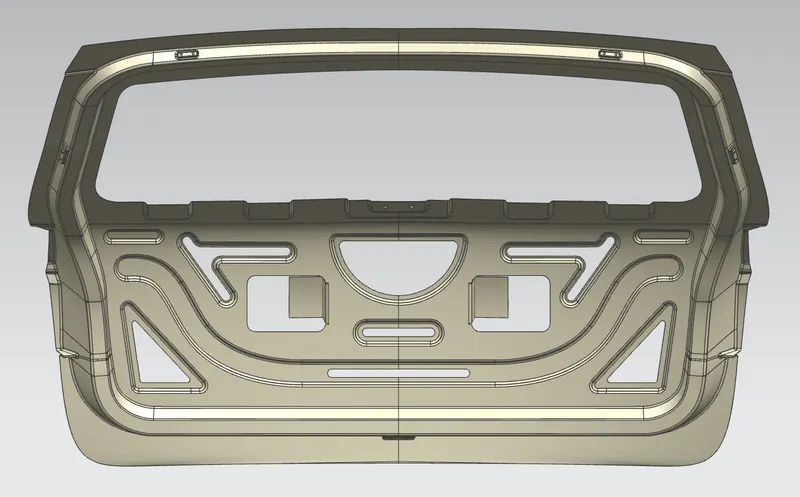
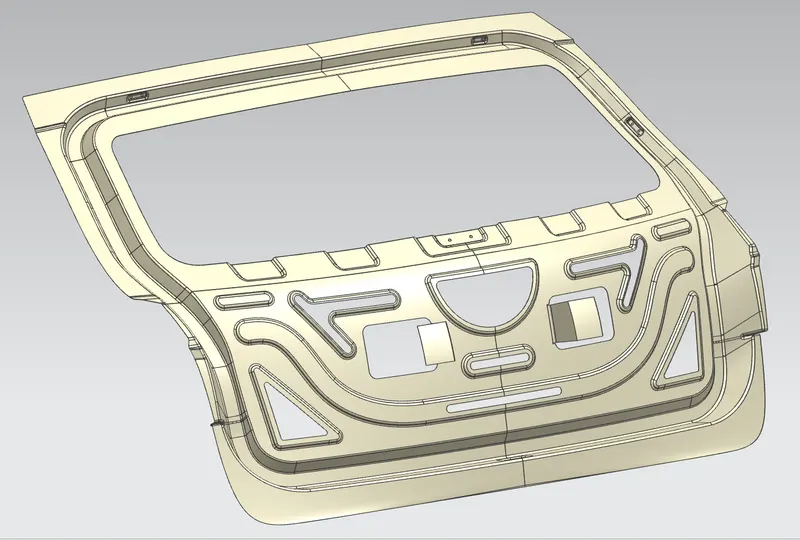
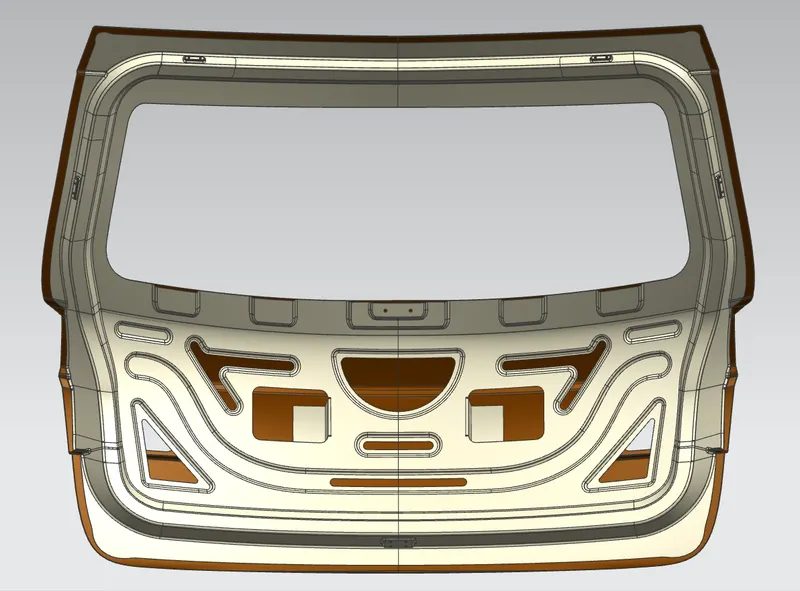
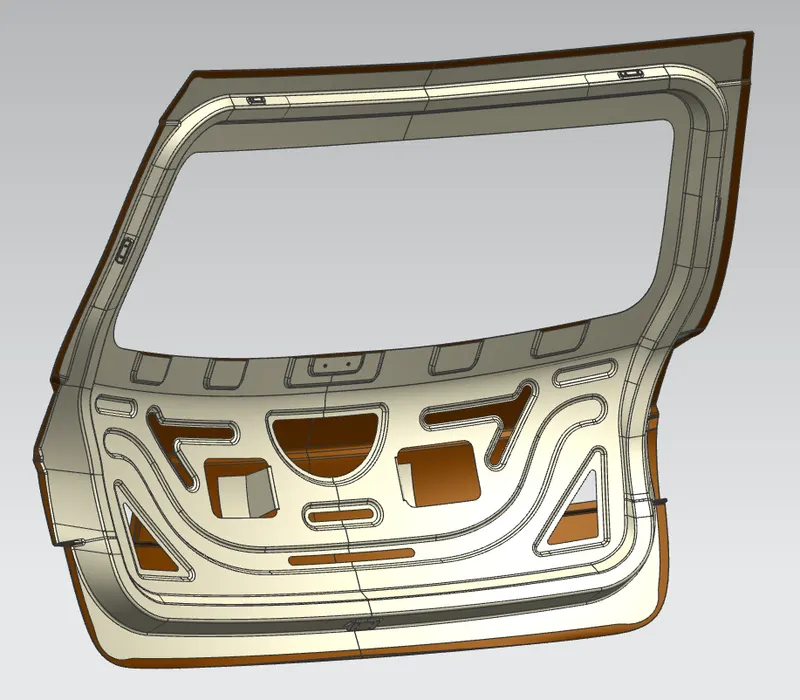
Inner panel provides strength to the back door. There are different mounting areas provided on the inner panel for Hinges, Gas stays, Wiper motor, Latch and striker etc. Reinforcements are necessary for each mounting area to improve the strength of that area locally. Embosses are provided on the inner panel to improve the strength of the inner panel. Thickness provided to the inner panel is 0.75mm.
Mastic sealant :-
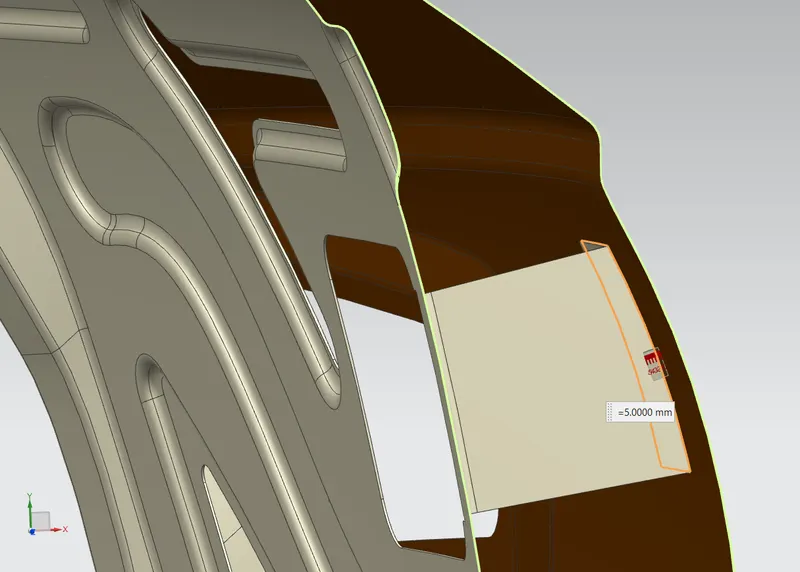
Mastic sealants are used to connect the inner panel to Outer panel. It improves the NVH factor. Projected area is created on inner panel and 4 to 5mm gap is provided between outer and inner panel to apply mastic sealants.
Force dissipation :-
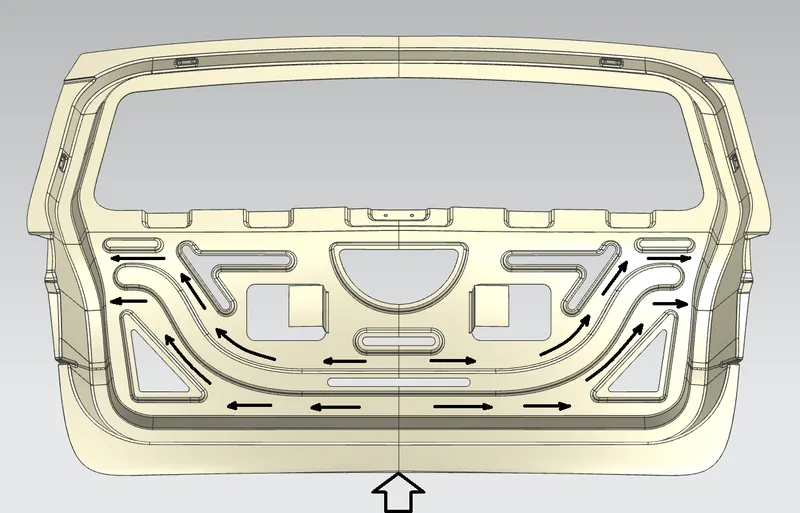
Force dissipation is very important factor in case of rear collision or impact. Collision forces should be dessipate towards outward direction of vehicle inorder to reduce the damage of impact inside the cabin of a car. Therefore V or Y shaped embosses are created on the inner panel.
Latch and striker position :-
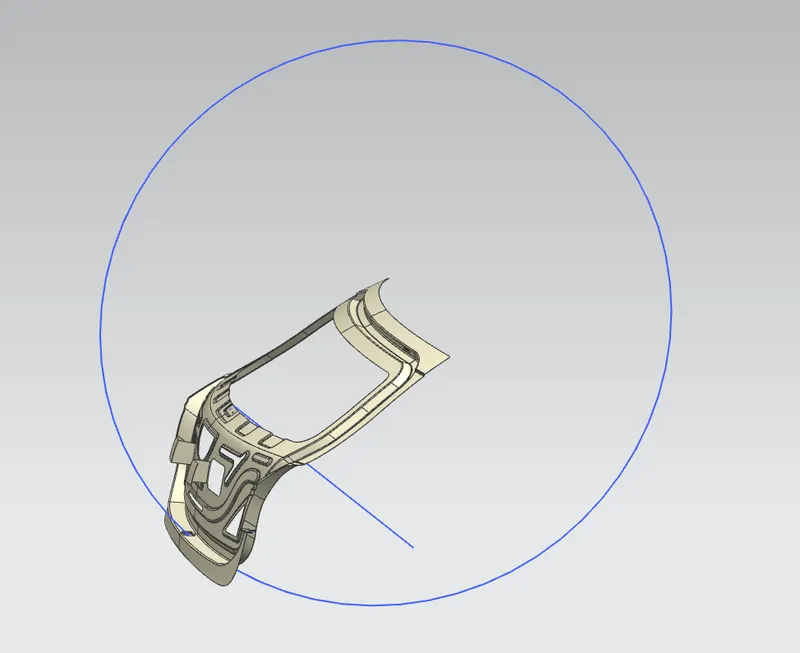
It plays major role in determining the smooth opening and closing of Backdoor. Circle is drawn by considering center as a hinge axis. Center point of the latch and striker should at the same point and its trajectory should be tangent to this big circle then proper opening and closing of back door is possible.
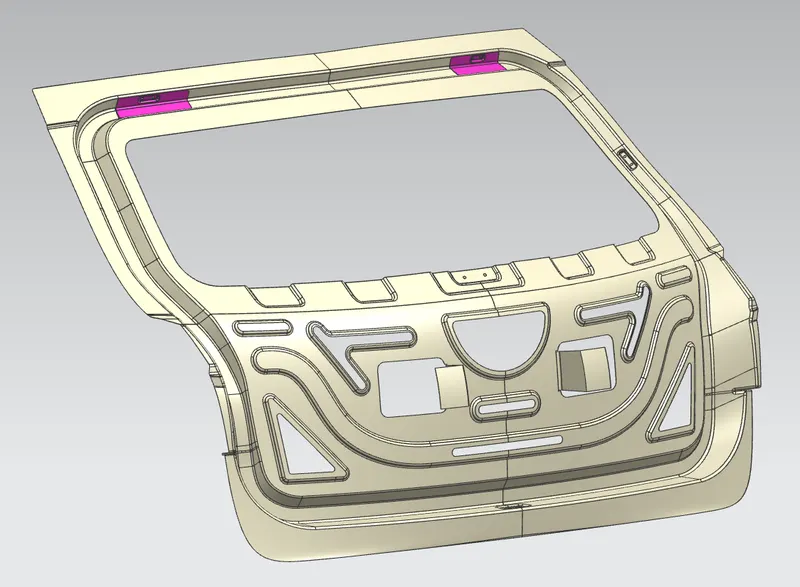
3) Hinge reinforcement :-
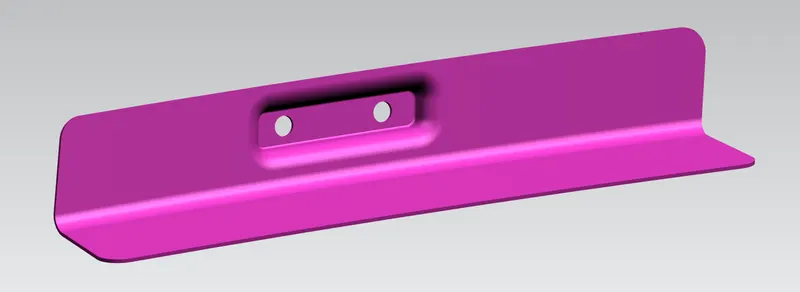
Hinge reinforcement is provided on the hinge mounting area to improve the strength of the mounting region. Hinges connects the back door with the vehicle allow the door to rotate around a fixed axis to open and close the door. one part of the hinge is connected to the vehicle body and other is connected to the back door.
4) Gas stay reinforcement :-
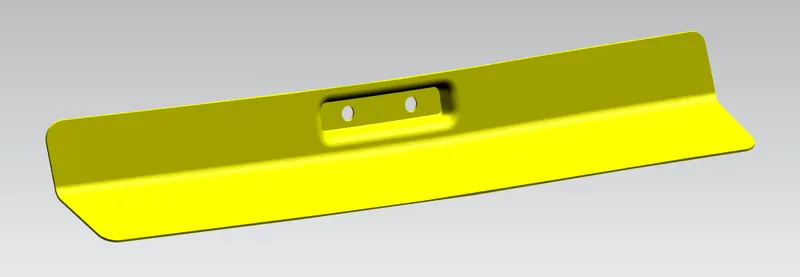
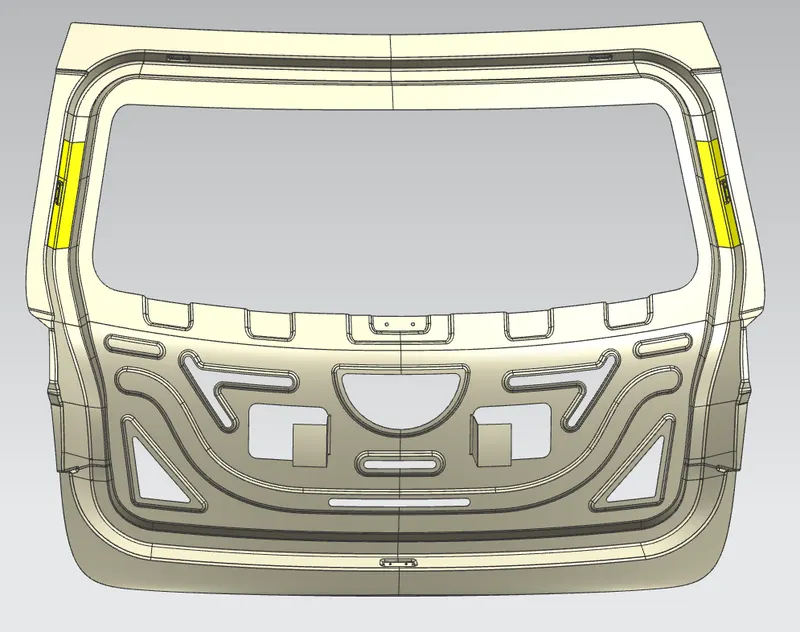
Gas stay is a pneumatic system used to support the back door to open and hold in open condition. Gas stay reduces the human efforts required to open the back door. One end of the gas stay is fixed on the back door and other end is fixed on the body of vehicle. Extra material is added at the gas stay mounting region of inner panel to improve the strength of mounting area.
5) Wiper motor reinforcement :-
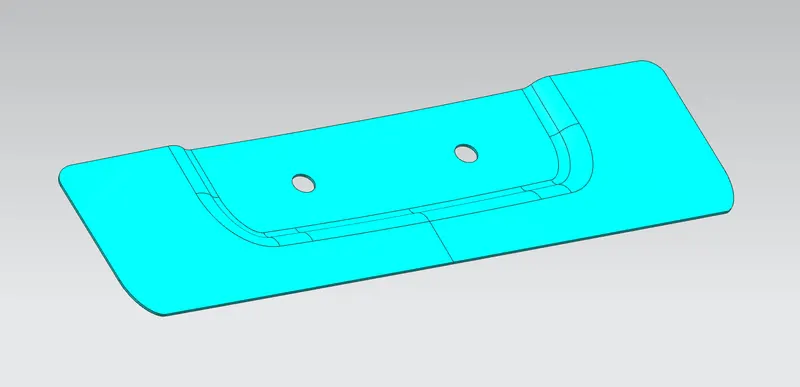
Wiper motor reinforcement is provided on the hinge mounting area to improve the strength of the mounting region. Windshield wipers are operated by an electric motor. The electric motor is attached to a worm gear, which transmits the necessary force to a long rod that sets the wiper arms in motion. The worm gear is able to generate the force required to move the wipers as fast as they need to move.
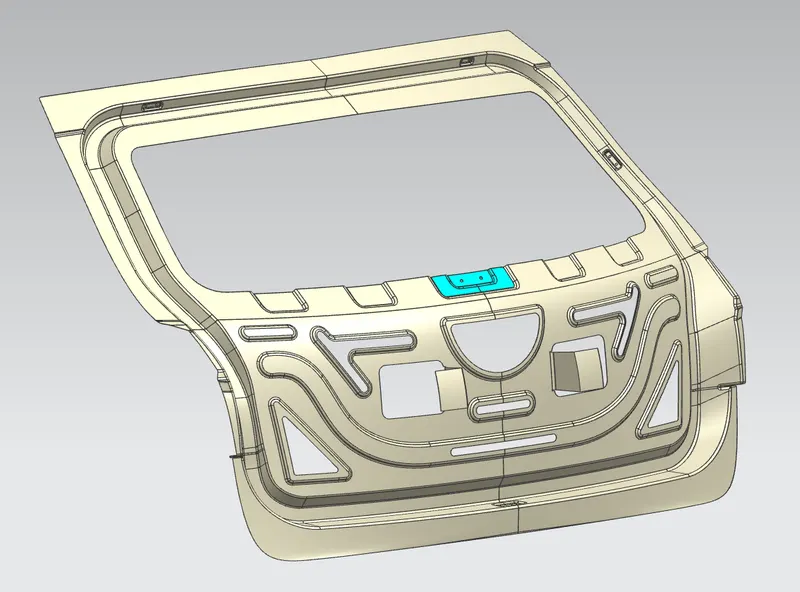
6) Latch and striker reinforcement :-
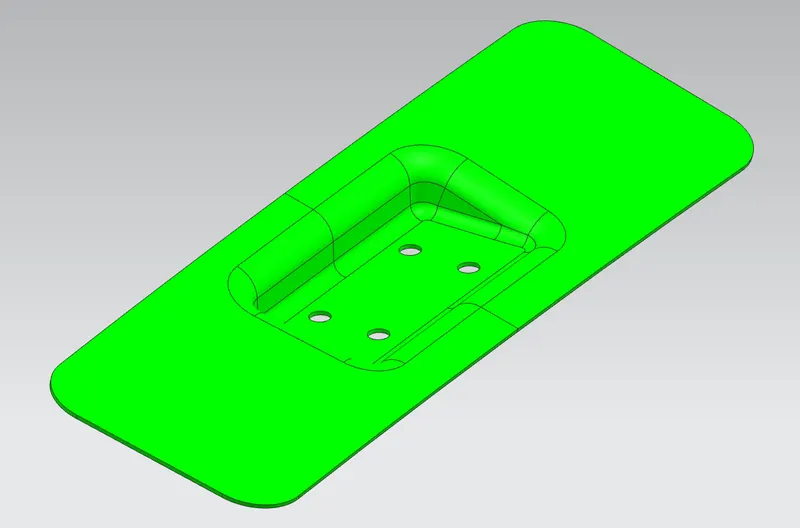
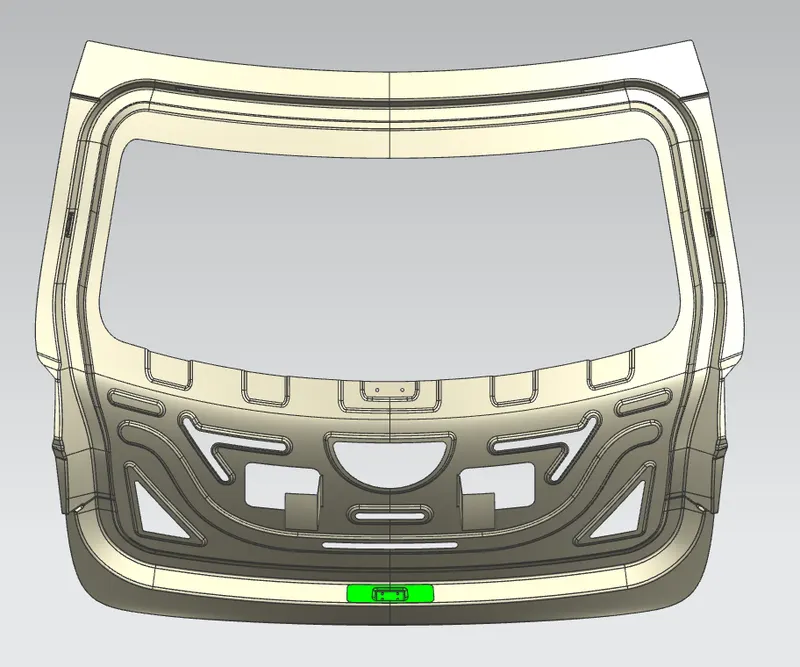
Extra material is added at the Latch and striker mounting region of the inner panel to improve the strength of mounting area.
Assembly :-
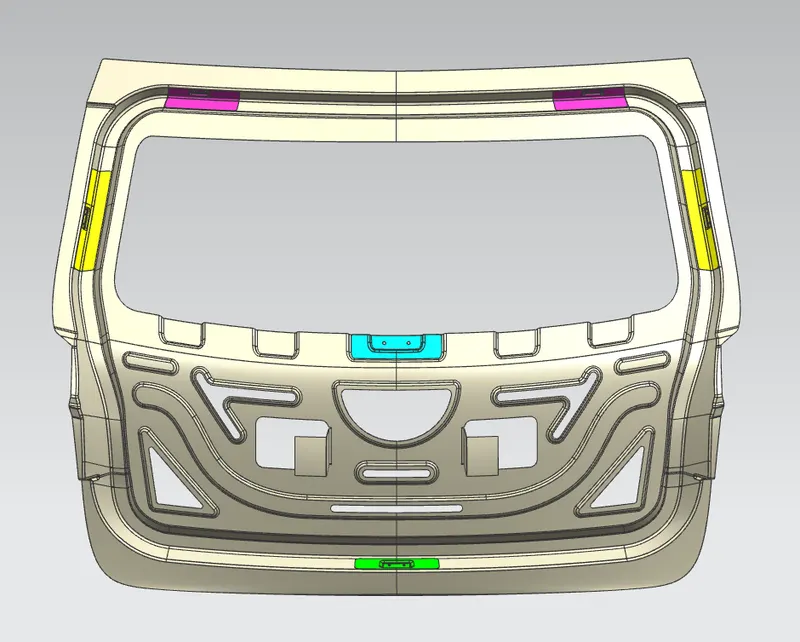
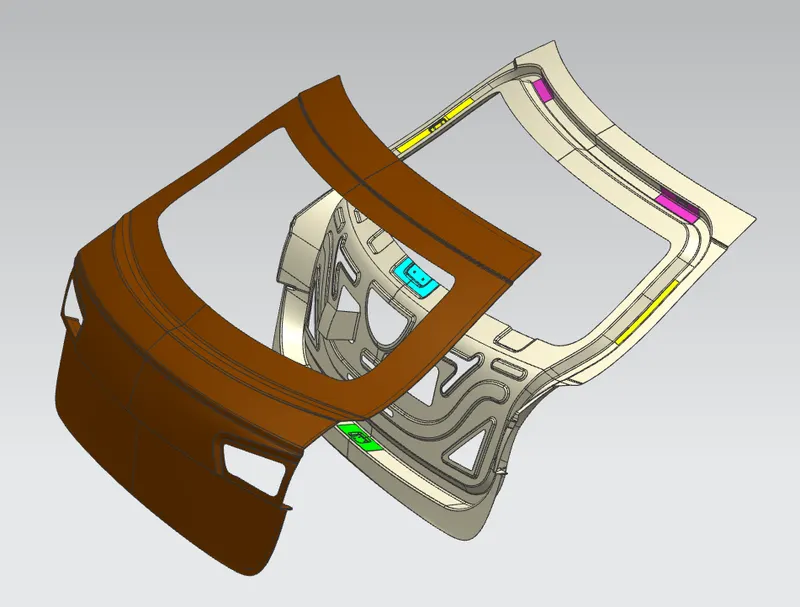
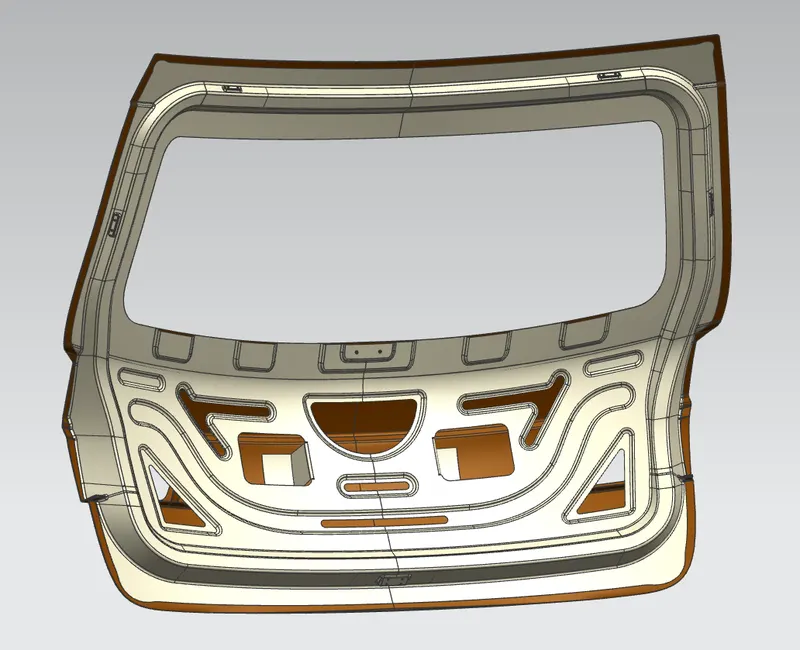
Sheet metal operations involved in manufacturing of back door
1) Deep drawing :-
The deep drawing process is a forming process which occurs under a combination of tensile and compressive conditions. A flat sheet metal blank is formed into a hollow body open on one side or a hollow body is formed into a hollow body with a smaller cross-section.
Deep drawing processes are divided into three types:
- Deep drawing with tools
- Deep drawing with active means
- Deep drawing with active energy
In the automotive industry, deep drawing is usually carried out using rigid tools
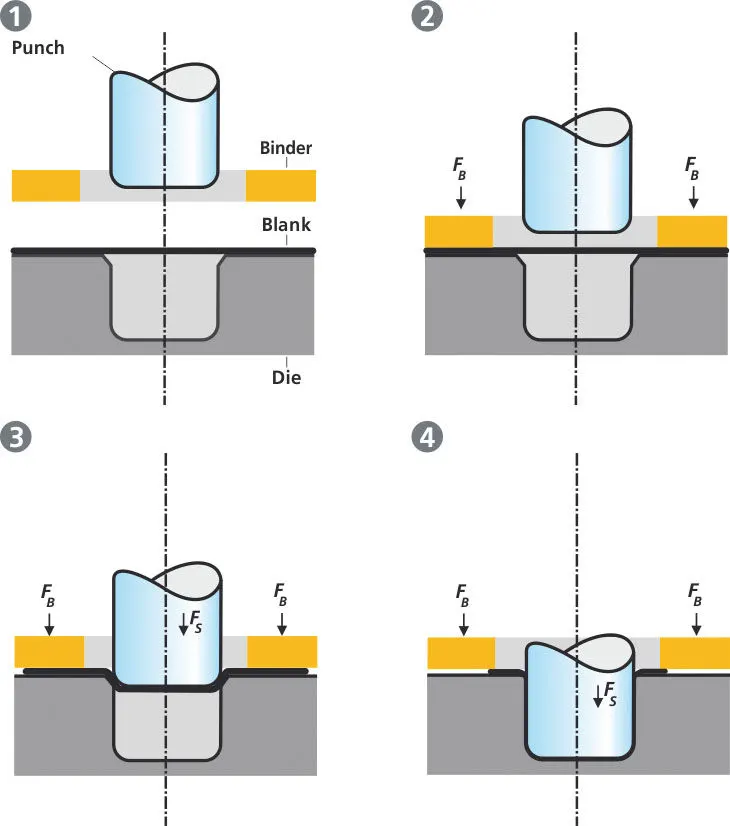
The figure illustrates the deep drawing process. The rigid tools consist of a punch, die and binder. In deep drawing, the plate holder closes after the metal sheet blank has been inserted.
Next the sheet is clamped between the die and the binder. This process slows down the flow of the sheet while it is being drawn and thereby prevents wrinkles from forming under the binder. The punch stretches the sheet over the die radius and forms it in the die. The amount of punch force necessary for forming is thereby continually increased up to the lower dead center of the punch.
Whereas in pure deep drawing there is no reduction of sheet metal thickness, forming is achieved in stretch forming purely as a result of a decrease in sheet metal thickness. Stretch forming is extensively used for the forming of only slightly curved parts with low depth of draw (e.g. roofs, doors).
When drawing complex car body parts in practice, there is usually a combination of stretch and deep drawing involved. It is necessary that the sheet metal is stretched as well as possible without reaching the material’s limits (e.g. splits, wrinkles).
2) Embossing :-
Sheet metal embossing is a metal forming operation in which the sheet metal is stretched into a shallow depression. Sheet metal embossing is generally used to create desired non-slip surfaces as well as other geometric features on the sheet metal.
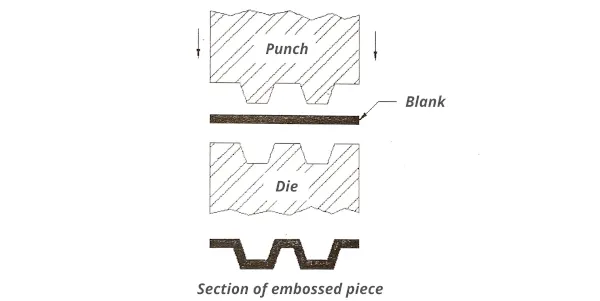
In sheet metal embossing, the deformation of the metal takes place because of stretching of the metal (or tensile force acting on the metal), due to which the sheet metal is subjected to excessive thinning and fracturing. Thus the depth to which the material is depressed depends upon the thickness of the sheet as well as stretchability of the material. Embossing is generally used to make dimples on sheet metal to increase their rigidity.
3) Hemming :-
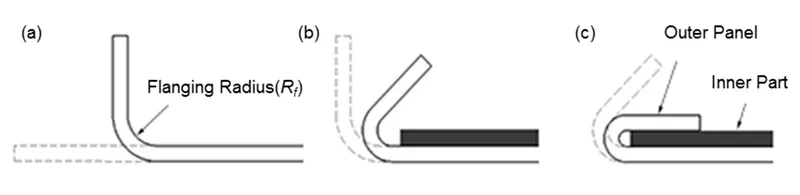
Hemming is a forming operation in which the edges of the sheet are folded or folded over another part in order to achieve a tight fit. Normally hemming operations are used to connect parts together, to improve the appearance of a part and to reinforce part edges.
In car part production, hemming is used in assembly as a secondary operation after deep drawing, trimming and flanging operations to join two sheet metal parts (outer and inner) together. Typical parts for this type of assembly are hoods, doors, trunk lids and fenders.
The accuracy of the hemming operation is very important since it affects the appearance of the surface and surface quality. Material deformations, which occur during the hemming process, can lead to dimensional variations and other defects in parts.
There are various types of hemming operations:
- Conventional die hemming
- Roll hemming
Conventional die hemming :-
Conventional die hemming is suitable for mass production. In die hemming, the flange is folded over the entire length with a hemming tool. Normally the actual hemming is a result of a forming operation in which the flange is formed with a hemming tool after the drawing and trimming operations have been completed. The formed flange is then hemmed in several process steps. These steps include, for example, the pre-hemming and final hemming depending on the respective opening angle of the flange. Production plants for conventional die hemming are very expensive, but the cycle times are very low.
Roll hemming :-
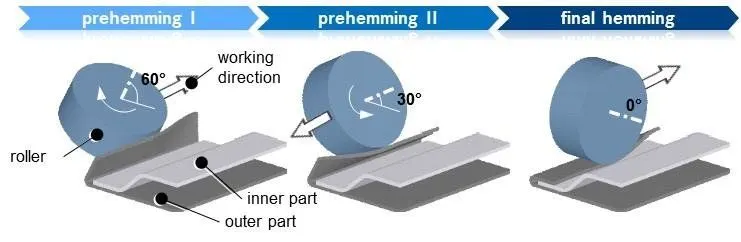
Roll hemming is carried out incrementally with a hemming roller. An industrial robot guides the hemming roller and forms the flange. Roll hemming operation can also be divided into several pre-hemming and final hemming process steps. Roll hemming is very flexible to use and tool costs are significantly lower as compared to those of conventional die hemming. However, the cycle times are much higher since the hemming is realized using a hemming roller which follows a defined path.
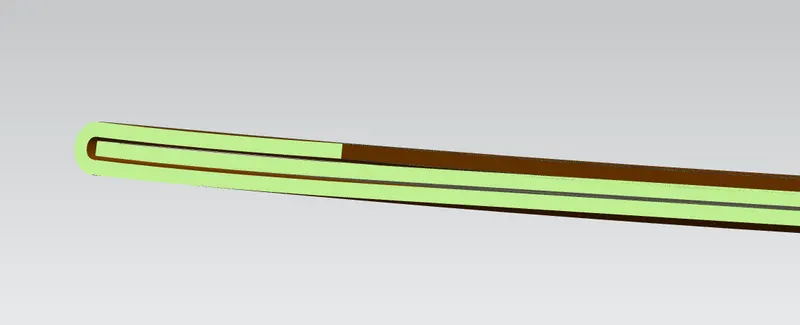
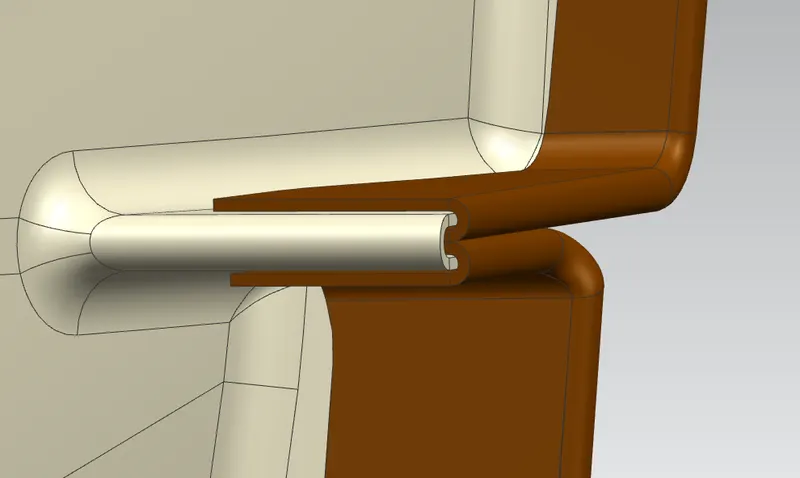
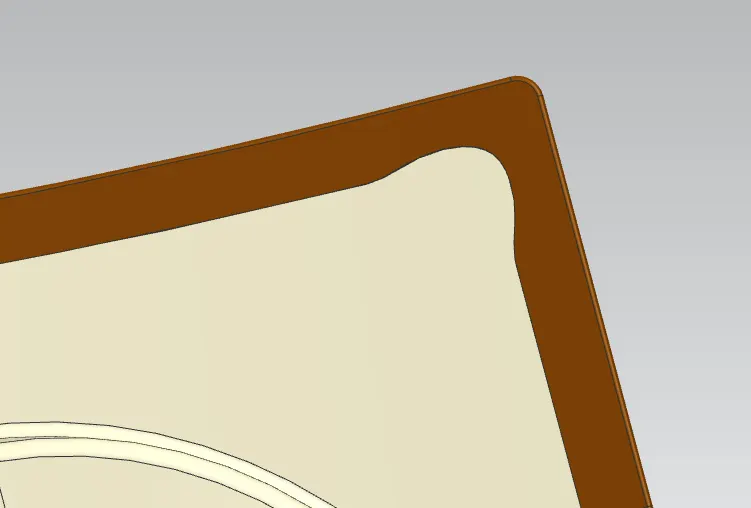
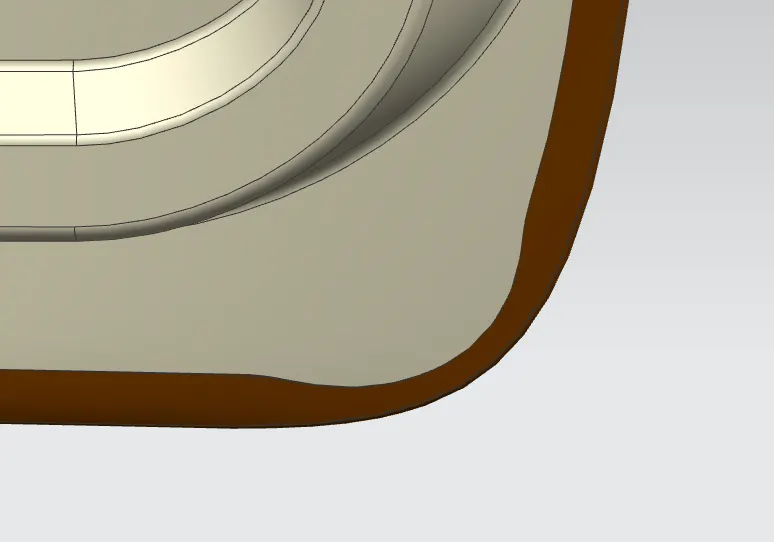
Corner reliefs are provided to reduce the stress concentration.
4) Blanking :-
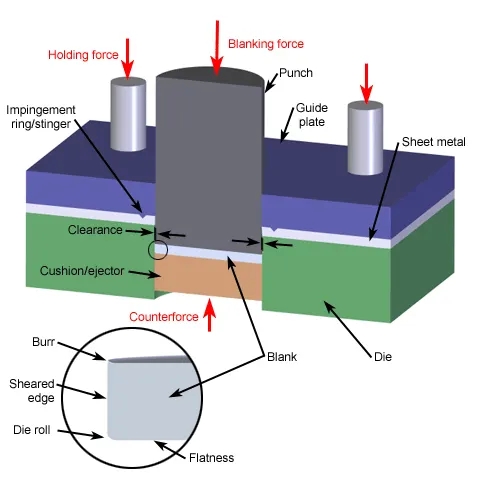
Blanking is a steel manufacturing process in which a flat, geometric shape or blank is created by feeding a coil of sheet metal into a press and die. In this process the blank is punched out from large metal sheet.
Press Blanking machinery can typically process material up to 72 inches (1828mm) wide and .250 inches (6.35mm) thick from coils up to 80,000 lbs. Typically multiple sheets are blanked in a single operation and the blanked parts will require secondary finishing to smooth out burrs along the bottom edge.
5) Piercing :-
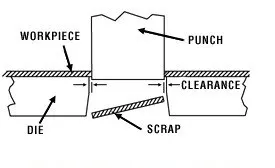
Piercing is a shearing process where a punch and die are used to create a hole in sheet metal or a plate. The process and machinery are usually the same as that used in blanking, except that the piece being punched out is scrap in the piercing process.
The amount of clearance between a punch and die for piercing is governed by the thickness and strength of the work-piece material being pierced.
Draft analysis :-
Draft analysis is performed to determine the model is suitable for manufacturing. Draft analysis is performed based on colour ranges identifying zones on the analyzed element where the deviation from the draft direction at any point, corresponds to specified values.
Views of back door :-
Conclusion :-
Thus the designing of the back door of a car is done as per the industrial standards and manufacturing aspects.