Design of backdoor
Objective:
The objective of this project is to design a BIW Back Door of a car with Inner Panel,Outer Panel and the Reinforcements for the Hinges, Gas stay, Wiper Motor and Latch byfollowing the engineering standards. The Inner Panel must be subjected to Draft Analysisfor verifying whether it satisfies the Deep Drawing requirements for the tooling direction created.
Introduction :
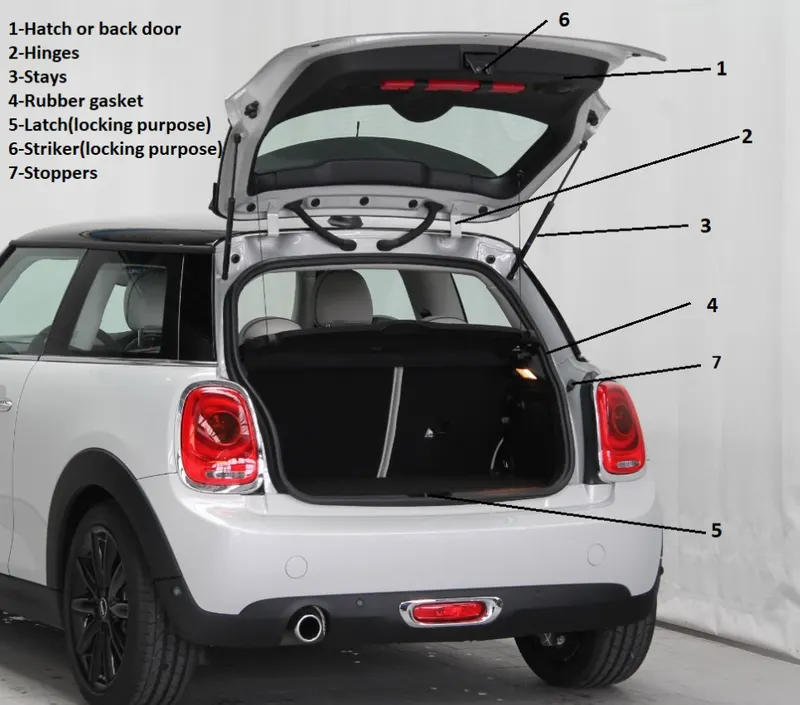
Back Door also called as ‘Hatch, or Tailgate, ‘Trunk-lid; ‘Boot-door is basically the 5 doorin a 4-door car. It the rearmost part of the vehicle which gives access to the trunk and hasmounts for wiper motor, tail lamps, hinges for supporting its weight opened position,gas stays which help with its opening and keeping it open, radars and cameras etc.
Types of doors based on working position:
1. Top Mounted Door
2. Side mounted Door
3. Bottom Door
A backdoor is usually made up of 1 inner panel and 2 or 3 outer panels joined together byhemming and spot welding wherever necessary. The material used for backdoor varies asper the price range of the vehicle. Most of the low cost vehicles use steel as it is cheaperand use parts that are stamped using moulds. These parts are usually of uniform thickness and reinforcements are added to improve local strength where needed. Thepremium vehicles use aluminum parts which are usually die casted and hence can havevariable thickness. This removes the need of reinforcements hence keeping the weighteven lower as aluminum parts are lighter in comparison.
Steel Parts are stamped, we cannot vary the thickness of the part because of morenumber of parts are added. which could increase the weight of the part.On the contrary aluminum is more expensive than steel hence its applications are limited in cheaper vehicle. Currently due to the extensive use of plastics trims and plastic parts the cost of aluminum is affordable for the manufacturers in all price brackets. Use of aluminum reduces the overall weight of the component and hence the vehicle improving its fuel efficiency.
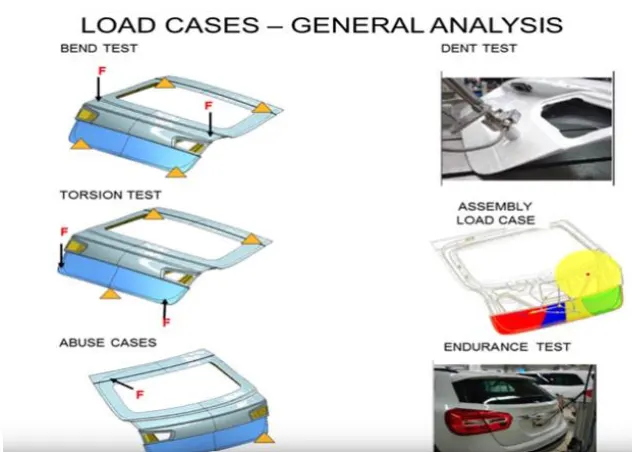
Different Sheetmetal processes used for manufacturing the Back Door:
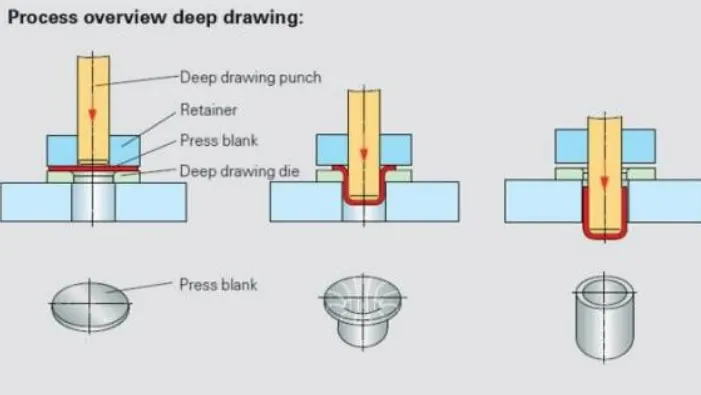
Deep Drawing:
The metal deep drawing process is an effective method of manufacturing of cups, cans and other similar deep drawing products. The deep drawings having two main categories:
1. First- stage drawing:
The blank shape of metal is placed on the die and contact with the punch. When the metal specimen is flat piece of sheet metal used in forming and finish the product. Initially the punch moves in downward direction. The outer rim of blank is subjected to pure radial drawing (drawing toward in vertical axes) between die and blank metal. The metal become a bend and sliding over die and also stretched between die and punch. The metal in vicinity of punch head and contact with it bend and slide over radii and stretch over punch head.
2. Redrawing:
The components drawn from first stage again it is redrawn convert into more depth to form a cup shape in the die and punch. The second stage of drawing is called as redrawing.
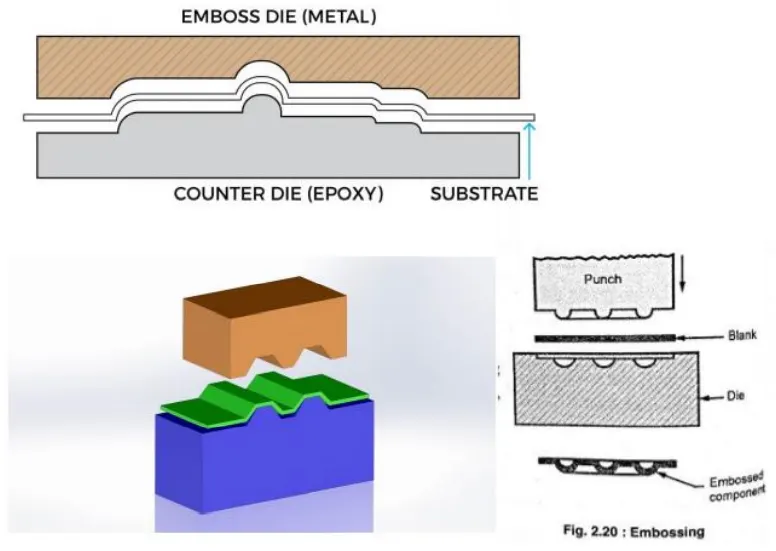
Emboss:
• Sheet metal embossing is a stamping process for producing raised or sunken design or relief in sheet metal.
• This process can be made by means of matched male and female roller dies or by passing sheet or a strip of metal between rolls of the desired pattern.
• Embossing is done by pressing a sheet of par=per in to female die, That has a design etched into it.
• This is usually done with a male counter part underneath the paper so that the two and the design is transferred to the paper.
• Depending on the roller dies used, different patterns can be produced on the metal sheet. Materials commonly used in the metal embossing process include: Aluminum alloys ,Steel alloys ,Zinc Copper, Galvanized steel, Brass Cold, rolled steel
Force Distribution:
When the car hit at rear end, the force which acted should be react outside. The Y/V emboss which is helps to move the force to the outer end. Hinge Reinforcement: Hinges are the essential, that allows doors to pivot on one edged as
open as they open and close. They are found on virtually all doors. It is a mechanical bearing that connects two solid objects, typically allowing only a limited angle of rotation between them Blanking: Blanking is a cutting operation of a flat metal sheet and the article punched out is known as blank. Blank is the required product of the operation and the metal left behind is considered as a waste. Punching: It is similar to blanking only the main difference is that, the hole is the required product and the material punched out from the hole is considered as a waste
MASTIC SEALANT
The mastic sealant is used to fix the inner panel with the outer panel which increases the NVH factor and stiffness of the back door. Inner and outer panel is joined using hem, but to make this bond stronger we introduce a paste between them which becomes like a rubber after solidifying. This paste covers around 80mm dia circular region around it and is firm for the distance of about 4mm to 5mm. Thus we must have a structure which is projected from the inner panel towards the outer panel and this must be around 5mm away from the outer panel to serve its purpose.
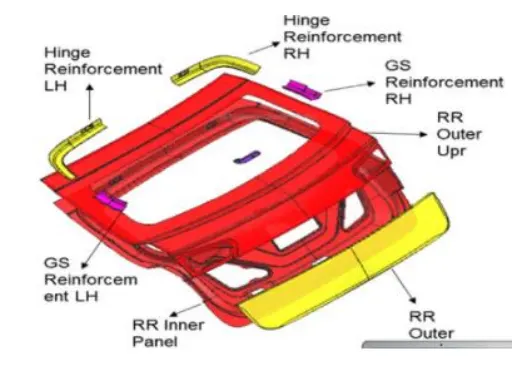
The different panels or regions are as follows:
• Inner panel:
• Outer upper panel:
• Outer lower panel:
• Latch and Striker Reinforcement
• Hinge Reinforcement Gas stay
• Reinforcement Wiper motor reinforcement
Design Considerations for a backdoor inner panel design:
1. Rear Visibility.
2. Support structures like hinges and gas stays.
3. Mounts for wiper motor, tail lamps, and other wiring loops.
4. Fit and clearances.
5. Boot space and accessibility.
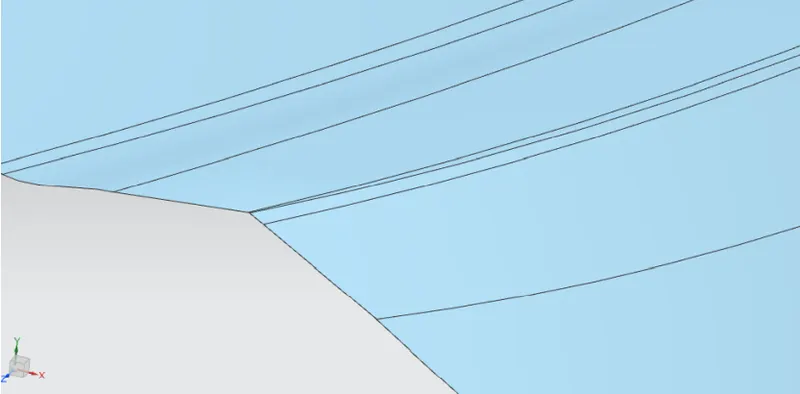
CHECKING THE CLASS A:
The first step is to organize the input skin data as upper outer surface and lower outer face. But before that we have to check for any irregularities in the surfaces and repair if and sew them together.
TOOLING DIRECTION:
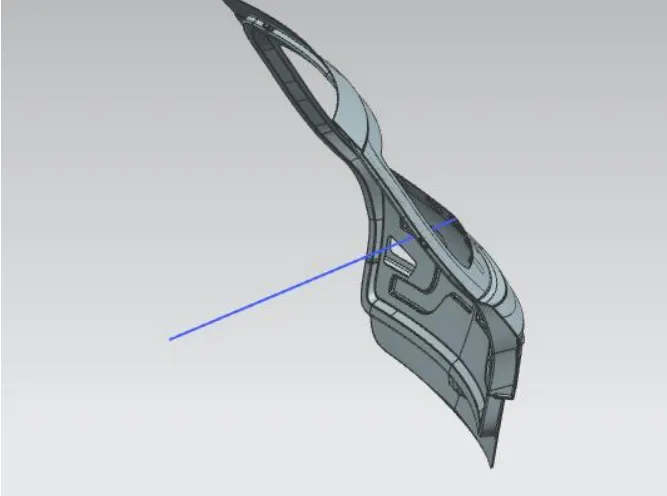
• Before starting to design the inner panel of the back door the tooling direction for Deep Drawing purpose should be created.
• Then the styling surface needs to be checked and analyzed since it might have irregularities, hence it must be fixed first.
• Then the back door was designed using the top down approach.
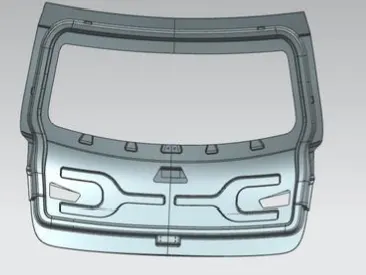
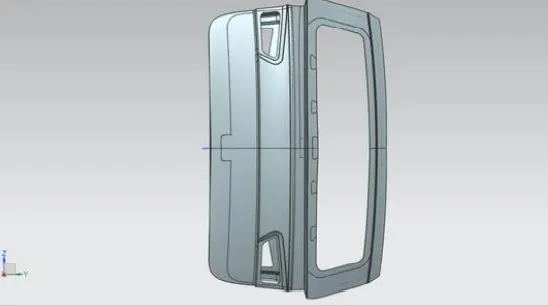
BACK DOOR INNER PANEL :
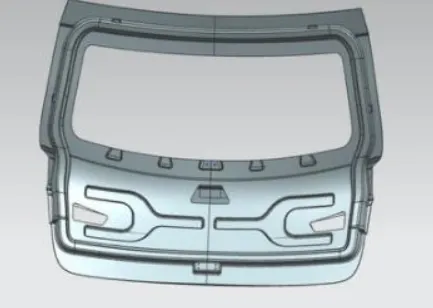
• After creating the tooling direction the design of the inner panel will begin where we will first develop an effective sealing flange by checking all the boundaries and by following the shape of the inner panel design .
• By creating multiple flanges and by using surface modeling techniques the concept design of the inner panel was created.
• After the concept of the inner panel is developed, then the child components like a hinge, latch, gas-stay locations and their reinforcements must be designed. Which complete the overall design of the tailgate.
• The embosses were created in ‘V-Shape or Y-Shape’ so that if the vehicle undergoes the crash then the force dissipates over it which reduces the damage transferred to the trunk space.
Gas stay Reinforcement:
They are two types of Gas stay reinforcement is there. That they are
• Manual System
• Power lift system
Manual system
This mechanism is most used in India cars. It is operated man by his own.
Power Lift System : It works on the basics of Sensor
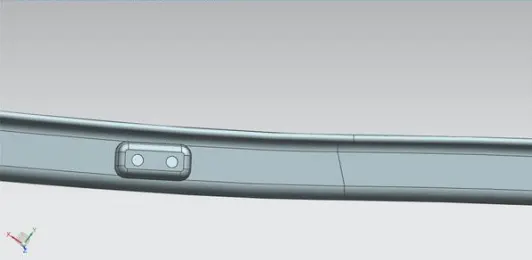
An angled or Diabolic emboss is provided for the gas stay mounts. The angle makes it easy to be machined and stamped. It is reinforced with a thicker sheet. It shows above figure
Wiper motor Reinforcement:
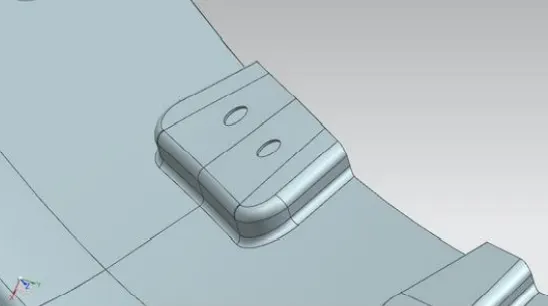
• A dedicated space near the window is left for wiper motor assembly. A cavity is placed in the middle of the panel for the necessary components in the assembly as well as other accessories.
• It is small electric motor which is mounted in the rear tail gate. It used to clean the rear wind sheid for clear visibility.
Latch and Striker reinforcement:
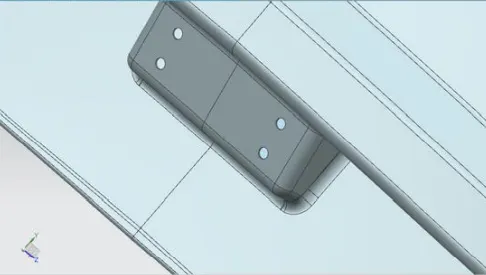
As shown above the holes or cavities are placed strategically to accommodate wiring looms, tail lamp mounts, and other accessories. Embosses a help stiffening the panel and act like local reinforcements. Extensions are provided around holes which are attached to outer panels and act as a crumple zone elements in case of rear impacts.
Hemming:
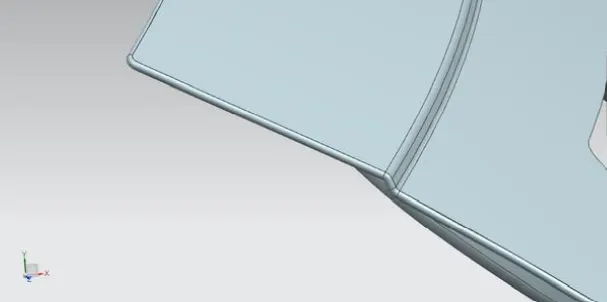
• Hemming is a forming operation in which the edges of the sheet are folded or folded over another part in order to achieve a tight fit.
• Normally hemming operations are used to connect parts together, to improve the appearance of a part and to reinforce part edges.
• Hemming is used in assembly as a secondary operation after deep drawing, trimming and flanging operation to join two sheet metal parts(outer and inner ) together.
• The accuracy of the hemming operation is very important since it affects the appearance of the surface and surface quality.
• Here hemming thickness -1mm
• There are various types of hemming operations:
1. Conventional die hemming: In conventional die hemming, the flange is folded over the entire length with a hemming tool.
2. Roll hemming: In roll hemming, the hemming roller is guided by an industrial robot to form the flange.
Corner Relief:
Relief helps to control sheet metal material behaviour and to prevent unwanted deformation during unbend operations.
BACK DOOR OUTER PANEL
• The Back Door outer panel was created using the styling surface.
• The outer panel was designed as two separate parts named as outer panel upper and outer panel lower.
• After designing the outer panel the Hemming was created by offsetting the surface with the help of face blend and swept surface.
• The two separate outer panel will be joined using Blanking
DRAFT ANALYSIS:
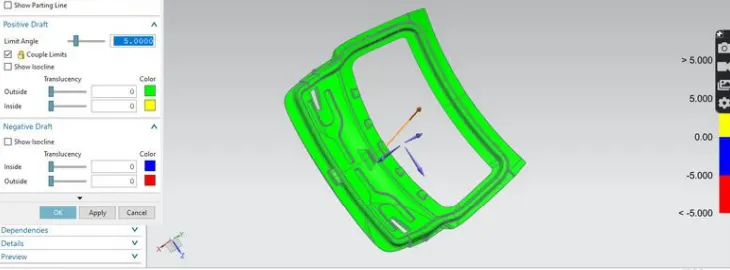
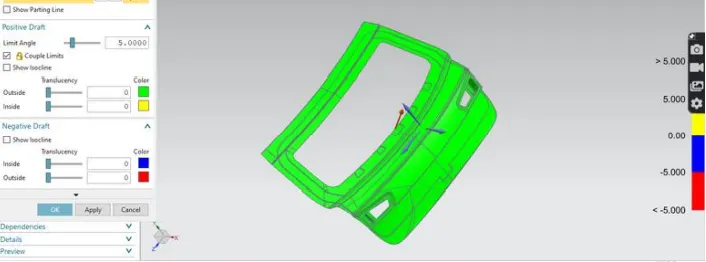
• The draft analysis will be performed for the tooling direction created at first and checked that the model is suitable for manufacturing.
• Then to get a complete green portion the necessary changes to the draft angle of the embosses were carried out by optimizing the model.
• The Draft Analysis command enables us to detect that the part drafted will be easily removed or not.
• This type of analysis is performed based on color ranges identifying zones on the analyzed element where the deviation from the draft direction at any point, corresponds to specified values.
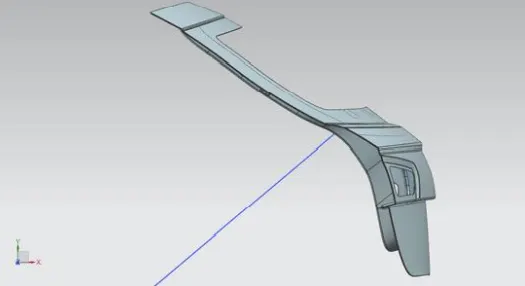
VARIOUS VIEWS OF THE CAD MODEL:
GOOGLE DRIVE LINK :-
https://drive.google.com/drive/folders/1to2q87fUs-AUIATJlq_jj4ROPThk0dbZ?usp=sharing