Design of backdoor
BACK DOOR DESIGN
AIM
To design the back door using the given styling surface provided along with the necessary embosses and reinforcements such as Hinge reinforcement, gas-stay reinforcement, wiping motor reinforcement and striker reinforcement.
INTRODUCTION
Back door:
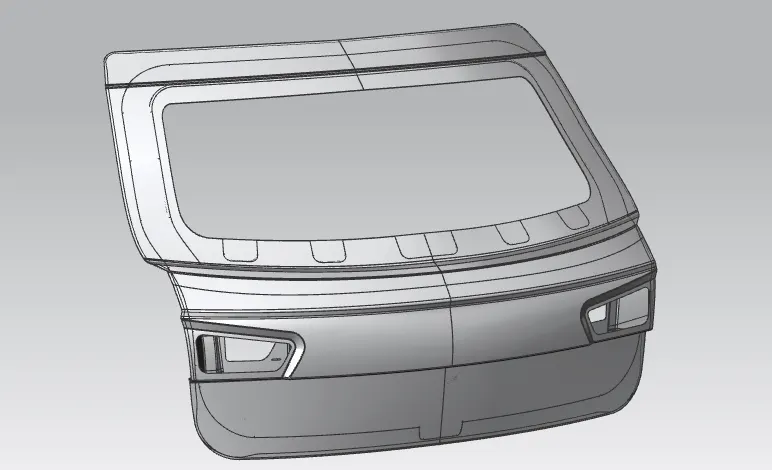
Fig shows: Back door
- The trunk or boot of a car is the vehicle's main storage or cargo compartment, often a hatch at the rear of the vehicle. It is also called a tailgate.
- The door that closes the trunk of the car is called the back door. Sometimes the rear passenger compartment door also get confused with the back door. But most of the time the back door defines the boot.
- The door or opening of a cargo area may be hinged at the top, side, or bottom.
- If the door is hinged at the bottom it is called a tailgate, particularly in the United States.
- They are used on station wagons and pickup trucks, as well as on some Sport Utility Vehicle (SUV). Traditional drop-down station wagon and pickup tailgates can also serve as a mount for a workbench.
- Traditional U.S. station wagons included a roll down window retracting into the tailgate to load small items or to allow the tailgate to be opened down on its bottom mounted hinges. Because of the potential for carbon-monoxide fumes, the tailgate window on station wagons should be closed whenever the engine is running.
- If the door is hinged at the top it is termed a hatch, and is used on a hatchback. A bottom opening door is now common on SUVs.
Lid:
- The trunk lid (in the U.S. automotive industry sometimes also called decklid or deck lid) is the cover that allows access to the main storage or luggage compartment. Hinges allow the lid to be raised.
- Devices such as a manually positioned prop rod can keep the panel up in the open position. This holding device is now called the gas stay which reduces the human effort when opening the back door and holds the back door in its opened position.
Various parts of the door:
- The door comprises of an inner panel, 2 or 3 parts as outer panel, gas stay reinforcement, Hinge reinforcement, striker reinforcement and wiping motor reinforcement.
- The outer panel and inner panel are joined together by using hemming process or spot welding if possible.
- The inner panle is always made as a single part whereas the outer panel may consist of 2 (or) 3 parts.
- The striker reinforcement position is predicted by using latch trajectory method after fixing the hinge position.
- The panels are generally made of steel and in modern days aluminium is widely used for its low weight and high strength and ease of manufacturability.
Material used:
- The material used for back door varies as per the price range of the vehicle. Most of the low cost vehicle use steel as it is cheaper and used parts that are stamped using moulds.
- These parts have uniform thickness and reinforcements are added to increase local strength wherever needed.
- The premium vehicle uses aluminium parts which are die casted and hence can have variable thickness. This eliminates the need of additional reinforcements which reduces the weight of the door as aluminium is much lighter than steel in comparison.
| Material | Yield strength (MPa) | Ultimate tensile strength |
| Steel | 210-1250 | 340-1520 |
| Aluminium | 90 | 195 |
| CFPR | - | 250-585 |
- The CFPR is the Carbon Fiber Reinforced Plastic which possess high strength of all and the main limiting factor is that the cost of the material.
- The response of the automotive industry has been to introduce new materials for body-in-white applications, including aluminium, polymers and composites. Much of the weight-saving focus has centred on the vehicle body as this accounts for about 30% of the total vehicle weight. In addition to this, the industry has also introduced new steels of higher strength and thinner gauge in order to replace the traditional mild steel in body applications.
Back door design:
Design considerations:
- Rear visibility criteria
- Supporting parts such as hinges and gas stay
- Rear crash requirements
- various mounts such as motor, tail lamps, sensors, cameras,etc.,
- Boot space
- Sealing functions
- Fit and clearances
- Joining techniques like hemming, spot welding, etc.,
Thickness of parts:
- Outer panel thickness - 0.75mm
- Inner panel thickness - 0.75mm
- Reinforcement thickness - 1.5mm
The main parts of the project are,
- Outer panel upper
- Outer panel lower
- Inner panel
- Hinge reinforcement LH
- Hinge reinforcement RH
- Gas-stay reinforcement LH
- Gas-stay reinforcement RH
- Latch and Striker reinforcement
- Wiping motor reinforcement
- Plastic trim (not designed)
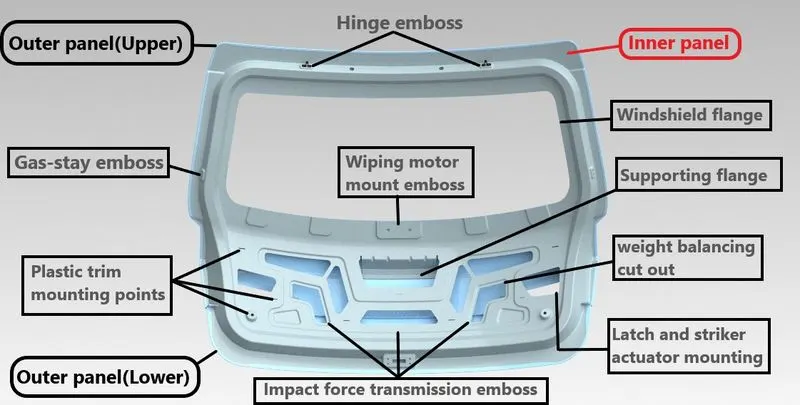
Fig shows: Various parts and mounting points of the back door
- Both the outer panel and inner panel are designed using the styling surface provided and checked for surface integrity at the initial stage.
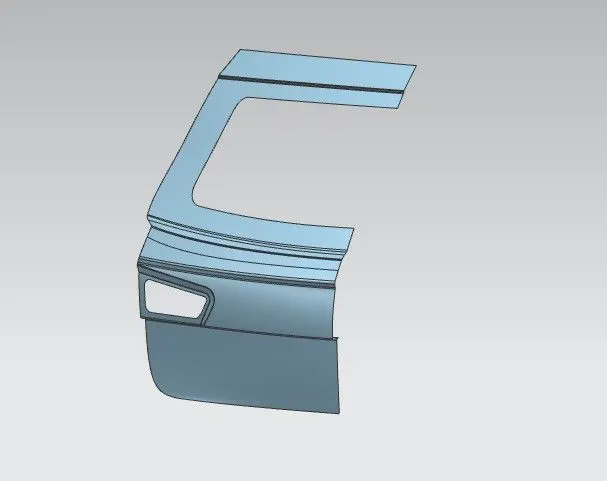
Fig shows: Styling surface provided
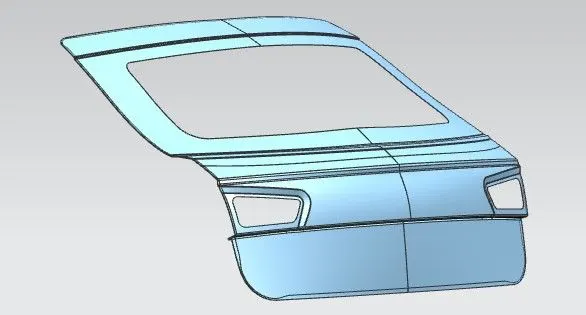
Outer panel-
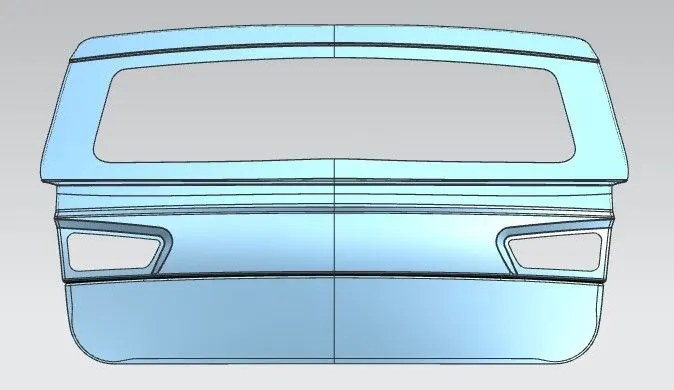
Fig shows: Outer panel
- It is one of the most vital parts of the back door that protects the vehicle from foreign particles such as dust, water, air,etc,
- It has a thickness of 0.75mm and it comprises of 2 to 3 parts that are joined together by welding.
- The outer panel comes with aerodynamic design which helps to reduce drag and also provides aesthetic look to the vehicle.
Design methodologies-
Hemming
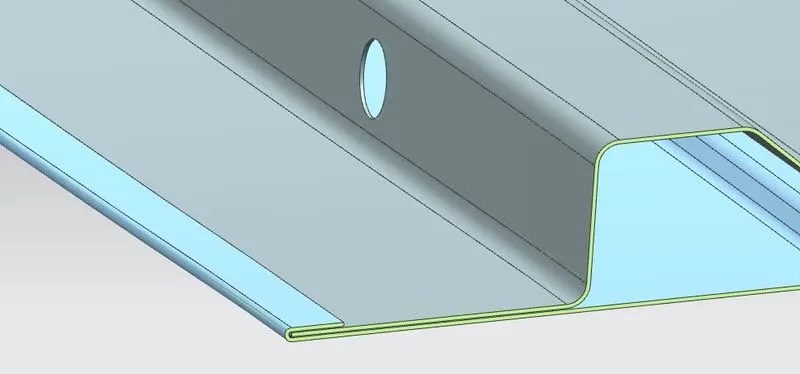
Fig shows: Hemming in backdoor
- Hemming is one of the joining processes of sheet metals. It is mainly used for joining the outer panel to its inner panel.
- Since the outer panel is exposed to the atmosphere and also gives the aesthetic look to the vehicle, it cant be spot welded to join the panels that will create impressions on the outer surface of the panel.
- To avoid these impressions hemming is used and adhesives also used after hemming to provide additional strength to the joints.
- Hemming is a sheet metal forming process in which sheets are joined by bending it usually to 180°. Automotive body panels and automotive parts such as deck-lids, trunk-lids, doors, hoods and tailgates are formed by hemming process.
- Hems are commonly used to reinforce an edge, hide burrs and rough edges, and improve appearance.
- In car part production, hemming is used in assembly as a secondary operation after deep drawing, trimming and flanging operations to join two sheet metal parts (outer and inner) together. Typical parts for this type of assembly are hoods, doors, trunk lids and fenders.
- The accuracy of the hemming operation is very important since it affects the appearance of the surface and surface quality. Material deformations, which occur during the hemming process, can lead to dimensional variations and other defects in parts. Typical hemming defects are splits or wrinkles in the flange, material overlaps in the corner areas or material roll-in. This is why it is important to use simulation tools in order to, on the one hand, better understand the hemming process and, on the other hand, significantly reduce the number of “trial and error” loops during tryout und production.
There are various types of hemming operations:
- Conventional die hemming
- Roll hemming
- Conventional die hemming is suitable for mass production. In die hemming, the flange is folded over the entire length with a hemming tool. Normally the actual hemming is a result of a forming operation in which the flange is formed with a hemming tool after the drawing and trimming operations have been completed.
- Roll hemming is carried out incrementally with a hemming roller. An industrial robot guides the hemming roller and forms the flange. Roll hemming operation can also be divided into several pre-hemming and final hemming process steps. Roll hemming is very flexible to use and tool costs are significantly lower as compared to those of conventional die hemming.
- In automobile industries roll hemming is widely used.
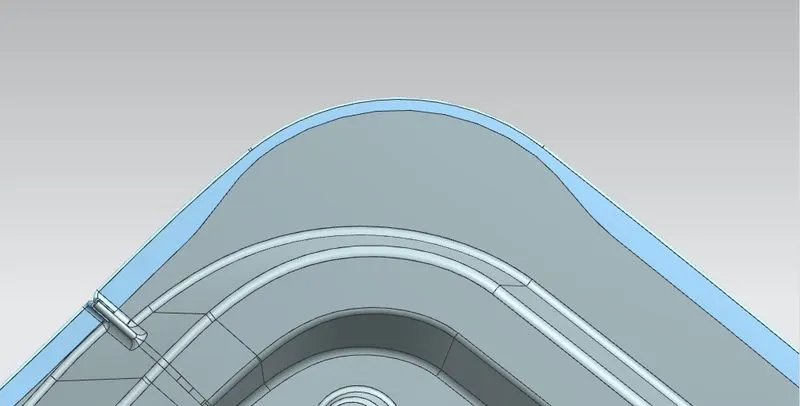
Fig shows: Relief angle provided in hemming
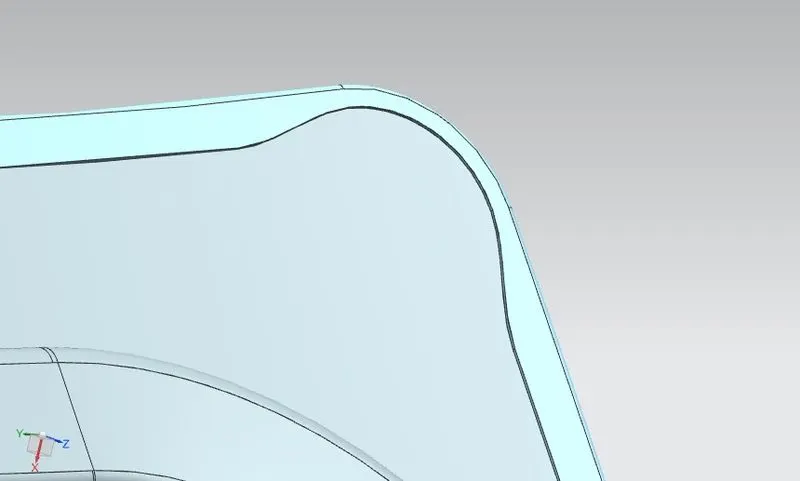
- During hemming process a relief angle is provided at the corner edges of the sheet metal design.
Inner panel-
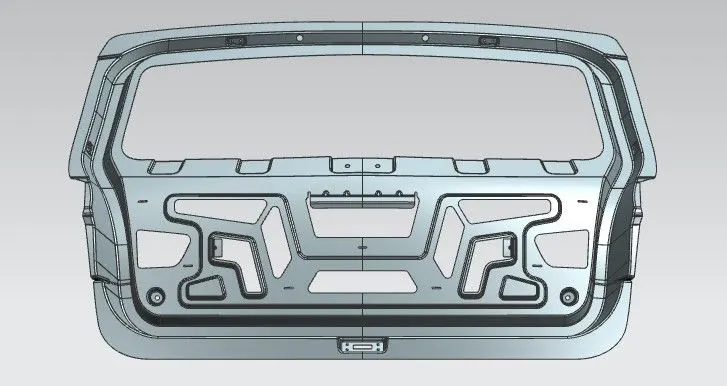
- A hybrid back door inner panel for a vehicle is provided to improve rigidity, durability, and pedestrian protecting performance by comprising a composite structure in which a multi-cone structure and a frame structure are individually arranged on the front and the rear.
- It is made as a single part and joined with the outer panel using hemming process.
- A separate tooling axis is initially drawn and the inner panel is designed with respect to that tooling axis defined as vector.
- Necessary embosses are provided to increase the strength of the inner panel.
- In this panel the embossing is done and other aspects like reinforcement, mastic points are also provided.
- The inner panel is designed with a thickness of 0.75mm.
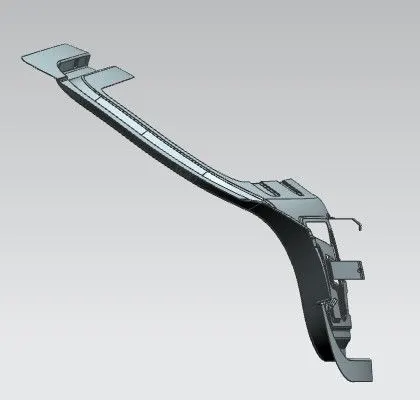
Deep drawing process-
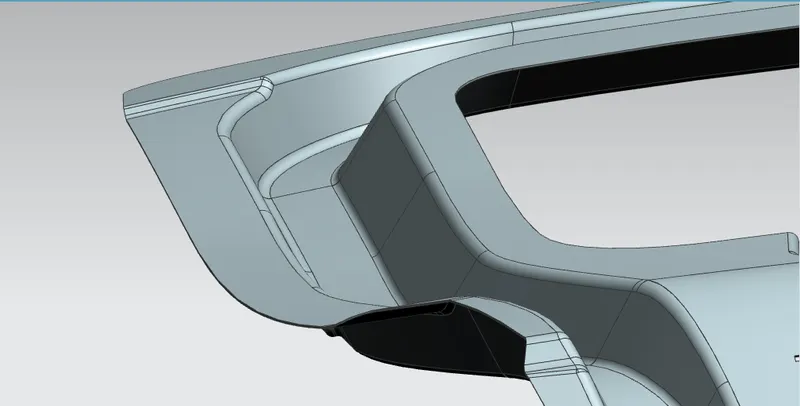
Fig shows: Deep drawing done in inner panel
- Deep drawing is one of the most widely used processes in sheet metal forming. Apart from its use in many other sectors, it is applied in the automotive industry for the manufacturing of car body parts.
- The deep drawing process is a forming process which occurs under a combination of tensile and compressive conditions. A flat sheet metal blank is formed into a hollow body open on one side or a hollow body is formed into a hollow body with a smaller cross-section.
- Deep drawing processes are divided into three types:
- Deep drawing with tools
- Deep drawing with active means
- Deep drawing with active energy
- In the automotive industry, deep drawing is usually carried out using rigid tools.
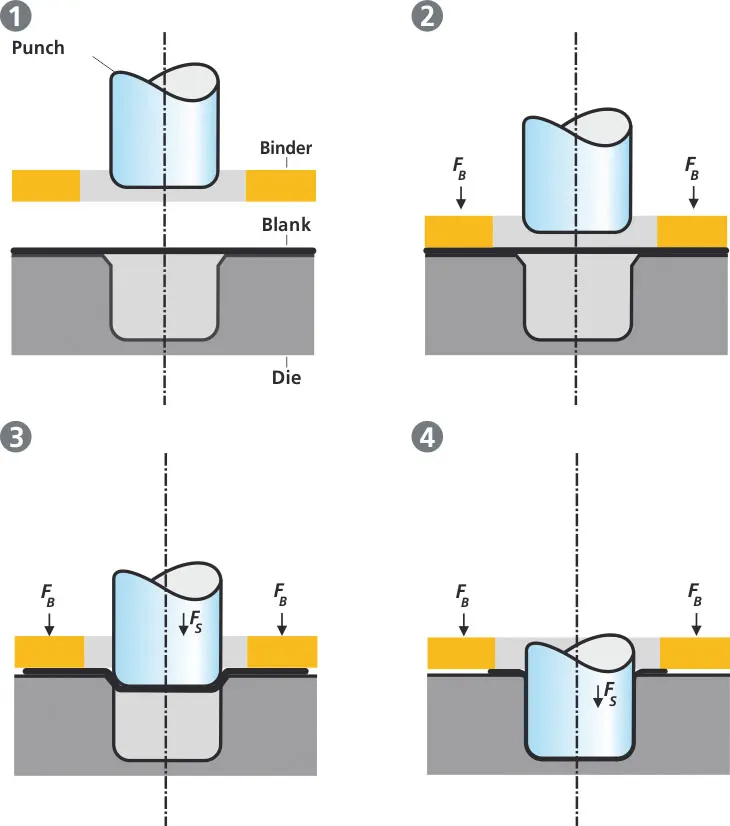
Fig shows: Deep drawing with tools
Emboss-
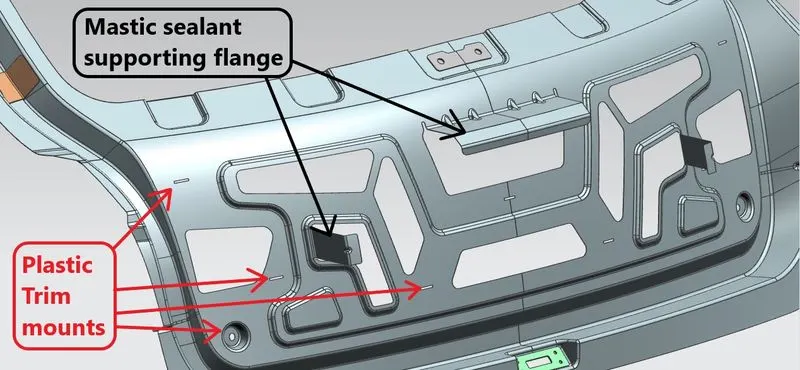
Fig shows: Embosses in back door inner panel
- The metal sheet embossing operation is commonly accomplished with a combination of heat and pressure on the sheet metal, depending on what type of embossing is required. Theoretically, with any of these procedures, the metal thickness is changed in its composition.
- It is mainly done to provide pedestrian safety and safety for the people in the vehicle. The energy created during collision is dissipated by the 'V' or 'Y' shaped embossing provided in the inner panel.
- It also reduces the weight of the panel therby increasing the performance of the vehicle and cost reduction can be achieved.
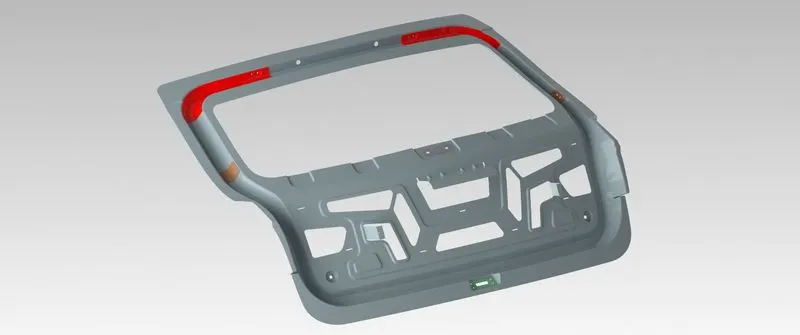
Fig shows: Inner panel with reinforcements
- Mastic sealant points must be provided between inner and outer panel. Mastic Sealants are used to Join Inner and outer Panel as welding both panel will neglect the shape and appearance of the panel.
- Mastic Sealer is a synthetic rubber based sealer material which has a good filling properties and corrosion resistance. It is designed to applied at doors, roof, hood, in specific, the gaps between inner & outer panel.
- The material is cured through e-coat oven, and it has a property of paste before curing processes.
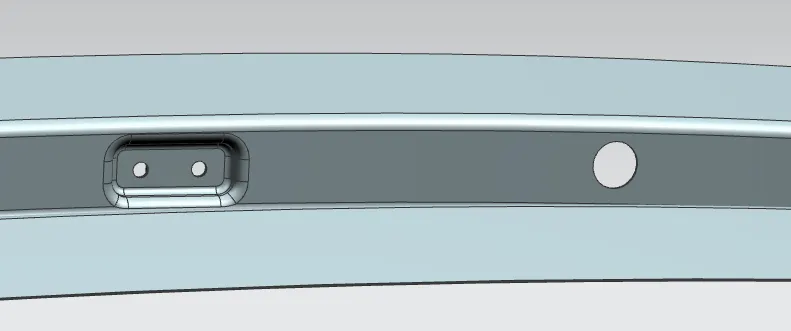
Fig shows: Emboss for hinge reinforcement and wiring harness hole
Draft analysis-
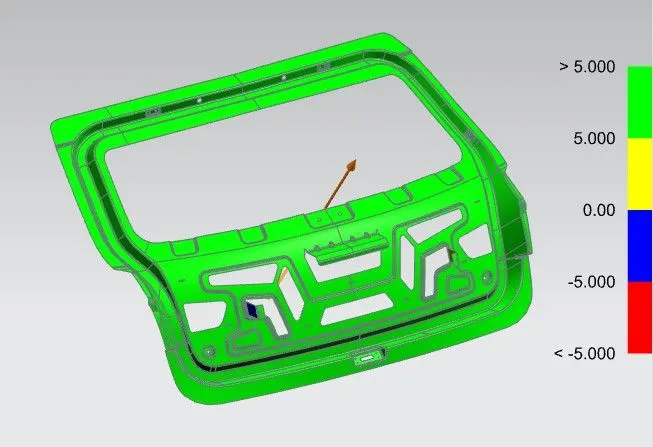
Fig shows: Draft analysis done for inner panel
- Draft analysis is done to make sure that there is no negative draft in the panel design before it is moved to the CAE team for analysis.
- Here, a 5 degree draft analysis is done and analysed for negative drafts or undercuts. Since all the faces are green in colour the drafts are positive.
- The design of the inner panel is positive one to be submited to the CAE team.
- The mastic sealant supporting flange could not be drawn by the same tooling axis. Hence, it is formed in the second step where the cut out portion of the emboss is bend and cut as needed.
Latch trajectory motion-
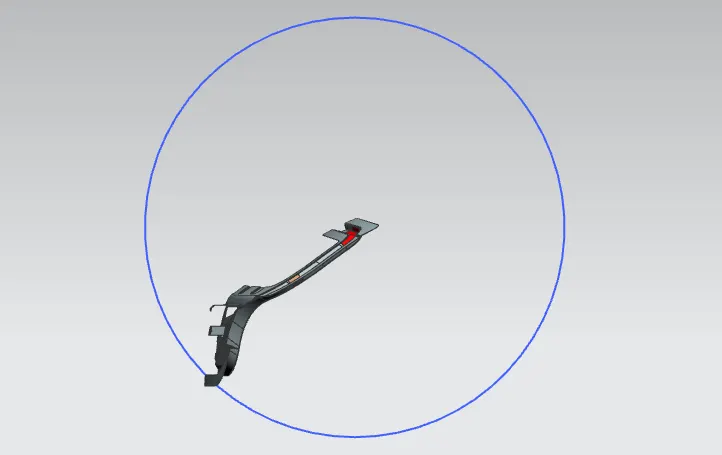
While opening and closing the back door, the latch must be perfectly alligned to the fixing or the striker position to avoid malfunction of the latch and striker mechanism. To ensure the position of the latch, the latch trajectory is drawn perpendicular to the hinge axis. The latch fixing or striker point is adjusted so that it would be perpendicular to the hinge axis and travels along the latch trajectory in its open and closed positions.
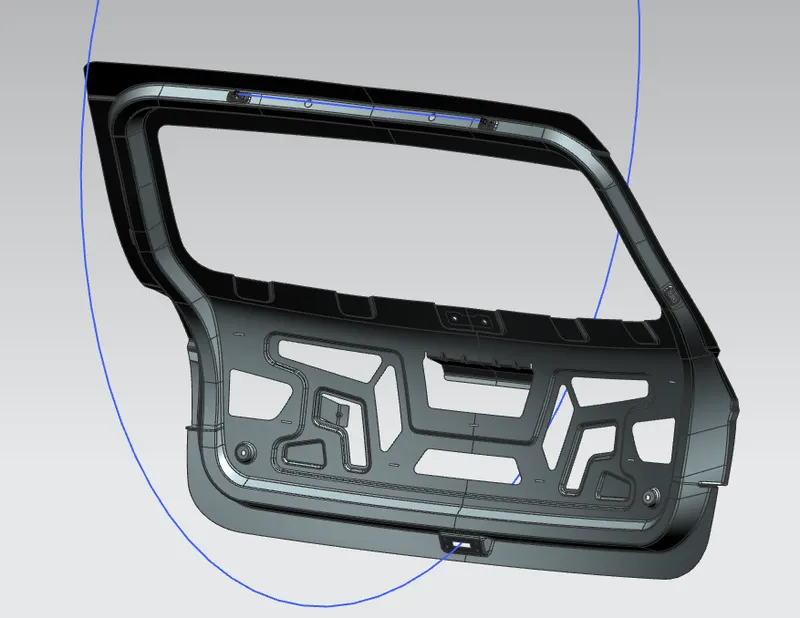
Fig shows: Latch trajectory and its postion with hinge axis
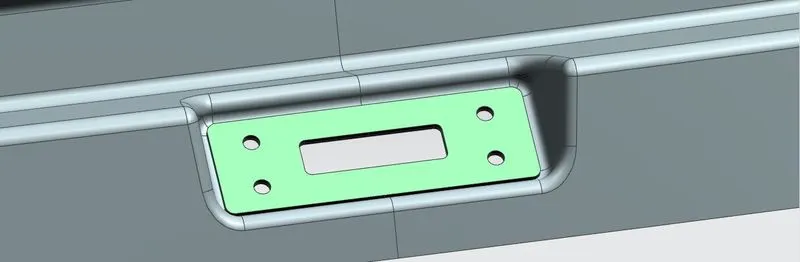
Fig shows: Striker and latch reinforcement mount
Reinforcements-
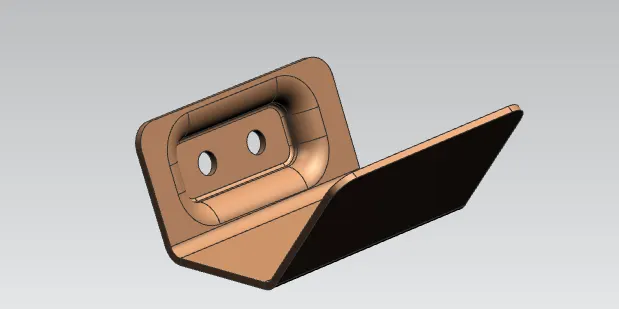
- The reinforcement structure as provided to reduce impact in collisions to passengers. When latch and striker attached to the panel, the strength will be reduced in that area. In order to improve the strength in that area the reinforcement is added.
- They are added to compensate the strength lost in the specific region yet increasing the weight of the panel.
- This increase in weight is prevented when using aluminium as production material which removes the need of reinforcements.
Hinge reinforcement:
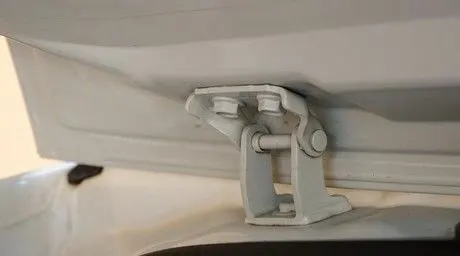
Fig shows: Hinge assembly in back door
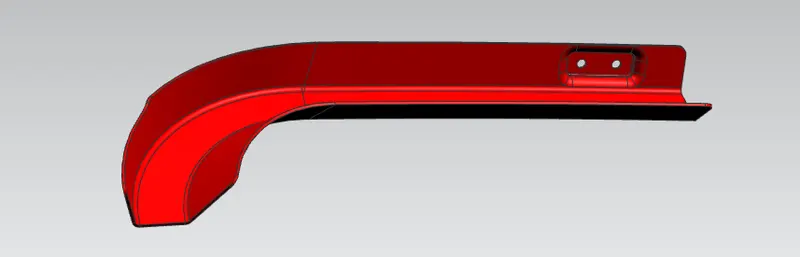
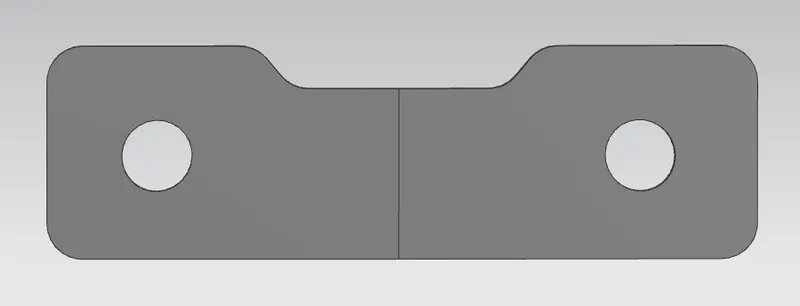
- The hinge is a pivot and bracket mechanism that makes it possible for us to open and close the trunk. Each car typically has a pair of hinges (driver and passenger side) installed in the rear side of the vehicle.The hinges control the up and down movement of the panel, limiting how far it can swing open while also supporting the weight of the hood when it is propped open for a longer period.
- To mount hinge in the door panel, embosses are made in the inner panel.
- Since the mounting area experiences more stress due to load applied, reinforcements are provided for each hinge with thickness of 1.5mm. This increases the strength locally.
Gas-stay reinforcement:
- Gas stay is used to reduce the human effort when opening and closing the back door. In premium cars the door can be opened automatically without the human effort and it is done with the help of pneumatic or hydraulic gas stay.
- The gas stay mounting points are given reinforcements to improve the localized strength of the inner panel.
- The thickness of the gas stay reinforcement is 1.5mm.
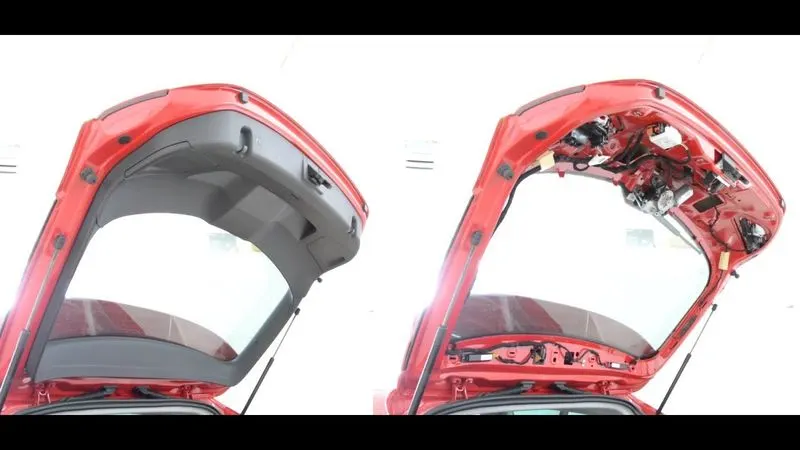
Fig shows: Gas stay position
Latch and striker reinforcement:
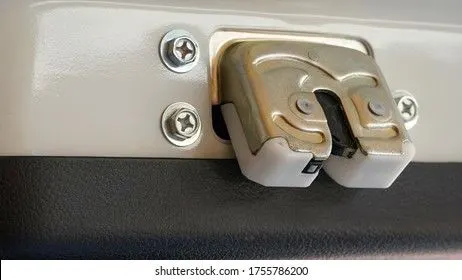
Fig shows: Latch in back door
- A vehicle door latch and release mechanism is latched when the door striker engages the latch portion of the mechanism as the door is moved to its closed position. The mechanism is actuated to release the door striker by a pushing action on the cable or strand movable in the sheath of a cable assembly rather than by the typical pulling action on current releasing mechanisms.
- The pushing action is obtained with actuation of the latching and releasing control, by movement of a handle which operatively pushes on the cable or strand, transmitting a longitudinally compressive force rather than a longitudinally tensional force to the latch mechanism and moving that mechanism to the striker-released position.
- Reinforcement is provided for the striker mounting point in the inner panel with thickness of 1.5mm.
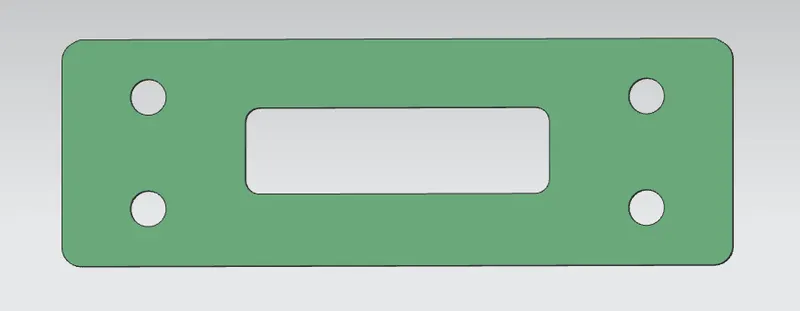
Wiper motor reinforcement:
- The wiper motor is assembled in the inner panel at the middle bottom edge of the windshield flange.
- It has mounting point with holes and reinforcement is provided to support the motor and to withstand the vibrations.
- It has a thickness of about 1.5mm.
Assembled back door images:
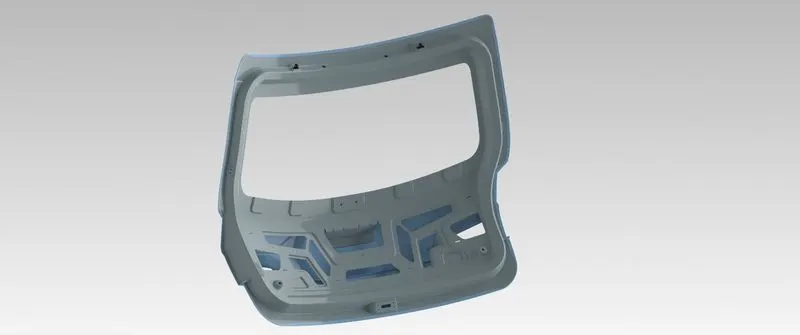
Fig shows: Assembled view of back door
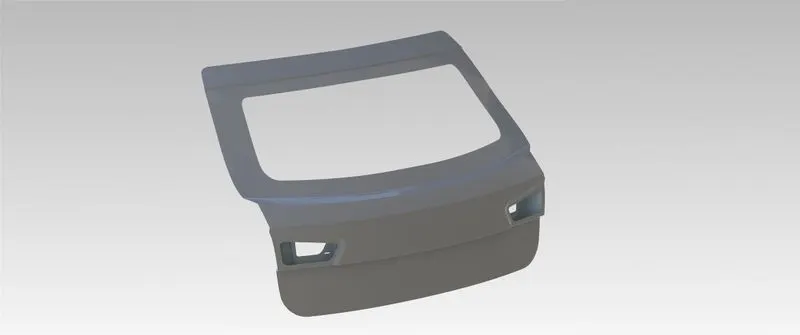
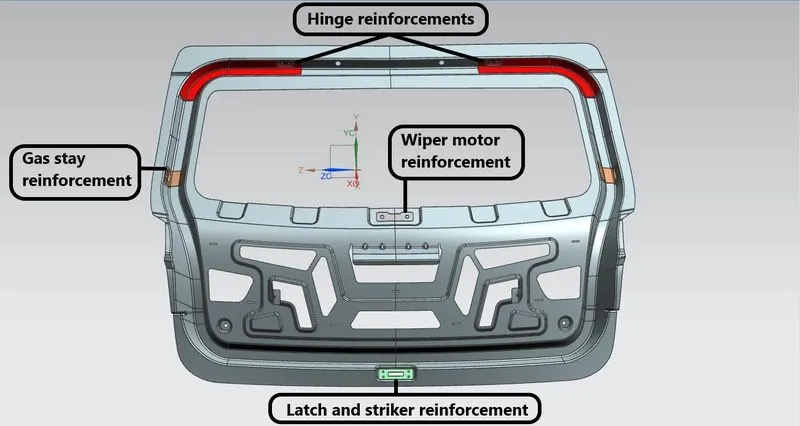
Fig shows: Position of the various reinforcements provided
Conclusion:
- Thus the back door is designed using the given styling surface along with the required embosses and reinforcements needed.
- The thickness of the outer panel and inner panel are 0.75mm each and the thickness of reinforcements are 1.5mm.