Design of backdoor
Design of Back Door
OBJECTIVE:
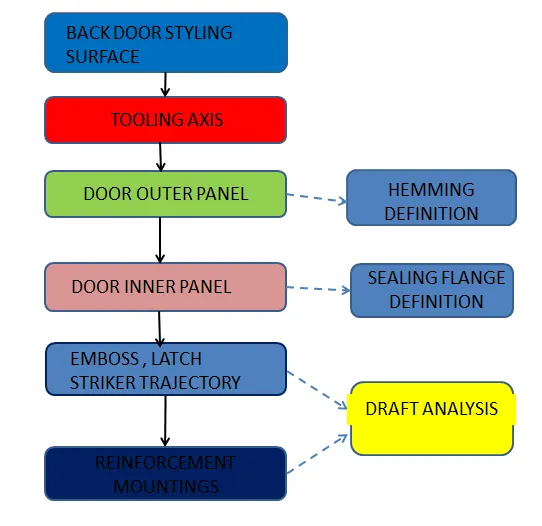
From the given styling surface, develop a back door using appropriate design methodologies. The objective of this project is to design a BIW Back Door of a car with an Inner Panel, Outer Panel, and Reinforcements for the Hinges, Gas stay, Wiper Motor, and Latch by following the engineering standards. The Inner Panel must be subjected to Draft Analysis for verifying whether it satisfies the Deep Drawing requirements for the tooling direction created in the design.
INTRODUCTION:
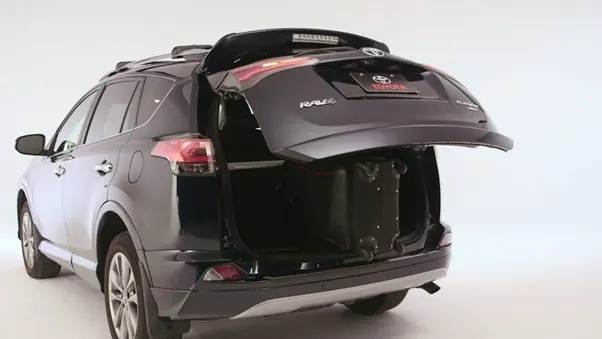
The Back Door of a car is the rearmost part of the vehicle which gives access to the trunk space of the vehicle. The rear door also supports the reinforcements and added weights of the Wiper Motor, Gas Stay, Tail Lamp, and Latch and Striker.
The Backdoor/tailgate is one of the closure commodities in BIW sheet metal design. The backdoor has a lot of components inside and is designed to incorporate them easily. It affects the rear visibility and luggage area.
The material used for door manufacturing depends on the budget and performance of the vehicle. Mostly Aluminium and Steel will be used whereas low-budget vehicles use Steel which makes the manufacturing process easy and cost-efficient since it follows the Stamping of Moulds.
DESIGN CONSIDERATIONS:
- The windscreen should give good visibility.
- The door should be strong to sustain the impact during closing.
- The door should be thin to maximize the boot area.
- The door should be lightweight for opening manually.
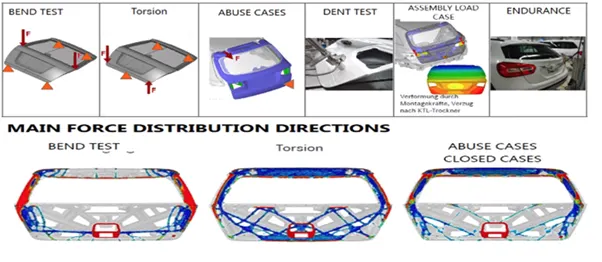
- Some of the load cases are the Bend test, Dent test, Torsion test, and Endurance test.
DESIGN METHODOLOGY:
Major Parts and Reinforcements:
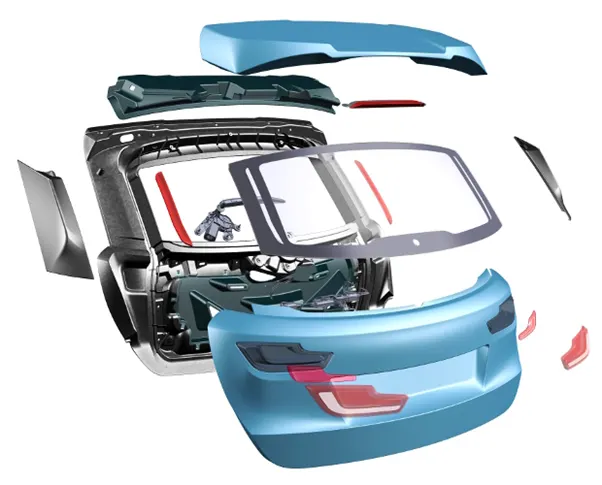
- The backdoor consists of the following basic components:
- Backdoor Outer Panel (Upper)
- Backdoor Outer Panel (Lower)
- Backdoor Inner Panel
- Hinge Reinforcements (LH & RH)
- Gas-Stay Reinforcements (LH & RH)
- Latch and Striker Reinforcement
- Wiper motor Reinforcement
MATERIAL PREFERENCE:
The inner panel is made out of steel which is manufactured through a deep-drawn process hence reinforcements are essential to compensate for the strength. At times Aluminium panels are used for casting outer panels which significantly reduces the weight and thickness can be varied along with the panel without the requirement of reinforcement mountings.
Although with added advantages of Aluminium, Steel Drawn parts are used which is much cheaper than the former.
LOAD CASE ANALYSIS
Bend Test
Torsion Test
Abuse cases
Dent test
Assembly Load Cases
Endurance test
Force Distribution under various load simulations
Based on these tests the effects of Gas Stay positioning or Power spindle are calculated.
Force Distribution under various load simulations
Based on these tests the effects of Gas Stay positioning or Power spindle are calculated.
TOOLING DIRECTION:
Based on the Styling surface the foremost step is the definition of tooling direction for the Deep Drawn Steel process and all downstream metal operations are based on Tooling Axis.
LATCH & STRIKER TRAJECTORY:
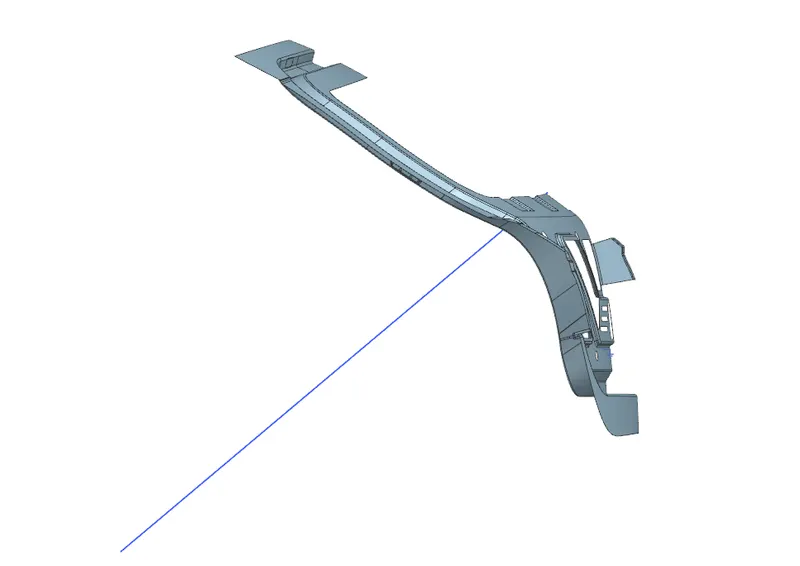
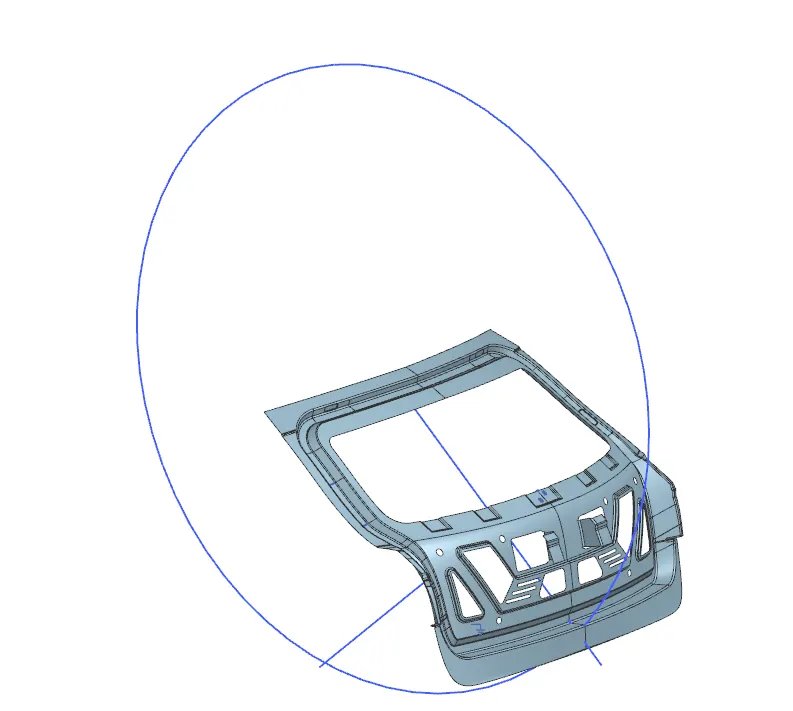
To define the opening and Closing Trajectory, the hinge and Latch are positioned based on the Hinge axis and Trajectory. The Circle drawn should perpendicular to the Latch’s Striker to satisfy the condition. Based on the Rotation trajectory the Hinge Axis, Latch Striker, and predefined Gas Stay are correlated for smooth kinematics of door opening and closing.
Based on the type of Gas Stay, Door Weight, and Kinematics the distance between the Gas Stay and the Hinge axis is 60-90mm and an angle of 85-90.
EMBOSS DEFINITION:
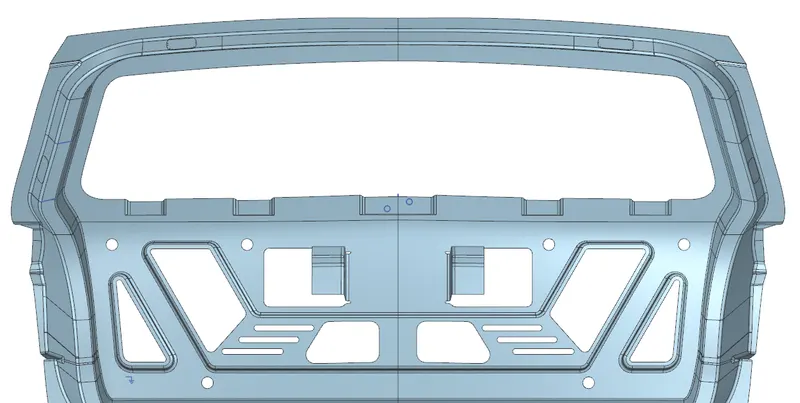
Based on the Load Simulations the Force acts in Y and hence emboss are defined on the inner panel to dissipate the force outwards caused due to slamming of door and Crash situations.
Emboss is defined and drafted along the tooling direction for feasible manufacturing and imparts strength to the panel without the need for an increase in thickness.
HEMMING:
Hemming is a sheet metal joining process of the inner and outer panels by eradicating the spot-welded areas which affect the aesthetics of the outer panel. It is also a safety requirement for door handling along the edges and suitable relaxations are provided along the corners to avoid stress concentration
MASTIC INFLUENCE:
Apart from Hemming, the Outer and inner panels are joined using mastic influence points to avoid the rattle noise and improve the NVH and Trim part mounting points are provided which are usually snap fits.
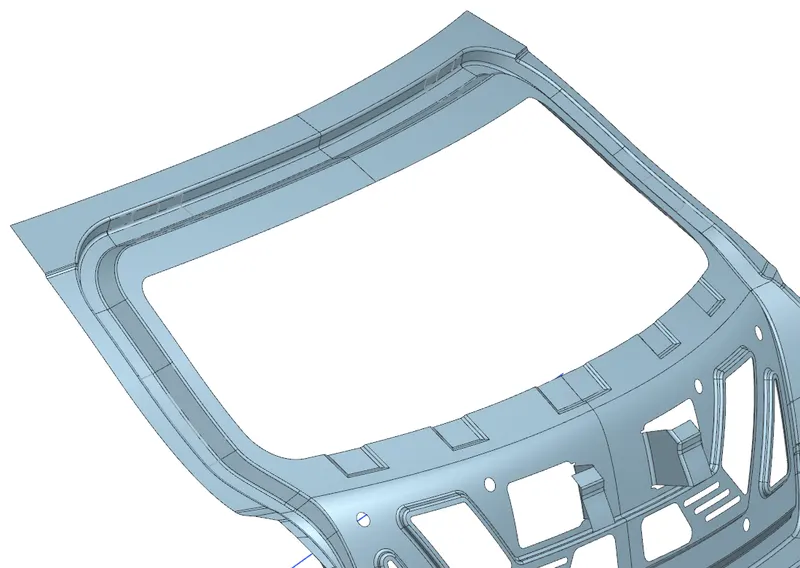
REINFORCEMENTS:
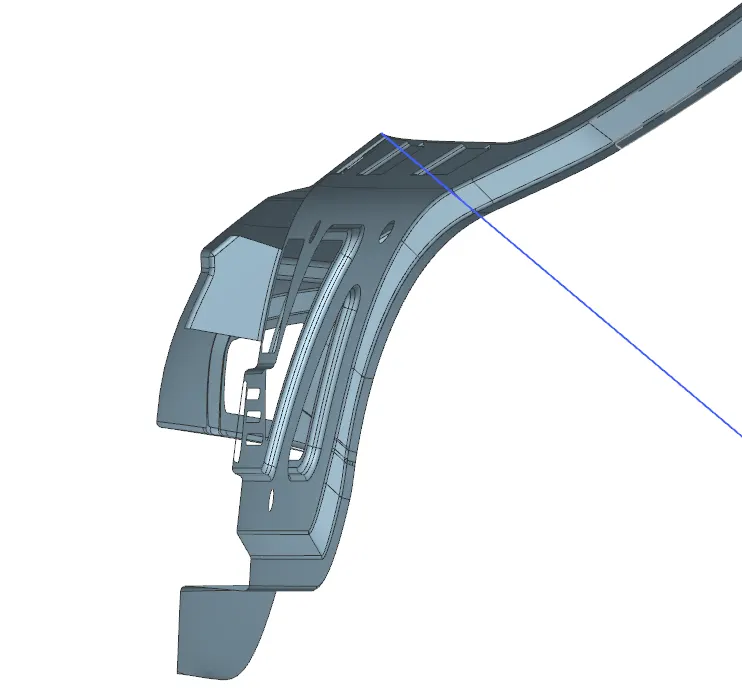
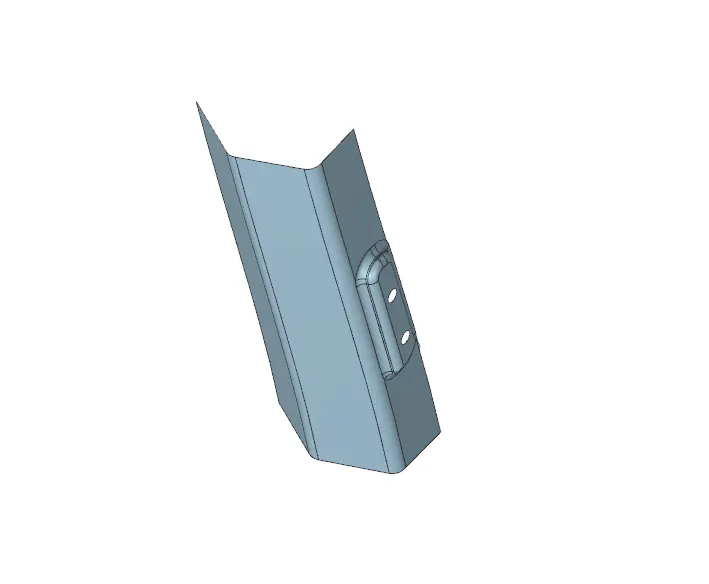
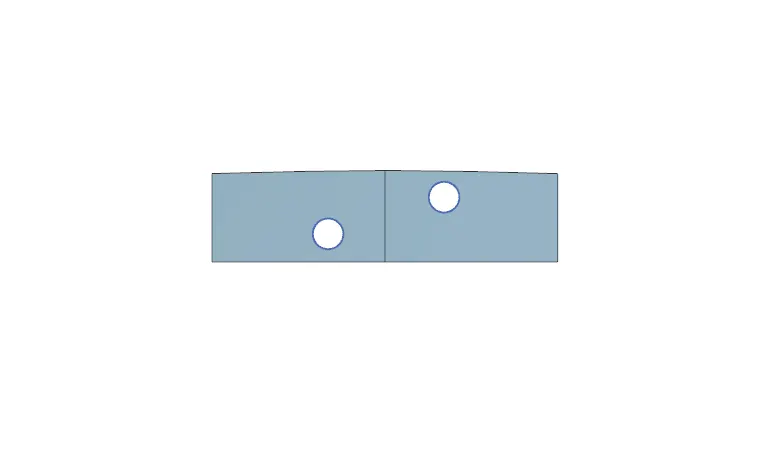
Reinforcement structures are provided to compensate for the loss of strength on the embossed section of mounting points.
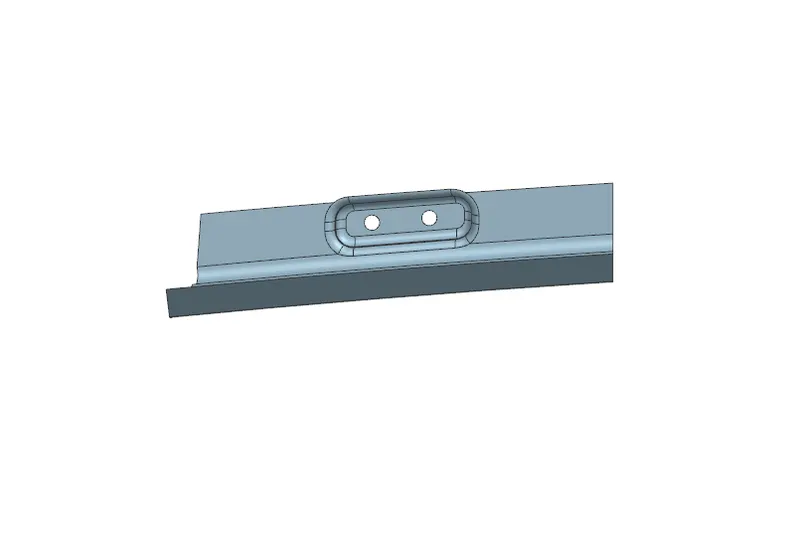
Hinge Reinforcement LH
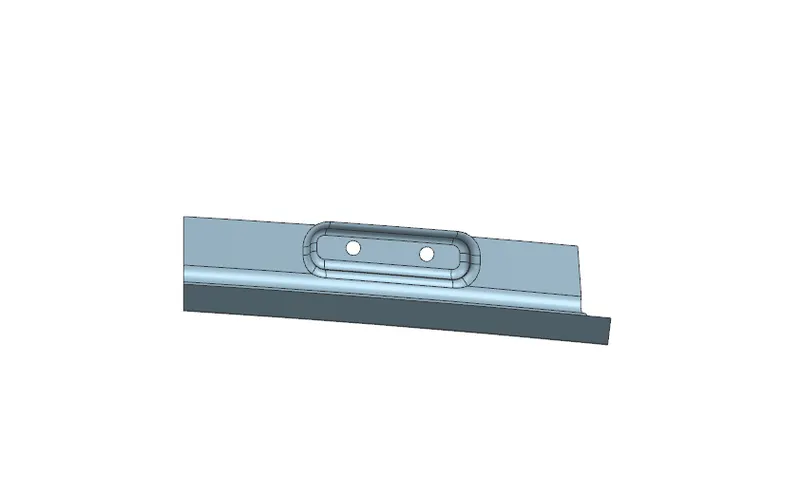
Hinge Reinforcement RH
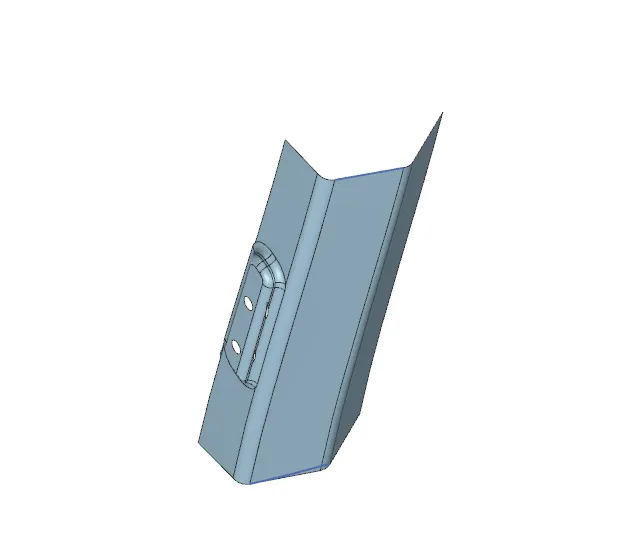
Gas Stay Reinforcement LH
Gas Stay Reinforcement RH
Wiper Mount
SEALING FLANGE:
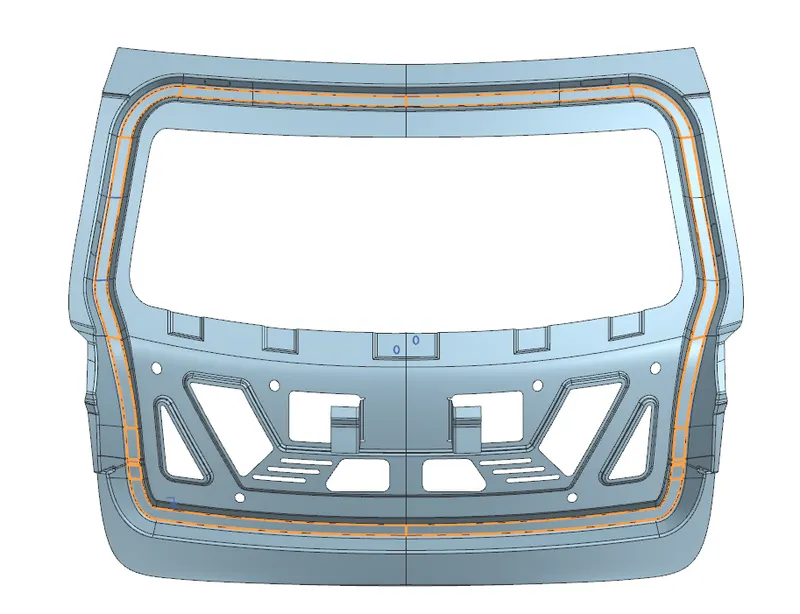
The Sealing Flange section shown forms an integral part as it contacts with the Roof, Body Side Door, and Rear Lower Panel.
DRAFT ANALYSIS:
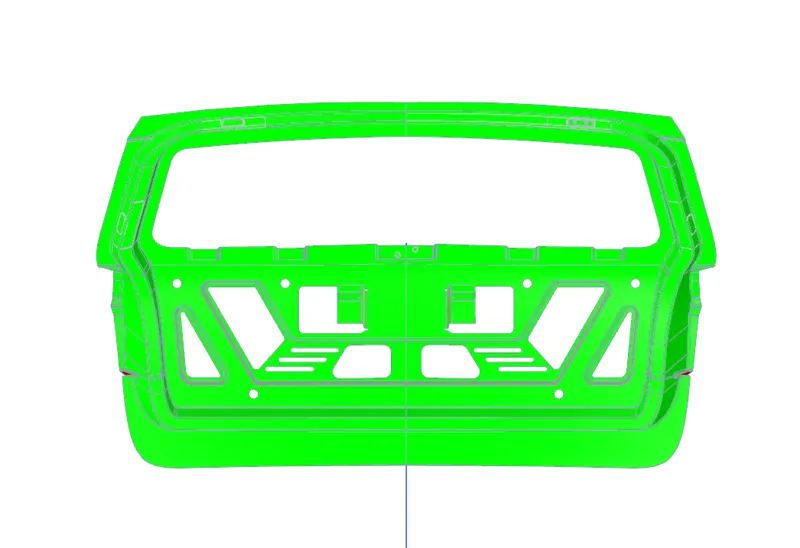
The draft analysis will be performed for the tooling direction created at first and checked that the model is suitable for manufacturing.
Then to get a complete green portion the necessary changes to the draft angle of the embosses were carried out by optimizing the model.
The Draft Analysis command enables us to detect that the part drafted will be easily removed or not.
This type of analysis is performed based on color ranges identifying zones on the analyzed element where the deviation from the draft direction at any point, corresponds to specified values.
CONCLUSION:
Thus, the parts of the back door were designed using the top-down approach in NX-cad using the provided styling surface back door is designed with appropriate design methodologies and provided the necessary reinforcements and embosses.