Design of backdoor
AUTOMOTIVE CAR TAIL GATE DESIGN
AIM
- To develop a automotive car back door design with appropriate design methodologies, necesseary reinforcement and embosses, from the styling surface provided.
- To Perform Draft Analysis along the tooling direction.
OBJECTIVE
- Develop an automotive car back door design using the provided styling surface.
- Utilize appropriate design methodologies to enhance the overall aesthetic appeal of the back door.
- Address structural considerations by incorporating necessary reinforcements to ensure optimal strength and durability.
- Integrate embosses into the design to contribute to the visual and tactile aspects of the back door.
- Perform Draft Analysis along the tooling direction to assess and optimize the manufacturability of the designed back door.
THEORY
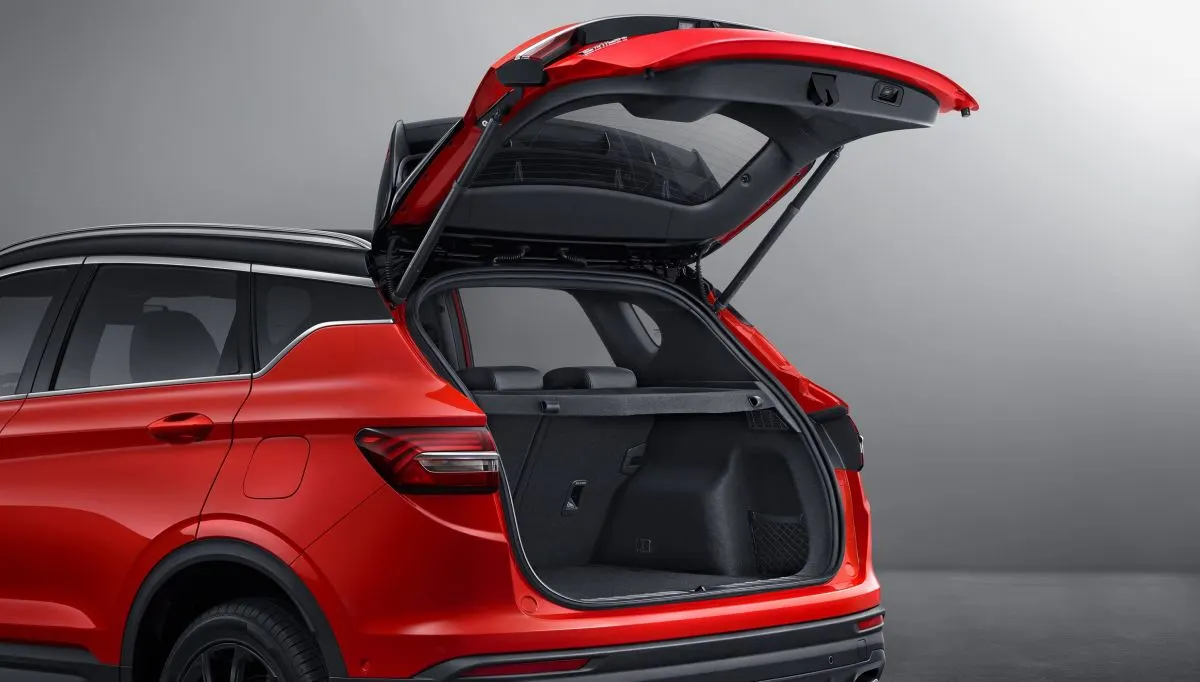
Back door/Tail gate
The Backdoor is an automotive component that is located at the rear side of the car which covers the back portion of the car body it is also known as the tailgate.Located adjacent to the rear passenger seats, it facilitates access to the luggage space by opening upward, serving as a trunk compartment for the storage of goods and luggage. The term "tailgate" specifically applies when the rear door is mounted on top, a configuration commonly found in station wagons, sport utility vehicles (SUVs), and hatchback-type cars. This versatile design provides practical utility for various vehicle types, offering a convenient and accessible storage solution for users.
The opening of the backdoor depends upon the type of vehicle the different types of rear door opening are as follows:- Side-mounted, Top-mounted, Bottom mounted.
Two-way station wagon tailgates may be hinged at the side and the bottom so they can be opened sideways like a regular door, or drop downwards as load platform extenders. They are designed with special handle(s) for opening in the selected direction on special hinges after the window is lowered.
Nowadays the modern cars come up with power-lifted tailgates that is it consists of electric motors to open the tailgate which require only initial force to activate and then it get opened automatically. In some cars, foot sensors are provided which senses the foot movement to open the tailgate. This type of system is used in premium cars and it eliminates the manual opening of the tailgate.
Different types of Tailgate :
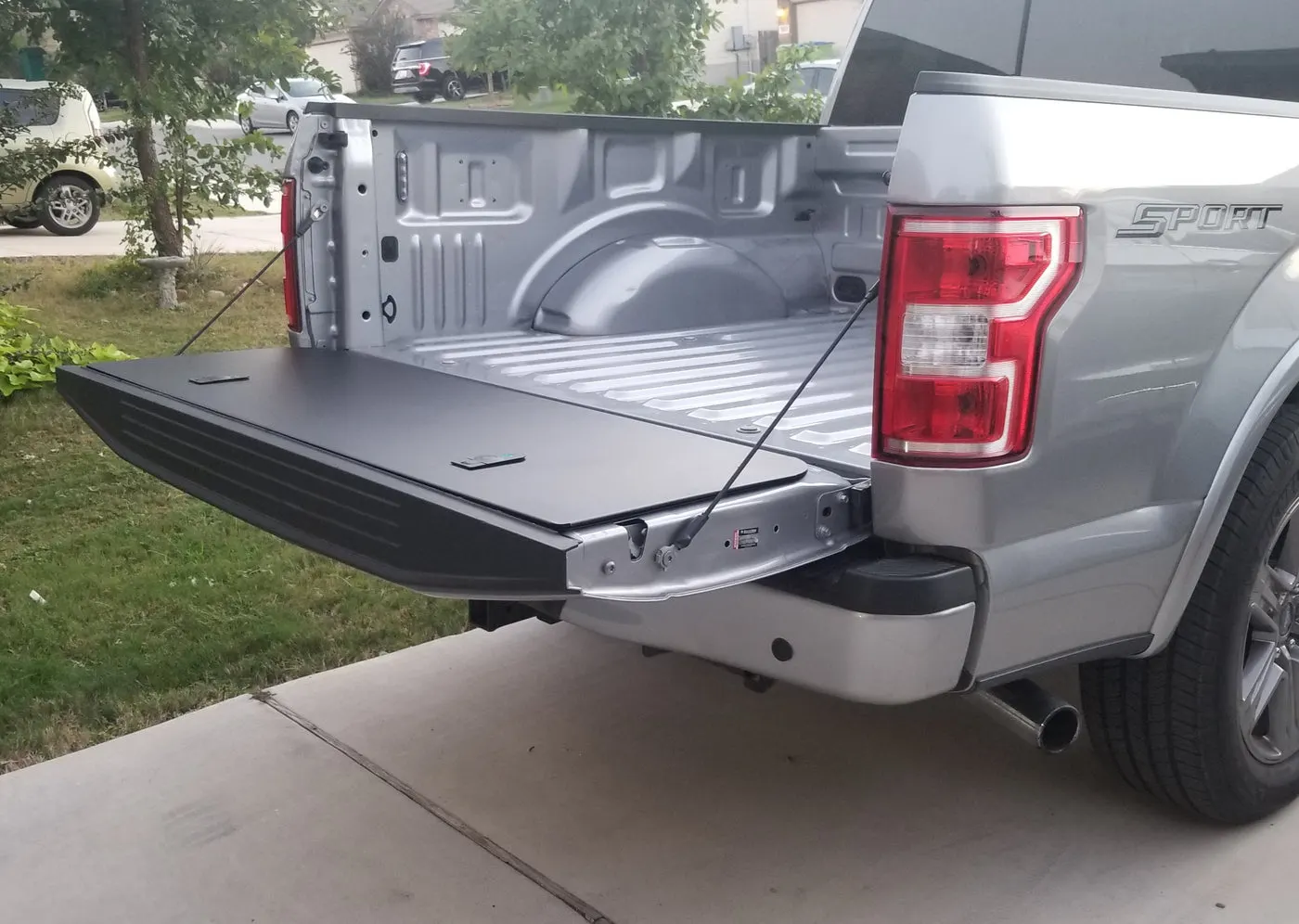
1. Traditional Tailgate : The traditional tailgate, hinged at the bottom and opening downward, is commonly found in many trucks and older SUVs.
2. Top-Hinged Tailgate : The top-hinged tailgate is hinged at the top and opens upward it is prevalent in hatchbacks, SUVs, and modern crossovers
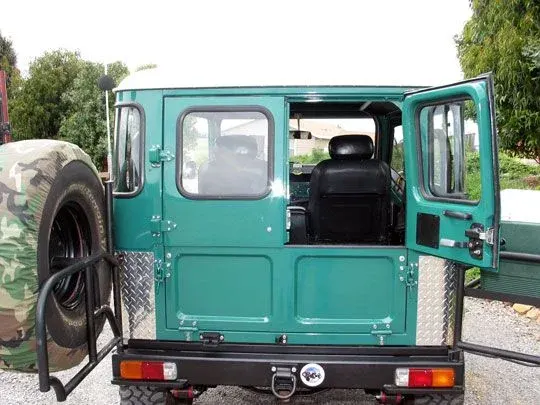
3. Side-Hinged Tailgate : The side-hinged tailgates are hinged on one side open like a door, these are often found in older SUVs and some trucks
4. Split Tailgate : The split tailgate introduces a dual-section design, allowing for multiple opening configurations. It can either open upward or swing horizontally, offering versatility in loading and unloading.
5. Power Liftgate : Power liftgates, equipped with electric motors for automatic operation, are a staple in modern SUVs and luxury vehicles, providing added convenience.
6. Two-Way Tailgate : Two-way tailgates, hinged both at the side and the bottom, present flexibility, enabling either sideways opening like a regular door or a downward drop as a load platform extender.
7. Hands-Free or Foot-Activated Tailgate : Hands-free or foot-activated tailgates, utilizing sensors for automatic opening, are a feature often found in premium and luxury vehicles.

8. Barn-Door Tailgate : The barn-door tailgate, split horizontally into two swinging doors, facilitates easier cargo area access in confined spaces.
Parts of a Tail Gate:
- Outer Panel
- Outer panel Lower
- Inner panel
- Hinge Reinforcements
- Latch and Stricker Reinforcement
- Wiper Motor Reinforcement
- Gas Stay Reinforcements
Manufacturing process of Backdoor
As we know that backdoor is a BIW component that is basically manufactured using a metal forming process. There are different types of metal forming processes that are used for manufacturing automotive parts they are bending, forming, stamping, forging, extruding, etc. From which the stamping is the methodology used to produce the door panels, basically, a die and punch are used in a press machine to stamped out the complete door panel in a single or multiple presses. This method is used because it does not require separate tools to manufacture the component also it is less time consuming and requires less material for the part which is to be produced with precision and accuracy.
Materials used for the manufacturing of backdoor panel
- Aluminum
- Steel
The first one as we all know that it is light in weight compared to that of steel but at the same time the price of aluminum is more than that of steel. So, it is only used for expensive cars or sport vehicles where the weight of the car plays a crucial role. The manufacturing process used for panels made up of aluminum is different when compared to that of steel.
Aluminum panels are made by casting process rather than stamping which is used for steel material due to which the accuracy and precision of the panel is more as compared to that of steel. We can provide sufficient strength by varying the thickness of the sheet at weaker sections in the case of aluminum no reinforcements are needed to be provided but in steel panels, reinforcements are essential as we can not vary the thickness of the sheet it is uniform throughout so, steel panel requires more components as compared to that of aluminum. These are some of the advantages of aluminum over steel.
But the drawback of aluminum is it requires more cost to produce a single panel when compared with steel. So, it can't be used all cars but used for luxury cars only.
DESIGN CONSIDERATIONS FOR BACKDOOR
Following are the design parameters
- Rear visibility criteria
- Rear Crash regulations
- Functions of sealing
- Joining techniques used like heming, spot welding
While designing this criterion should be followed and the maximum area should be covered by rear windshield glass for better visibility of the driver and his safety
Next is the rear crash conditions so, the designer should also take a look at this parameter the outer panel should have sufficient strength that in case there is an impact from the rear side then the outer panel should take a maximum of load and allow less load to be driven towards passengers thus protecting them from any fatal injury. For that purpose, a design engineer can use an inner panel to strengthen the structure of the back door.
Proper sealing is also to be provided in between car body and backdoor thereby not allowing any foreign material to get inside the storage space, that is sealing prevents water, dirt, dust to get in the storage space. So, proper rubber sealing is to be provided on the car body, and a sealing flange is provided on the inner panel of the backdoor which gets in contact with the rubber sealing and forms bound when the door is closed.
Load Analysis of Backdoor
- Bend Test
- Torsion
- Abuse case
- Dent test
Joining Processes of Tailgate
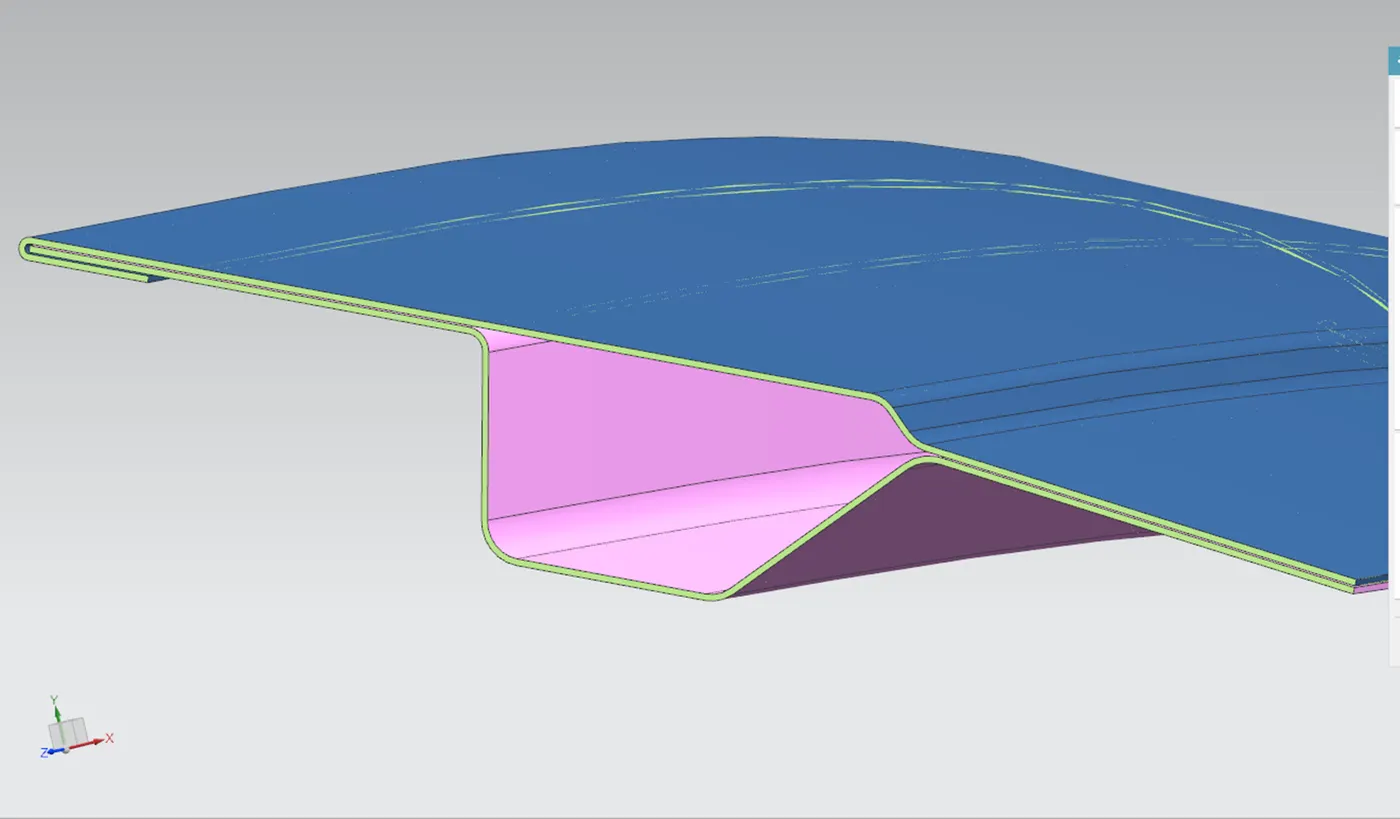
1) Hemming : Hemming is a forming operation applied in the production of car parts where the edges of a sheet are folded over another part, creating a tight fit. This process is commonly used to connect and reinforce parts, enhancing both the structural integrity and appearance of the final product. In the production of automotive components, hemming serves as a secondary operation, often following deep drawing, trimming, and flanging processes. It is particularly employed in the assembly of various sheet metal parts, such as hoods, doors, trunk lids, and fenders, effectively joining inner and outer sheets for a cohesive and aesthetically pleasing result.
There are various types of hemming operations:
- Conventional die hemming: In conventional die hemming, the flange is folded over the entire length with a hemming tool.
- Roll hemming: In roll hemming, the hemming roller is guided by an industrial robot to form the flange.
- Open Hem: A Hem has a full round feature and a return flange. In open hem bend angle is equal to 180 degrees.
- Tear drop Hem: In tear drop hem the bend angle is greater than 180 degrees.
- Closed Hem: Hems without any inside radius are called as closed hem. Closed hems are not recommended if the hem geometry is to be painted or if the material used is SST or Aluminium.
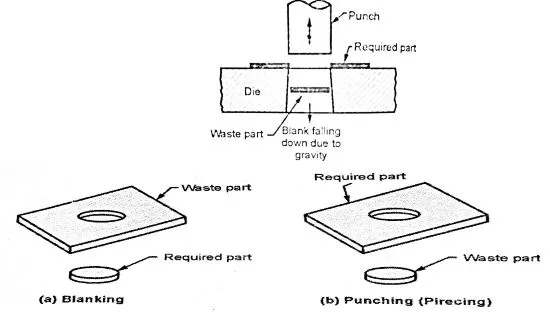
2) Blanking : Blanking is a process in sheet metal forming where a flat piece, known as a blank, is cut out from a larger sheet. The cutout piece is the desired shape and size for further processing.
3) Punching : Punching is a process in which a hole or holes are created in a sheet metal workpiece. It is similar to blanking but involves the removal of a portion of the material rather than cutting out an entire piece.
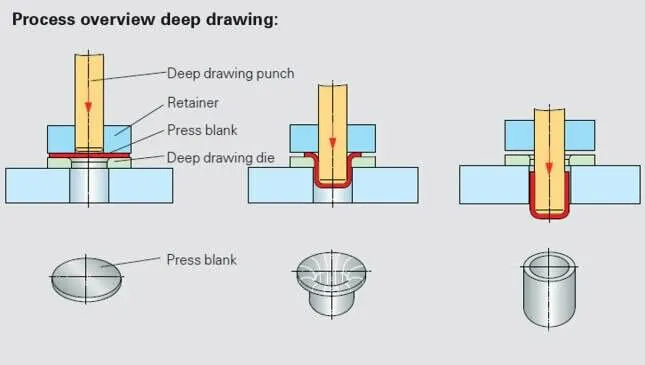
4) Deep drawing : It is a sheet metal forming process commonly used in the manufacturing of car tailgates. This process involves transforming a flat sheet of metal into a three-dimensional component with a deeper shape, typically a cup or box-like structure.
The deep drawings having two main categories :
First- stage drawing: The blank shape of metal is placed on the die and contact with the punch. When the metal specimen is flat piece of sheet metal used in forming and finish the product. Initially the punch moves in downward direction. The outer rim of blank is subjected to pure radial drawing (drawing toward in vertical axes) between die and blank metal. The metal become a bend and sliding over die and also stretched between die and punch. The metal in vicinity of punch head and contact with it bend and slide over radii and stretch over punch head.
Redrawing: The components drawn from first stage again it is redrawn convert into more depth to form a cup shape in the die and punch. The second stage of drawing is called as redrawing.
5) Embossing : Embossing stands as a metal forming process designed to create raised or sunken patterns, known as relief, on sheet materials. This technique involves the utilization of matched male and female roller dies. The fundamental objective is to impart a pattern onto a metal sheet without any alteration in its thickness. The process can be executed by directly passing a sheet or strip of metal between the rollers or through a method where the metal is drawn through the male and female roller dies.
6) Spot Welding : Spot welding is a rapid and cost-effective method used in sheet metal fabrication for joining metal sheets at specific points. Electrodes apply pressure to tightly compress the sheets, and an electric current passes through them, generating heat at the contact points. This localized heat causes the metal to melt, forming weld nuggets that solidify to create strong and durable joints. Widely utilized in industries such as automotive manufacturing and appliance production, spot welding is valued for its efficiency, speed, and ability to create robust connections without causing extensive heat distortion to the surrounding areas.
7) Mastic Sealing : Mastic sealing involves the application of a mastic or sealant, a viscous substance with adhesive properties, to create a protective and impermeable barrier. This process is commonly used in construction and automotive industries to seal joints, gaps, or seams in various materials, preventing the ingress of water, dust, or air. Mastic sealants are flexible and resilient, adapting to changes in temperature and movement, making them ideal for sealing applications in areas prone to expansion and contraction. They play a crucial role in enhancing structural integrity, weatherproofing, and preventing leaks, contributing to the longevity and durability of structures or components.
Thickness Details
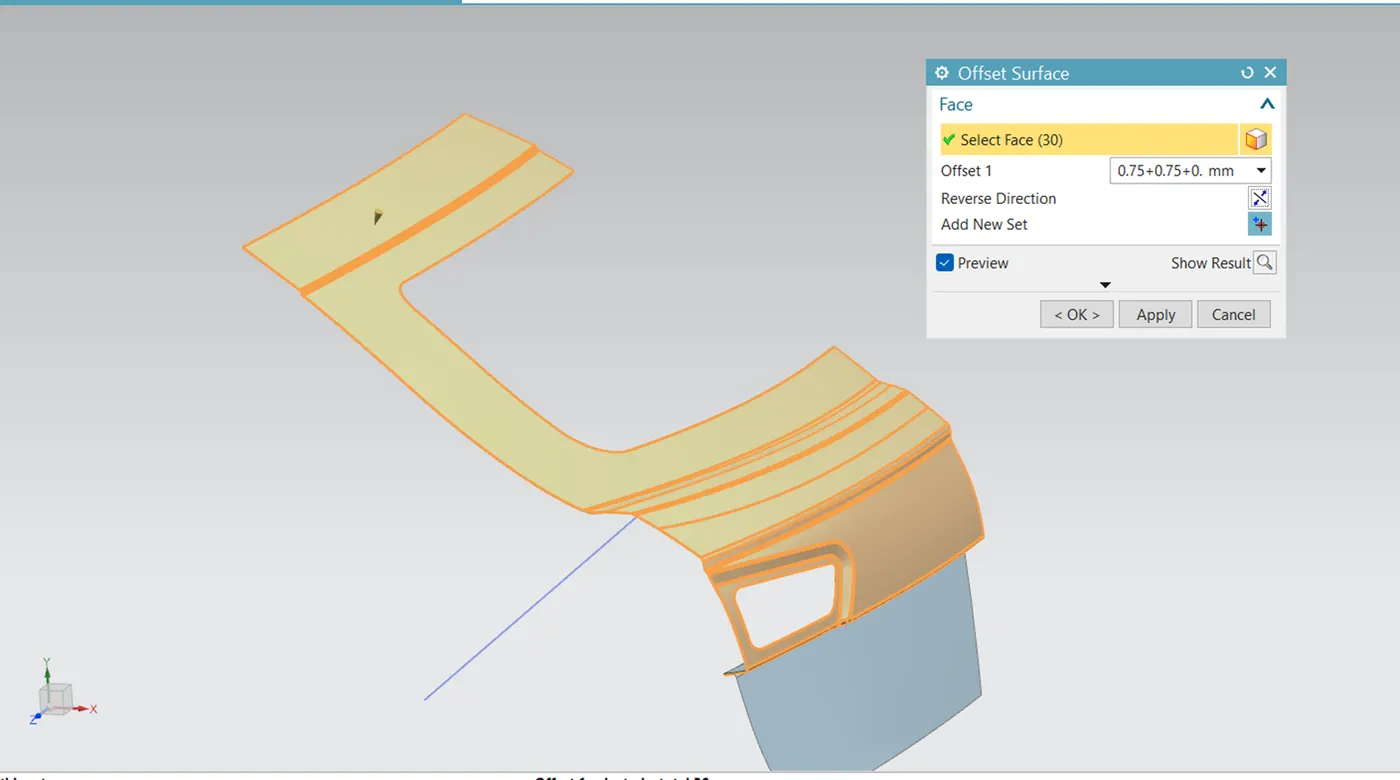
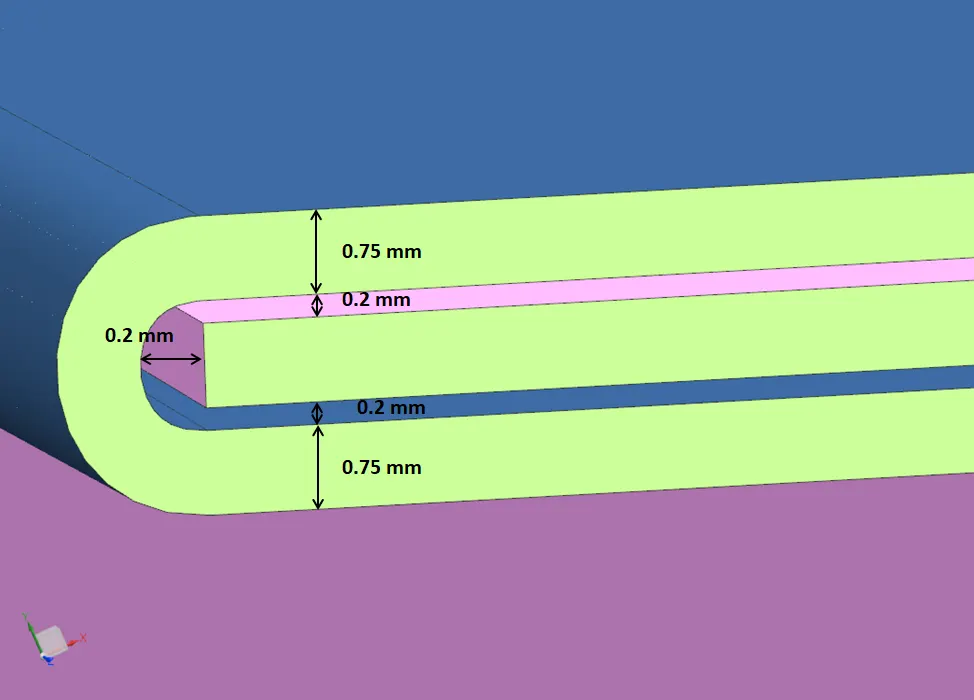
- Outer Panel - 0.75 mm
- Inner Panel - 0.75 mm
- Reinforcements - 1.5 mm
Input Styling Surface
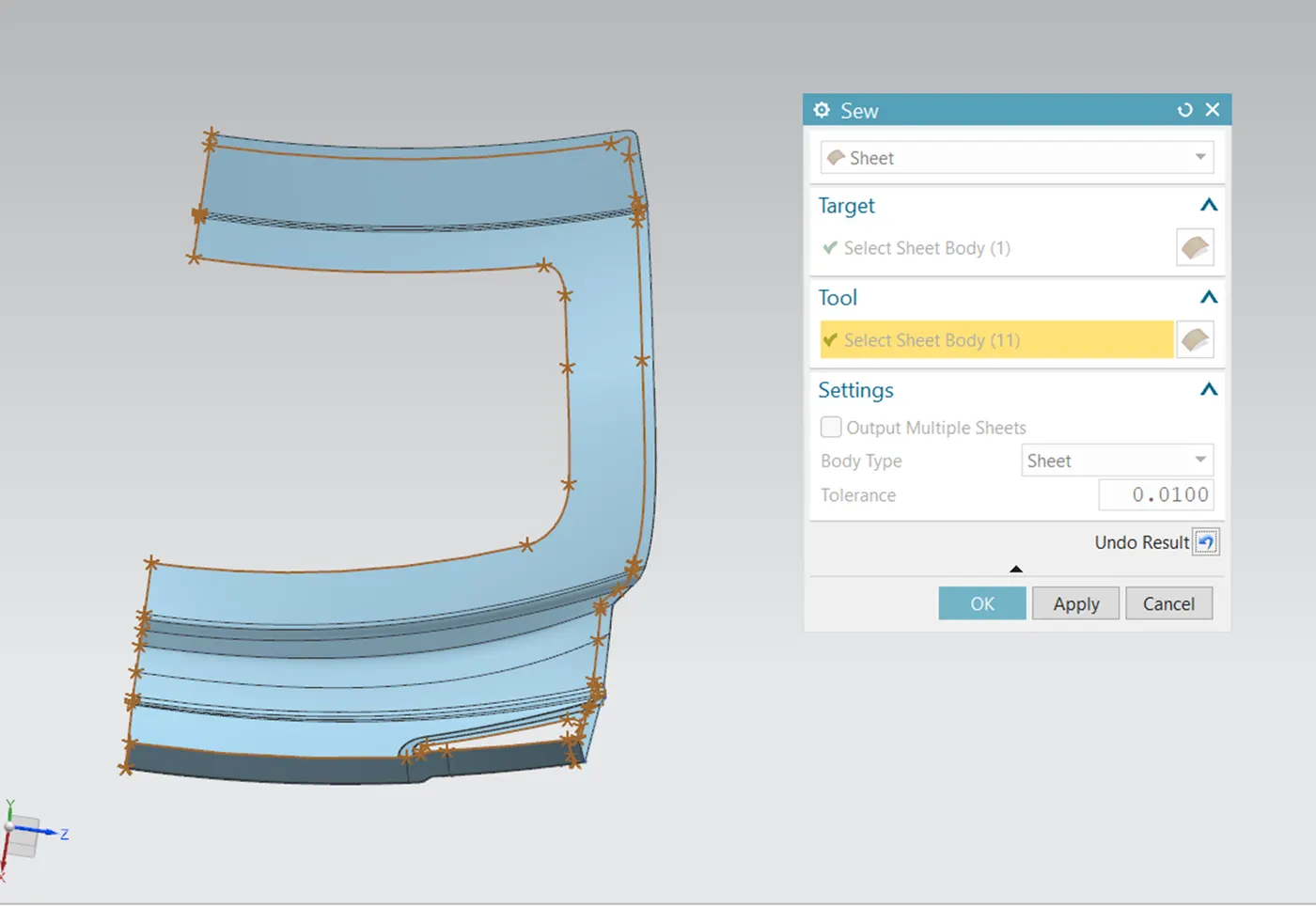
The backdoor outer upper and lower class a surface has to be repaired according to the smoothness. After repairing the surfaces, the door is divided into two parts as Door Outer Upper and Door Lower Panel.
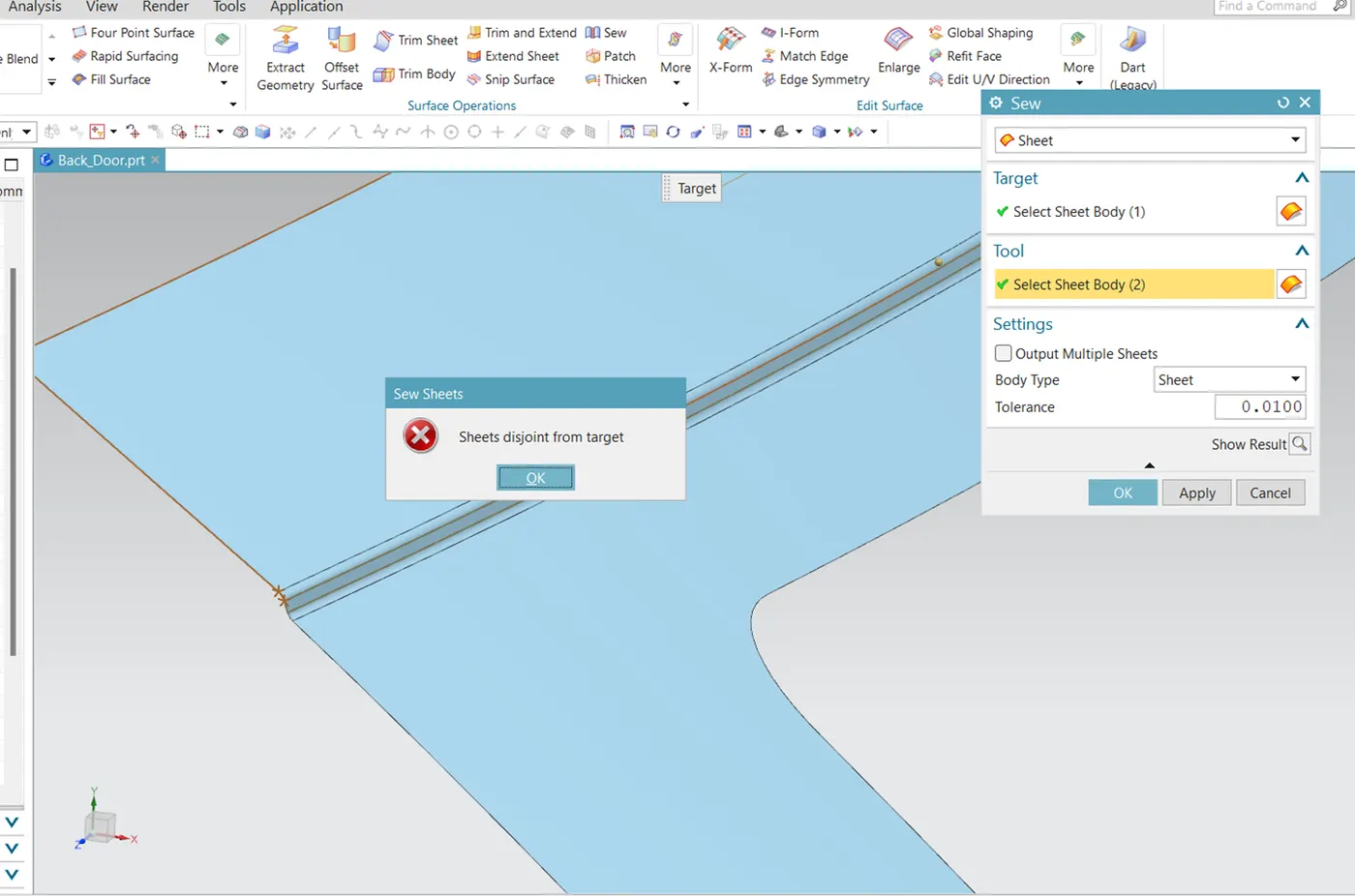
After repairing
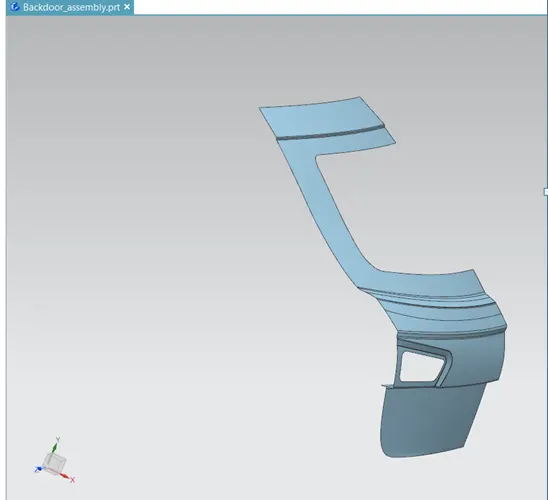
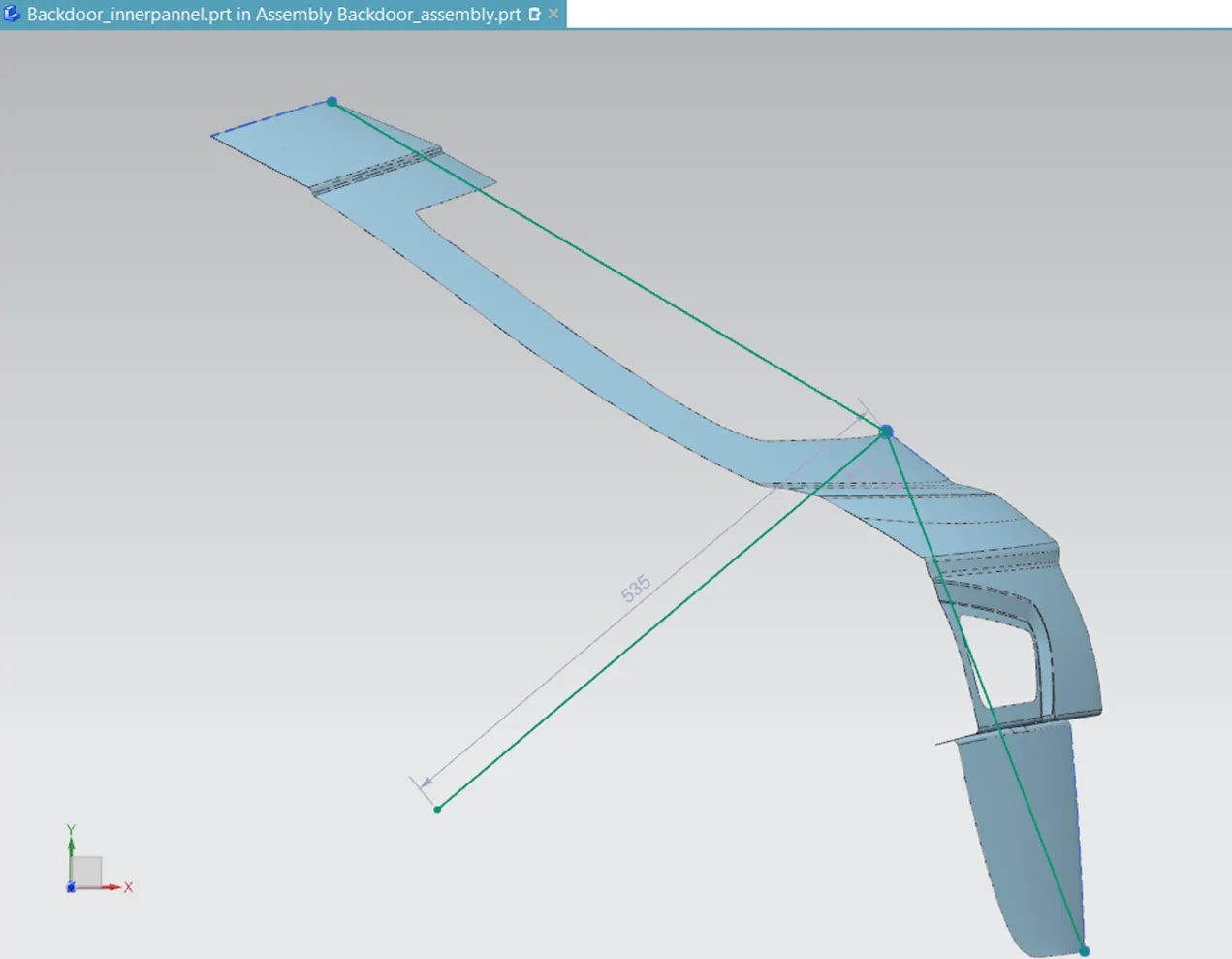
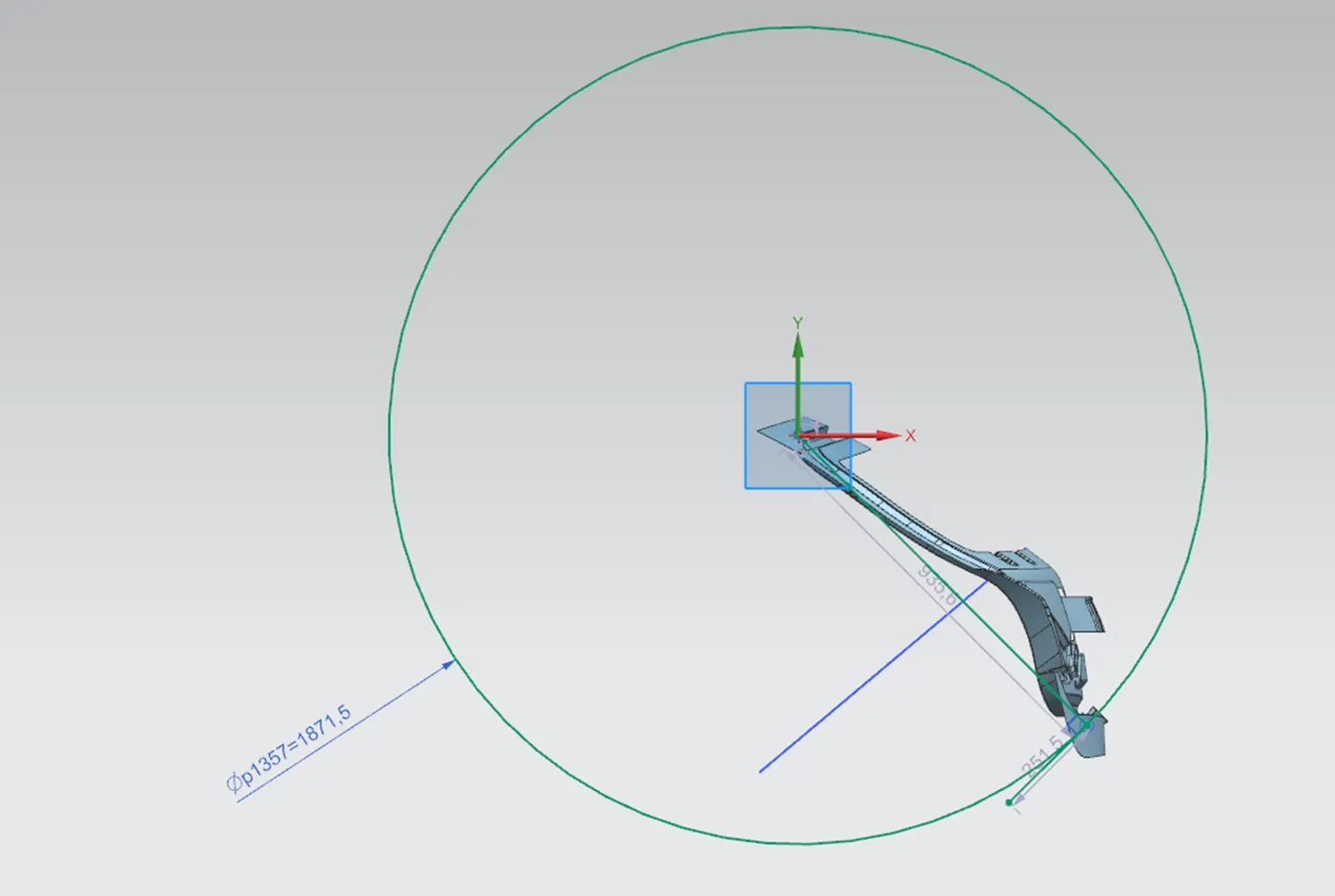
Then, we need to create the Tooling direction for the Deep drawing operation. It shows that all the operations like embossing is done by considering this vector direction.
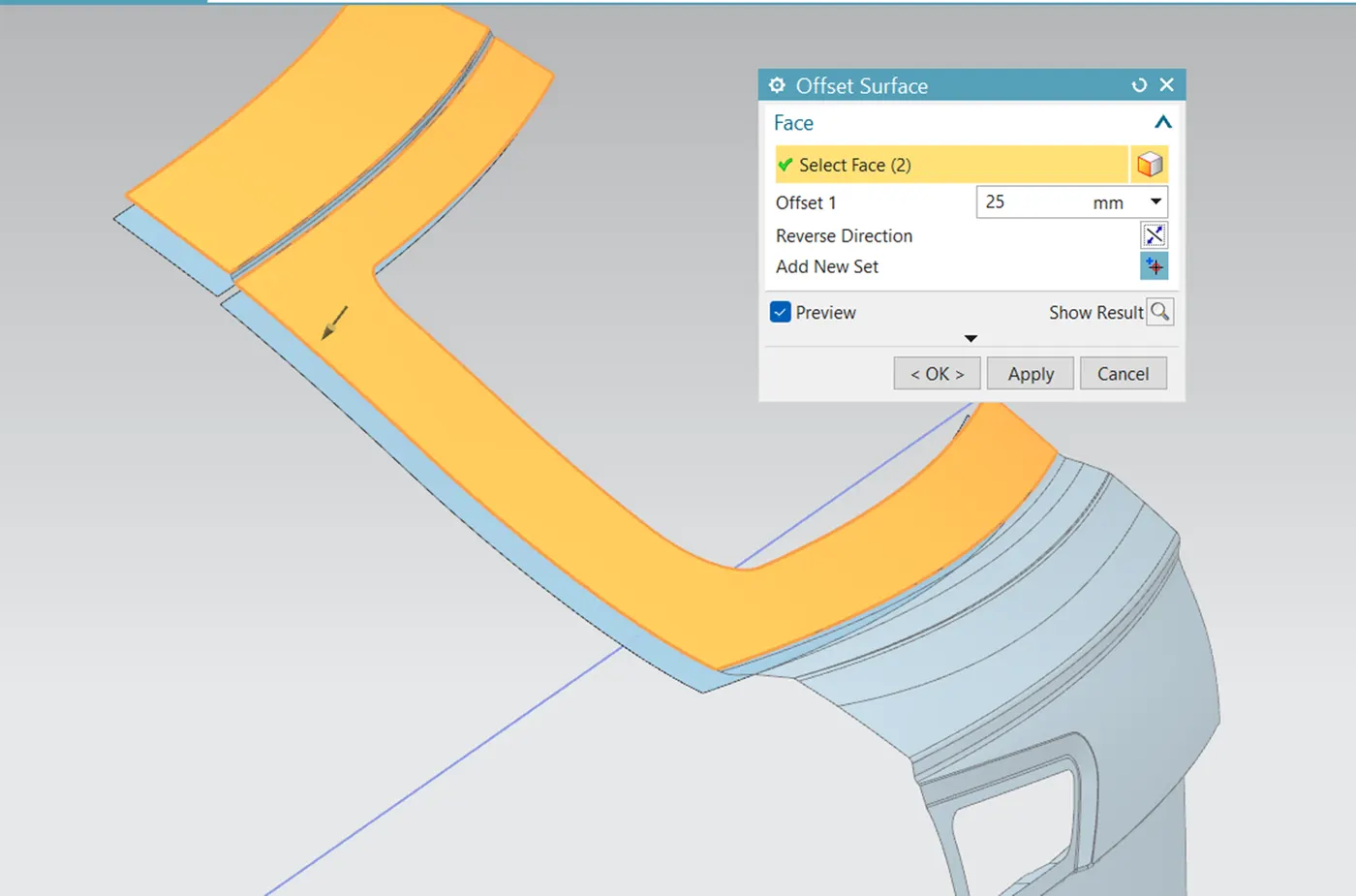
To create sealing flange the outer panel is offsetted to a specific distance.
Then the back door inner panel flange is created by offsetting the outer surface at a distance 0.75 + 0.75 + 0.2, the thickness of inner and outer pannel + clearance.
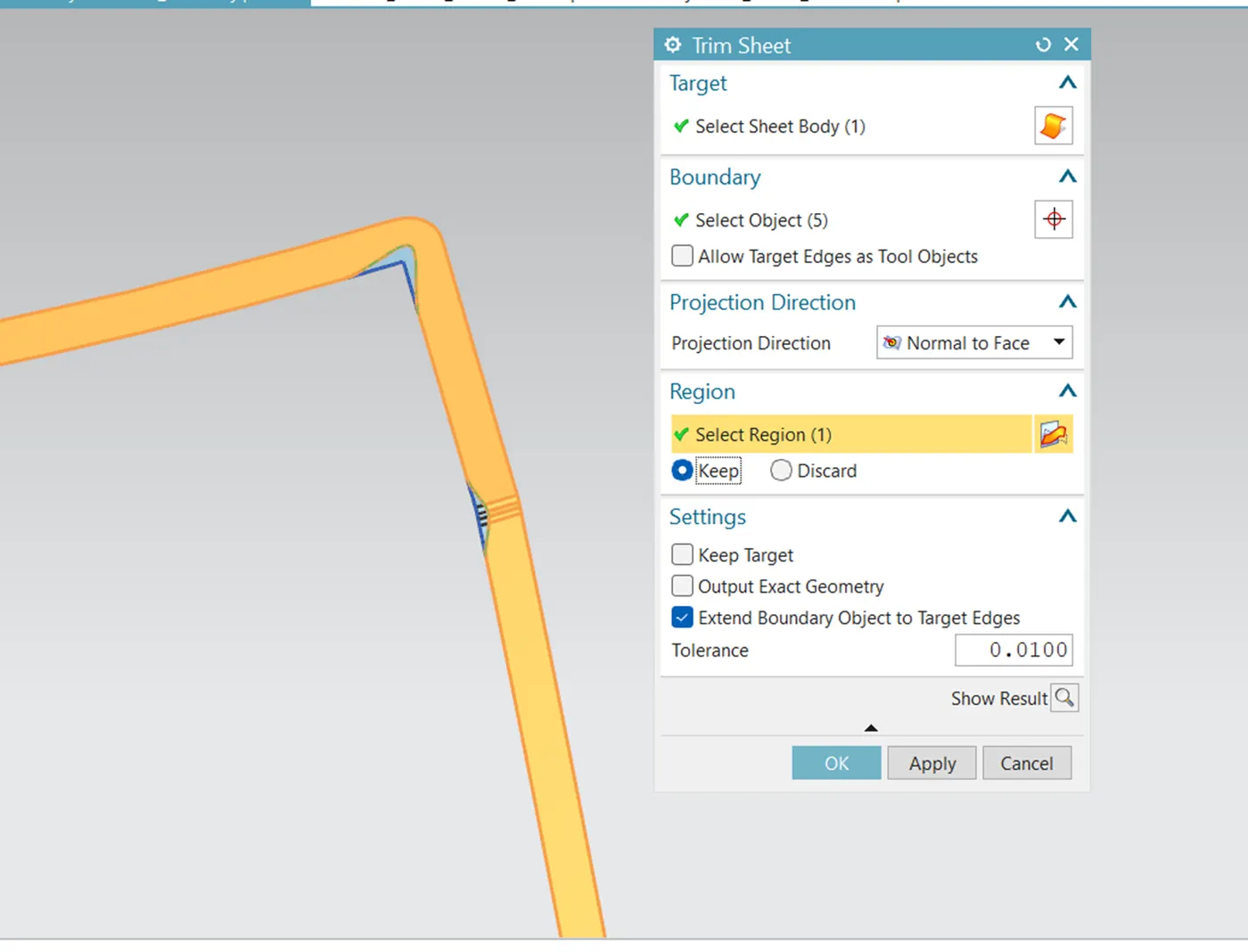
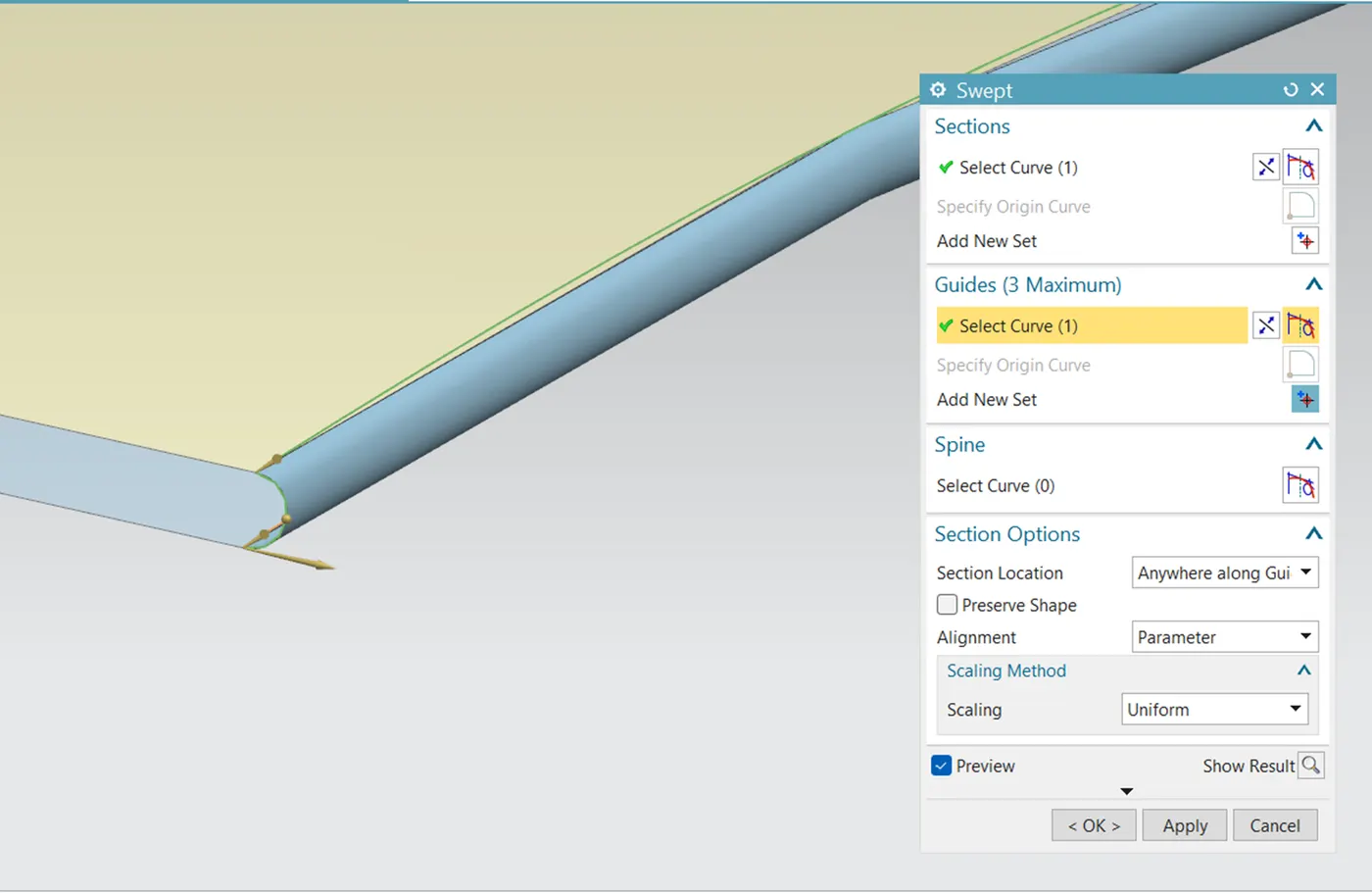
Then the connecting flange to join the inner panel and sealing flange is created.
Then created the connecting flange to join the inner panel and sealing flange.
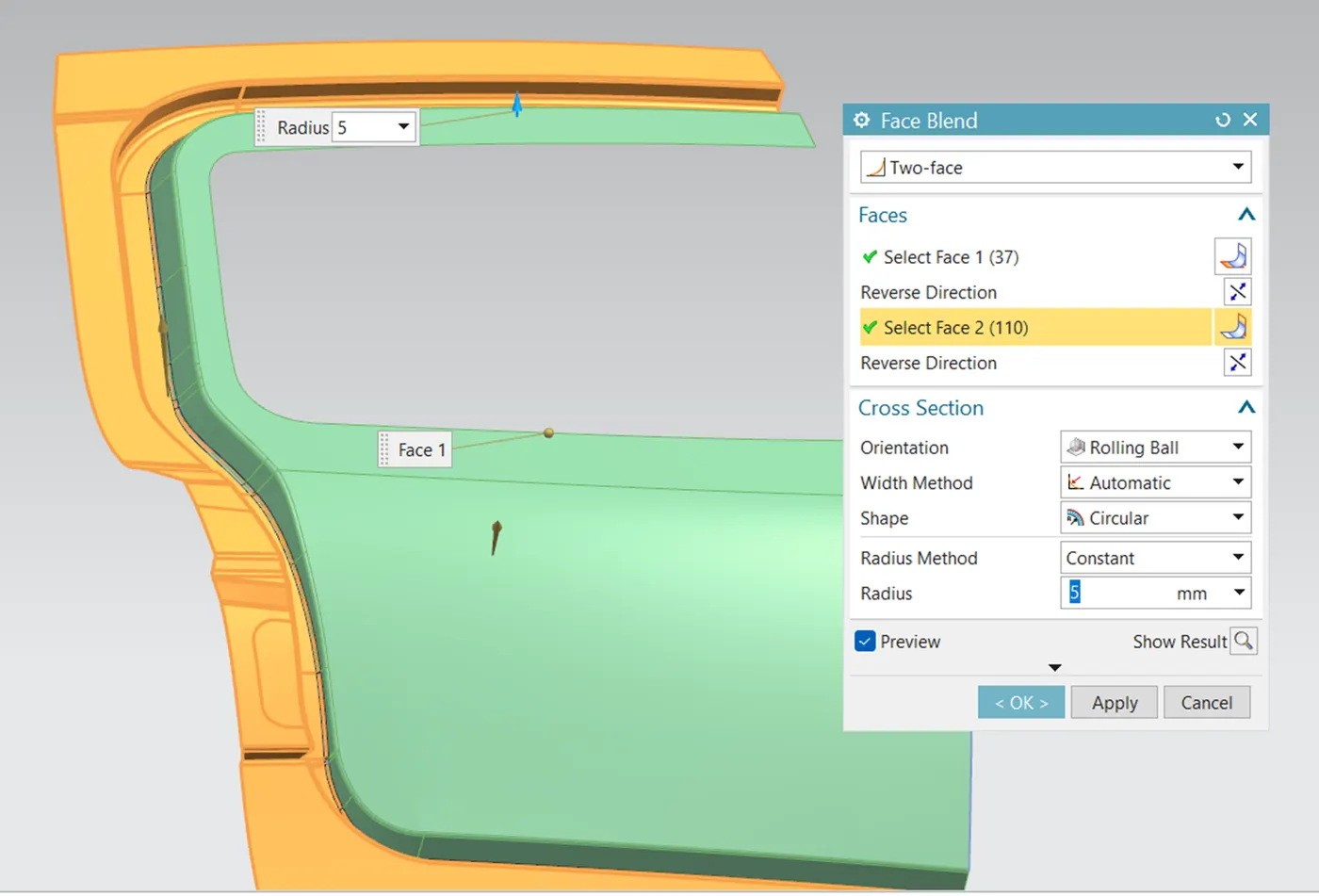
Next the hinge mounting emboss, latch mounting emboss, viper motor mounting embossess, wind shield emboss were created.
The embossess are also necessery to increase the strength
To further strength, reinforcements were also created.
To join the inner panel with outer pannel mastic flanges were also made.
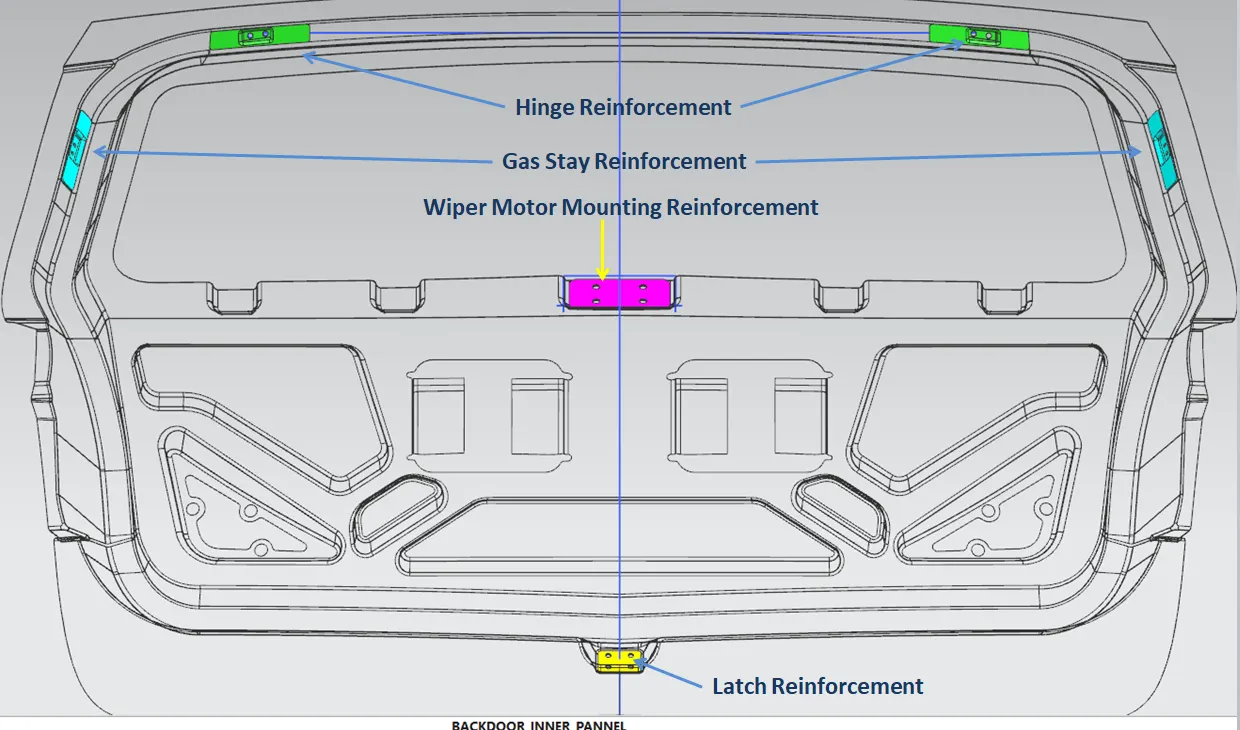
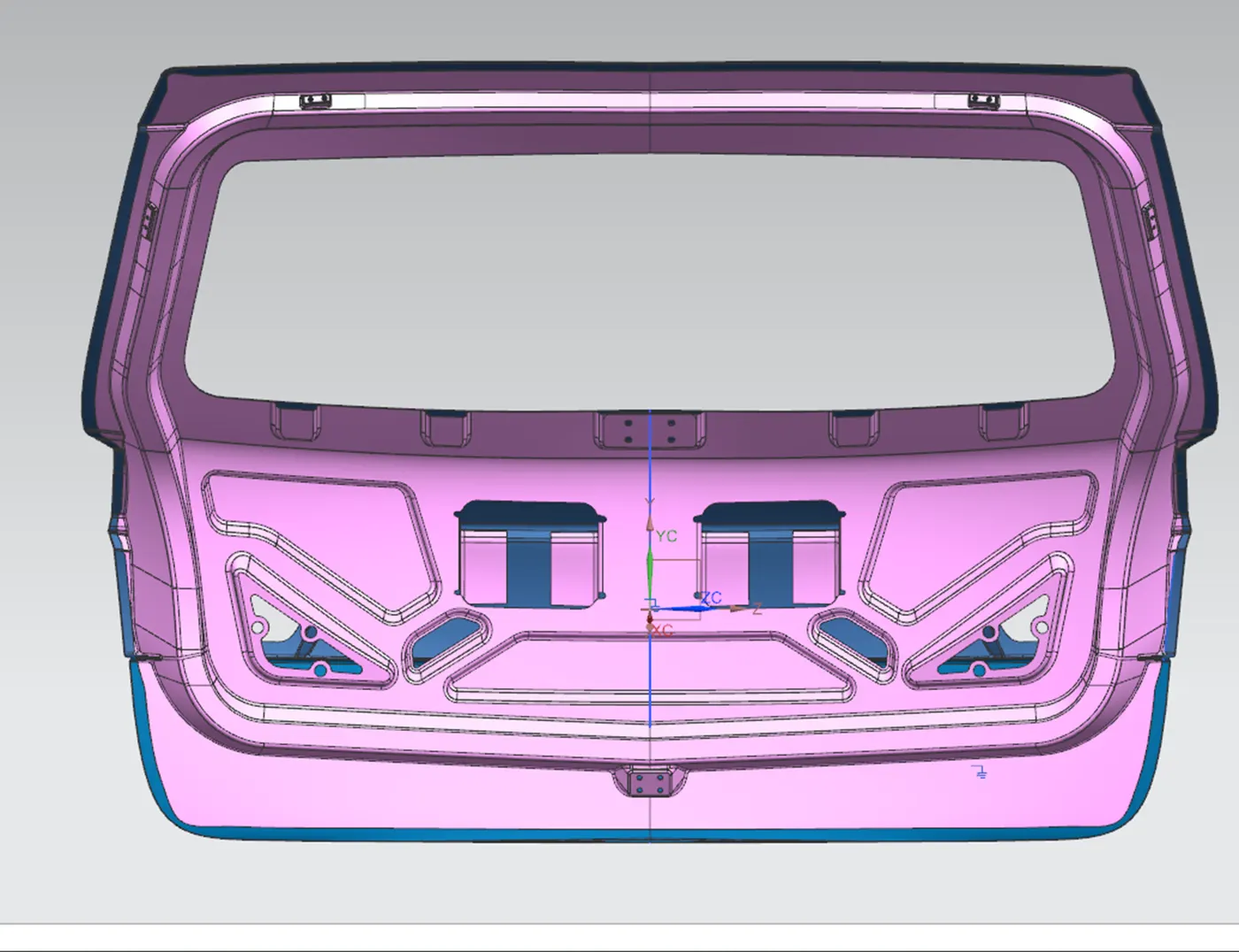
Tail gate inner panel with reinforcements
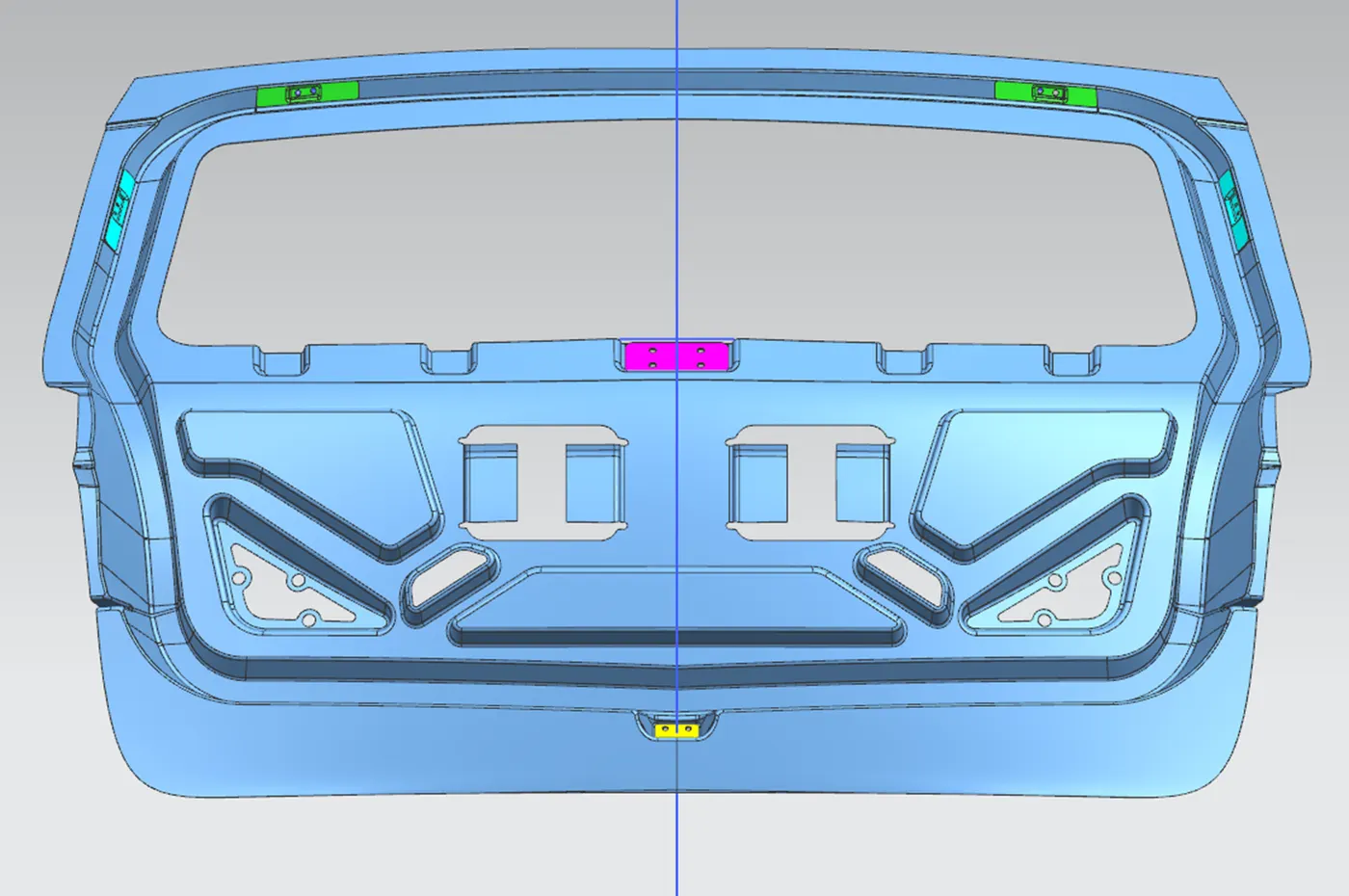
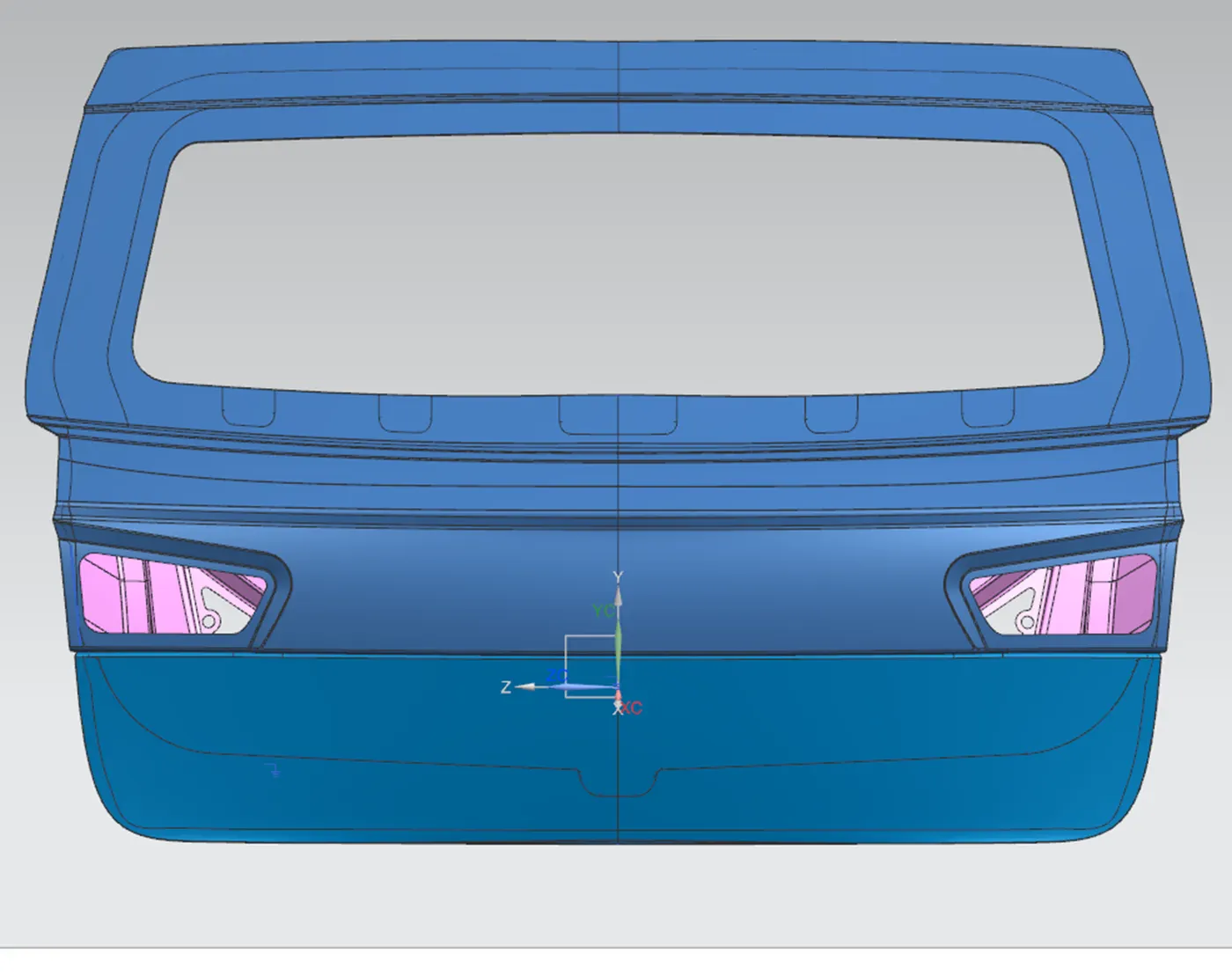
Then the outer panel is made with hemming flange
ASSEMBLY
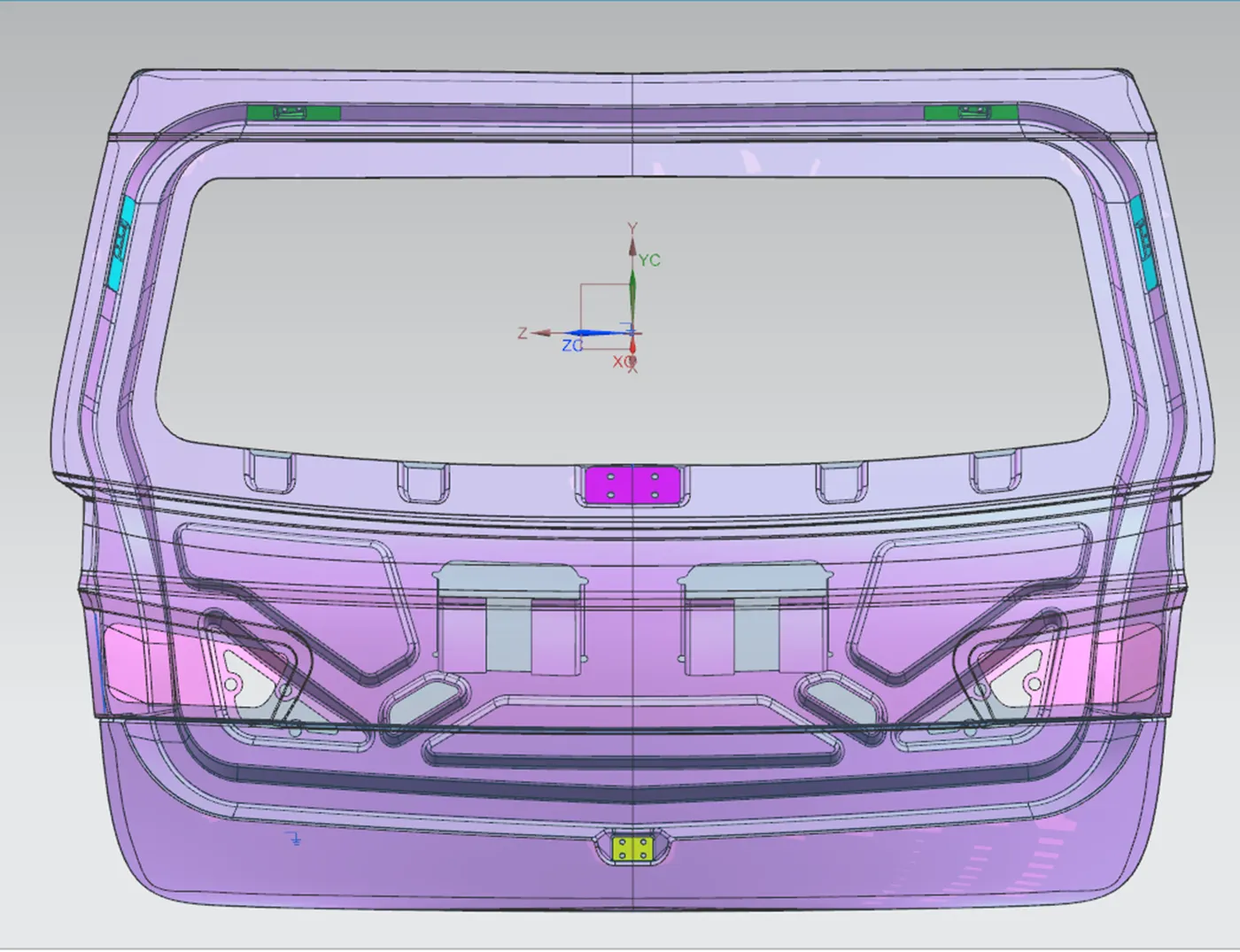
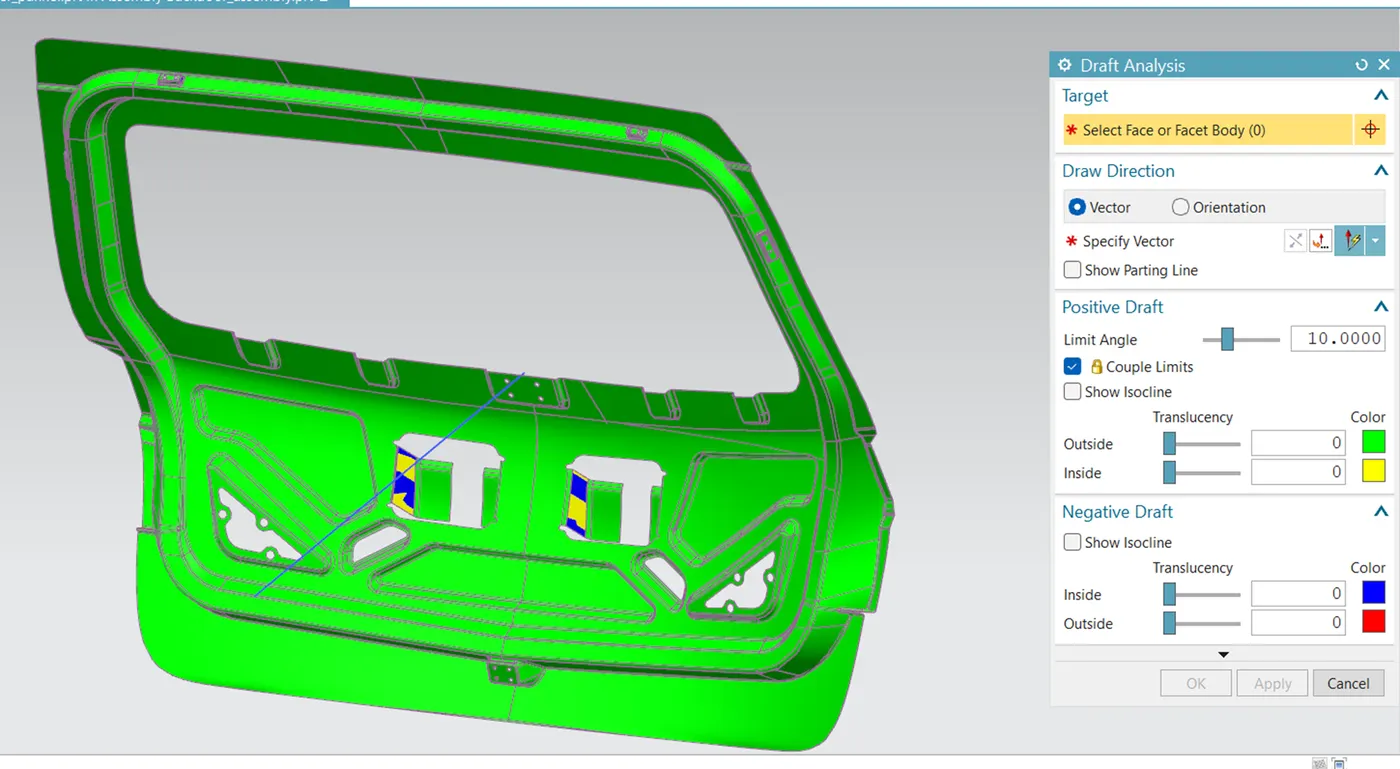
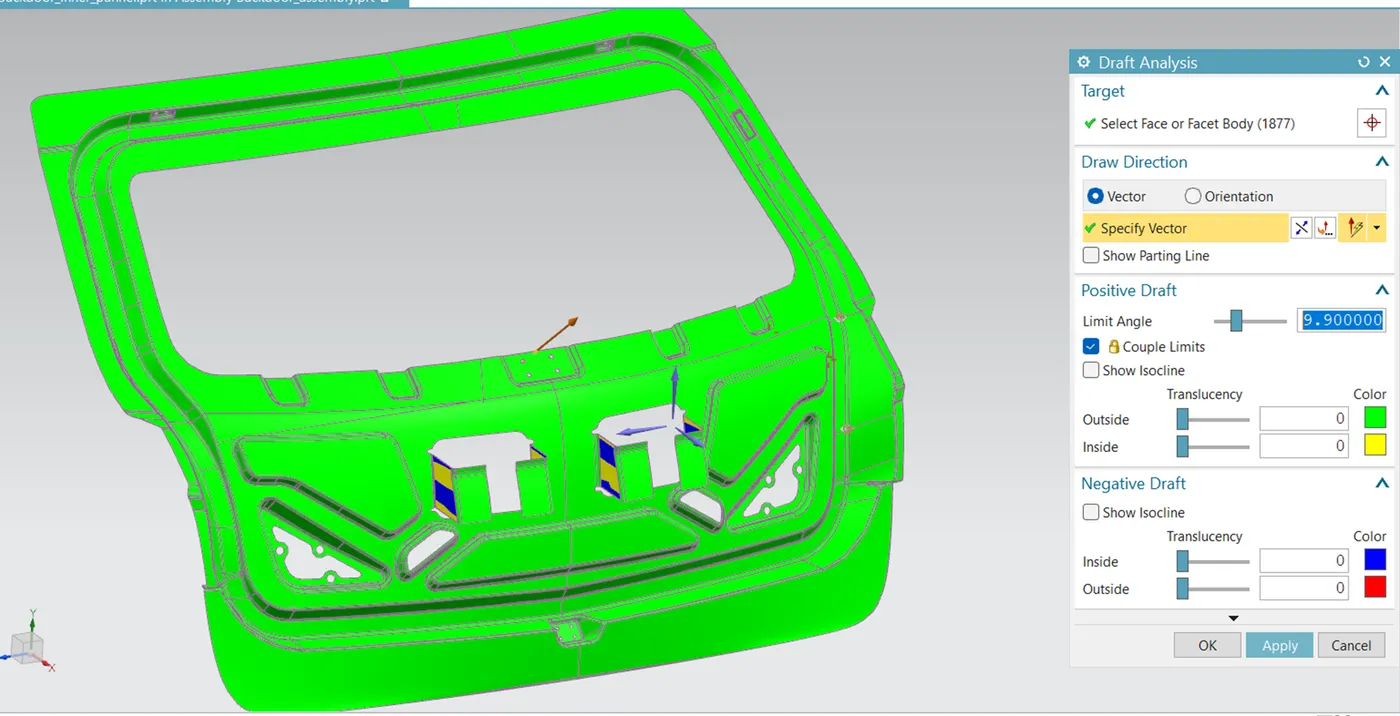
Draft analysis on Door inner panel
CONCLUSION
- Developed an automotive car back door design using the provided styling surface.
- Utilize appropriate design methodologies to enhance the overall aesthetic appeal of the back door.
- Addressed structural considerations by incorporating necessary reinforcements to ensure optimal strength and durability.
- Integrated embosses into the design to contribute to the visual and tactile aspects of the back door.
- Performed Draft Analysis and found all the parts are manufacturable.