Design of backdoor
BACKDOOR
Backdoor also know as 'Tailgate' is the hinged door present at the rear of the vehicle. it provide access to main storage compartment, called as bootspace, trunkspace or luggage compartment, that is used for keeping the luggage or store the spare wheel.
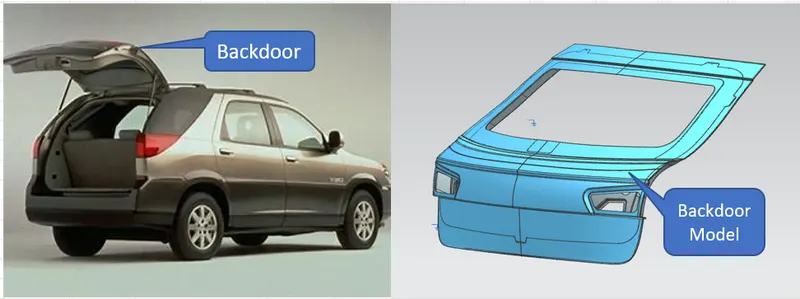
Main Purpose of Backdoor: Backdoor prevent the passenger from injury during rear crashing of automobile. It also serve the purpose of covering the bootspace thet used to store the luggage or spare wheel.
Opening of Backdoor: Backdoor open either manually or electriaclly operated. In most of the luxurious car backdoor opening is electrically operated.
Type of Mechanisms:
-
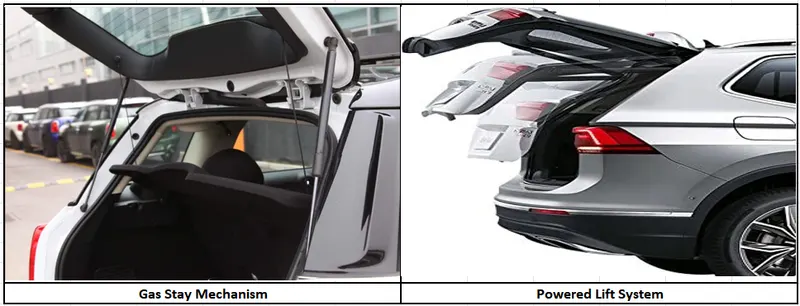
Gas Stay: Gas stay types backdoor/tailgate is an most commonly used mechanism for lower segment car to luxury car. The ideal components of backdoor consist of hinge, door, gas stay and some rubber beadings for sealing of door.
-
Power Lift Sysytem: Powered lift system is another mechanism of opening the backdoor/tailgate, which is automatically open and close the backdoor/tailgate and release the latch by the pressing a button.
Material Used for Manufacturing: Aluminium and Steel are the widely used material for manufacturing of backdoor. Where low budget vehicle used Steel for manufacturing as it is cost efficent.
Choise of material depend upon the budget and performance of car.
Types of Backdoor:
-
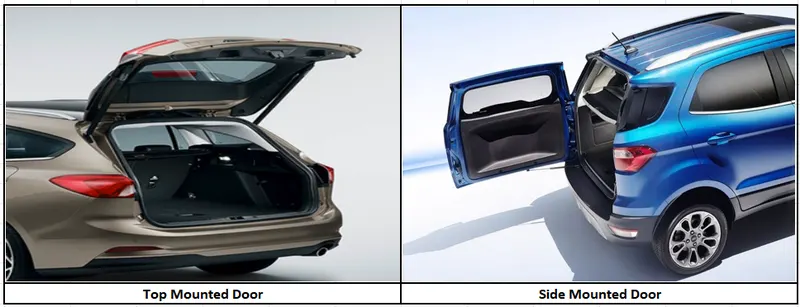
Top-Mounted Backdoor: This type of back doors is found in a station wagan, pickup truck and some of the sport utility vehicles. Today's modern cars, use top-mounted tailgate systems. These top mounted tailgates provide greater rear visibility compared to side-mounted door.
-
Side-Mounted Backdoor: Side-mounted doors are used in the van type MPVs, SUVs, pickup truck vehicles. These doors are generally smaller in size and can be easily accessed as compared to top-mounted backdoor.
ASSEMBLY OF BACKDOOR
Backdoor assembly comprises of following component :
- Backdoor Outer Panel
- Backdoor Outer Upper Panel
- Backdoor Outer Lower Panel
- Backdoor Inner Panel
- Hinge & Hinge Reinforcement (LH & RH)
- Gas Stay & Gas Stay Reinforcement (LH & RH)
- Wiper & Wiper Motor / Wiper Motor Reinforcement
- Latch & Stiker / Latch & Striker Reinforcemet
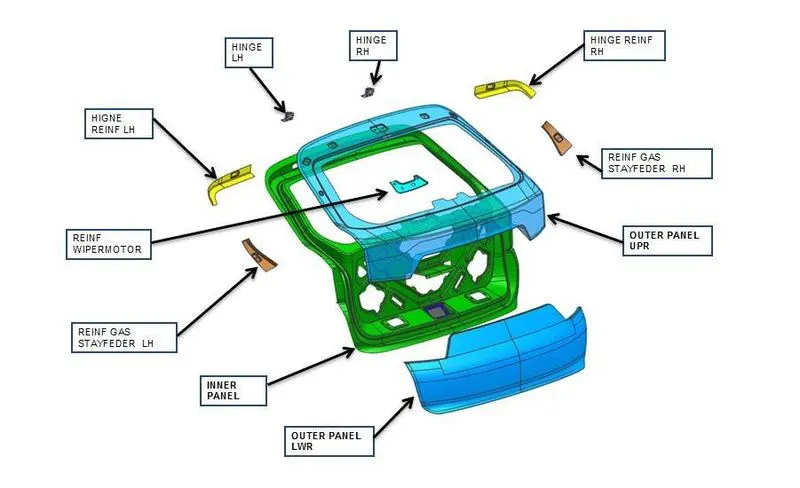
COMPONENT OF BACKDOOR
- Backdoor Outer Panel
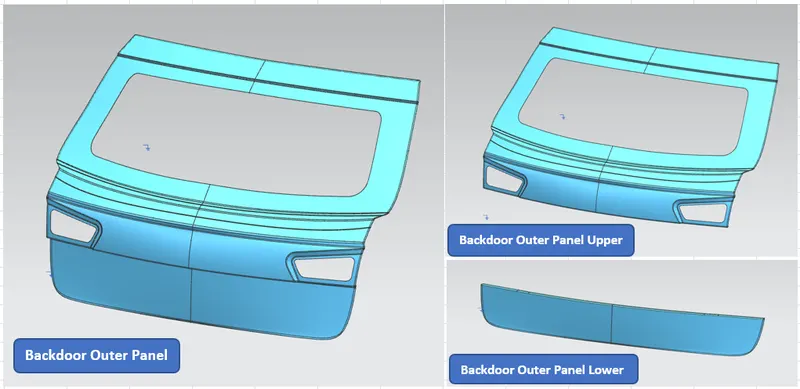
It is the outer cover of backdoor. Backdoor Outer Panel is the styling surface of the back door and responsible for the aesthatic of backdoor. Other parts of the backdoor are designed by using the reference of outer panel.
The outer door handle and the number plate may also be installed on the outer panel of the back door. Usually it is installed on lower side of backdoor.
Backdoor Outer panel is divided into two parts named as :
- Backdoor outer panel upper.
- Backdoor outer panel lower.
Manufacturing process Involve: Stamping, deep drawing and embossing.
Material use: Aluminium and Steel depending upon budget and performance.
Thickness: 0.65-0.75mm.
- Backdoor Inner Panel
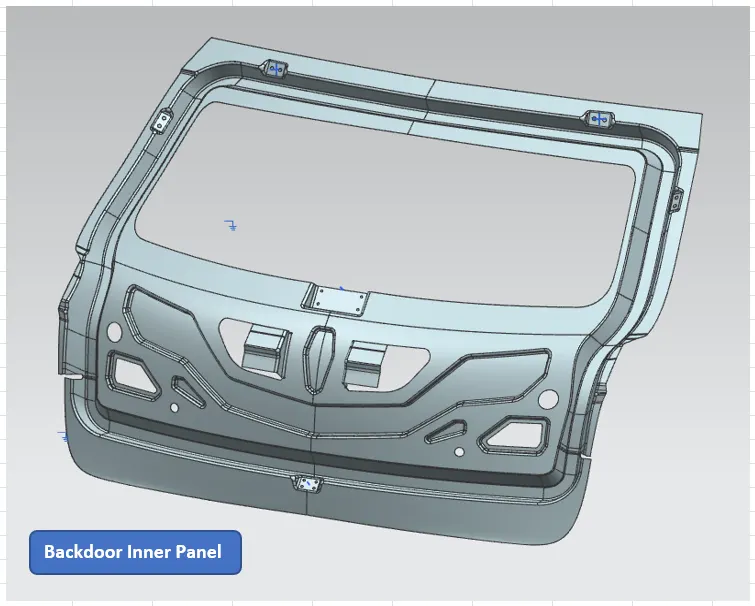
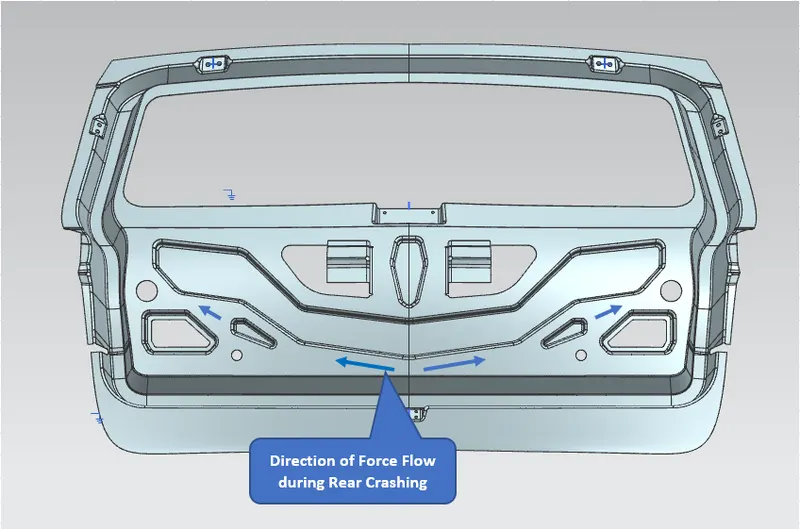
It is the inner part of the backdoor. Most of the reinforcements and components are installed on the inner panel. Inner Panel provides strength to the back door. For provinding strength to the inner panel, reinforcement are mounted on it and embosses are created for force distibution in case of rear crashing.
Manufacturing process Involve: Aluminum panel manufactured by casting where steel sheet metal by stamping.
Material use: Aluminium and Steel depending upon budget and performance.
Thickness: 0.65-0.75mm.
- Reinforcements
Reinforcements are provided to support and add extra material to the sheet metal part to increase its strength near component installation regions and minimize the impact of collisions. Thickness of reinforcement is from 0.65mm to 1.50mm and made up of aluminium or steel.
Assembly Part and their Reinforcement Used in Backdoor Assembly:
1. Hinges
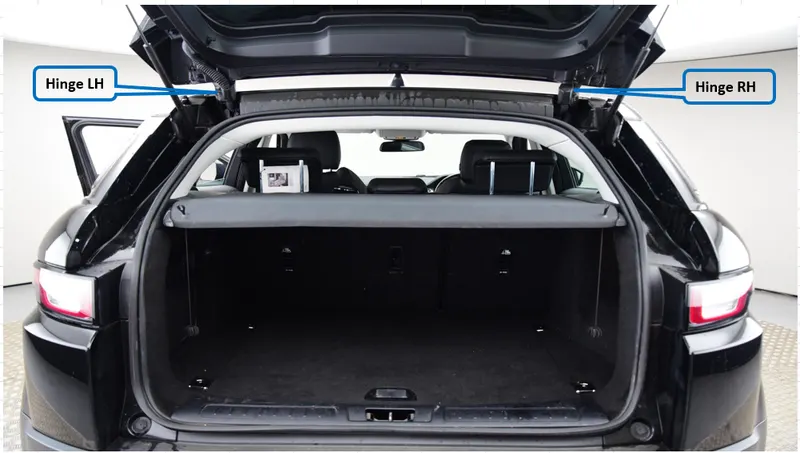
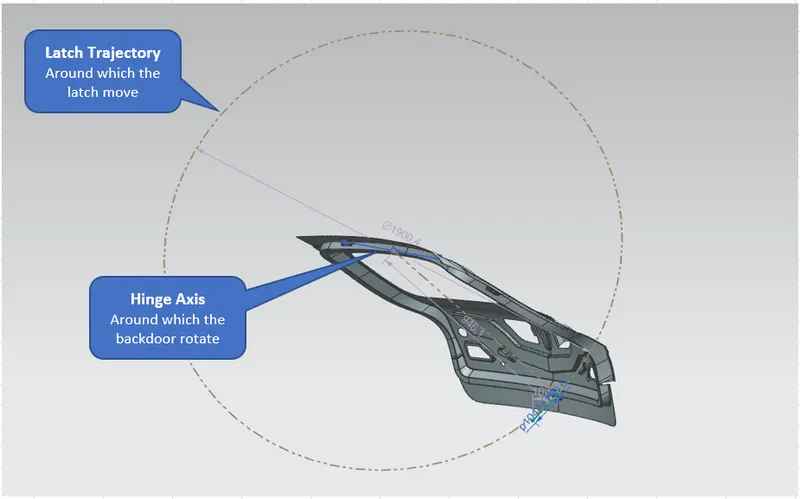
Hinge is the mechanical component that attached the backdoor to the rear end of vehicle roof. One end of hinge fixed to the roof of vehicle and other end fixed to the backdoor. Backdoor rotate around the hinge axis during opening and closing, it allows the backdoor to be open up and close down.
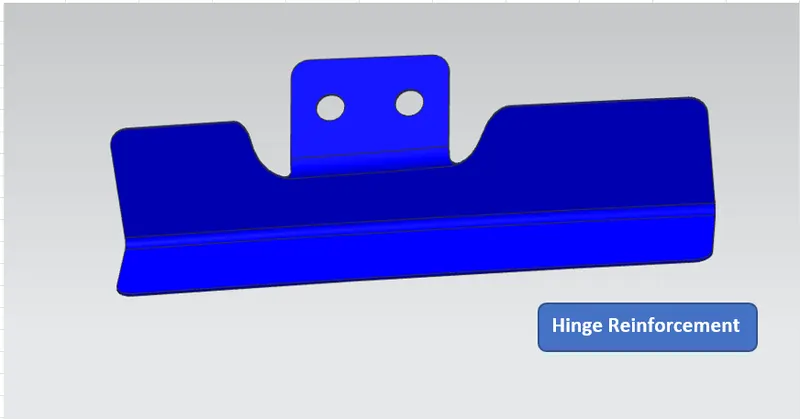
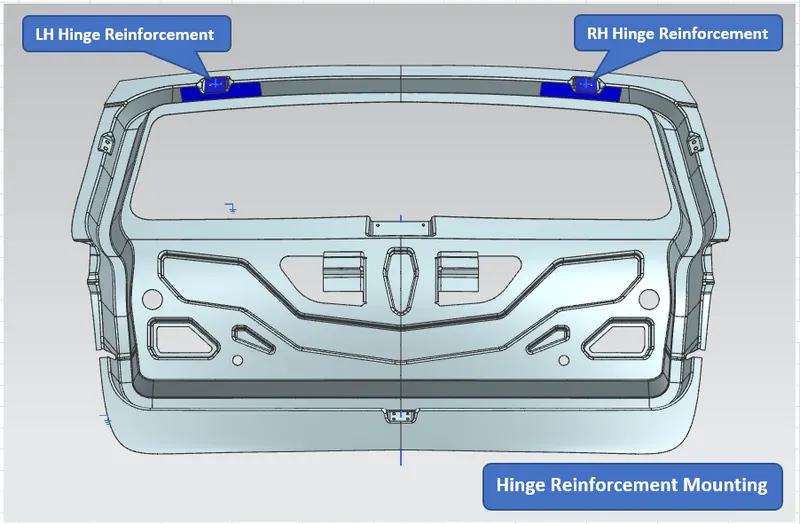
Hinge Reinforcement
As the door open up and close down around the hinge axis frequently while using, the load being acted upon the backdoor to compensate this load and provide strength to the inner pannel hinge reinforcement added to the inner panel of backdoor.
2. Gas Stay
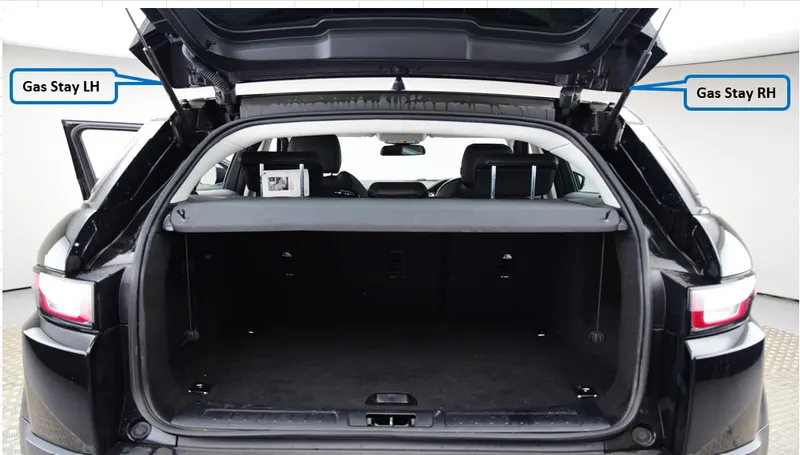
Gas stay is a device that keep the backdoor in open position and allow easy access to the boot space. One end of it fasten to backdoor and another end fixed to rear body side of the vehicle.
Type of Gas stay
- Semi-Automatic: Require little force for lifting the backdoor then hold the backdoor in open position by its own.
- Fully-Automatic: It ahs power spindle that powered the backdoor to open up without manual interaction and keep it open till use.
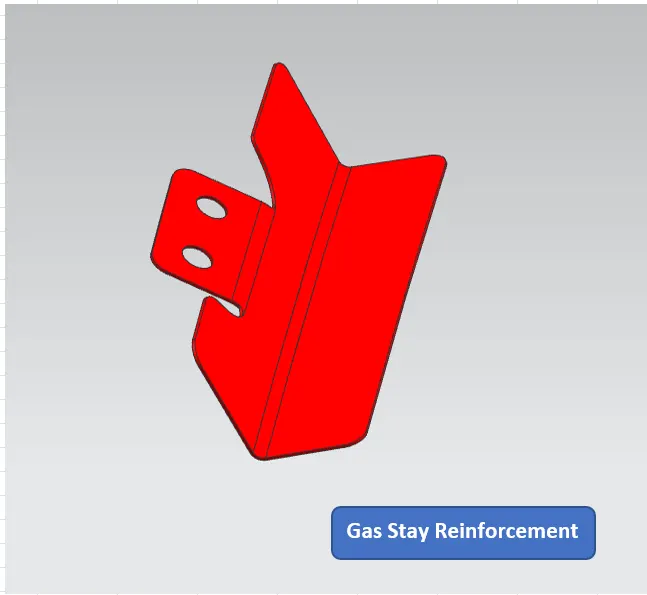
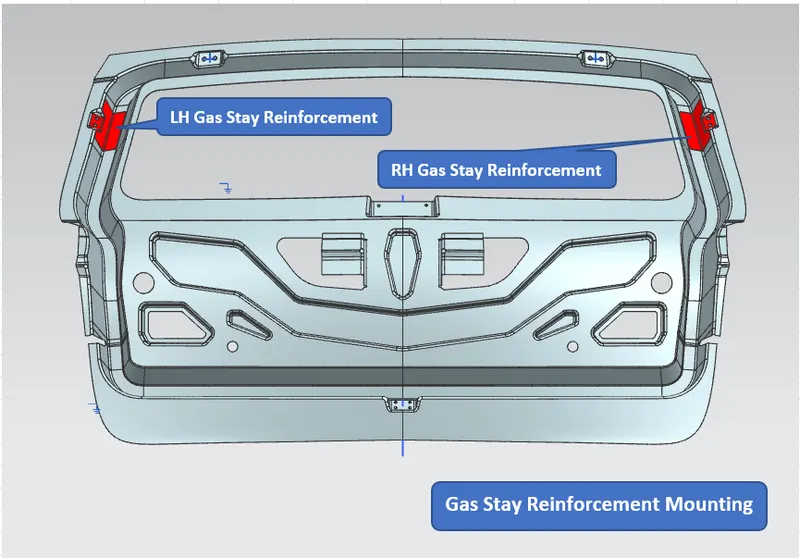
Gas Stay Reinforcement
When Gas stay keep the door is in open condition, a load is acted on the inner panel of backdoor to compensate this load and provide strength to the inner panel gas stay reinforcement is mounted on inner panel.
3. Wiper and Wiper Motor
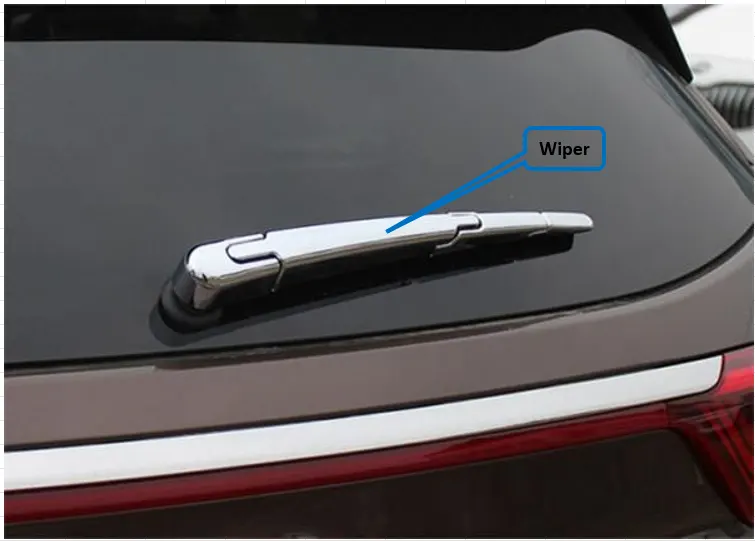
Wiper is a device used to clean the windglass, it wipe out the dust and water from the glass. Wiper is fixed with motor that power the wiper to wipe out the windscreen of the vehicle.
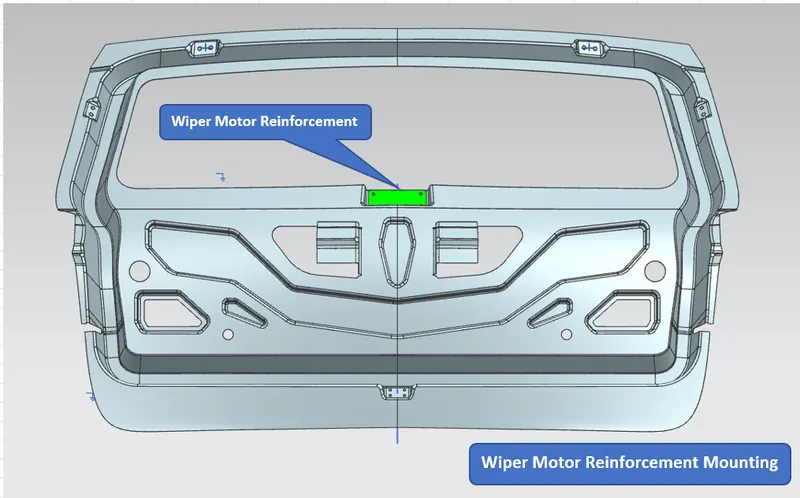
Wiper Motor Reinforcement
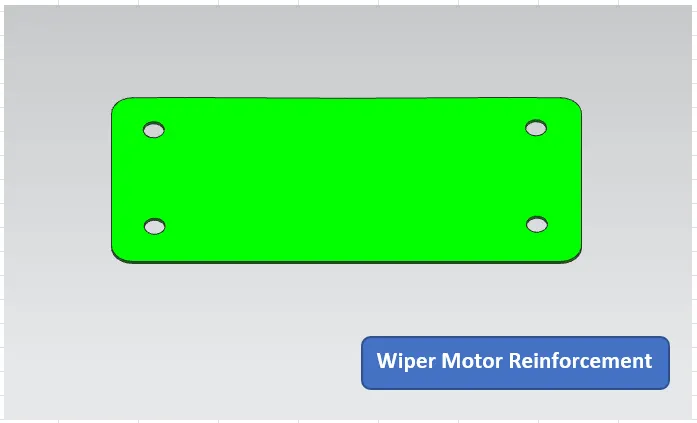
To hold out the wiper motor and wiper, inner panel require some strength at the installation region of wiper motor. To provide that strength at the installation region wiper motor reinforcement added to the inner panel.
4. Latch and Striker
Latch and striker are the device ued for locking the backdoor with vehicle. And, keep it in locking condition while driving.
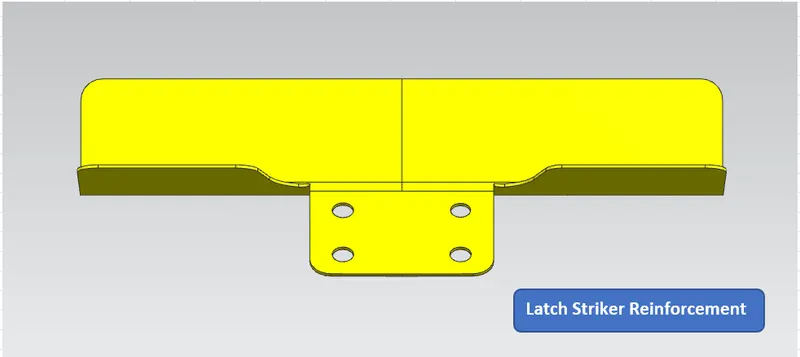
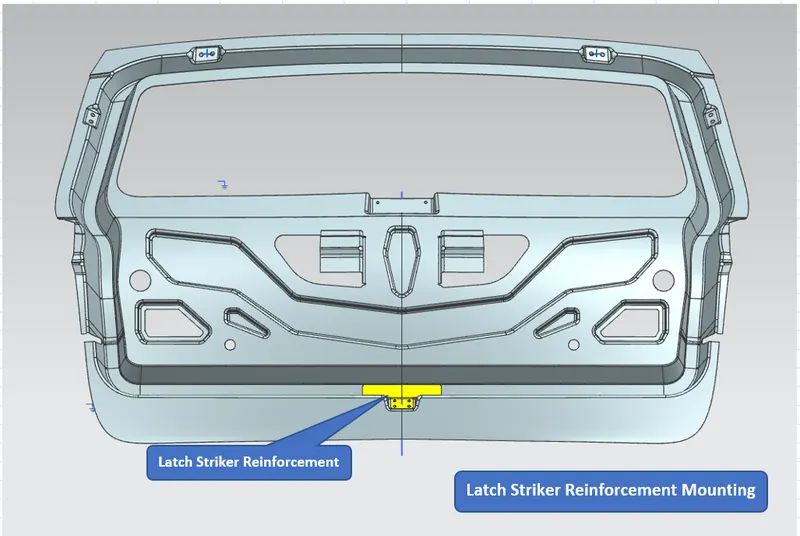
Latch and Striker Reinforcement
When the door is closed and open the force is acted on the latch and striker frequently. To provide the strength to inner panel in latch and striker region the reinforcement is provide to compensate the load.
DESIGN CONSIDERATION OF BACKDOOR
- Rear Visibility Criteria: More and Wider the rear visibiltiy better will be design consider for backdoor. As Rear visibility depend upon the space given for windscreen glass.
- Rear Crash Analysis: Design of backdoor should be as that in case of rear crashing the force distribution is towards the side of backdoor rather than imparting impact on centre region. To meet that purpose, emboss are created on inner panel of backdoor.
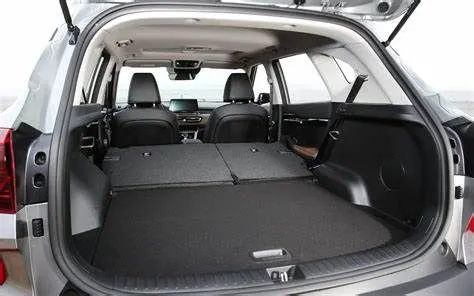
- Luggage Volume / Bootspace: More the boot space for carrying luggage more will be the advantage for passenger.
- Functional requirement of Hinge and Gas Stay: Hinge and Gas stay mounted at such a region that minimum amount of load is acted upon backdoor during opening and closing of backdoor.
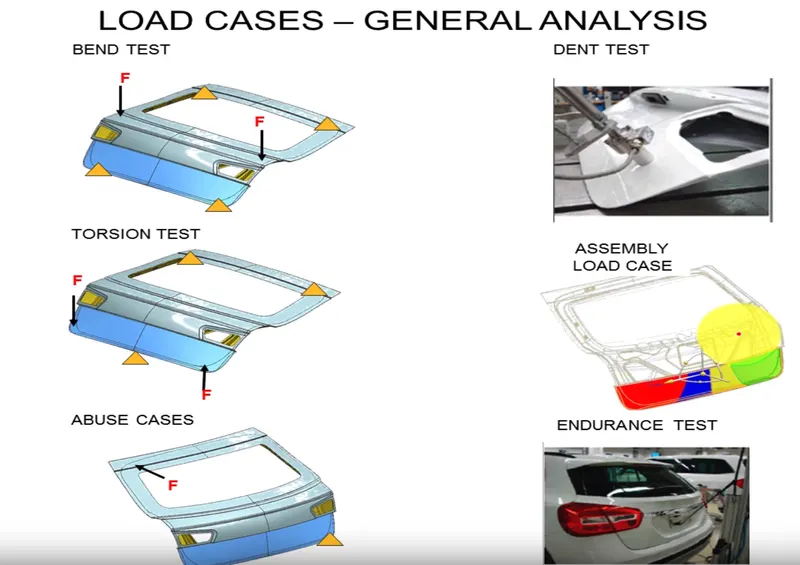
- Load case analysis of Backdoor: Bend Test, Dent Test, Torsion Test & Endurance Test are the general load case study that carry on backdoor for better performance of backdoor.
- Gap & Flushness Requirement: Depending upon the standard of manufacturing & design, Gap & Flushness provide to backdoor.
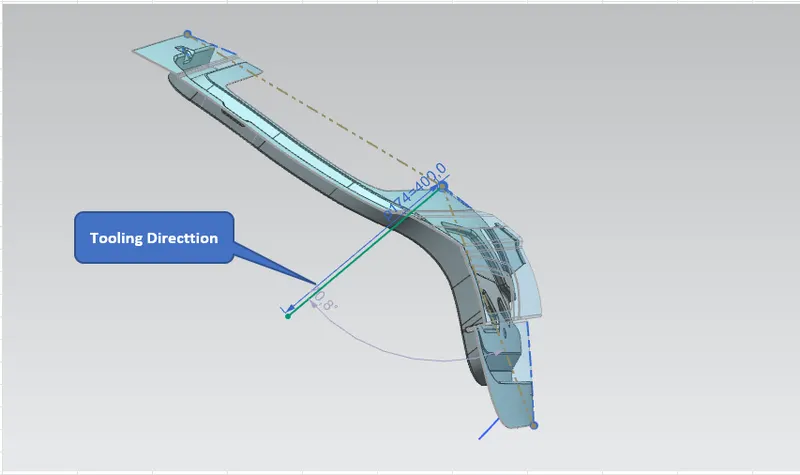
- Tooling Direction: Design of backdoor is such that it will be easily manufacturable and pass the draft analysis test. Hence, it is design by considering the tooling direction in consideration.
- Latch Trajectory: Latch trajectory is the path around which the stiker move while opening and closing of the door. It is circle that passes through the centre of hinge axis and around which the backdoor rotate. It taken into design consideration for mounting of stiker on inner panel.
JOINING PROCESS
1. Hemming
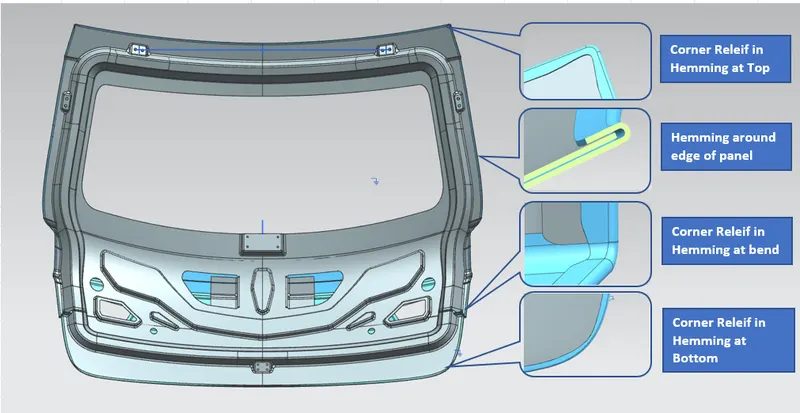
Hemming is the sheet metal forming operation in which edge of the sheet are folded over another part in order to join the two parts. Sheet metal usually bending around 180 dgeree to join the parts. Hemming used in automobile to join the inner door panel with outer panel of door. Typically parts assembly are hood, door and fender.
Hemming is used in backdoor assembly to join the inner panel to outer panel around the edge.
Design Consideration: 0.2 mm gap should be between joining suraface for application of hem glue.
Corner Relief in Hemming
The accuracy of hemming is very important as its affect the apperance and quality of surface. Typical hemming defects are splits or wrinkles in the flanges, material overlap in the corner area. That is why it is important to provie relief at corner.
2. Mastic Sealent Application
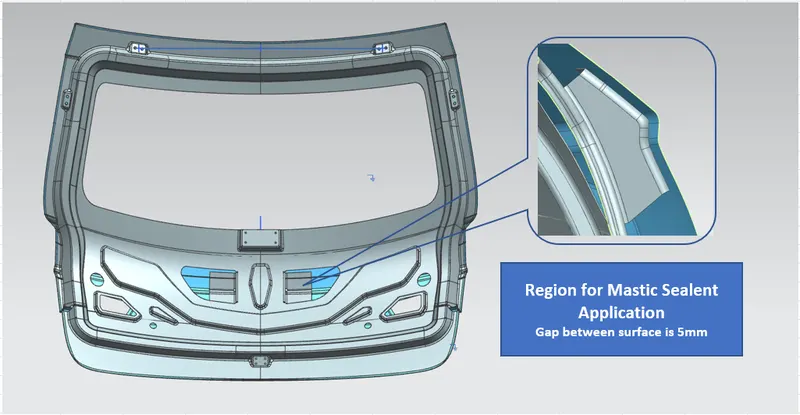
Mastic Seal are used to join ther inner panel to outer panel at centre region. As mastic seal provide strength to the assembly, it also serve the main purpose of reducing NVH (Noise, Vibration and Harshness) value.
Design Consideration: 5mm gap should be between joining surface for application of mastic sealent.
3. Spot Welding
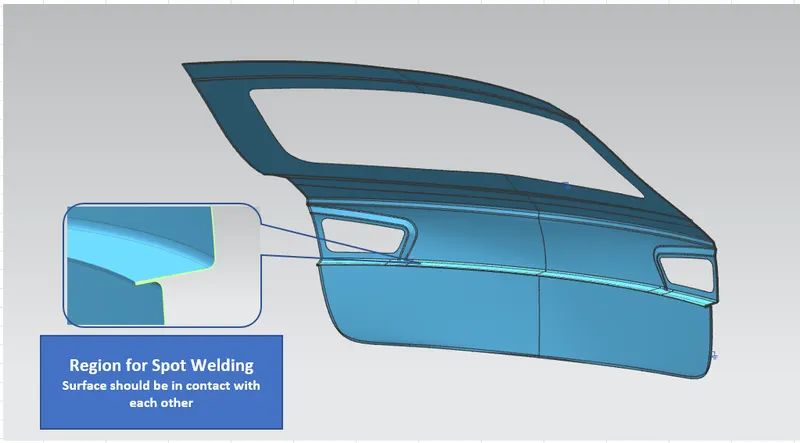
Spot Welding is a form of resistance welding in which two sheet metal part are placed between electrode togather to fuse them and make a joint, by application of resistance to the current. A current is discharge through the elctrode, the gap between two metal surafce offer high resistance to the current result into heat generation at that region which melt the matal and fused them togather due to presssure applied on them by electrode.
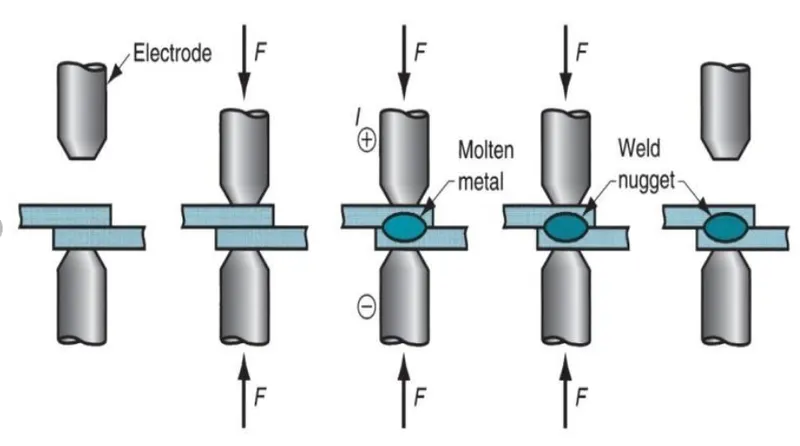
Design Consideration: Surface of metal to be joint is in contact with each other with no gap between it.
DRAFT ANALYSIS
Draft: It is the amount of taper given in manufacturing or machining part to the tool axis.
Draft angle for aluminium casted panel is 2 to 3 degrees is sufficent but for steel the angle is more than 7 degrees.
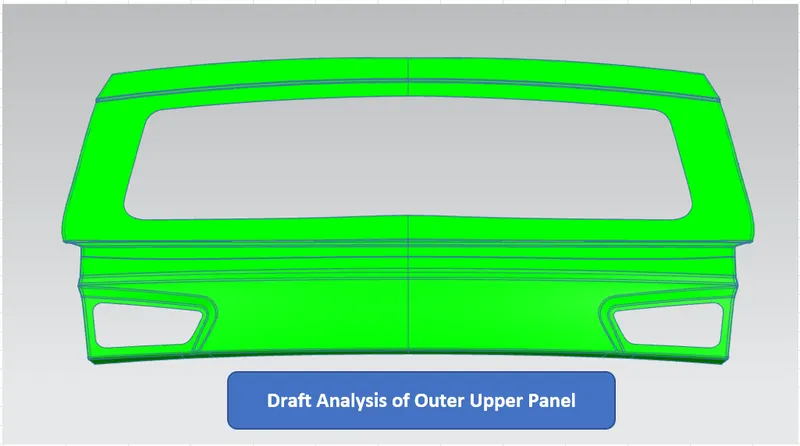
1. Draft Analysis of Backdoor Outer Upper Panel
Result : Draft angle is more than 7° from Tool Axis
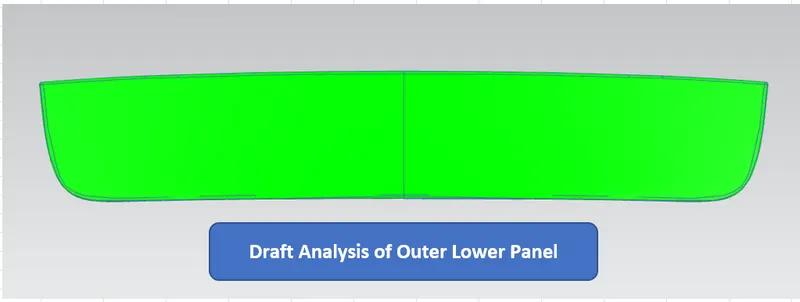
2. Draft Analysis of Backdoor Outer Lower Panel
Result : Draft angle is more than 7° from Tool Axis
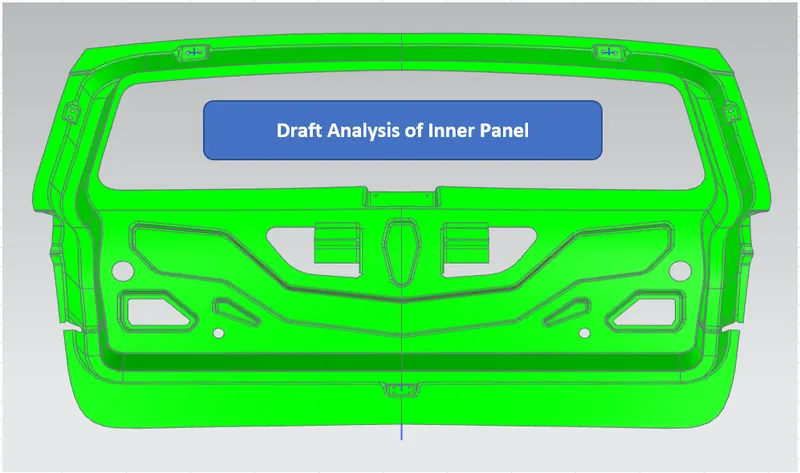
3. Draft Analysis of Backdoor Inner Panel
Result : Draft angle is more than 7° from Tool Axis
MANUFACTURING PROCESS
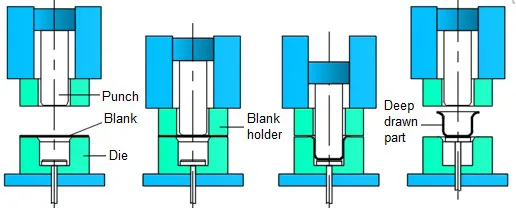
- Deep drawing : Deep drawing is a sheet metal forming process in which blank of sheet metal rapidly drawn into a forming die through the mechanical action of punch. Thus, it is a shape transformation process with material retention. After the process material take the shape of the punch. it consists of sheet metal blank holder, punch and die. Mainly used for the manufacturing of automobile parts.
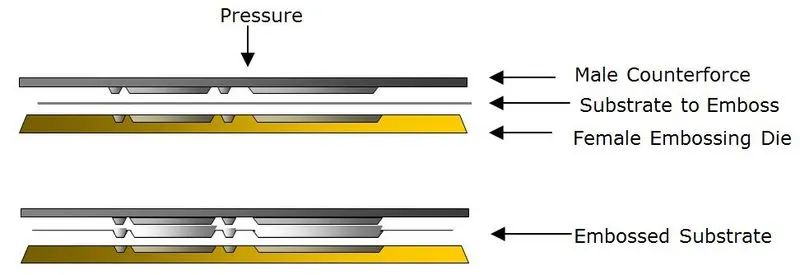
- Embossing : Embossing is a metal forming process used to create a raised surface on a material by applying a pressure on the material. Machine press the material against the die to impart a raised surface onto the material. Embossing add dimension to the surafce and enhance its look. it also protect material from wear and tear.
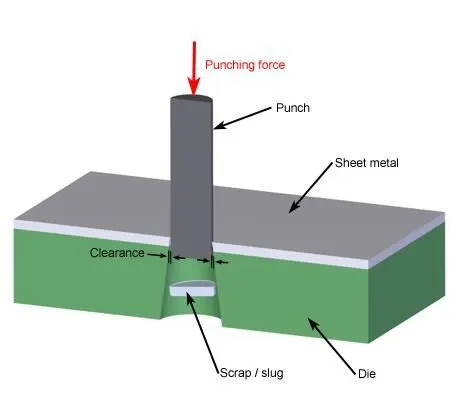
- Blanking or Piercing : Blanking or piercing is a shearing process in which punch and die used to produce a parts from coil or sheet stock. Blanking creates the outside feature of the component, while piercing also know as 'punching' make a internal holes or shapes.