Damper Optimization.
1. Calculate the following parameters for front and rear suspension.(2 points each-total 16 points)
2. Using the information calculated above, come up with a force vs. velocity shock curve for the front and rear suspensions (velocity range = 0 to 500 mm/sec) (7 points each for the front and rear plots for a total of 14 points)
Your Answers
The excel file is uploaded to the google drive and the link is attached below:
https://drive.google.com/file/d/1bqwgBwqabDt29mJms7Ly2MuambdGpafv/view?usp=sharing
2. The force vs velocity shock curve for the front and rear suspension is as follows:
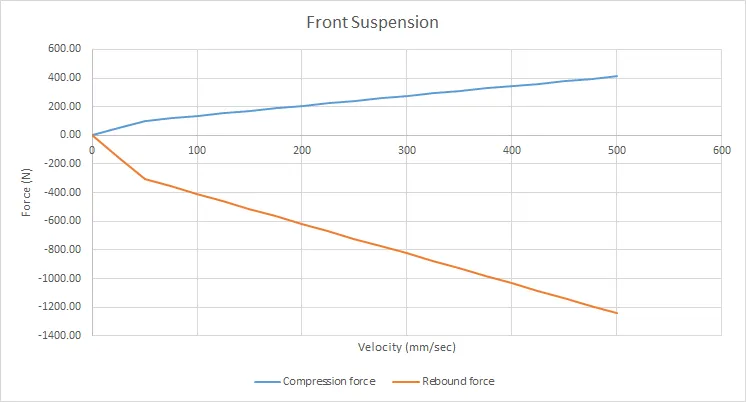
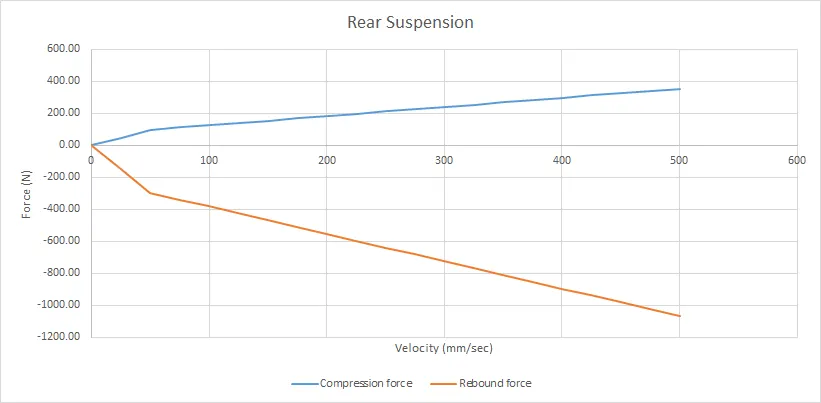
Inference from the plot : The plot represents the force-velocity damper curve which typically has four regions -low speed compression, low speed rebound, high speed compression and high speed rebound.The low speed ratios control the low frequency motions of the sprung mass while the high speed ratios damp the high frequency inputs and keep the suspension in control over bumps.
Calculation Steps Followed :
The force-velocity damper curve above are the starting point in the damper selection process. This curve is based on the fact that :
- compression damping is lower than the rebound damping, because in compression the spring absorbs energy and the damping force needs to be lower, whereas in rebound the energy is dissipated. It must be controlled and hence the rebound damping needs to be higher. So the rebound damping coefficients is generally greater than the compression damping coefficients.
- At higher speeds(higher frequency) the damping coefficient has to be less and for lower speeds (Low frequency) the damping coefficient has to be more, so that we arrive at a condition of minimum vertical acceleration at all speeds.
First the initial sprung mass damping coefficient and initial unsprung mass damping coefficient is calculated using the below mentioned formula.
I(sprung mass) = damping ratio*2 * (sqrt(ride rate*sprung mass))
I(unsprung mass) = damping ratio*2*(sqrt(ride rate*unsprung mass))
Then based on the rebound to compression ratio, the sprung mass initial damping coefficients, the rebound and compression damping coefficients are calculated using the below mentioned formula. This gives the compression- rebound split.
Lets say the rebound to compression ratio is 'm'. Then the initial damping coefficent (I) must be the average of rebound(R) and compression(C) damping coefficients as well.
I = (R+C)/2
R/C = m
Then R = (m*2*I)/(1+m) and C = (2*I)/(1+m).
These rebound and compression damping coefficients are based on the sprung mass. These represent the slope of the force-velocity curve in the low speed region and thus are known as the low speed rebound damping coefficient(R) and low speed compression damping coefficient(C).
For the high speed region the rebound and compression damping coefficients are calculated similar to the steps mentioned above for low speed condition but considering the mass to be unsprung mass and the ride rate of the unsprung mass.