Concept on positioning of Columns
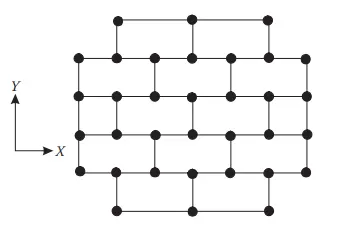
1) Comment on the layout of the framing plan concerning earthquake resistance in the two horizontal directions X or Y (dots are columns, lines depict beams). Look into aspects of symmetry, redundancy and bi-directional stiffness and ductility.
1Ans:
- Symmetry:
- Moment resisting frames are uniformly distributed about both the orthoginal axis, so the centre of stiffness will be present at the centre.
- Due to synnetry, the centre of mas will lie near to the centre of stiffness, if the loads are distributed uniformly.
- Torsional response will be far because of the reduced eccentrities b/w the centre of mass an d the centre of stiffness.
- This tenders to reduce the horizontal displacements in both of two horizontal displacement in both of the two orthogonal horizontal direcections.
- It also has a very good uniformity also.
- Redundancy:
- There are missing structiral elements in the periphery of the plan. this causes the uneven distribution of earthquake action effects in non linear range across the plan. the energy dissipation across the structure is very low which results in non - reliable structure.
- Bi-directional Stiffness:
The building plan may not be able to resist the horizontal seismic actions in the shorter direction (Y-axis); also the resistance and stiffness in the stiffness in the shorter direction (Y-axis) is less when compared to longer direction (X-axis)
- Ductility:
The building may not be able resist the elastic earthquake forces in shorter direction (Y-axis) so it may result in in erlastic response. the reduction in design forces inn the shorter direction (Y- axis ) is to be compensated by Ductility.
2) What are the possible sources of irregularity in the building shown here? Explain how, as an engineer, each of these irregularities should be dealt with.

2) Ans
1. Stiffness Irregularity:
The lateral stiffness of the story at the mid height which is opne is vey less when compared to the above levels because the main reason is the structure is discontinued at the mid height.
It is observed that the open storey causes reduction in the stiffness in the building and attracts lateral seismic exixitation more in that floor which causes severe damage to upper floors.
The irregularity can be solved by providing the shear walls to this high seismic action prone floor.
2.Mass Irregularity:
The open story also cause mass irregularity in the building because the high mas concentratikon is present the open floor. that is the upper floors carry more nass that the open floor.
Also the no of floors are higher above this open floor.
3. Vertical Geometrical Irregularity:
There is a change with the horizontal dimension of the lateral force resisting due to the open storey in mid height and also the vertical geometry of the building which means the length of the top storeys are varying along the buildign unit.
This cause torsional effects in the building which need to be decoupled by providing shear walls or decoulped moments.
Theflexibilty provided due the variation need to be compe sated by providing Ductility.
3) A 4-storey hotel building has an open ground floor for the restaurant. Story 2 to 4 have one row of rooms along each long side in plan, separated by a corridor. The two short sides of the perimeter are fully in-filled in all storeys, except for certain openings at the ends of the corridor at storeys 2 to 4 and along the right-hand side of the ground floor. There is a staircase near the upper left-hand corner, with straight flights between landings at floor levels and in-between floors. Cross-section dimensions are written next to the member no. in meters.
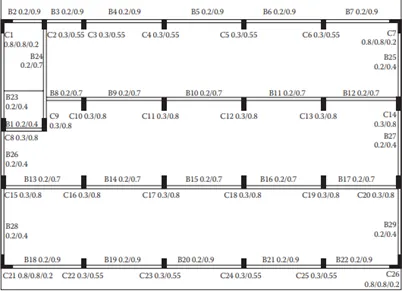
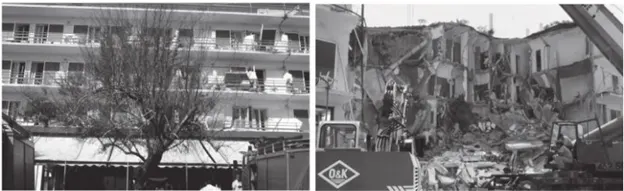
Comment on the features of the structural design and of the layout of infills which are important for earthquake resistance and seismic performance. How do they relate to the almost full collapse of this building (the extreme left-hand bay with the staircase survived, as well as one long-side façade in the rear end, and the frame along the right-hand side in plan).
3)ANS :
The building collapse occured due to the ground excitation in both orthogonal horizontal direction and also due to the torsional effects . inspite of being having the earthquake resistance for the two mentioned actions
The following are the resonsible factors:
1. Open Ground Floor
2. Two short sides of the perimeter in - filled
3. Extreme left hand bay Staircase filled with the Concrete
4. Columns not in the same line
1. Open Ground Floor.
The ground floor of the building is open which may be a soft story (having long columns0 due to this the ground floor excitation the columns colud have been unable to resist the earthquake nad form collapse.
This is called as soft storey mechanism.
This can be avoded by having string column - weak beam mechanism.
2. Two short sides of the perimeter in- filled
The mass has been undidtributed in all the sides of the buildingb in all storeys because it is give that the two side of the permeter of the building is in filled mayn be with the soil whcih cause the irregualr distribution of mass called as mass irregularity.
This can be avoided by providing the shear walls in the directions of two short sides of the oerimeter which can resist the lateral loads soil due to infill by providing stiffness in the buildign frame and helps to resist the earthquake actions.
Also it adjusts the mass irregularity for the plan.
3. Extreme left hand bay staircase filled with the Concerete.
The extreme left hand bay has staircases made of concrete due to this the mass got concentrated in the staircase area due to which torsional effects are formed having the base of the concentration of mass in the staircase.
To avoid this type of failure the staircase should be kept in the centre of the building which makes the torsional effcet as Zero by Uncoupling the moment. it also makes the implicationas of having irregularity in plan of the building.
4. Columns not in the same line:
It is observed that the columns in the extreme left hand middle columns has the deviation in the line of the constrcution at the starircase whih again a reason for the irregularity in plan having the torsional flexibilty
To avoid this the eccentricity should be maintained for the deviation to be with in the limits of Beam size and the columns size.
Also the size of the beam and columns in the plan should be redesigned in such a way that the line of the columns doesn't deviate even in the staircase area.