Challenge: EV Drivetrain
Question
1. Which types of power converter circuits are employed in electric and hybrid electric vehicle?
2. An Electric Vehicle's powertrain with 72V battery pack in shown in the diagram below. The duty ratio for acceleration operation is 'd1' and for the braking operation the duty ratio is 'd2'.
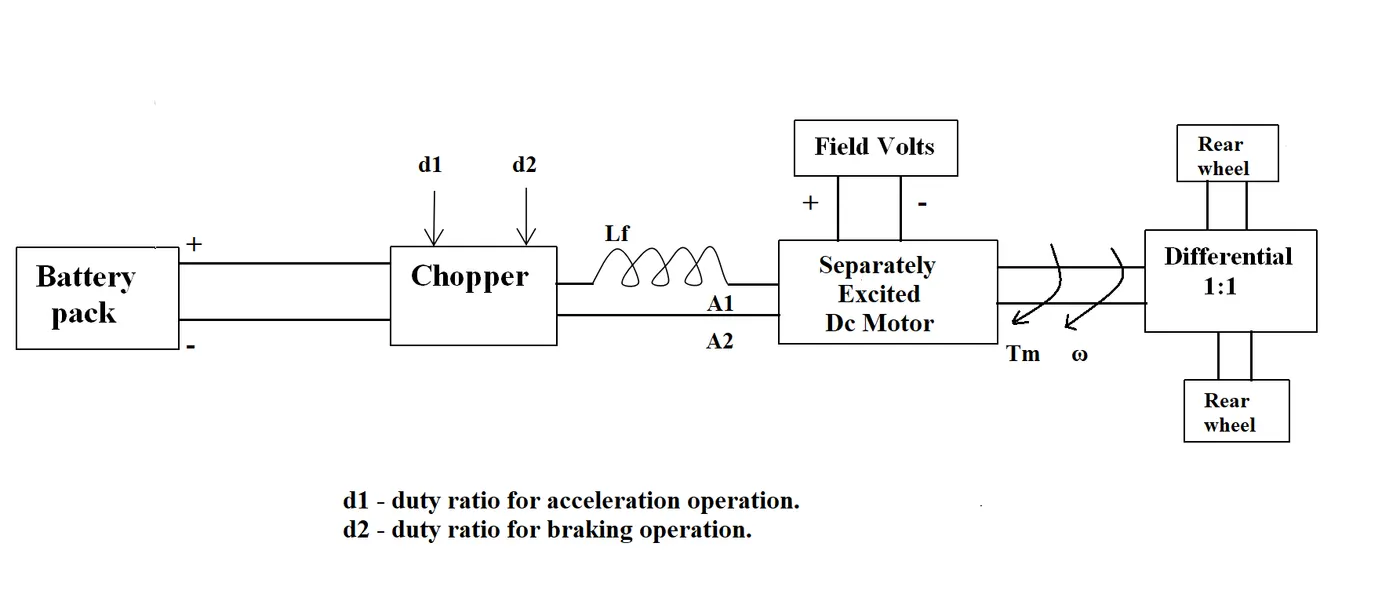
The other parameters of the electric vehicle is given below,
Motor and Controller Parameters:
Rated Armature voltage= 72 V
Rated armature current= 400 A
Ra= 0.5Ω, KΦ= 0.7 Volt second
Chopper Switching frequency= 400 Hz
The vehicle speed-torque characteristics are given by the below equation

What is EV steady state speed if duty cycle is 70%?
3. Refer to the blog on below topic:
Induction Versus DC brushless motors by Wally Rippel, Tesla
Explain in brief about author’s perspective.
Answers
#1
The different types of power converters used in EVs and HEVs are,
DC-DC converter, these are electronic circuits that converts a source of direct current (DC) from one voltage level to another, that is, they can step-up or step-down the voltage. In step-up converters the output voltage is higher than the input voltage, it is also called a boost converter. In step-down converters the output voltage is lower than the input voltage, it is also called a buck converter. These converters are used to power the auxillaries.
DC-AC converter, also called as an inverter or a power inverter, is an electronic device that converts direct current (DC) to alternating current (AC). The input voltage, output voltage, output frequency, output waveform depend on the design of the specific device. It is to be noted that the power inverter does not produce any power, the power is provided by the DC source, the inverter only converts the DC to AC. These types of power converters are used to power the AC induction motors that propel the EVs and HEVs.
AC-DC converter, also called as a rectifier, is an electrical device that onverts alternating current (AC) into direct current (DC). This process is known as rectification. These types of power converters are used as battery chargers in EVs and HEVs as battery can only store DC and not AC.
#2
The given equation is, `T_v = 24.7 + 0.0051omega^2` `->(1)`
Other given parameters,
Rated armature voltage, `V_a = 72 V`
Rated armature current, `I_a = 400 A`
Armature resistance, `Ra = 0.5 ohm`
Motor constant, `kphi = 0.7` volt second
Chopper switching frequency, `f = 400Hz`
Duty cycle, `D = 70% = 0.7`
Voltage obtained from 70% duty cycle is
`V = V_a xx D`
`= 72 xx 0.7`
`= 50.4V`
Using the DC motor torque-speed relation equation,
`omega = V/k -(TR_a)/k^2`
`omega = 50.4/0.7 - (Txx0.7)/0.7^2`
`implies omega = 72 - 1.02 T`
`implies T = (72- omega)/1.02` `->(2)`
substituting (2) in (1)
`(72-omega)/1.02 = 24.7+0.0051omega^2`
`implies 0.0051omega^2 + 0.98omega - 45.88 = 0`
Now solving for `omega`, we get
`omega = 38.924` rad/s
Rotation per minute, `N = omegaxx60/(2pi)`
`implies N = 38.924 xx 60/(2pi)`
`implies N = 371.696` rpm
#3
The author Wally Rippel was a long time proponent of electric vehicles. According to him there is no single solution to the type of drive for EVs or HEVs. The comparison is mainly between DC brushless motor and induction motor as these types are being used nowadays. Earlier there were only DC brush motors powered by lead acid batteries controlled by contactors, now the technology has evolved a lot with batteries that has a much higher energy density and complex controllers to control the speed and torque of the motor. In the earlier days DC brushless drives dominated the electric vehicles except for one. Today all the hybrids are powered by DC brushless drives and only pure EVs use induction motor.
The stator construction for both DC brushless and induction drives are similar, both use 3-phase modulating inverters. The only difference are in the rotors and the inverter controllers, and with digital controllers the only differences found are with the control code. Another main differences is that the DC drives generate much less rotor heat and its peak point efficiency is higher, also this drive can operate at unity power factor. On the other hand the best power factor for induction motor is around 85 percent which means that the peak point energy efficiency for a DC drive will be a higher than that for an induction drive. The author mentions also mentions that it is much difficult to control an induction machine as the control laws are complex and difficult to understand. It is more difficult to achieve stability over the entire torque speed range and over temperature with and induction than with a DC brushless.
The author thinks that DC brushless drives will likely continue to dominate the HEV market and that induction drives will maintain the dominance for high performance pure EVs.