Challenge 9
Aim:-
Que (1):- Explain in detail the steps involved in the calculation of the loads considered in piers.
Answer:-
- Pier is the compression member of the bridge
- They support the span ( superstructure) of the bridge by transferring the load to the foundation.
- They are subjected to massive loads like
- Axial loads and shear force
- Bi-axial moment in both longitudinal & transverse direction
Load Consideration
- Dead Load:
- This load majority comprises of self - the weight of the girder, pier caps, and pier.
- Superimpose Dead Load:
- This load majority comprises the weight of track plinth, rail, cable, cable trays, cable trough, handrails, parapets, etc
- Live Load:
- This load comprises the train ( rolling stock) live load that runs on the superstructure.
- One track one side Loaded (OTOS)
- One track with both sides Loaded (OTBS)
- Both track one side Loaded (BTOS)
- Both track both sides Loaded (OTOS)
- Breaking Load:
- This load comes into play when the train applied brakes while moving.
- It is taken as 18% of the unfactored vertical load.
- Traction Load:
- This load comes into play when the train starts to accelerate from rest.
- It is taken as 20% of the unfactored vertical loads.
- Centrifugal Force:
- This load acts on curved spans.
- It shall be calculated with the actual maximum allowed speed of the train in a curve according to the planned radius of curvature.
- Coefficient of CF = `V^2/(127 xx R)`
- Wind Load ( Without Live Load):
- This load comes into play when wind exerted load on the structure.
- In this case, the wind pressure will be very high, making it quite difficult to move the live load.
- Wind Load ( With Live Load):
- This load comes into play when wind applied forces on the structure.
- In this case, the wind pressure will be normal, allowing the movement of live load.
- Vz = Vb x K1 X K2 X K3
- where Vb (m/s) is the regional basic wind speed.
- Earthquake Load ( In Longitudinal Direction):
- This load comes into play during an earthquake when the structure vibrates in the longitudinal direction.
- Live load is not considered in the case as vibration doesn't have any impact on the live load as it rolls away.
- Earthquake Load ( In Transverse Direction - With live load):
- This load comes into play during an earthquake when the structure vibration is in the transverse direction.
- Live Load is considered in the case as the live load will be restrained to move in the transverse direction and would thus vibrate along with the structure.
- Earthquake Load ( In Transverse Direction - without live load):
- This load comes into play during an earthquake when the structure vibrates in the transverse direction
- In this case, the live load will not be present on the structure.
- LWR Force:
- The " Long welded rail" force acts on the structure to stress generated in the rail.
- It is generated by the expansion/contraction of rail due to an increase/decrease in temperature.
- LWR force is considered to be 0.8t|m|track.
- Derailment Load:
- This load comes into play when the live load gets derailed.
- In this case, the live load may get off the track & slide to the edge of the structure, or the live load may derail and topple on the edge.
Que (2):- Elaborate the design codal provisions for piers of metro viaducts.
Answer:-
Shear Checks
Shear stress enhancement factor:
- d = `(1+0.05 P)/(Ac)`
Where,
- P=ultimate axial load in newtons
- Ac=area of entire column section in mm^2
- Fck=characteristic compressive strength of concrete.
According to table 15 of IRS-CBC 1997 ultimate shear stress in concrete as per percentage area of tension reinforcement and grade of concrete.
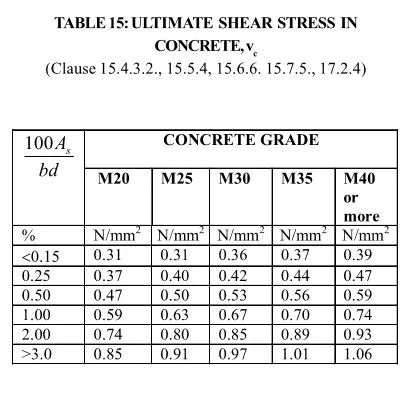
Ultimate shear stress ,Vc = 0.767 N/mm2
Depth factor, S = 0.799
Enhanced ultimate shear strength of concrete, S x Vc x d = 0.715 N/mm2
Shear reinforcement is required if V>S x Vc x d
If V<=Vc x S, Asv =0.4 x b x sv/0.87xfy
If V>S x Vc, Asv =b x Sv x (V+0.4-SVc)/0.87xfy
Where,
- ASv = C/S area of all the legs of the stirrups/links at a particular C/S.
- Sv = Spacing of the stirrups along the member.
- B = Breadth of the section.
Confining reinforcement (for circular section)
Ash = 0.09 x S x Dk x (Ag/Ac-1) x Fck/fy
or
Ash = 0.024 x S x Dk x fck/fy
Take the maximum value from above.
Where,
- Concrete grade (fck)
- Reinforcement grade (fy)
- Dia of the pier (D)
- Clear cover on either side (c)
- Dia of pier core (Dk)
- Area of concrete core (Ac)
- Gross area of pier section (Ag)
- Pitch of spiral (S)
P-delta effect
Effective Length Calculation
- Diameter of the pier, d
- Cantilever Height of pier, Lo
- Effective Height of pier, Le ( = 2.3 x Lo)
Additional moment due to slenderness ratio effect
Slenderness ration, Le/d ( as per Cl 15.6.1.1 of IRS CBC)
As per the below clause
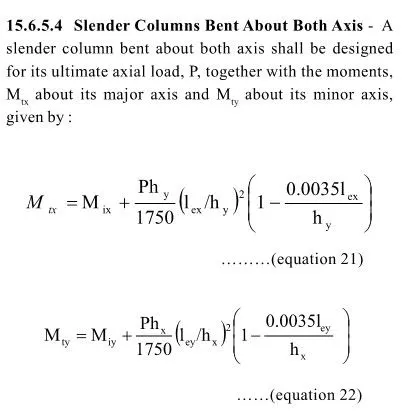
Additional momemnt, Me = P x e