Challenge 6
1. What is elastomeric bearings? And what is made of and the uses of them.
Ans:-
Elastomeric bearings, also known as rubber bearings or elastomeric isolators, are structural components used to provide flexibility, vibration isolation, and load-bearing capability in various types of infrastructure. These bearings are commonly employed in the construction of buildings, bridges, and other civil engineering structures.
Elastomeric bearings are typically made of layers of elastomer material, such as natural rubber or synthetic rubber compounds. The rubber layers are reinforced with steel plates or fabric sheets to enhance their strength and load-carrying capacity. The elastomer material exhibits excellent elasticity and damping properties, allowing it to deform under load and absorb energy from vibrations and movements.
The primary purpose of elastomeric bearings is to provide flexibility and accommodate movements caused by factors such as thermal expansion, seismic activity, wind-induced vibrations, and live loads. They effectively isolate the superstructure (e.g., building or bridge) from the substructure (e.g., foundation or supporting piers), reducing the transmission of forces and vibrations. This isolation helps protect the structure from damage and ensures occupant comfort.
The uses of elastomeric bearings include:
-
Bridge construction: Elastomeric bearings are commonly used in bridge piers and abutments to support and accommodate movements caused by thermal expansion, traffic loads, and seismic events. They help distribute loads and minimize stress concentrations, thereby extending the lifespan of the bridge.
-
Buildings: Elastomeric bearings are employed in buildings to mitigate the effects of vibrations and ground motions caused by earthquakes. They help improve the structural integrity and occupant comfort by isolating the building from ground movements.
-
Industrial equipment: Elastomeric bearings find applications in industrial machinery and equipment, where they provide vibration isolation, shock absorption, and noise reduction. They help protect sensitive equipment, enhance performance, and reduce maintenance costs.
-
Pipelines and HVAC systems: Elastomeric bearings are used to support and isolate pipelines and HVAC (heating, ventilation, and air conditioning) systems from structures. They minimize the transmission of vibrations, reduce noise, and prevent damage caused by thermal expansion.
Overall, elastomeric bearings play a vital role in maintaining the safety, durability, and functionality of various infrastructure elements by providing flexibility, vibration isolation, and load-bearing capabilities.
2. What are the importance of elastomeric bearing in the metro viaduct?
Ans:-
Elastomeric bearings play a crucial role in metro viaducts, providing several important benefits and fulfilling various functions. Here are the key importance of elastomeric bearings in metro viaducts:
-
Vibration Isolation: Metro viaducts are subjected to significant dynamic loads caused by the movement of trains, which can generate vibrations and noise. Elastomeric bearings effectively isolate the viaduct structure from these vibrations, reducing their transmission to surrounding buildings and minimizing the impact on nearby residents.
-
Structural Flexibility: Metro viaducts experience thermal expansion and contraction due to temperature variations, as well as movements resulting from settlement, seismic activity, and other factors. Elastomeric bearings allow the viaduct to flex and accommodate these movements, preventing the buildup of stresses that could lead to structural damage.
-
Load Distribution: Elastomeric bearings distribute the load from the metro viaduct uniformly to the supporting piers or columns. This ensures that the load is transferred efficiently and reduces the risk of localized stress concentrations, enhancing the overall structural integrity of the viaduct.
-
Seismic Protection: Metro viaducts in earthquake-prone regions require seismic protection. Elastomeric bearings act as seismic isolators, allowing the viaduct to move independently of the supporting structures during an earthquake. This helps dissipate seismic energy and protects the viaduct from severe damage, ensuring the safety of passengers and preserving the functionality of the transit system.
-
Maintenance and Durability: Elastomeric bearings are designed to be durable and require minimal maintenance. They are resistant to environmental factors, such as moisture and UV radiation, which helps extend their lifespan. Additionally, their replaceable nature allows for easy replacement if necessary, minimizing disruptions to metro operations during maintenance activities.
-
Cost-Effectiveness: Elastomeric bearings offer a cost-effective solution for metro viaduct construction and maintenance. Their relatively simple design, ease of installation, and long service life contribute to reduced construction and maintenance costs over the viaduct's lifecycle.
In summary, elastomeric bearings are of great importance in metro viaducts as they provide vibration isolation, accommodate movements, distribute loads, offer seismic protection, ensure durability, and contribute to cost-effectiveness. These benefits collectively enhance the safety, functionality, and longevity of metro viaducts, making them a vital component in urban transit infrastructure.
3. What are the design input parameters need for the designing of the elastomeric bearings? Explain the inputs that shall be provided by the vendor/material supplier?
Ans:-
When designing elastomeric bearings, several input parameters need to be considered. These parameters include both design-specific inputs and inputs that should be provided by the vendor or material supplier. Here are the key design input parameters:
-
Load Capacity: The load capacity is a critical design parameter and is typically determined based on the anticipated vertical and horizontal loads that the elastomeric bearing will need to support. The designer should provide the expected loads, including static loads, dynamic loads, and any special loading conditions that may be relevant to the specific application.
-
Movement Capability: Elastomeric bearings should be designed to accommodate the expected movements of the structure, including thermal expansion/contraction, live load deflections, and potential displacements due to seismic activity or other factors. The design input should include the maximum anticipated horizontal and vertical movements in different directions.
-
Material Properties: The vendor or material supplier should provide information about the specific elastomer material being used for the bearings. This includes properties such as stiffness, elasticity, damping characteristics, and load-deformation behavior. Material specifications should cover factors like hardness, tensile strength, elongation at break, tear resistance, and resistance to aging and environmental conditions.
-
Bearing Dimensions: The designer should provide the required dimensions and configuration of the elastomeric bearings, including thickness, width, and length. These dimensions are determined based on the specific structural requirements, load capacity, and movement capabilities.
-
Environmental Conditions: The vendor or material supplier should consider the anticipated environmental conditions in which the elastomeric bearings will be installed. This includes factors such as temperature variations, exposure to chemicals or pollutants, UV radiation, and moisture levels. Providing this information helps the supplier recommend suitable elastomer materials with appropriate resistance and durability.
-
Design Codes and Standards: Designing elastomeric bearings requires compliance with relevant design codes and standards specific to the application and region. The designer should provide the applicable codes and standards that the elastomeric bearings must meet, ensuring they are designed and manufactured accordingly.
-
Service Life Requirements: The expected service life of the elastomeric bearings should be considered during the design phase. The designer should communicate the desired service life or durability requirements to the vendor or material supplier. This helps in selecting the appropriate elastomer material and designing the bearings to meet the desired lifespan.
By providing these design input parameters, the vendor or material supplier can recommend and supply elastomeric bearings that meet the specific project requirements, ensuring optimal performance and longevity in the intended application. Collaboration between the designer and the vendor/supplier is crucial to ensure a successful elastomeric bearing design.
4. What are the design loads that are considered for the design of bearings?
Ans:-
In the design of bearings, several design loads are considered to ensure that the bearings can safely support the applied loads and movements. The specific design loads considered may vary depending on the type of structure and the application. Here are some common design loads that are typically considered:
-
Dead Load: Dead load refers to the permanent weight of the structure itself, including the weight of the structural elements, non-structural components, and any fixed equipment or systems. It is an essential design load that accounts for the self-weight of the structure and its permanent contents.
-
Live Load: Live load refers to the variable or transient loads imposed on the structure, such as the weight of people, furniture, vehicles, or equipment. Live loads are typically specified by building codes or relevant standards based on the intended use and occupancy of the structure. They are considered to account for the temporary or moving loads that may act on the bearings.
-
Wind Load: Wind load is the force exerted by the wind on the structure. It is an important design load for bearings, especially in tall or exposed structures. The wind load is determined based on factors such as the wind speed, building height, wind directionality, and local wind conditions. It is considered to account for the lateral forces that the bearings must resist.
-
Seismic Load: Seismic load refers to the forces generated by earthquakes or ground motions. In seismically active regions, bearings must be designed to withstand these dynamic loads. The seismic load is determined based on factors such as the seismic zone, the response spectrum, the mass of the structure, and the design criteria specific to the region.
-
Thermal Load: Thermal load accounts for the expansion and contraction of the structure due to temperature variations. Bearings need to accommodate thermal movements without causing excessive stresses or displacements. The thermal load is calculated based on the expected temperature range and the coefficient of thermal expansion of the structure materials.
-
Impact Load: Impact load refers to the sudden or impulsive loads that can occur due to events such as vehicle collisions, equipment failures, or dynamic events within the structure. Impact loads are considered to ensure that the bearings can handle the resulting forces and dissipate the energy effectively.
It is important to note that these design loads are interrelated, and they may act simultaneously or in combination on the bearings. The designer must carefully analyze and calculate the expected loads to ensure that the bearings are properly sized, selected, and designed to withstand the anticipated loads and movements throughout the service life of the structure.
6. What are the other types of bearings used in a design of metro viaduct? Explain the locations where these are used. Conditions where elastomeric bearings used?
Ans:-
In addition to elastomeric bearings, there are other types of bearings used in the design of metro viaducts. These bearings serve different purposes and are employed in specific locations based on their characteristics and functionalities. Here are some common types of bearings used in metro viaduct design:
-
Pot Bearings: Pot bearings consist of a shallow steel pot that contains an elastomeric pad or disc. The elastomeric pad allows for vertical movements and rotation, while the steel pot provides lateral restraint. Pot bearings are commonly used in metro viaducts at locations where large vertical movements and rotations need to be accommodated, such as expansion joints and areas with high seismic activity.
-
PTFE (Polytetrafluoroethylene) Bearings: PTFE bearings consist of a sliding surface made of PTFE, which provides low-friction movement between the superstructure and substructure. These bearings are used to accommodate longitudinal and transverse movements in metro viaducts, particularly in expansion joints and areas where precise and smooth movement is required.
-
Friction Pendulum Bearings: Friction pendulum bearings employ a sliding interface and a curved sliding surface to dissipate seismic energy during an earthquake. These bearings allow the superstructure to move independently of the substructure and provide excellent seismic isolation. Friction pendulum bearings are used in seismic regions or high-risk areas in metro viaducts where enhanced seismic performance is required.
-
Spherical Bearings: Spherical bearings consist of a steel plate with a concave spherical surface and a matching convex spherical surface. They allow rotational movement in all directions and provide flexibility to accommodate movements in metro viaducts. Spherical bearings are typically used in locations where rotations and angular movements need to be accommodated, such as curved sections, transition spans, or changes in alignment.
Regarding the conditions where elastomeric bearings are used, they are commonly employed in the following scenarios in metro viaducts:
-
Vibration Isolation: Elastomeric bearings are used to isolate the superstructure from vibrations generated by the movement of trains, reducing their transmission to surrounding structures and minimizing the impact on nearby residents.
-
Thermal Movements: Elastomeric bearings are designed to accommodate thermal expansion and contraction of the metro viaduct due to temperature variations. They allow the structure to expand and contract without causing excessive stresses or displacements.
-
Load Distribution: Elastomeric bearings distribute the load from the superstructure to the supporting piers or columns, ensuring uniform load transfer and minimizing stress concentrations.
-
Seismic Protection: Elastomeric bearings act as seismic isolators, allowing the superstructure to move independently of the substructure during an earthquake. This helps dissipate seismic energy and protect the viaduct from severe damage, ensuring the safety of passengers and preserving the functionality of the transit system.
Overall, elastomeric bearings are commonly used in metro viaducts to provide flexibility, vibration isolation, load distribution, and seismic protection, while other types of bearings such as pot bearings, PTFE bearings, friction pendulum bearings, and spherical bearings are employed in specific locations based on their unique characteristics and requirements.
7. Why are PSC piers caps preferred over RCC pier caps in a metro viaduct?
PSC (Pre-Stressed Concrete) pier caps are often preferred over RCC (Reinforced Concrete) pier caps in a metro viaduct for several reasons:
-
Strength and Durability: PSC pier caps are made of pre-stressed concrete, which provides higher strength and durability compared to RCC. The pre-stressing process involves applying tension to the reinforcing steel before casting the concrete, resulting in a stronger and more resilient material. This strength is crucial for supporting the heavy loads and dynamic forces associated with metro viaducts.
-
Reduced Weight and Thickness: PSC pier caps have a higher strength-to-weight ratio compared to RCC pier caps. The pre-stressing technique allows for the reduction of the cross-sectional dimensions and thickness of the pier caps while maintaining the required load-bearing capacity. This leads to a lighter structure, reducing the overall dead load and allowing for longer spans and more efficient design.
-
Increased Span Length: The higher strength and reduced weight of PSC pier caps allow for longer spans between piers. This leads to fewer piers and supports required along the viaduct, resulting in cost savings and reduced interference with the surrounding environment. The increased span length also provides a smoother and more aesthetically pleasing appearance to the viaduct.
-
Crack Control: Pre-stressing the concrete in PSC pier caps helps control cracking. By introducing tension into the reinforcing steel, the pre-stressing forces counteract the tensile stresses induced by external loads, reducing the likelihood of cracks. This improves the long-term performance and durability of the pier caps, especially in environments with aggressive elements like moisture and chemicals.
-
Construction Efficiency: PSC pier caps are generally prefabricated off-site, allowing for efficient and controlled manufacturing conditions. The pre-casting process enables precise quality control, faster construction, and reduced on-site labor and equipment requirements. This results in shorter construction durations and minimized disruptions to metro operations during viaduct construction.
-
Long-Term Maintenance: PSC pier caps require less maintenance compared to RCC pier caps. The higher durability and crack control properties of PSC reduce the likelihood of deterioration and the need for frequent repairs. This translates into lower maintenance costs and longer service life for the viaduct structure.
It is important to note that the selection between PSC and RCC pier caps depends on various factors such as design requirements, cost considerations, construction methodologies, and specific project constraints. However, the advantages of PSC pier caps in terms of strength, durability, reduced weight, longer spans, and construction efficiency make them a preferred choice for many metro viaduct projects.
8. Explain the basic purpose of pier caps and the components of the pier caps with their uses.
The basic purpose of pier caps in a bridge or viaduct structure is to provide support and distribute the loads from the superstructure (such as girders or beams) to the supporting piers or columns. Pier caps serve as the connecting element between the superstructure and the vertical supports, ensuring the transfer of loads while providing stability and structural integrity. Here are the main components of pier caps and their uses:
-
Deck Slab: The deck slab is the top surface of the pier cap and forms the roadway or platform for the metro viaduct. It provides a level and stable surface for the passage of trains, vehicles, or pedestrians. The deck slab also distributes live loads and provides lateral stability to the superstructure.
-
Cross Girders/Beams: Cross girders or beams are horizontally placed structural members that span between the piers or columns. They provide additional support to the deck slab and help distribute the loads from the superstructure to the supporting piers. Cross girders/beams also contribute to the overall rigidity and stability of the pier cap.
-
Diaphragms/Transverse Beams: Diaphragms or transverse beams are typically located below the deck slab and connect the cross girders/beams. They provide lateral bracing and transfer horizontal loads, such as wind or seismic forces, to the supporting piers. Diaphragms also help maintain the spacing and alignment of the cross girders/beams.
-
Reinforcement: Reinforcement, usually in the form of steel bars or meshes, is embedded within the concrete structure of the pier cap. Reinforcement provides tensile strength to resist bending moments and shear forces. It enhances the structural integrity and load-bearing capacity of the pier cap.
-
Shear Keys: Shear keys are horizontal projections or recesses provided at the ends of the pier cap. They engage with corresponding elements on the supporting piers or columns, creating a mechanical connection. Shear keys help resist the horizontal forces and prevent lateral movement or sliding of the pier cap during seismic events or other loads.
-
Bearing Pads: Bearing pads are elastomeric or other material components placed between the pier cap and the supporting piers or columns. They provide a cushioning effect, allowing for movement and rotation between the pier cap and the supports. Bearing pads help accommodate thermal expansion, shrinkage, and other deformations without causing excessive stresses.
Collectively, these components work together to ensure the structural stability, load transfer, and integrity of the pier cap. They distribute the loads from the superstructure to the supporting piers, provide resistance against bending, shear, and lateral forces, and accommodate movements and deformations, thereby contributing to the safe and efficient functioning of the metro viaduct.
5.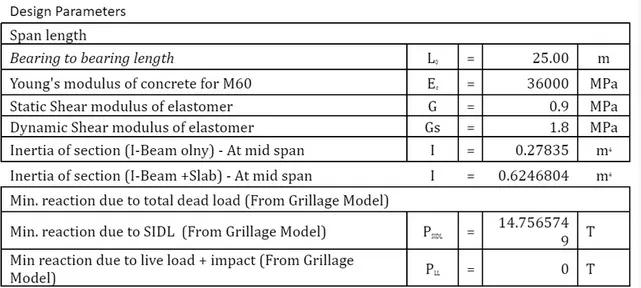
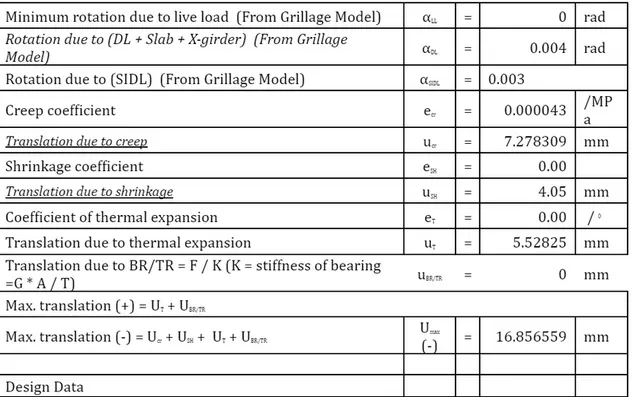
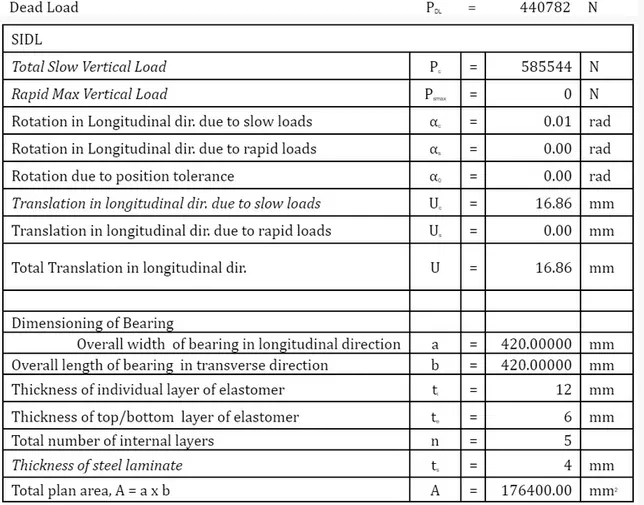
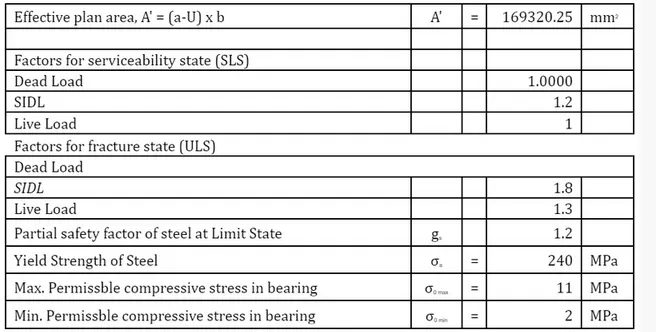
Ans:-
| A. Mean Pressure Serviceability State (Cl.4.3.31) | ||
| σm = P/A' ≤ 11 Mpa | 3.45823 | Mpa |
| Where | ||
| P = PC + PS | ||
| CONDITION VERIFIED | ||
| B. No Slip Serviceability State (Cl. 4.3.3.2) | ||
| B1 σm mini = Pmini / A ≥ 2.0 Mpa | 3.31941 | Mpa |
| B.2 H<f*p | ||
| Enter the type of contact of bearing face with the structure | ||
| f=0.12+0.2/Sigma m | ||
| For Slow loads: | ||
| T>(G *A*Uc) / (0.12 Pc + 0.2A) | 25.3606 | mm |
| For Rapid Loads: | ||
| T>G*A*(Uc + 2Us) / (0.12 Pc + 0.2A) | 25.3606 | mm |
| CONDITION VERIFIED | ||
| C. Limitation of Distortion - Serviceability Stat (Clause 4.3.3.3) | ||||
| tH / G ≤ 0.7 | ||||
| or T > ( Uc +Us) / 0.7 | T | > | 24.0857 | mm |
| CONDITION VERIFIED | ||||
| Fracture State | ||||
| D. No uplift at the edge with the least load - Fracture load (Clause 4.3.3.4) | ||||
| D.1 tanα < 6∑ eic / a | ||||
| For Internal layer | ||||
| Si = ab / 2ti (a+b) | Si | = | 8.75 | |
| σmc = Pc / A' | σmc | = | 3.45823 | Mpa |
| eic1 = tiσmc/(4GSi2 + 3σmc) | ∑eic1 | = | 0.1451 | mm |
| For top & bottom | ||||
| Si = ab / 2te (a+b) | Si | = | 17.5 | |
| eic2 = tiσmc/(4GSi2 + 3σmc) | ∑eic2 | = | 0.03729 | |
| Total eic ( ∑eic1 + ∑eic2) | ∑eic | = | 0.18239 | |
| Therefore | 6∑eic/a | = | 0.00261 | |
| Tanαc = (αc + αo) | tanαc | = | 0.01 | |
| CONDITION VERIFIED | ||||
| D.2 tan αc + 1.5 tan αs < 6∑e1 / a | ||||
| αm = ( Pc + Ps ) / A' | σm | = | 3.45823 | Mpa |
| For internal layer ei1 = tiσmc/(4GSi2 + 3σm) | ∑ei1 | = | 0.1451 | mm |
| For top & bottom layer ei2 = tiσmc/(4GSi2 + 3σm) | ∑ei2 | = | 0.03729 | |
| 6∑ei/a | = | 0.01303 | ||
| tanαc + 1.5 tanαs | = | 0.01 | ||
| CONDITION VERIFIED | ||||
| Shear strength of plate | |||||||||||||||||||||||||||||||||||||||||||||||||||||||||||||||||||||||||||||||||||||
| No buckling ( Clause 4.3.3.5) | |||||||||||||||||||||||||||||||||||||||||||||||||||||||||||||||||||||||||||||||||||||
| a/10 ≤ T ≤ a/5 | |||||||||||||||||||||||||||||||||||||||||||||||||||||||||||||||||||||||||||||||||||||
| T | = | 72 | mm | ||||||||||||||||||||||||||||||||||||||||||||||||||||||||||||||||||||||||||||||||||
| a/10 | = | 42 | mm | ||||||||||||||||||||||||||||||||||||||||||||||||||||||||||||||||||||||||||||||||||
| a/5 | = | 84 | mm | ||||||||||||||||||||||||||||||||||||||||||||||||||||||||||||||||||||||||||||||||||
| CONDITION VERIFIED | |||||||||||||||||||||||||||||||||||||||||||||||||||||||||||||||||||||||||||||||||||||
|
|||||||||||||||||||||||||||||||||||||||||||||||||||||||||||||||||||||||||||||||||||||