Challenge 11
Aim:-
Que (1):- Provide the empirical formula for Pile Load.
Answer:-
Piles transmit a load of a structure to competent sub-surface strata by the resistance developed from bearing at the toe or skin friction along the surface or both. The piles may be required to carry uplift and lateral loads besides the direct vertical load.
For dividing the total load on each pile this given formula is used
- Maximum / Minimum normal force in the pile
Pile Load = `P/n +- (My xx x/(Sx^2)) +- (Mx xx y/(Sy^2))`
Where,
P = Total Vertical loads on piles
n = Total no of piles.
`Sx^2`=Sum of the square of the distance of all piles in the X direction.
`Sy^2`=Sum of the square of the distance of all piles in the Y direction.
My = Total moment about L-L axis Longitudinal moment
Mx = Total moment about the T-T axis Transverse Moment
x = Coordinate in the longitudinal direction
Y = Coordinate in the transverse direction
Que (2):- Describe the design philosophies of monopile & group piles.
Answer:-
- Mono piles
Piles can be provided as a single pile called a monopile.
Monopile are preferred in location where piling is very difficult and multiple cast my be delay the project
- For example, in sea links where the sea bed is more than 25-30 meters below the top of the pile or if the sea bed had hardy rock strata
The diameter of the monopile is higher than normal pile, the construction process is more difficult rather than in normal piles
An important advantage of this foundation is that no preparations for the seabed are necessary. On the other hand, it requires heavy-duty piling equipment, and the foundation type is not suitable for locations with many large boulders in the seabed. If a large boulder is encountered during piling, it is possible to drill down to the boulder and blast it with explosives.
- Group Piles
Group of piles means when we have more than 1 pile in a row. Many factors influence pile group stability. The major factors are the Geometry of the group, soil conditions, and the direction of loads.
The capacity of the pile group is the sum of the individual capacities of piles, but it is influenced by the spacing between the piles. Piles are driven generally in groups in a regular pattern to support the structural loads. The structural load is applied to the pile cap that distributes the load to individual piles. If piles are spaced a sufficient distance apart, then the capacity of the pile group is the sum of the individual capacities of piles. However, if the spacing between piles is too close, the zones of stress around the pile will overlap and the ultimate load of the group is less than the sum of the individual pile capacities, especially in the case of friction piles, where the efficiency of the pile group is much less.
Group action of piles is evaluated by considering the piles to fail as a unit around the perimeter of the group. Both end bearing and friction piles are considered in evaluating the group capacity. End bearing pile is evaluated by considering the area enclosed by the perimeter of piles as the area of footing located at a depth corresponding to the elevation of pile tips. The friction component of pile support is evaluated by considering the friction that can be mobilized around the perimeter of the pile group over the length of the piles
Pile group capacity, Q = q0 X B2 + 4 x B x L x f (Square) Where, Q = ultimate capacity of pile group q0 = ultimate bearing pressure of footing of area B2 (B = size of pile group) L = Length of pile f = shear resistance
Efficiency Of Pile Group
The efficiency of the pile group depends on the following factors:
- Spacing of piles
- Total number of piles in a row and number of rows in a group, and
- Characteristics of the pile (material, diameter, and length)
The reduction in the total bearing value of a group of piles is more in the case of friction piles, particularly in clayey soils. No reduction in grouping occurs in end-bearing piles. In the pile groups which are resisting the load by the combined action of friction and end bearing, only the load-carrying capacity of friction is reduced. The efficiency  of the pile group can be calculated by using the following formula:
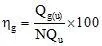
Thus, the pile group efficiency is equal to the ratio of the average load per pile in the group at which the failure occurs to the ultimate load of a comparable single pile. The efficiency of a pile group can also be obtained by using the Converse - Labarre formula:
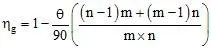
Where m = number of rows n = number of piles in a row  in degrees d = diameter of pile end s = spacing of piles. Generally, the center-to-center spacing between piles in a group is kept between 2 D and 4 D where d is the diameter of the pile.