Challenge 1
1.Why is a metro rail needed in countries with developing economy? What is your basic understanding on the differences between a conventional rail system and a metro rail system?
Ans:
Considering India as a country with developing economy below mentioned points shows the importance of metro rails in India.
Metro rails are the most desirable infrastructures for the cities in India. They are known for facilitating people’s safe, quick, and easy movement. The transit system helps connect the hard-to-reach places with the rest of the city, which dissipates congestion as people reduce the usage of their vehicles. Moreover, with the inception of metro rail, the quality of life of people has also improved by providing more economic activities to the less influential segment of society. In this era of population explosion, the incoming of metro rail has proved to be a boon for society. With the pace with which Indian cities are getting populous, the Mass Rapid Transit Systems are the need of the hour.
The National Metro Rail Policy of 2017 has also advised the cities with a population of 20 lakhs or more to look for Mass rapid Transit Systems. Metro Rail is just one type of the MRTS, others being the:
<!-- [if !supportLists]-->1. <!--[endif]-->Bus ways and bus rapid transit systems.
<!-- [if !supportLists]-->2. <!--[endif]-->Light Rail Transit
<!-- [if !supportLists]-->3. <!--[endif]-->Tramways
<!-- [if !supportLists]-->4. <!--[endif]-->Regional Rail
India is investing heavily in the country’s transport infrastructure, imitating the Western Transportation System. The prospects of the metro rail are pretty bright in India. Cities are witnessing fast growth in the economic domain, and the clear manifestation is the increased number of personal vehicles. The negative side of the coin is that it has resulted in severe congestion and an increase in the pollution level of a country. The remedying efforts are required in the public transportation system, and the most pressing need is the implementation of the MRTS.
Metro rail has seen substantial growth in India in recent years, and the rate of growth is going to become twice or thrice in the coming years. The cities are facing the need for metro rail to meet daily mobility requirements. The metro rail encourages the walkable developmental pattern, which is also beneficial for society. The other merit of Metro rail is that it reduces cost and travelling time, which lowers the cost of production of goods and services, which significantly improves the city’s competitiveness. The pollution level has also reduced with the maximum public transport usage, bringing down chronic diseases and resulting in public health benefits.
Metro rails are needed because of the following reasons:
<!-- [if !supportLists]-->1. <!--[endif]-->The most efficient transportation system is space occupancy, energy consumption, and numbers transported.
<!-- [if !supportLists]-->2. <!--[endif]-->They are very high-capacity carriers, transporting many people during peak hours.
<!-- [if !supportLists]-->3. <!--[endif]-->Unlike buses and other modes of public transportation, metro rails are eco-friendly, cause much less sound pollution, and have no air pollution.
<!-- [if !supportLists]-->4. <!--[endif]-->They possess greater traffic capacity. It carries as much traffic as seven lanes of bus traffic and 24 lanes of car traffic.
<!-- [if !supportLists]-->5. <!--[endif]-->It reduces the journey time from 50% to 75%.
<!-- [if !supportLists]-->6. <!--[endif]-->The usage of metros should be promoted more and more as it helps in reducing the levels of greenhouse gases.
<!-- [if !supportLists]-->7. <!--[endif]-->The number of road accidents has also gone down drastically as the people have chosen the Metro. Speeding usually happens when people are late for their work.
<!-- [if !supportLists]-->8. <!--[endif]-->Metro provides air-conditioned travelling with the best comfort at relatively cheap rates.
Social Impact of the Metro Rail: All members of the society, irrespective of their caste, religion, financial status, can travel, which enhances the social integrity of the country. The necessity of a driving license is also eliminated to a great extent. It has come as a blessing in disguise for those who cannot drive or ride.
The economic impact of the Metro Rail: Mass Transit Development improves the usefulness and efficiency of the Public Transit system, which results in increased business for commercial developments and helps improve the country’s economy. Public Transit systems offer considerable savings in materials, labour, energy over other private transit systems. In addition, they have very efficient engines to carry large capacities, which helps in saving fuels.
Metro and Local Train
Both metro trains, as well as local trains, run in metropolitan cities but they can be differentiated in many ways. They are means of transport that help the passengers reach from one corner of a state to another in very less time. Local trains connect the distances between the city and its suburban areas in India.
TABLE OF CONTENT
<!-- [if !supportLists]-->· <!--[endif]-->Local Trains in India
<!-- [if !supportLists]-->· <!--[endif]-->Difference between metro trains and local trains
Metro trains run in metropolitan cities across 12 Indian states and rapidly they have become the number one choice of mass transit owing to their ever-growing popularity. Metro railway was introduced in India back in 1984. This opening project is none other than the Kolkata Metro Network which is to date the only rail connectivity that is controlled by the Indian Railways. The other metro transportations in several metropolitan cities like Delhi, Mumbai, and Chennai are looked after by autonomous local bodies. The metro rail tracks that are under operation in all the Indian cities can be underground or elevated too. The second city to get access to metro connectivity is the Union Capital Territory of Delhi. The metros that operate in Delhi are the busiest among all the other metro trains that run in metropolitan cities across the country. Its popularity encouraged the government to invest more in developing metro connectivity in other cities as well to connect the distances within the city and its suburbs areas. Many projects have kick-started as the Government announced its handsome budget of Rs. 1 trillion for developing more metro projects in India.
Currently, the population residing in the cities of Kolkata, Delhi, Bengaluru, Chennai, Mumbai, Hyderabad, Lucknow, Gurgaon, Nagpur, Noida, Jaipur, and Kochi enjoy the facilities of local metro rail companies. Apart from these megacities, there are several other cities in which over 450 km of metro rail tracks have been planned, and accordingly, construction has also started. Some of them include Ahmedabad, Pune, Kozhikode, Kanpur, Patna, Guwahati, Navi Mumbai, Coimbatore, Bhopal, Indore, and Varanasi.
Local Trains in India
The local trains are the most popular means of the public transport system in the country that not only run-in metropolitan cities but also extend their services to most of the major Indian cities. These trains fall under the category of suburban rail service that helps in facilitating daily intercity passenger commutation. The local train network in India is one of the oldest railway networks in Asia. The trains are heavily crowded with passengers daily who belong from all the economic levels of the society. The local train networks are distributed into separate suburban railway lines that connect multiple railway stations. These suburban lines often share tracks that are dedicated to long-distance trains. The Mumbai local train network records for the most severely crowded railway network in the world. It experiences a commuter volume of more than 8 million passengers each day and covers a span of 465 kilometers altogether. This proves how efficiently the suburban trains run in metropolitan cities.
Difference between metro trains and local trains
Both the metro trains and the local trains run in metropolitan cities and they are effectively managed to cater to huge volumes of the population daily. These two different types of commutes operate using separate rail networks. But the main difference between the two is that the metro trains are designed to be driven over independent rail lines, unlike local trains that are forced to share paths with trains that are meant for covering long distances. The second difference can be spotted in the type of power supply. While the metros only operate on electricity, local trains also have the option of using diesel as fuel besides electricity. The passenger intake capacity of local trains is much greater when we compare it to the average occupancy of metro trains at any time of the day. Also, the metro trains can be underground or elevated too owing to the infrastructural advancements procured in metro cities. Local trains run on rail tracks that pass-through villages and small towns. Thus, they offer more access. The issuance of tickets is also different in the case of local trains where the passengers are given printed passes compared to the digitally coded tokens that are used in metro railway transportation. The metro stations are more developed as modern technologies like computerized checkout systems, elevators, air-conditioning units, etc. are installed there. These facilities are not available in most of the local railway stations.
Conclusion
Metros can be driven on tracks that are constructed not only on the ground but also on pillars as well as in the underground. Local trains cannot be operated on pillars. The local train network helps in the commutation of most of the Indians across different cities of a state as they provide most of the access in small towns and villages as well. Both these transport modes run in metropolitan cities but in many ways, they differ from each other. Even the operating and legislative bodies are also separate as the Indian Railways authorizes only the metro railway network of Kolkata. Metro train systems enhance the financial status of the state government while local trains cater to most of the transportation requirements daily.
2.The course depicts the data regarding the operational and upcoming metro rail projects of India with reference to the statistics of latest by August 2019. Research and provide the current statistics of metro rail operations in India. At the end you can identify the necessary of metro rail transit system followed by you will be able to resonate/analyze the feasibility of metro rail to one’s own city.
Ans :
Metro Rail Projects in India – Quick Snapshot
New metro rail (subway) systems are under construction and bringing about vast changes in 20+ Indian cities at a breathtaking pace.
This page provides a quick snapshot with a list of all Indian metro & metrolite rail systems – operational, under construction (ongoing), approved (upcoming) and proposed (planned) projects.
Visit each system’s project page for more in-depth information on their construction progress, project status & news, cost, funding, history, deadlines, tenders, contracts, corridors, lines, station numbers, station names, PDF official route maps, ridership figures, timings and fares.
Most Indian metro projects are being developed in phases (eg. Delhi Metro which is now on Phase 4) while others are being developed by line as funds become available (eg. Mumbai Metro where 169 km of lines are currently under construction in parallel).
Note: I track each project at the package level which gives a better idea of each city’s network in different stages of development. Lengths are derived from tender or detailed design documents. When that is unavailable, satellite imagery is used for approximation.
Key Figures
<!-- [if !supportLists]-->· <!--[endif]-->Operational Routes: 845.95 km
<!-- [if !supportLists]-->· <!--[endif]-->Under Construction Routes: 462.00 km
<!-- [if !supportLists]-->· <!--[endif]-->Approved Routes: 372.77 km
<!-- [if !supportLists]-->· <!--[endif]-->Proposed Routes: 1056.35 km
Fun Facts
<!-- [if !supportLists]-->· <!--[endif]-->Oldest (First) Metro Rail System: Kolkata Metro
<!-- [if !supportLists]-->· <!--[endif]-->Newest Metro Rail System: Pune Metro
<!-- [if !supportLists]-->· <!--[endif]-->Largest Metro System: Delhi Metro (347 km)
<!-- [if !supportLists]-->· <!--[endif]-->Smallest Metro System: Kanpur Metro (8.73 km)
<!-- [if !supportLists]-->· <!--[endif]-->Busiest (Highest Ridership) Metro System: Delhi Metro
The following tables are best viewed on a Desktop device. Approved route figures include routes approved at least by the state government.
List of Operational & Under Construction Metro Projects in India
|
CITY & STATE |
OPERATIONAL NETWORK |
UNDER CONSTRUCTION NEW ROUTES |
APPROVED NEW ROUTES |
PROPOSED NEW ROUTES |
OPERATOR |
START DATE |
|
Agra Metro, Uttar Pradesh |
0 km |
11.90 km |
17.50 |
0 km |
UPMRCL |
N/A |
|
Ahmedabad Metro, Gujarat |
37.9 km |
29.65 km |
0 km |
5 km |
GMRC |
6 March, 2019 |
|
Bangalore Metro, Karnataka |
68.6 km |
102.86 km |
0 km |
105.55 km |
BMRCL |
20 October, 2011 |
|
Bhopal Metro, Madhya Pradesh |
0 km |
6.22 km |
21.65 km |
77.13 km |
MPMRCL |
N/A |
|
Chennai Metro, Tamil Nadu |
54.1 km |
102.93 km |
15.93 km |
15.30 km |
CMRL |
29 June, 2015 |
|
Delhi Metro, Delhi-NCR |
349 km |
66.98 km |
0 km |
57.3 km |
DMRC |
24 December, 2002 |
|
Gurgaon Rapid Metro, Haryana |
12.1 km |
0 km |
0 km |
200 km |
RMRG (now DMRC) |
14 November, 2013 |
|
Hyderabad Metro, Telangana |
67 km |
0 km |
0 km |
63 km |
HMRL |
29 November, 2017 |
|
Indore Metro, Madhya Pradesh |
0 |
16.23 km |
15.31 km |
57.18 |
MPMRCL |
N/A |
|
Jaipur Metro, Rajasthan |
11.98 km |
0 km |
0 km |
27.71 km |
JMRC |
3 June, 2015 |
|
Kanpur Metro, Uttar Pradesh |
8.73 km |
22.58 km |
0 km |
8.6 km |
UPMRCL |
29 December, 2021 |
|
Kochi Metro, Kerala |
26.8 km |
1.1 km |
12.36 km |
0 km |
KMRL |
19 June, 2017 |
|
Kolkata Metro, West Bengal |
47.85 km |
47.72 km |
28.2 km |
15.7 km |
Metro Railway & KMRC |
24 October, 1984 |
|
Lucknow Metro, Uttar Pradesh |
22.90 km |
0 km |
0 km |
85 km |
UPMRCL |
6 September, 2016 |
|
Meerut Metro, Uttar Pradesh |
0 km |
20 km |
0 km |
15 km |
NCRTC, UPMRC |
N/A |
|
Mumbai Metro, Maharashtra |
46.50 km |
133.9 km |
21.29 km |
136.40 km |
MMOPL, MMRC & MMMOCL |
8 June, 2014 |
|
Nagpur Metro, Maharashtra |
38.22 km |
0 km |
48.30 km |
0 km |
Maha-Metro |
8 March, 2019 |
|
Navi Mumbai Metro, Maharashtra |
0 km |
11.10 km |
0 km |
95.30 km |
CIDCO |
N/A |
|
Noida Metro, Uttar Pradesh |
29.70 km |
0 km |
14.95 km |
70 km |
NMRC |
25 January, 2019 |
|
Patna Metro, Bihar |
0 km |
22.1 km |
8.8 km |
0 km |
PMRC |
N/A |
|
Pune Metro, Maharashtra |
23.79 km |
58.23 km |
4.41 km |
13.02km |
Maha-Metro & Pune IT City Metro Rail Ltd. |
6 March, 2022 |
|
Surat Metro, Gujarat |
0 km |
41.93 km |
0 km |
0 km |
GMRC |
N/A |
List of Approved Metro, Metrolite & Metro Neo Projects in India
|
CITY & STATE |
NETWORK LENGTH |
APPROVAL DATE |
TOTAL COST |
OPERATOR |
|
Gorakhpur Metrolite Uttar Pradesh |
27.41 km |
October 2020 |
Rs. 4,672 crore |
UPMRC |
|
Kozhikode Metrolite, Kerala |
13.13 km |
February 2021 |
Rs. 4,673 crore |
KRTL |
|
Nashik Metro Neo, Maharashtra |
32 km |
August 2019 |
Rs. 2100 |
Maha-Metro |
|
Trivandrum Metro, Kerala |
21.82 km |
February 2021 |
Rs. 2,773 crore |
KRTL |
List of Proposed Metro / Metrolite /
Metro Neo Projects in India
|
CITY & STATE |
PROPOSED NETWORK LENGTH |
|
Aurangabad Metrolite, Maharashtra |
TBD |
|
Bangalore Metrolite, Karnataka |
60 km |
|
Bhavnagar Metrolite / Metro Neo, Gujarat |
TBD |
|
Chennai Metrolite, Tamil Nadu |
15.50 km |
|
Coimbatore Metro, Tamil Nadu |
136 km |
|
Delhi Metrolite, Delhi |
40.88 km |
|
Guwahati Metro, Assam |
61.40 km |
|
Jamnagar Metrolite / MetroNeo, Gujarat |
TBD |
|
Jammu Metro, J&K UT |
43.50 km |
|
Madurai Metro, Tamil Nadu |
31 km |
|
Mathura Metrolite, Uttar Pradesh |
12 km |
|
Prayagraj Metro, Uttar Pradesh |
42 km |
|
Raipur Metro, Chhattisgarh |
TBD |
|
Rajkot Metrolite / Metro Neo, Gujarat |
TBD |
|
Srinagar Metro, J&K UT |
25 km |
|
Uttarakhand Metro, Uttarakhand |
58 km |
|
Vadodara Metrolite / Metro Neo, Gujarat |
TBD |
|
Varanasi Metro, Uttar Pradesh |
29.235 km |
|
Vijayawada Metro, Andhra Pradesh |
66.2 km |
|
Visakhapatnam Metro, Andhra Pradesh |
79.91 km |
|
Warangal Metro Neo, Telangana |
17 km |
Each Indian city and town has a large number of proposed new lines, most of which will never see the light of the day. The following table lists out cities / towns with with serious proposals that could possibly materialize as light rail (Metrolite) and be built in the next 10 years.
Besides the above cities, metro projects are proposed in Amritsar, Ludhiana, Chandigarh, Jalandhar, Jabalpur, Ranchi, Hubli, Mathura, Dholera, Thane, Gwalior, Bareilly, Dehradun, Bhubaneswar, Mysore, and Mangalore.
3.Why DMRC is the busiest metro in India. Apart from the points mentioned in the course video. You can find several interesting facts on the internet. Please research and provide your learnings.
Introduction
For implementation and subsequent operation of Delhi MRTS, a company under the name DELHI METRO RAIL CORPORATION was registered on 03-05-95 under the Companies Act, 1956. DMRC has equal equity participation from GOI and GNCTD.
Structure
<!-- [if !supportLists]-->00001. <!--[endif]--> Chairman
<!-- [if !supportLists]-->00002. <!--[endif]--> Managing Director
<!-- [if !supportLists]-->00003. <!--[endif]--> Total No. of Directors - 17 (Including Chairman)
<!-- [if !supportLists]-->00004. <!--[endif]--> Nominee of Govt. of India - 5
<!-- [if !supportLists]-->00005. <!--[endif]--> Nominee of Govt. of NCTD - 5 (Including MD)
<!-- [if !supportLists]-->00006. <!--[endif]--> No. of full-time functional Directors at present including MD - 8
<!-- [if !supportLists]-->00007. <!--[endif]--> The corporate office of the company is located at Metro Bhawan, Fire Brigade Lane, Barakhamba Road New Delhi - 110001, India
About Delhi Metro
(i) It is the largest and busiest metro in India. (ii) Its total length is 317 kilometers, serving 231 stations. (iii) The system has a mix of underground, at grade, and elevated stations using both broad-gauge and standard-gauge. (iv) It operates 2,700 trips daily and carries 2.76 million passengers.
The Delhi Metro has been instrumental in ushering in a new era in the sphere of mass urban transportation in India. The swanky and modern Metro system introduced comfortable, air conditioned and eco-friendly services for the first time in India and completely revolutionized the mass transportation scenario not only in the National Capital Region but the entire country.
Having constructed a massive network of about 390.14 Km with 286 stations (including NOIDA-Greater NOIDA Corridor and Rapid Metro, Gurugram) in record time in Delhi, NCR, the DMRC today stands out as a shining example of how a mammoth technically complex infrastructure project can be completed before time and within budgeted cost by a Government agency.
The Delhi Metro Rail Corporation Limited (DMRC) was registered on 3rd May 1995 under the Companies Act, 1956 with equal equity participation of the Government of the National Capital Territory of Delhi (GNCTD) and the Central Government to implement the dream of construction and operation of a world- class Mass Rapid Transport System (MRTS).
The DMRC opened its first corridor between Shahdara and Tis Hazari on 25th December, 2002. Subsequently, the first phase of construction worth 65 kilometres of Metro lines was finished two years and nine months ahead of schedule in 2005. Since then the DMRC has also completed the construction of another 125 kilometres of Metro corridors under the second phase in only four and a half years.
Presently, the Delhi Metro network consists of about 390.14 Km with 286 stations. The network has now crossed the boundaries of Delhi to reach NOIDA and Ghaziabad in Uttar Pradesh, Gurgaon, Faridabad, Bahadurgarh and Ballabhgarh in Haryana. With the opening of the Majlis Park to Shiv Vihar and Janakpuri West - Botanical Garden Sections, new age trains equipped with the Unattended Train Operation (UTO) technology have been introduced. These trains operate with the Communication Based Train Control(CBTC) signaling technology which facilitate movement of trains in very short frequencies. This network also includes the NOIDA - Greater NOIDA Aqua Line. The Aqua Line has been constructed by DMRC on behalf of the NOIDA Metro Rail Corporation and is also being operated by DMRC currently. In addition, the 11.6 kilometre long Rapid Metro also connects with the Delhi Metro network at Sikanderpur station of Yellow Line. The Rapid Metro provides connectivity within the satellite city of Gurugram.
The Airport Express link between the Indira Gandhi International Airport and New Delhi has now propelled Delhi to the league of global cities which have high speed rail connectivity between the city and the airport. The DMRC today has over 300 train sets of four, six and eight coaches.
The Delhi Metro has also contributed tremendously on the environment front by becoming the first ever railway project in the world to claim carbon credits for regenerative braking. DMRC has also been certified by the United Nations (UN) as the first Metro Rail and Rail based system in the world to get carbon Credits for reducing Green House gas emissions as it has helped to reduce pollution levels in the city by 6.3 lakh tons every year thus helping in reducing global warming.
It has also set up roof top solar power plants at many of its stations. All stations of the presently under construction corridors are being constructed as green buildings. In the present phase of Delhi Metro’s construction, the DMRC has completed 160 kilometres of Metro lines which has woven a web of Metro corridors along the city’s Ring Road besides connecting with many other localities in NOIDA, Ghaziabad, Bahadurgarh and Ballabhgarh.
Apart from providing Delhites with a comfortable public transport option, the Delhi Metro is also contributing significantly towards controlling pollution as well as reducing vehicular congestion on the roads.
4.What are the components of a Metro rail? Explain briefly about the concepts of the components?
Tunnels
At subterranean levels, tunnels move traffic away from street level, avoiding delays caused by traffic congestion and leaving more land available for buildings and other uses. In areas of high land prices and dense land use, tunnels may be the only economic route for mass transportation. Cut-and-cover tunnels are constructed by digging up city streets, which are then rebuilt over the tunnel. Alternatively, tunnel-boring machines can be used to dig deep-bore tunnels that lie further down in bedrock.
The construction of an underground metro is an expensive project and is often carried out over a number of years. There are several different methods of building underground lines.
In one common method, known as cut-and-cover the city streets are excavated and a tunnel structure strong enough to support the road above is built in the trench, which is then filled in and the roadway rebuilt. This method often involves extensive relocation of utilities commonly buried not far below street level – particularly power and telephone wiring, water and gas mains, and sewers. This relocation must be done carefully, as according to documentaries from the National Geographic Society, one of the causes of the April 1992 explosions in Guadalajara was a mislocated water pipeline. The structures are typically made of concrete, perhaps with structural columns of steel. In the oldest systems, brick, and cast iron were used. Cut-and-cover construction can take so long that it is often necessary to build a temporary roadbed while construction is going on underneath, in order to avoid closing main streets for long periods of time.
Another tunneling method is called bored tunneling. Here, construction starts with a vertical shaft from which tunnels are horizontally dug, often with a tunneling shield, thus avoiding almost any disturbance to existing streets, buildings, and utilities. But problems with ground water are more likely, and tunneling through native bedrock may require blasting. The first city to extensively use deep tunneling was London, where a thick sedimentary layer of clay largely avoids both problems. The confined space in the tunnel also limits the machinery that can be used, but specialized tunnel-boring machines are now available to overcome this challenge.
A disadvantage with this, is that the cost of tunneling is much higher than building cut-and-cover systems, at-grade or elevated. Early tunneling machines could not make tunnels large enough for conventional railway equipment, necessitating special low, round trains, such as are still used by most of the London Underground. It cannot install air conditioning on most of its lines because the amount of empty space between the trains and tunnel walls is so small. Other lines were built with cut-and-cover and have since been equipped with air-conditioned trains.
The deepest metro system in the world was built in St. Petersburg, Russia where in the marshland, stable soil starts more than 50 metres (160 ft) deep. Above that level, the soil mostly consists of water-bearing finely dispersed sand. Because of this, only three stations out of nearly 60 are built near ground level and three more above the ground. Some stations and tunnels lie as deep as 100–120 metres (330–390 ft) below the surface. Usually, the vertical distance between the ground level and the rail is used to represent the depth. Among the possible candidates are:
The Sportivnaya station of the Saint Petersburg Metro has two levels.
<!-- [if !supportLists]-->· <!--[endif]-->Deepest stations:
<!-- [if !supportLists]-->· <!--[endif]-->Arsenalna station in Kyiv Metro, Ukraine (105.5 metres (346 ft), opened 1960, built under a hill)
<!-- [if !supportLists]-->· <!--[endif]-->Admiralteyskaya (The Admiralty, 102 metres (335 ft), opened 2011, probably the best candidate)
<!-- [if !supportLists]-->· <!--[endif]-->Hongtudi station in Chongqing Metro, China (94 metres (308 ft), opened in 2016)
<!-- [if !supportLists]-->· <!--[endif]-->Liyuchi station in Chongqing Metro, China (76 metres (249 ft), opened in 2017)
<!-- [if !supportLists]-->· <!--[endif]-->Park Pobedy station in Moscow (~80 metres (260 ft), opened 2005, built under a hill)
<!-- [if !supportLists]-->· <!--[endif]-->Puhung station in Pyongyang Metro, North Korea (which doubles as a nuclear shelter)
<!-- [if !supportLists]-->· <!--[endif]-->Washington Park MAX Light Rail station in Portland, Oregon, US(built under a hill), 260 feet (80 m)
An advantage of deep tunnels is that they can dip in a basin-like profile between stations, without incurring the significant extra costs associated with digging near ground level. This technique, also referred to as putting stations "on humps", allows gravity to assist the trains as they accelerate from one station and brake at the next. It was used as early as 1890 on parts of the City and South London Railway and has been used many times since, particularly in Montreal.
The West Island line, an extension of the MTR Island line serving western Hong Kong Island, opened in 2015, has two stations (Sai Ying Pun and HKU) situated over 100 metres (330 ft) below ground level, to serve passengers on the Mid-levels. They have several entrances/exits equipped with high-speed lifts, instead of escalators. These kinds of exits have existed in many London Underground stations and stations in former Soviet Union nations.
Elevated railways
Elevated railways are a cheaper and easier way to build an exclusive right-of-way without digging expensive tunnels or creating barriers. In addition to street level railways they may also be the only other feasible alternative due to considerations such as a high water table close to the city surface that raises the cost of, or even precludes underground railways (e.g. Miami). Elevated guideways were popular around the beginning of the 20th century, but fell out of favor. They came back into fashion in the last quarter of the century—often in combination with driverless systems, for instance Vancouver's SkyTrain, London's Docklands Light Railway, the Miami Metrorail, Bangkok Skytrain,and Skyline Honolulu
Stations
Stations function as hubs to allow passengers to board and disembark from trains. They are also payment checkpoints and allow passengers to transfer between modes of transport, for instance to buses or other trains. Access is provided via either island- or side platforms. Underground stations, especially deep-level ones, increase the overall transport time: long escalator rides to the platforms mean that the stations can become bottlenecks if not adequately built. Some underground and elevated stations are integrated into vast underground or skyway networks respectively, that connect to nearby commercial buildings In suburbs, there may be a "park and ride" connected to the station
To allow easy access to the trains, the platform height allows step-free access between platform and train. If the station complies with accessibility standards, it allows both disabled people and those with wheeled baggage easy access to the trains though if the track is curved there can be a gap between the train and platform. Some stations use platform screen doors to increase safety by preventing people falling onto the tracks, as well as reducing ventilation costs.
5.Elevated metro or Underground metro which metro rail system shall be preferred? Justify your choice of the system.
Because underground metro system is costlier, time consuming, challangeable.On the other side elevated metro system is less expensive and safer.Fire hazards can be more dangerous in underground system.When there is no option of making elevated system then only they go for underground system
Elevated metro is cheaper than underground anyday. There are cable ducts/sewage lines/building foundations underground that are hard to get around, also the curves can only be so tight with the underground construction. Once built, the expansion, such as, adding a third line/making platforms longer/any other miscellaneous construction is very hard. All the metro constructions in india are new and hence have to use boring machine, whereas most, if not all, constructions in developed countries were ‘cut and cover’ which requires you to
a. dig the section
b. build the tunnel
c. cover it back up
This was possible back then (50–100 years ago) since there were not a lot of buildings/structures around, and was also cheaper/easier compared to elevated subways.
But today ‘cut and cover’ is just not feasible because of all the buildings out there already. Therefore we are left with boring machine vs elevated. Elevated winning the argument because of all the pros listed above.
<!-- [if !supportLists]-->6. <!--[endif]-->What is a Design Basis Report (DBR)? In which phase of a project a DBR is prepared?
<!-- [if !supportLists]-->7. <!--[endif]-->What is significance of a DBR of an elevated metro?
ANSWERS ATTACHED AS PDF
8.In the planning of metro project, what are the chronology of activities before the construction?
1.Way Forward for Implementing the Project
On receipt of the Detailed Project Report, following action will be required for implementing the Metro:
• Approval of the Detailed Project Report by the State Government and the Central Government, both the Governments committing to an investment decision.
• Signing of an MOU between the State Government and the Central Government for firming up arrangements for equity and other related items pertaining to this project.
• Setting up of a Special Purpose Vehicle (SPV) for implementing the project on the pattern of Delhi Metro Rail Corporation (DMRC).
• Providing legal cover for construction as well as operation and maintenance stages of the project.
• The two Governments to agree to financing of the debt portion of the project and also the time frame for its implementation. Normally above actions will require about 6 to 8 months.
During this period the implementing agency can go ahead with the following preliminary work.:-
• Preliminary action for diversion of utility and preparation of estimates thereof.
• Reservation of land along the corridors, identification and survey for acquisition.
<!-- [if !supportLists]-->2. <!--[endif]-->Institutional Arrangements
To enable the Metro rail project to be implemented without any loss of time and cost-over run, effective institutional arrangements need to be set up. Details of these arrangements are explained below:
Setting up of SPV Experience of implementing Delhi Metro project has shown that Special Purpose Vehicle (SPV), vested with adequate powers, is an effective organizational arrangement to implement and subsequently operate a Metro Rail project. An SPV should, therefore, be set up for the Metro rail project and registered under the Companies Act, 1956. Since it has been recommended earlier in this Report that equity in the SPV for this project should be contributed in equal proportions by the State and the Central Governments, the SPV will have equal number of Directors on its Board from these two Governments. While the Managing Director of the state metro corporation should be a nominee of the State Government, its Chairman should be the nominee of the Central Government. In order to avoid delays usually associated with bureaucratic process of decision making, the Board of Directors (BOD) of that state metro corporation should be vested with full powers needed to implement the project. The BOD, in turn, should delegate adequate powers to the Managing Director of that state metro corporation to enable him to take all decisions on day to day matters.The Managing Director should be a technocrat with proven track record and of impeccable integrity. A Railway background would be an added advantage. A Metro background would be most desirable.
3. Organizational Set up of state MRC
Implementing a metro project in a congested metropolis is indeed a challenge. In sheer size, magnitude and technical complexity there are no parallels to metro projects. Further, these projects are to be carried out in difficult urban environment without dislocating city life, while at the same time preserving the environment. The project involves integration of a number of complex technical systems – some of these technologies used in these systems are totally new to the country – each one of which is a major project by itself. Interfacing various system contracts is a difficult and highly skilled exercise. Side by side, timely and adequate funds have to be assured for implementation and lands, without encumbrances, have to be taken possession of in time. Clearances from the local authorities have to be taken permission to cut trees, diversion of utilities, management of road traffic, etc., all of which will call for an efficient and competent project implementing agency. Metro projects cannot be executed the way Government agencies execute projects in this country. Timely completion is very important to safeguard the financial viability. Competent and skilled technical personnel to man such an organisation are difficult to mobilize. In fact such experienced persons are not readily available in the country. Being a rail based project, for most of the systems such as rolling stock, signaling, telecommunication, traction power supply, etc., persons with railway background would be necessary. It is therefore, impossible to have a single organisational set up which can be responsible for all aspects of metro implementation, namely investigation, planning, designs, drawing up of specifications, preparation of tender documents, fixing of contractors, supervising the contractor’s works, ensuring interface fusion between different contractors, ensuring quality and safety during constructions, planning and supervising integration system trials and getting the project commissioned in time. It is, therefore, suggested that a two-tier organisation with well-defined responsibilities for getting the project executed be set up. At the apex will be the State metro corporation itself. It should be a lean but effective organisation with full mandate and total power – with accountability- free from political and bureaucratic control. The second level will be a project management team called “General Consultants” who will be engaged by the state metro corporation on contract basis and who will fully be responsible for planning, design and full project management. In fact they will be the “Engineer” for the implementation the project for the State metro corporation, who is the “client“. The General Consultants will have no role in the Operation and Maintenance of the lines after it is commissioned for traffic. The General Consultants should be fixed on the basis of competitive bidding, the way General Consultants were fixed for the Delhi Metro Project. If any further detailed design consultants are needed, the same should be engaged by the General Consultants as their sub-consultants within their own contract responsibilities. Learning from the Delhi Metro experience, we would recommend that major contracts are awarded on “construct basis” based on designs and specifications finalised by the General Consultants. In certain system contracts such as signalling, tele-communication, automatic fare collection, etc. it may be desirable to go in for “design and construct” contracts based on broad technical specifications and performance requirements drawn up by the General Consultants. International Consultants are very expensive and should be engaged only in areas where Indian experts cannot manage and they should invariably be part of the General Consultants’ team. Since State metro corporation will not have the required expertise and experienced manpower to check and monitor the General Consultants it may be necessary to engage proof Consultants from the very start who will do this job on behalf of State metro corporation. Generally the General Consultants will cost about 2.0% and the Proof Consultants about 0.5% of the project cost. The State metro corporation Organisation, as stated earlier, should be very lean but effective. It will consist of a non-executive Chairman, a Managing Director with full Executive Powers and four Functional Directors including Director (Finance). All the four Functional Directors will be full members of the Management Board. The Directors will be assisted by Heads of Departments in each of the major disciplines and they in turn will have Deputy Heads of Departments. The organisation should be basically officer-oriented with only Personal Assistants and Technical Assistants attached to senior officers by eliminating unproductive layers of staff such as Peons, Clerks, etc. We strongly recommend that the total organisational strength is limited to 45 to 50 eliminating too many tiers to enable faster decision-making. It is necessary for the State metro corporation officers to get exposed to the Metro technology and Metro culture through study tours of some of the selected foreign Metros and Delhi Metro.
4. High Power Committee
During the implementation of the project several problems with regard to acquisition of land, diversion of utilities, shifting of structures falling on the project alignment, rehabilitation of project affected persons, etc. are likely to arise. For expeditious resolution of these problems, an institutional mechanism needs to be set up at the State Government level. Towards this end, it is recommended that a High Power Committee under the chairmanship of Chief Secretary, Gujarat should be set up. Other members of this Committee should be Secretaries of the concerned Departments of the State Government and Heads of civic bodies who will be connected in one way or the other with the implementation of the project. This Committee should meet once a month and sort out all problems brought before it by State metro corporation. For Delhi Metro also such a High Power Committee was set up and it proved very useful in smooth implementation of the Delhi Metro rail project.
5. Empowered Committee
At the Central Government level an Empowered Committee, under the chairmanship of Cabinet Secretary, is presently functioning for Delhi Metro project. Other members of this Committee are Secretaries of Planning Commission, Ministry of Home Affairs, Ministry of Urban Development, Ministry of Surface Transport, Ministry of Environment and Forests, Department of Expenditure, Chief Secretary of Delhi Government and a representative from the PMO. The Empowered Committee meets regularly and takes decisions on matters connected with inter-departmental coordination and overall planning, financing and implementation of the Delhi Metro project. It is suggested that the role of this Empowered Committee should be enlarged to include Ahmedabad Metro project also and the Chief Secretary, Gujarat should be inducted as a member of this Committee.
6. Group of Ministers
Union Cabinet had set up a Group of Ministers (GOM) to take decisions on behalf of the Cabinet on policy matters concerning Delhi Metro project. The Group of Ministers is chaired by the Home Minister. Other members of the GOM are Minister of Urban Development, Minister of Railways, Minister of Finance and Company Affairs and Deputy Chairman Planning Commission. Chief Minister, Delhi and Lt. Governor, Delhi, are permanent invitees to all meetings of the GOM. The GOM meets whenever any problem requiring decision on behalf of the Union Cabinet is to be taken. It is suggested that the role of this GOM should be enlarged to include Ahmedabad Metro. The Chief Minister, Gujarat should be inducted as a member and should attend the meetings of GOM whenever any issue concerning Ahmedabad Metro is to be deliberated upon.
<!-- [if !supportLists]-->7. <!--[endif]-->Implementation Schedule
Once the SPV is formed, it has to take action for appointment of General Consultants for project management including preparation of tender documents. Till the General Consultants are in position, State metro corporation should appoint an interim Consultant for all preliminary and enabling jobs such as land acquisition, detailed design of civil structures, utility diversions, etc.Civil contracts for elevated structures will be on “Construct” basis. Therefore all designs are to be finalised and progressed in advance. The number of contracts can be decided when the detailed design work is in progress. Architectural finishes, fire fighting arrangements and general electrification, will form part of civil contracts.
System Contracts - These contracts will generally be on ‘design construct and installation’ basis. The number of contracts may be as under.:- • Design, construct and installation for Traction and Power Supply. • Design, construct and installation of Signal and Telecommunication works. • Design, construct and installation of lifts. • Design, construct and installation of escalators. • Design, construct and commissioning of Automatic Fare Collection System. • Design, manufacture and supply of rolling stock. • Installation of track in Depot and on main line. • Design and installation of Signages.
Depot Contracts - Following contracts are proposed for Depot works: • Design of Depot layout and buildings. • Construction of Depot including general electrification. For supply of Depot Equipment, the number of contracts may be decided as and when the work is in progress.
<!-- [if !supportLists]-->8. <!--[endif]-->Legal Framework
Metro rail projects are undertaken in congested urban environment. Metro lines have, therefore, to pass through heavily built-up areas. As vacant land for laying these lines is seldom available, they have to be constructed either as elevated or underground. When elevated, the metro lines are generally located along the medians of the existing roads to obviate the need for acquiring land. Even in such cases, land is to be acquired for siting station buildings, traffic integration areas, etc. Whenever underground, metro lines may have to pass under privately owned buildings, involving use of underground space below such buildings. After construction of a metro line is complete, it has to be certified as ‘safe’ by a statutory authority before it can be opened for public carriage of passengers. For operation and maintenance of a metro line, which has been commissioned for traffic, several crucial issues having legal implications need to be taken care of. These include continued monitoring of safety of train operations, security of metro properties, maintaining law and order within metro premises, enquiries into accidents involving metro trains whenever they happen, deciding the extent of compensation payable for damages/injuries/casualties arising out of such accidents, laying down passenger fares and their subsequent revision etc. There has, therefore, to be a proper legal frame-work to take care of such problems encountered during construction as well as operation of metro rail lines. Hence there is a need for a comprehensive legislation on Metro Railways.
11.CONCESSIONS FROM GOVERNMENT
Metro rail projects need very heavy investment. Loans have invariably to be taken to fund a part of the capital cost of the projects. These projects yield low financial internal rate of return though their economic internal rate of return is very high. With reasonable fair level, servicing of these loans often pose problems. To make the project financially viable, therefore, the fares need to be substantially increased to socially un-acceptable levels. This results in the ridership coming down significantly, as it is sensitive to increases in the fare level. Thus the very objective of constructing the metro rail system to provide an affordable mode of mass travel for public is defeated. It, therefore, becomes necessary to keep the initial capital cost of a metro project as low as possible so that the fare level of the metro system can be kept at reasonable level. Experience of Delhi Metro project has shown that the taxes and duties constitute about 16 – 18% of the project cost. Following are the taxes and duties, which have to be borne by a metro project: • Custom Duty on all imported rolling stock and other equipment needed for the project. • Excise Duty on all indigenously manufactured rolling stock and other indigenously finished goods required for the project.• Sales Tax on all purchases made for implementation of the project whether directly by the project implementation authority or by the contractors executing the project. • Sales Tax on works contracts to be executed for the implementation of the - project. • Tax on electricity required for operation and maintenance of the metro system. • Municipal Taxes. In the case of Delhi Metro project, the Union Government has granted exemption from payment of Custom Duty and Excise Duty while the Delhi Government has agreed to give exemption from payment of Sales Tax and Sales Tax on works contracts. Delhi Metro Rail Corporation is also pursuing with the Government for exemption from tax on electricity being consumed by Delhi Metro for its operation and maintenance. It is recommended that for Ahmedabad Metro similar exemptions from taxes and duties be granted by the Central Government/Gujarat Government for Ahmedabad Metro. In this connection it may be mentioned that the Central Government has been encouraging infrastructure projects in the country through fiscal and non-fiscal concessions Cities have emerged as the engines of growth and mass transport systems today are one of the most important prerequisites for the balanced growth of the city. The Government can demonstrate the importance it attaches to this sector by granting the above concessions which would not only help reduce the initial cost of the project so that Ahmedabad Metro remains commercially viable during its operation phase but also send strong signals to the effect that it is committed to a safer and pollution free city. Moreover, public transport is employment-friendly and favours social balance in a sustainable way since it allows access to jobs and services to all.
<!-- [if !supportLists]-->12. <!--[endif]-->NEED FOR DEDICATED FUND FOR METRO PROJECTS
Metro Rail projects, being capital intensive projects, have to be funded jointly by the Central Government and the State Government. In order to facilitate funding of these projects, the Central Government should set up a non-lapsable ‘National Metro Transport Fund’ for financing its share of metro rail projects. The 10 th Plan document has also recommended creation of such a Fund with an initial seed money contribution of Rs.3,000 crores by the Central Government, with another contribution of Rs.3,000 crores to be raised during the 10 th Plan period through dedicated taxes. This Fund should be utilized to meet the Central Government’s share towards equity contribution in the Special Purpose Vehicles to be set up to implement the metro rail projects for various The Central Government may consider imposing of surcharge on petrol, diesel and CNG to raise resources for this Fund. To enable the State Governments to provide their share of equity in the Special Purpose Vehicles set up for such projects, it would be necessary to constitute a Special Metro Fund at the State Government level also. The State Governments should resort to imposition of dedicated levies for raising resources for these Funds. Following dedicated levies may be considered by the State Governments for this purpose: • Additional cess on the tax levies for registration of road vehicles. • A Surcharge on fuel (petrol, diesel and CNG). The above two levies would also assist to discourage the use of personalised vehicles and encourage the use of public transport, which would not only reduce the pollution level in the city but also reduce traffic congestion on the road. • Metro Tax @ 2% on pay rolls of all establishments having more than 100 employees. Such cess is in existence in a number of Western countries for raising resources for metro rail. The employer’s benefit a good deal by good Metro System. • Surcharge @ 10% on luxury tax on the earning of all Star Hotels. At present level, the luxury tax is 10%. The surcharge will raise the level to only 11%. Chinese cities have adopted this scheme. 12.13 Security Arrangement Law and order within premises of Ahmedabad Metro (North-South Corridor, East-West Corridor of phase – I and other additional Corridor(s) to be added in future) should be the responsibility of the State Police. Security of the assets of state Metro should be the responsibility of the Metro Administration. For this purpose, services of private security agencies should be hired. In these arrangement there will be no need for RPF personnel. A similar arrangement was adopted on Delhi Metro and has proven highly successful.
9.What is topographical survey? Why it is necessary for the metro rail project?
Topographic surveying is the process of determining the positions, both on plan and elevation, of the natural and artificial features of a locality for the purpose of delineating them by means of conventional signs upon a topographic map. By topography is meant the shape or configuration of the earth’s surface.
The basic purpose of the topographic map is to indicate the three, dimensional relationships for the terrain of any given area of land. Thus, on a topographic map, the relative positions of points are represented both horizontally as well as vertically. The representation of the difference in elevation is called the relief.
On a plan, the relative altitudes of the points can be represented by shading hachures, form lines, or contour lines. In addition to the relief, the topographic map depicts natural features such as streams, rivers, lakes, trees, etc. as well as artificial features such as highways, railroads, canals, towns, houses, fences, and property lines.
The topographic maps are very essential for the planning and designing of most engineering projects such as the location of railways, highways, the design of irrigation and drainage systems, the development of water power, the layout of industrial plants, and city planning. Topographic maps are also very useful in directing military operations during a war.
11.What are underground utilities which would be there existing under the ground level. Also mention some other utilities apart from the ones mentioned in the course.
Borewell from houses nearby
Relatively few (Why few? explained later) situations that metro lines are built directly below houses that draw water from borewells and directly in the path of the borewell, the tunnel cuts right through it. Once a machine called Tunnel Boring machine digs out the earth in its way, it seals the tunnel’s walls using concrete.
So what you have is a sealed tunnel kind of cutting through the ex-borewell, with part of the borewell above it and the water table below it.
Why few?
Because underground metro tunnels are dug, as far as possible, to not cross paths with public utilities such as sewerage, water pipes and underground electric cables. For most cases, this is ensured by digging the tunnel far deeper than public utilities.
Also, engineers try to keep the alignment on as few residential areas as possible. That’s a big ‘as far as possible’, meaning its not possible a lot of times and then This happens.
<!-- [if !supportLists]-->12. <!--[endif]-->Mention in detail about the solutions a designer would be suggesting as the challenges of underground utilities.
Underground utility detection and protection is a crucial aspect of site planning and construction. It involves identifying and locating the existing pipes, cables, and other infrastructure that run beneath the ground, and ensuring that they are not damaged or disrupted by the construction activities. In this article, we will explore some of the main challenges and risks of underground utility protection during construction, and how to overcome them with best practices and technologies.
Why is it important?
Underground utility protection is not only a matter of safety and compliance, but also of cost and efficiency. Damaging underground utilities can cause serious injuries, fatalities, environmental hazards, service outages, and legal liabilities. It can also delay the project, increase the budget, and damage the reputation of the contractor and the client. According to a study by Purdue University, the estimated cost of underground utility damage in the US was $30 billion in 2019.This is where invited experts will be adding contributions.
What are the challenges?
One of the main challenges of underground utility protection is the lack of accurate and reliable data. Many underground utilities are old, undocumented, or poorly mapped. Some may have been modified, abandoned, or relocated without proper records. This makes it difficult to identify and locate them with confidence and precision. Another challenge is the complexity and diversity of underground utilities. There may be multiple types of utilities, such as gas, water, electricity, telecommunications, sewer, and stormwater, with different characteristics, depths, and materials. Some may be buried close to each other, creating potential conflicts and interferences.
How to detect them?
The most common method of underground utility detection is using electromagnetic (EM) locators. These devices emit and receive electromagnetic signals that interact with the metallic components of the utilities, such as pipes, cables, or tracer wires. The locators can indicate the approximate location, depth, and direction of the utilities, based on the strength and polarity of the signals. However, EM locators have some limitations. They cannot detect non-metallic utilities, such as plastic pipes, or utilities that are too deep, too small, or too congested. They may also be affected by external sources of electromagnetic interference, such as power lines, fences, or metal structures.
How to verify them?
To overcome the limitations of EM locators, and to verify the accuracy and completeness of the data, other methods of underground utility verification are often used. One of the most widely used methods is potholing or daylighting. This involves digging small holes or pits at strategic locations along the utility path, using hand tools or vacuum excavation, and exposing the utility for visual inspection and measurement. Potholing can confirm the type, size, condition, and alignment of the utility, and reduce the risk of damage during excavation. However, potholing can also be time-consuming, labor-intensive, and disruptive to the traffic and environment.
How to protect them?
Once the underground utilities are detected and verified, they need to be protected from damage during construction. To ensure this, it is important to mark the utility locations on the ground and on the site plans, using standard colors and symbols, and communicating them to all workers and stakeholders involved. Additionally, safe zones or buffer areas should be established around the utilities, and any digging or drilling should only be done with proper authorization and supervision. To further protect the utilities, appropriate tools and techniques for excavation should be used, such as hand digging, soft digging, or trenchless methods, while following relevant regulations and standards. Moreover, monitoring and inspecting the utilities regularly during construction is essential, as well as reporting any changes or damages immediately. Finally, restoring and repairing the utilities and the surface after construction should be done and records and maps should be updated accordingly.
How to leverage technology?
Technology can play a key role in enhancing underground utility detection and protection. Ground-penetrating radar (GPR) is a non-invasive method that uses radio waves to scan the subsurface and generate images of the utilities and other objects. GPR can detect both metallic and non-metallic utilities, as well as their depth and shape, although it can be affected by soil conditions, moisture, and clutter. Utility mapping software can collect, store, analyze, and display underground utility data from various sources. It can help create accurate and comprehensive maps of the utilities, which can be integrated with other geospatial data. Augmented reality (AR) is a technology that can overlay digital information onto the physical environment, helping to visualize the underground utilities in real time. AR can also enhance the awareness and communication of the workers and managers on site.
13.What is known as feeding of U-girders and how it is launched during construction?
A concrete post-tensioned U-girder is an exceptional structural component widely employed in the construction of bridges and specifically on elevated metro networks. It boasts a precast concrete configuration meticulously constructed to bear substantial loads and span extensive distances
The U-girder has a distinct shape, resembling the letter "U" when observed from the side. The U-girder is divided into mainly two components:
· Webs
The girder has two vertical webs on either side of the ends as shown. Geometrically, these members are OF uniform WIDTH AND THICKNESS unless otherwise specified.
· Bottom flange
The cross-section consists of a bottom flange that horizontally orients, and which thickens at the supports and thins at the mid segment. This geometry will determine the cable profile and the save on material costs.
The girder can be single span or double spanned in which case the pier at the middle will be at a single plane of support at the bearing location. The singly supported span is supported at both ends by means of being suspended on pier bearings simply where the load is transferred via the bearings to the footing below.
Post-Tensioning System
A distinguishing feature of the U-girder is its incorporation of post-tensioning tendons that run throughout the girder span. These tendons, fabricated from high-strength steel strands or bars, are meticulously encased within conduits or tubes embedded within the concrete during the precasting phase. Following concrete curing, hydraulic jacks expertly stress the tendons to premeditated levels. Specialized anchorages secure the tendons, meticulously transferring the induced tension to the concrete matrix.
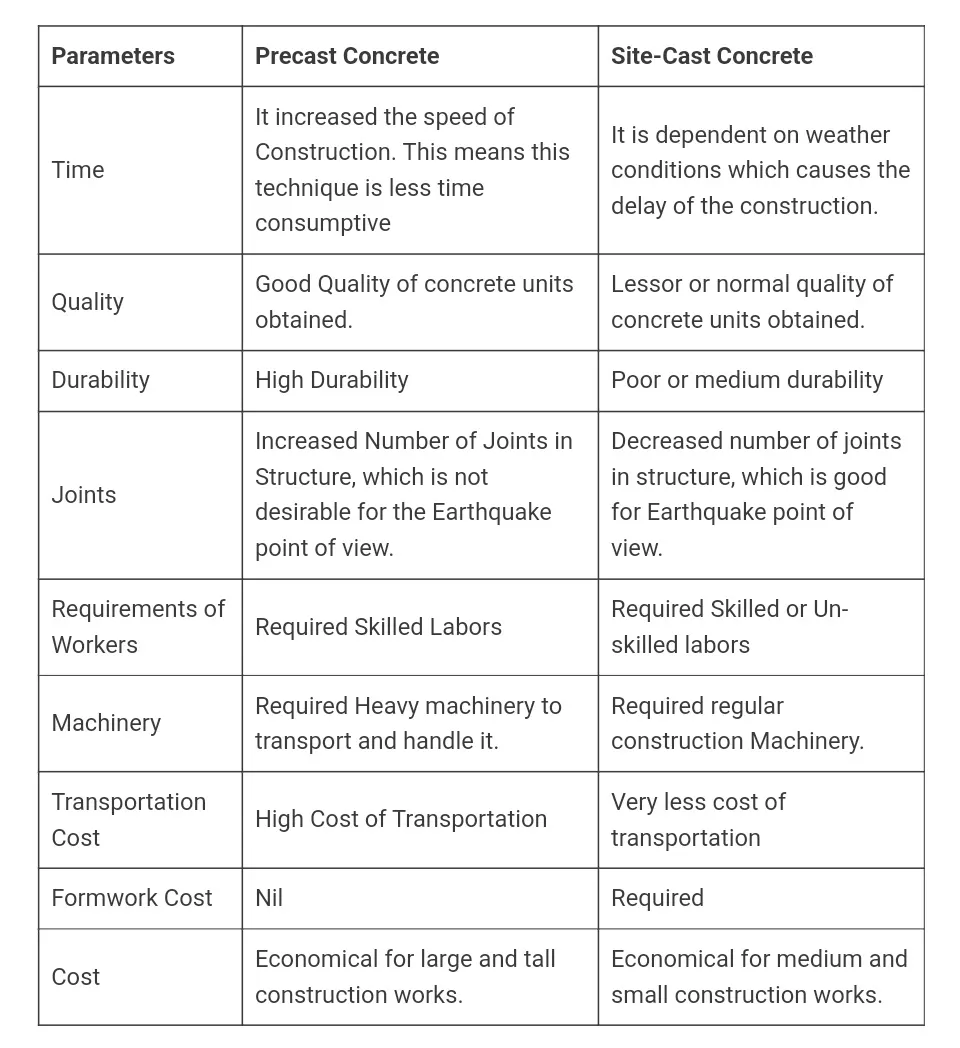
14.What are advantages of precast girders in an elevated metro? Explain in detail about the how it is efficient over the cast in-situ girders?
Cast-in-situ methodology requires more time & space and hence adds inconvenience to public. From environmental consideration also, cast-in-situ methodology is not a preferred option. Therefore use of precast elements to the maximum extent becomes the natural choice for the elevated metro projects in cities.
The main difference between a precast and an in-situ concrete beam is that a precast beam is made of individual pieces that are shipped to the site and joined together once installed, while an in-situ concrete beam is made from a continuous slab of concrete that is poured directly into the ground.
Precast Concrete:
The name of this type of concrete explains all about it, which means the concrete is cast in the other location and then assembled at the construction site.
Precast concrete is defined as a type of concrete that is casted at factories or workshops in a controlled manner then the units are assembled on the construction site to make a unique structure.
Site Cast Concrete (Cast-in-situ Concrete):
Again the names shows all about this concrete, means concrete is casted on the construction site.
Site cast concrete is the concrete which is prepared, poured, casted and cured on the construction site.