Calculation of Stiffness in Structural elements
1) To Calculate the Lateral Stiffness -
Assume L=2h and EIc = EIb
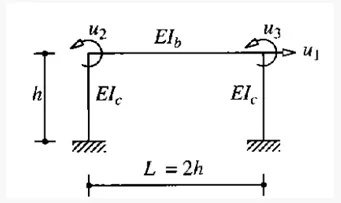
Step 1) Apply Unit displacement @ U1
`:.`U1 = 1 and U2=U3=0`
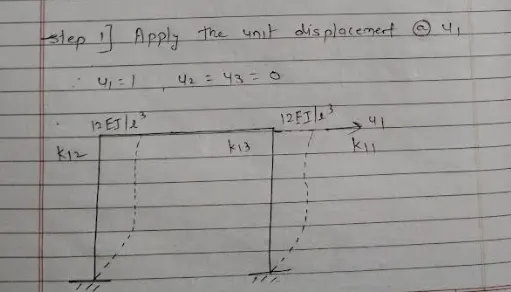
`∴K11 = (2*12 EIc)/h^3`
`=(24EIc)/h^3`
`∴K12 = (6 EIc)/h^2`
`∴K13 = (6 EIc)/h^2`
Step 2) Applying Unit rotations @ U2
`∴`U2 = 1 and U1=U3=0`
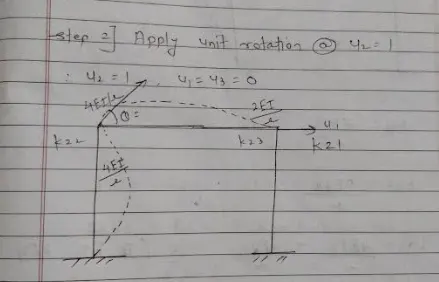
`∴K21 = (6 EIc)/h^2`
`∴K22= (4 EIb)/h^2 + (4EIc)/h^2`
`∴K23 = (2 EIb)/h`
Step 3) Applying Unit rotations @ U3
`∴`U3 = 1 and U1=U2=0`
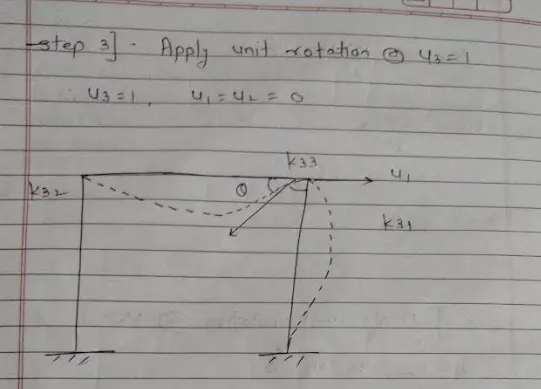
`∴K31 = (6 EIc)/h^2`
`∴K32 = (2 EIb)/h`
`∴K33= (4 EIb)/h^2 + (4EIc)/h^2`
Step 4) Stiffness Matrix -
K = `[[K_11,K_12,K_13],[K_21,K_22,K_23] ,[K_31,K_32,K_33]]`
`:.`K =`(EI_c)/h^3` `[[24,6h,6h],[6h,6h^2,h^2] ,[6h,h^2,6h^2]]`
Step 5)
We know that
`[F] = [K] [U]`
`:. ((Fs),(0),(0))` =`(EI_c)/h^3``[[24,6h,6h],[6h,6h^2,h^2] ,[6h,h^2,6h^2]] ((u_1),(u_2),(u_3))`
Solving above matrix and we get following equations
`24u1+6hu2+6hu3=fs`------------------------1
`6hu1+6h^2u2+h^2u3=0`----------------------2
`6hu1+h^2u2+6h^2u3=0`----------------------3
So from 2nd and 3rd equation Joint rotation is expressed in terms of displacement
`:. ((u_1) ,(u_2)) = - [[6h^2,h^2],[h^2,6h^2]] * ((6h) ,(6h))`
Solving above matrix we get ,
`:. ((u_1) ,(u_2)) = - 6/7 ((1) ,(1)) . u1`
Step 6) Substitute above value in `eq^n` 1
we get ,
`Fs = [(24EI_c)/h^3 - (EI_c)/h^3 * 6/7h * [ 6h , 6h) ((1),(1))] u_1`
`= (24EI_cu1)/h^3 - [(EI_c)/h^3 *12h * 6/7 h * u_1]`
`=u_1 [(24EI_c)/h^3 -(72EI_c) /(7h^3)]`
solving above eqn we get
`Fs =(96EI_c)/(7h^3) *u_1`
Comparing this eqn with
`[F] = [K] [U]`
`[k]=(96EI_c)/(7h^3)`
Results -
Therefore , Stiffness of the given storey frame is
`[k]=(96EI_c)/(7h^3)`
Q.2)
1) To calculate the no.of degree of freedom for dynamic analysis
2) Establish the equation of motion
3) Calculate their natural frequencies
a)
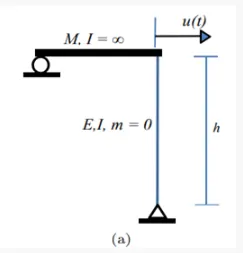
1) The no. of degree of freedom for dynamic anaysis is = 1
2)
The standard form of equation of motion is given as
`mddot u + ku = 0`
So for given frame , the value of Stiffness (K) is
`= (3EI)/h^3`
`:.` The equation of motion is
`mddot u + [(3EI)/h^3]u = 0`
3) Natural Frequency
We know that ,
`f_n = 1/(T_n)`
and
`T_n = (2pi)/omega_n`
But ,
`omega _n = sqrt [(k)/(m)]`
Put the value of K in Above equation , ( We have already calculate the value of Stiffness (k))
`omega _n = sqrt [(3EI)/(h^3m)]`
put the value of `omega_n` in `T_n` formula
`:.T_n = (2pi)/(omega_n)`
`:.T_n = (2pi)/(sqrt [(3EI)/(h^3m)]`
Therefore Natural Frequeny
`f_n = 1/T_n`
`f_n = 1/[(2pi)/(sqrt [(3EI)/(h^3m)]`
`f_n = 1/(2pi) *sqrt [(3EI)/(h^3m)]`
b)
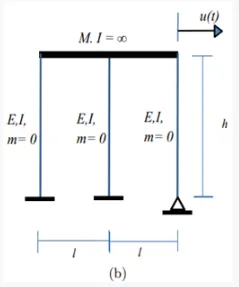
1) The no. of degree of freedom for dynamic anaysis is = 1
2)
The standard form of equation of motion is given as
`mddot u + ku = 0`
i) The value of Stiffness for 1st column = `(12EI)/h^3`
ii) The value of Stiffness for 1st column = `(12EI)/h^3`
iii) The value of Stiffness for 1st column = `(3EI)/h^3`
This stiffness are in parallle connection
So ,
Effective Stiffnes = `K_(effective) = K_1 + K_2 + K_3`
`:.K_(eff) = (12EI) /h^3 + (12EI) /h^3 + (3EI) /h^3`
`:.K_(eff) = (27EI)/h^3`
Now , put the value of K_(eff) in Eqn of motion
we get ,
`mddot u + [(27EI)/h^3]u = 0`
`Therefore , Eqn of motion is
`mddot u + [(27EI)/h^3]u =`
3) Natural Frequency
We know that ,
`f_n = 1/(T_n)`
and
`T_n = (2pi)/omega_n`
But ,
`omega _n = sqrt [(k)/(m)]`
Put the value of K in Above equation , ( We have already calculate the value of Stiffness (k))
`omega _n = sqrt [(27EI)/(h^3m)]`
put the value of `omega_n` in `T_n` formula
`:.T_n = (2pi)/(omega_n)`
`:.T_n = (2pi)/(sqrt [(27EI)/(h^3m)]`
Therefore Natural Frequeny
`f_n = 1/T_n`
`f_n = 1/[(2pi)/(sqrt [(27EI)/(h^3m)]`
`f_n = 1/(2pi) *sqrt [(27EI)/(h^3m)]`
Q.3)
1) To calculate the natural period of this system -
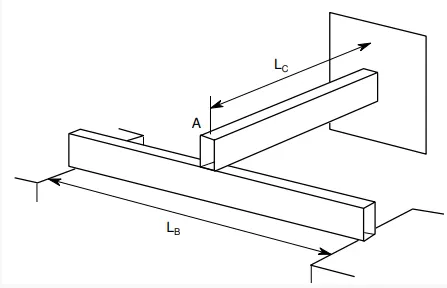
We know that ,
`T_n = (2pi)/omega_n` -------------------------------(A)
where , Tn = Natural Period of System
But ,
`omega _n = sqrt [(k)/(m)]` --------------------------(B)
i) To calculate the Effective Stiffnes of Beam and column
we know that , For Simly Supported Beam
`K_b = (48EI)/l^3`
and For One end free pinned and other end is free
`K_c = (3EI)/l^3`
This are in parallel connection
Effective Stiffnes = `:.K_(effective) = K_1 + K_2`
`:.K_(eff) = (48EI) /l^3 + (3EI) /l^3`
`:.K_(eff) = 3EI [1/l^3 + 16/l^3]`
so put this value in Eqn (B) i.e `omega_n`
we get ,
`omega _n = sqrt [(k)/(m)]`
`omega _n = sqrt [(3EI*[1/l^3 + 16/l^3])/(m)]`
Therefore ,
`T_n = (2pi)/omega_n`
`T_n = (2pi)/sqrt [(3EI*[1/l^3 + 16/l^3])/(m)]`
4)
1) To determine an expression for the effective stiffness of the following systems -
a)
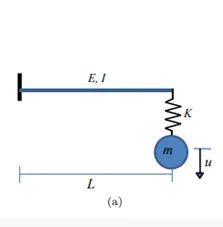
To find out the Effective Stiffness -
i) Stiffness of Beam is
`K_(beam ) = (3EI)/l^3`
ii) Stiffnes of Spring is given as = K
iii) `K_(beam ) and K_(spri ng)` are in series connection as shown in figure
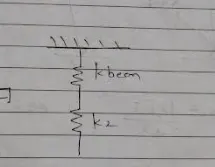
iv) Therefore ,
`:.(1)/K_(eff) = (1) / K_(beam) + (1) /K_(spri ng)`
`:.(1)/K_(eff) = (1) / [(3EI)/l^3) + (1) /K`
`:.K_(eff) = (3EI * K) / (3EI + KL^3)`
b)
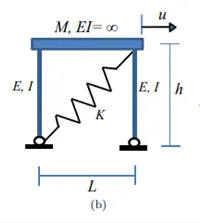
i) Stiffness of Column is
`K_(c_1 ) = (3EI)/h^3`
`K_(c_2 ) = (3EI)/h^3`
ii) Stiffnes of Spring is attached in Inclined manner
so we have to resolve the force and deformation component it into sin and cos component
So Load component ' P ' = `p / cos(theta)`
and Deformation component = 'u' = `u * cos (theta)`
Therefore ,
Stiffness of Spring Coefficient = `K= (p) /(u cos^2theta)`
But , we know that
`p/u = K_s` ( Stiffness of Spring)
Therefore ,
`K_s = K * cos^2 theta`
we can write ,
`cos^2 theta = (L^2) / (L^2 + h^2)`
`K_S = K *(L^2) / (L^2 + h^2)`
So ,
`K_(c_1 ) , K_(C_2) and K_(spri ng)` are in parallel connection as shown in figure `
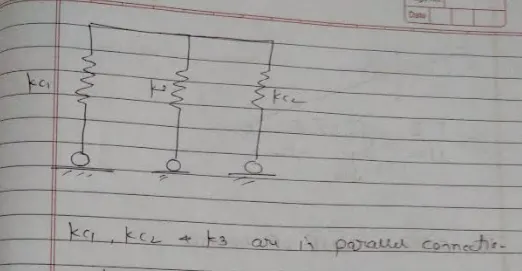
Therefore ,
`K_(eff) = K_(c_1 ) + K_(c_2) + Ks`
`K_(eff) = (3EI)/h^3 + (3EI)/h^3 + K* (L^2)/(L^2 + h^2`
`= (6EI)/h^3 +K* (L^2)/(L^2 + h^2`
c)
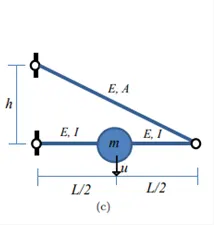
i) Stiffness of Beam is
`K_(beam ) = (48EI)/l^3`
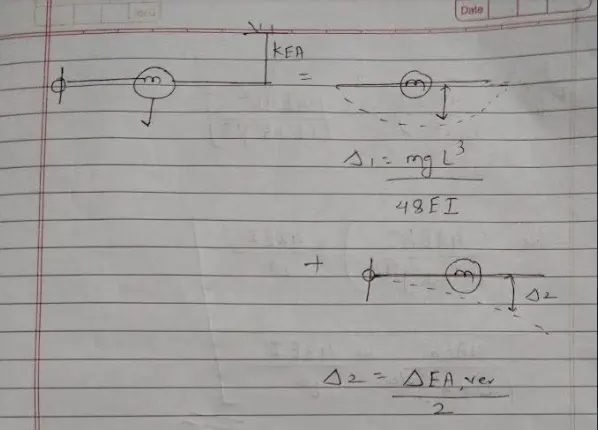
ii) To find out stiffness of Inclined struct , first we have to assume that it is in Vertical direction
So ,
When force acting at the right end is " (mg/2) " and deformation caused by struct at point of " m" is half of its right end
as shown in figure .
iv)
`:.(mg)/2 = K_(ea) * 2 * Delta 2`
`:.(mg)/(Delta2 ) = K_(ea) * 4`
but
`:.(mg)/(Delta2 ) = K2`
`:.K_2 = K_(ea) * 4`
iv) Now we have assumed that given member is in Vertical manner but actually it is in Inclined manner
So,
we have to resolved the K_(ea) into `K_(ea _i)` into cos component
`K_2 = 4 (K_(ea_i)) * cos^2theta`
we can write
`cos^2 theta = (h^2) / (L^2 + h^2)` ( From the figure)
`:.K_2 = 4 (K_(ea_i)) *(h^2) / (L^2 + h^2)`
v) `K_(b ) , K_2)` are in series connections .
Therefore ,
`(1)/K_(eff) = (1)/K_(b ) + (1)/K_2`
`(1) /K_(eff) = (1)/ ((48EI)/l^3 )+ (1)/ [4 (K_(ea_i)) *(h^2) / (L^2 + h^2)]`
`(1) /K_(eff) = (1)/ ((48EI)/l^3 )+ (1)/ [4 (EA) *(h^2) / ((L^2 + h^2))^15]`
`:.(1) /K_(eff) = (((48EI)/l^3 )* [4 (EA) *(h^2) / ((L^2 + h^2))^1.5] ) / (((48EI)/l^3 )+[4 (EA) *(h^2) / ((L^2 + h^2))^1.5] )`