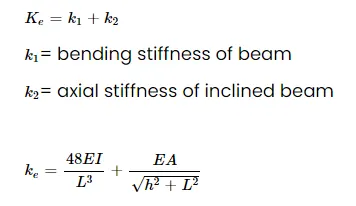
Calculation of Stiffness in Structural elements
Question 1:-
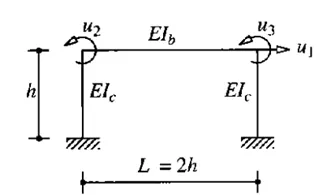
Compute lateral stiffness of the one story frame with an intermediate realistic stiffness of the beam. The system has 3 DOFs as shown. Assume L = 2h and Elb = Elc .
Aim :-
- Compute lateral stiffness of the one story frame with an intermediate realistic stiffness of the beam.
Introduction :-
- The lateral stiffness of a story is obtained by combining all columns into a single elastic spring that connects the lateral degrees of freedom at adjacent stories.
- The ability of a body to resist lateral deflection when a lateral force is applied. This is also called as Storey Stiffness, wherein the lateral deflection is storey drift and lateral force is storey shear.
Lateral Stiffness Of One Story Frame :-
- This structure can be analyzed by any of the standard methods, including Moment Distribution.
- Thus 3X3 stiffness matrix of the structure is known and equilibrium equations can be written.
- Degree of Freedom is 3.
Procedure :-
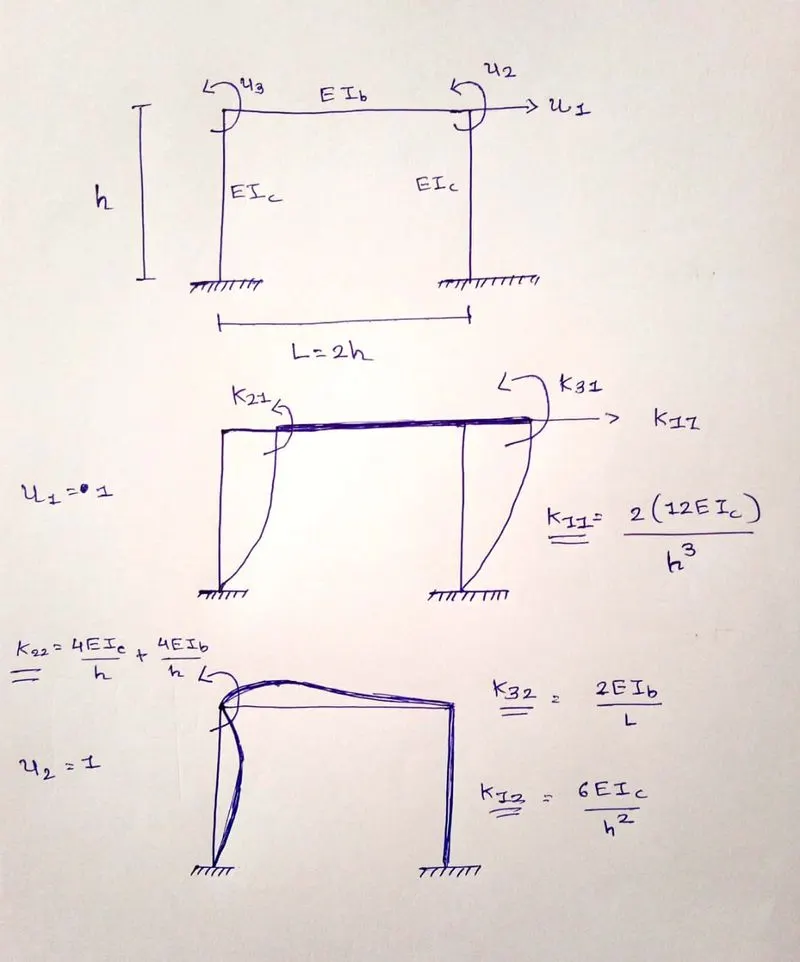
- The element Ki1 in the first column, we determine the stiffness matrix by imposing u1=1, with u2=u3=0.
Stiffness coefficient of column translation = 2 X 12EI/h^3. = 24EI/h^3
Stiffness coefficient of Beam Rotation = EI /h^2.
- The element Ki2 in the second column, we determine the stiffness matrix by imposing u2=1, with u1=u3=0.
Stiffness coefficient of column rotation at right end = 6EI/h^2.
Stiffness coefficient of Beam Rotation at left end = 4EI/h + 4EI/L
= 4EI/h + 4EI/2h
= 6EI/h
- The element Ki3 in the third column, we determine the stiffness matrix by imposing u3=1, with u1=u2=0.
Stiffness coefficient of column rotation at left end = 6EI/h^2.
Stiffness coefficient of Beam Rotation at right end = 4EI/h + 4EI/L
= 4EI/h + 4EI/2h
= 6EI/h
- K = Matrix of [ K11 K12 K13
K21 K22 K23
K3 1 K32 K33 ]
K = Martrix of [ 24EI/h^3 6EI/h^2 6EI/h^2
6EI/h^2 6EI/h 6EI/h
6EI/h^2 EI/h 6EI/h ]
- k * u = Fs
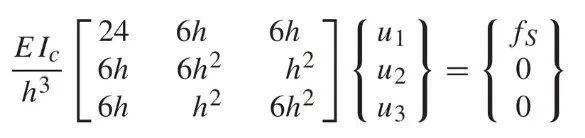
- By applying static condensation method, we are deducing the 3 unknown expression into 3 unknown equation.
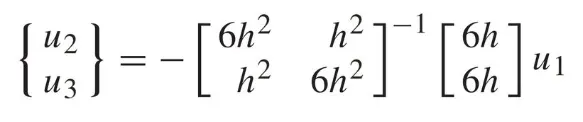

- Stifness is the amount of force required for unit displacement.So interchanging the translation u1 to the left side, we arrive the stiffness coefficient as follow.
Question 2:-
For the following structures:
- Determine the number of degrees-of-freedom for dynamic analysis.
- Establish the equation of motion.
- Calculate their natural frequencies.
Aim :-
- To find the number of degrees-of-freedom for dynamic analysis and establish the equation of motion. and also Calculate their natural frequencies.
Introduction :-
- Degrees of freedom refers to the maximum number of logically independent values, which are values that have the freedom to vary, in the data sample.
Procedure :-
A.
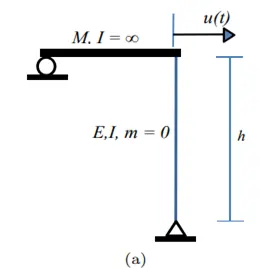
- Position of the element can be describrd by 1 coordinate unit.
- Number of degree of freedom for dynamic analysis is 1.
- Equation of the motion is
mu + ku = 0
- The column has fixed end at bottom. So stiffness coefficient will be
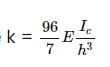
K = 3EI/h^3.
- Equation of Motion -> mu + ku = 0
-> mu + (3EI/h^3)u = 0
-> mu + (3EI/h^3)(1) = 0
-> mu + 3EI/h^3 = 0
- Natural Frequency -> f = ω / 2π =√k/m * 1 / 2π.
-> ωn = √ 3EI / h^3 /m
B.
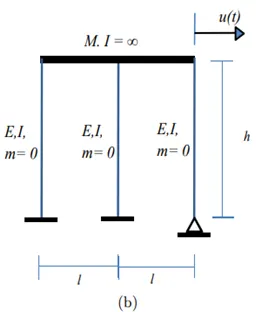
- Position of the elements can be describrd by 1 coordinate unit. Because Beam with infinite stiffness will induce uniform translation in all column.
- Number of degree of freedom for dynamic analysis is 1.
- Equation of the motion is
mu + ku = 0
- First we need to know the stiffness of the column.
k = ( 12EI/h^3) + ( 12EI/h^3) + ( 3EI/h^3)
k = 27EI/h^3
- Equation of Motion -> mu + ku = 0
-> mu + (27EI/h^3)u = 0
-> mu + (3EI/h^3)(1) = 0
-> mu + 3EI/h^3 = 0
- Natural Frequency -> ωn = √ 27EI / h^3 /m
Question 3:
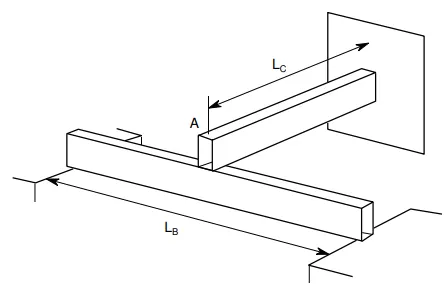
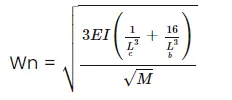
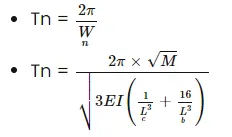
Consider the propped cantilever shown in the figure below. The beams are made from the same steel section and have lengths as shown on the diagram. Determine the natural period of this system if a large mass, M, is placed at the intersection of the beams at point A. The weight of the beams in comparison with the mass M is very small.
Aim :-
- To calculate the natural period of this system.
Procedure :-
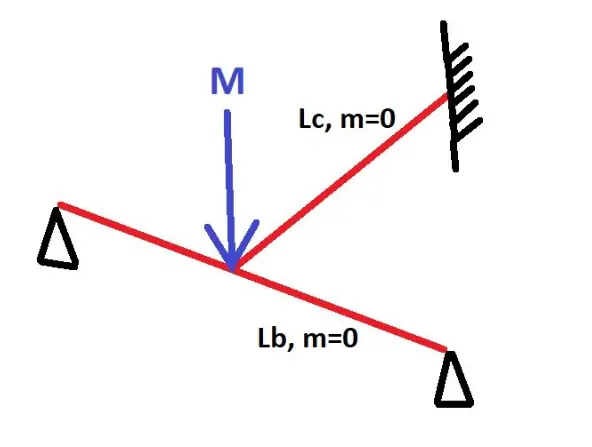
- The two beams contribute to overall stiffness of the system in parallel manner.
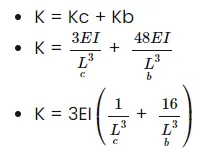
- This implifies the system stiffness can be found from the direct addition of the stiffnesses of the individual beams.
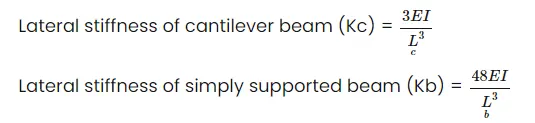
- Now we need to add lateral stiffness of both cantiliver beam and simply supported beam.
- Natural frequency -> ωn = √ k/m
- Natural period of the system can be found from natural frequency using this equation,
Question 4 :-
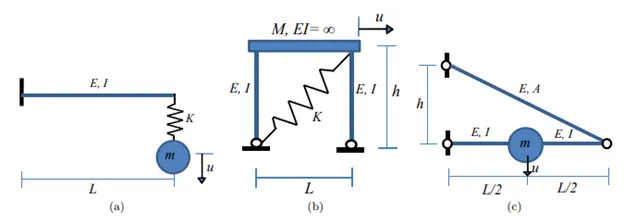
Determine an expression for the effective stiffness of the following systems:
Aim :-
- To Determine an expression for the effective stiffness.
Procedure :-
A.
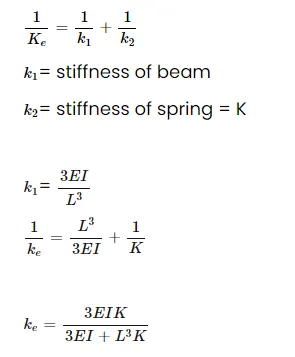
- There are 2 stiffness components connected to mass. One is fixed Cantiliver Beam. Another Spring. Both are connected in series with mass.
So effective stiffness of the system with components in series.
B.
- There are 3 stiffness components connected to mass. One is fixed Cantiliver Beam. Another Spring. Both are connected in series with mass.
So effective stiffness of the system with components in series.
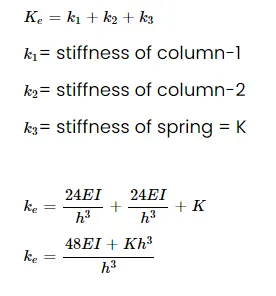
C.
- There are 2 stiffness components connected to mass. One is fixed Cantiliver Beam. Another Spring. Both are connected in series with mass.
So effective stiffness of the system with components in series.