Bending of an Iphone - Ansys
OBJECTIVE :
To simulate the Iphone bending using the fingers of the user. To change the location of fingers and to evaluate the results.
Case 1 : Fingers at the edge of the phone
Case 2 : Fingers moved to the centre
PROCEDURE :
Basic setup :
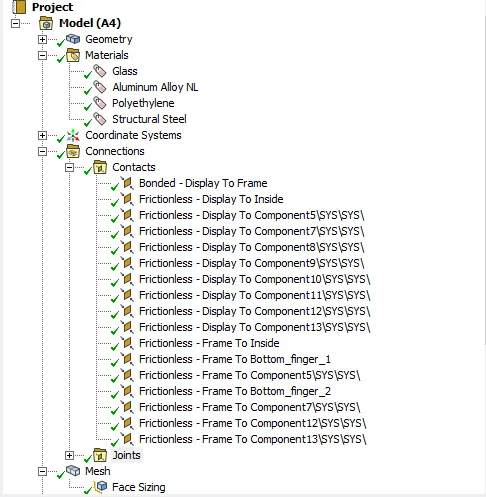
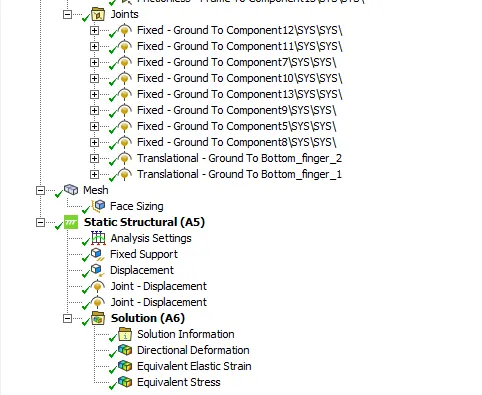
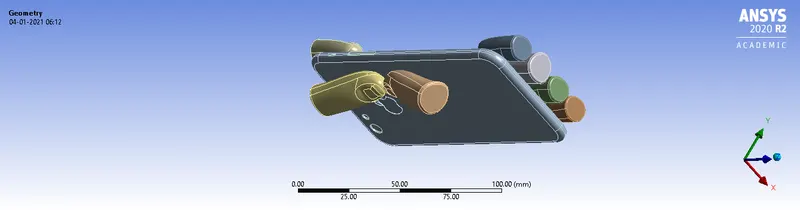
The above image shows some of the setup for this challenge. Iphone geometry contains number of parts and were named based on the features. The main components are display, frame and inside parts. The materials for each of the components are different and are listed below.
Display --> Glass material
Frame --> Aluminium alloy NL
Inside parts --> Polyethylene
Fingers --> Structural steel
In connections module, there are number of contacts involved since it holds the number of fingers and they will be in touch if they are undergone simulation. All the contacts are frictionless other than the contact between display and frame. The contact between display and frame is bonded. There are also numerous joints defined for the fingers since some of the fingers need to be in fixed position. There are total of 10 fingers available in the model. The bottom fingers are going to move upwards so that the phone will deform. For those two fingers, the translational joints are applied. The remaining eight fingers are applied as fixed joint.
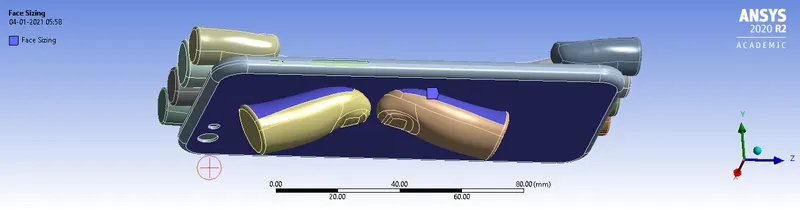
In meshing, two faces from the bottom fingers and the bottom face of the frame are selected for the face sizing in which the element size is 8mm. All other surfaces are meshed with default mesh size. Since the upper fingers are fixed with ground the face of the finger going to have contact with the display alone contains mesh. All other faces of the fingers don't have mesh.
Fixed support in the Static structural denotes that the top and bottom face of the display are constrained.
While in a simulation, after applying the force using hands the frame will undergo deformation so that the left and right side faces of the frame are set to be free in Y-axis.
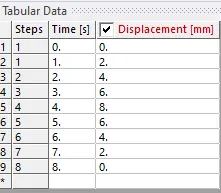
Two other joint displacements are applied for the bottom fingers since it will advances in positive Y direction. The displacement conditions for bottom fingers are tabulated below.
Case 1 : Fingers at the edge of the phone
In this case, the bottom fingers are located more near to the left side edge of the Iphone. All other setups are same as discussed above.
Case 2 : Fingers moved to the centre
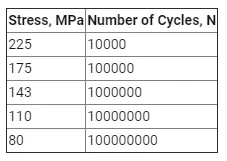
In this case, the bottom fingers are moved to X=22.5mm and Z=10mm. And in addition to that, the S-N curve is applied for the alumnium alooy material. A SN-Curve (sometimes written S-N Curve) is a plot of the magnitude of an alternating stress versus the number of cycles to failure for a given material. Typically both the stress and number of cycles are displayed on logarithmic scales.
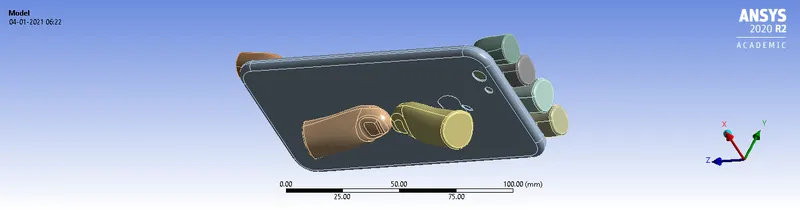
The position of the fingers at the middle of the frame are adjusted using ANSYS Spaceclaim.
RESULTS :
Case 1 : Fingers at the edge of the phone
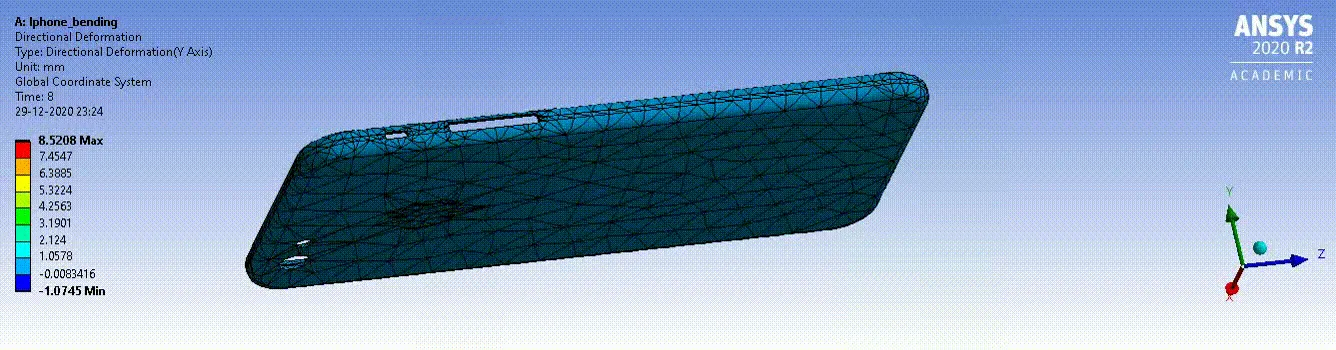
Directional deformation :
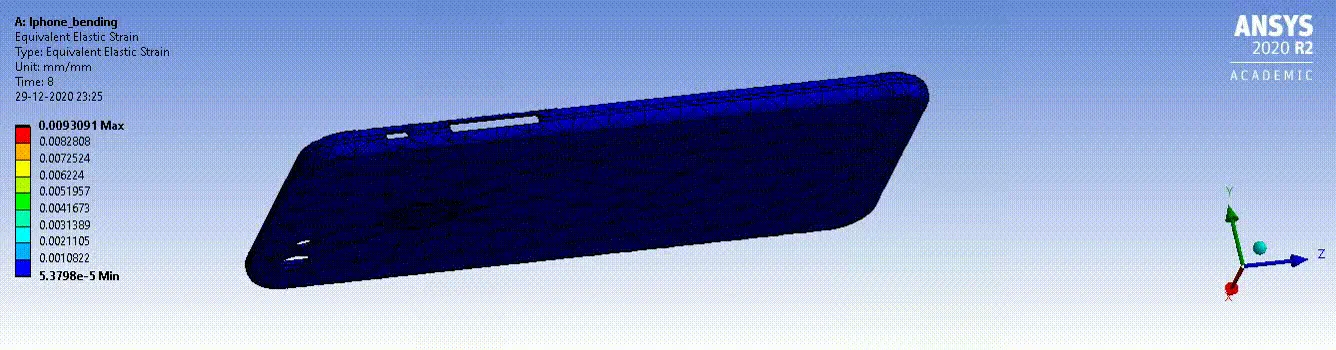
Equivalent elastic strain :
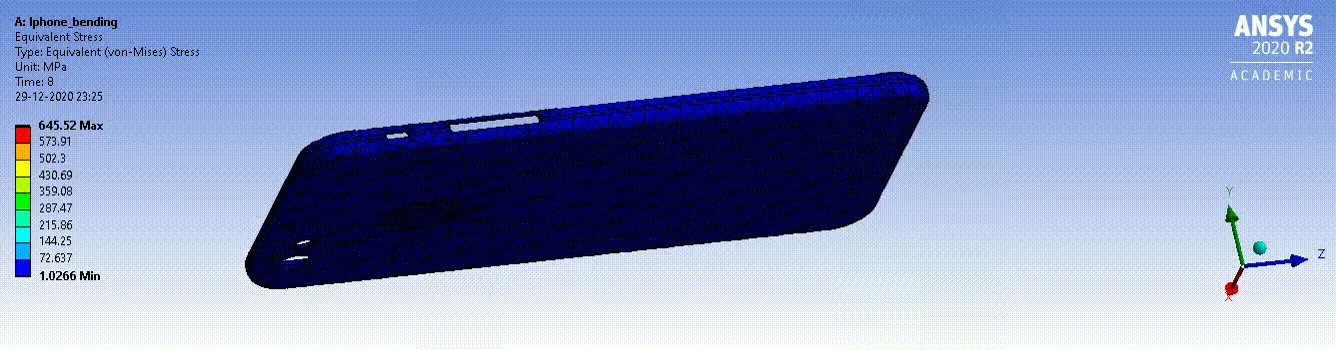
Equivalent stress :
Case 2 : Fingers moved to the centre
Directional deformation :
Equivalent elastic strain :
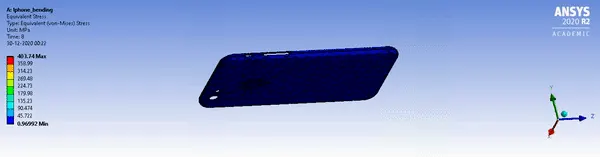
Equivalent stress :
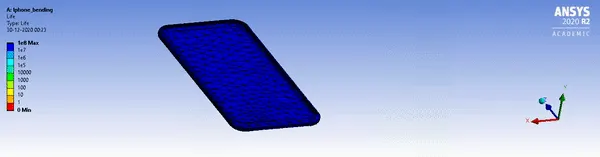
Fatigue life :
Safety factor :
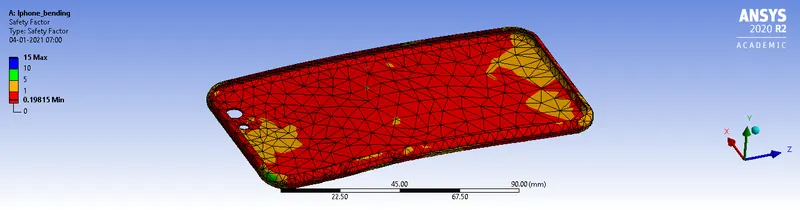
The above image clearly shows that the frame is failured by the applied load. Orange contour is in the range of 0.19815FOS. As the FOS is less than 1, the stress inside the frame exceeded the allowable stress and resulted in failure.
CONCLUSION :
| Directional deformation(mm) | Equivalent elastic strain(mm/mm) | Equivalent stress(MPa) | |
| Case 1 | 8.5208 | 0.0093091 | 645.52 |
| Case 2 | 8.0638 | 0.0057253 | 403.74 |
From the above table it is clear that the values for all the criteria in case 1 are greater than the case 2. In other words, case 2 bends like a elastic material. It return back near to the original state than the case 1. But case 1 doesn't return back after the displacement of the finger return backwards.
Thus the simulation for both the cases are done and the results are tabulated.