Benchmarking
Benchmarking:-
Benchmarking is the competitive edge that allows organizations to adapt, grow, and thrive through change. Benchmarking is the process of measuring key business metrics and practices and comparing them within a business area or against a competitor, industry, or other company around the world to understand how and where the organization needs to change in order to improve performance.
Types of benchmarking:-
There are four types of benchmarking
- Performance benchmarking
- Practice benchmarking
- Internal benchmarking
- External benchmarking
Performance benchmarking:- Performance benchmarking involves gathering and comparing quantitative data. It is also involved with the different types of performance indicators. It had an independent perspective compared with other companies. It was one of the comparing processes which give a better analysis of your arrangements. It enables the mindsets and another culture improvement. It was mainly used for retail stores with different types of features. This kind of benchmarking is used to analyze market growth.
Practice benchmarking:-Practice benchmarking takes a more qualitative approach. It aims at evaluating how things are done in your company and pinpointing areas to optimize. The first step is mapping internal processes. You can compare different workflows inside your business to see which yield better results and set standards for teams and employees. Process benchmarking is not limited to your own company. You can benchmark against publicly available statistics or data that you receive from external sources. Monitor the processes over time, especially after implementing changes, to help boost motivation and efficiency.
Internal benchmarking:- Internal benchmarking includes internal monitoring of workload, task completion, cost, revenue generated, and time spent on task. Internal benchmarking helps to set expectations for your team and lets you define and optimize workflow. Internal benchmarking is relevant mainly for large organizations with competing departments or where departments rely heavily on each other. Internal benchmarking is a good starting point to understand the current standard of business performance.
External benchmarking:- External Benchmarking is simply comparing one organization to another. Many government organizations want to know what other comparable jurisdictions are doing because they want to see their performance in context. After all, if crime rates remain constant in one city, it may not raise alarm bells. But if crime rates are going down in every other city, then there might be a problem.
Steps involved in benchmarking:-
- Planing
- Data collection
- Analysis of data
- Implementation
- Monitoring or action
Planing:-
Planing is the most important phase. Any mistakes, errors, or incompleteness in this phase generally affect the rest of the phases. Sufficient time and attention have to be devoted during the phase to ensure that planning becomes as error-free as possible, and hence makes the rest of the phases more effective and efficient.
Data collection:-
In this phase, the all data required for the project is collected. To clarify further, here, primary data refers to the collection of data directly from the benchmarked company/companies itself, while secondary data refers to information garnered from the press, publications, or websites. Exploratory research, market research, quantitative research, informal conversations, interviews, and questionnaires, are still, some of the most popular methods of collecting information.
Analysis of data:-
After the data is collected then the next step is to analyze the collected data. The correct implementation of this step will result in a clear picture of your processes in comparison with others in your business or industry. The incorrect implementation of this step could result in vague information that would not ultimately be useful in improving your operations.
Implementation:-
After analyzing all the data the next step is the implement all the data.
This is the stage in the benchmarking process where it becomes mandatory to walk the talk. This generally means that far-reaching changes need to be made so that the performance gap between the ideal and the actual is narrowed and eliminated wherever possible. A formal action plan that promotes change should ideally be formulated keeping the organization's culture in mind so that the resistance that usually accompanies change is minimized.
Monitoring or action:-
The final stage of benchmarking is to monitor the data. Assimilating the required information, evaluating the progress made, re-iterating the impact of the changes, and making any necessary adjustments, are all part of the monitoring process.
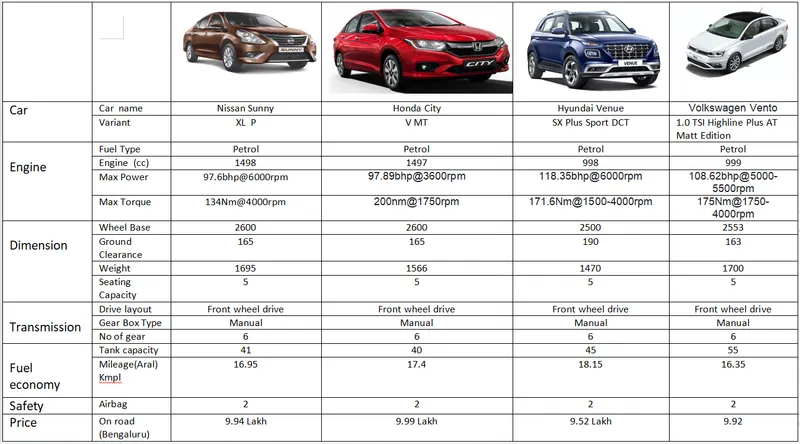
Mr. D.S. Pughazhyendhii is a married man who lives in Bangalore which is a highly crowded city. His Family comprises five members including his wife, a five-year-old boy, his father, and his mother. He visits his native place Madurai which is 500kms away from Bangalore once a month. Also, he will be using his car to commute to his office. His budget falls between 8 to 10 lakhs on road. Please suggest to him options so that he will buy a good car for his family.
Note: Pughazhyendhii is fond of big cars