Benchmarking
Benchmarking:
Benchmarking is defined as the process of measuring products, services, and processes against those of organizations known to be leaders in one or more aspects of their operations. Benchmarking provides necessary insights to help you understand how your organization compares with similar organizations, even if they are in a different business or have a different group of customers.
Benchmarking can also help organizations identify areas, systems, or processes for improvements—either incremental (continuous) improvements or dramatic (business process re-engineering) improvements.
Incremental Quality Improvement vs Benchmarking Breakthroughs
Technical Benchmarking:
Technical benchmarking is performed by design staff to determine the capabilities of products or services, especially in comparison to the products or services of leading competitors. For example, on a scale of one to four, four being best, how do designers rank the properties of your organization’s products or services? If you cannot obtain hard data, the design efforts may be insufficient, and products or services may be inadequate to be competitive.
Competitive Benchmarking:
Competitive benchmarking compares how well (or poorly) an organization is doing with respect to the leading competition, especially with respect to critically important attributes, functions, or values associated with the organization’s products or services. For example, on a scale of one to four, four being best, how do customers rank your organization’s products or services compared to those of the leading competition? If you cannot obtain hard data, marketing efforts may be misdirected and design efforts misguided.
Benchmarking Procedure:
Considerations
- Before an organization can achieve the full benefits of benchmarking, its own processes must be clearly understood and under control.
- Benchmarking studies require significant investments of manpower and time, so management must champion the process all the way through, including being ready and willing to make changes based on what is learned.
- Too broad a scope dooms the project to failure. A subject that is not critical to the organization’s success won’t return enough benefits to make the study worthwhile.
- Inadequate resources can also doom a benchmarking study by underestimating the effort involved or inadequate planning. The better you prepare, the more efficient your study will be.
Plan
- Define a tightly focused subject of the benchmarking study. Choose an issue critical to the organization’s success.
- Form a cross-functional team. During Step 1 and 2, management’s goals and support for the study must be firmly established.
- Study your own process. Know how the work is done and measurements of the output.
- Identify partner organizations that may have best practices.
Collect
- Collect information directly from partner organizations. Collect both process descriptions and numeric data, using questionnaires, telephone interviews, and/or site visits.
Analyze
- Compare the collected data, both numeric and descriptive.
- Determine gaps between your performance measurements and those of your partners.
- Determine the differences in practices that cause the gaps.
Adapt
- Develop goals for your organization’s process.
- Develop action plans to achieve those goals.
- Implement and monitor plans.
Below is the Benchmarking Case Study for the given problem:
For this Benchmarking Case Study, I have finalized four different cars as per user requirement:
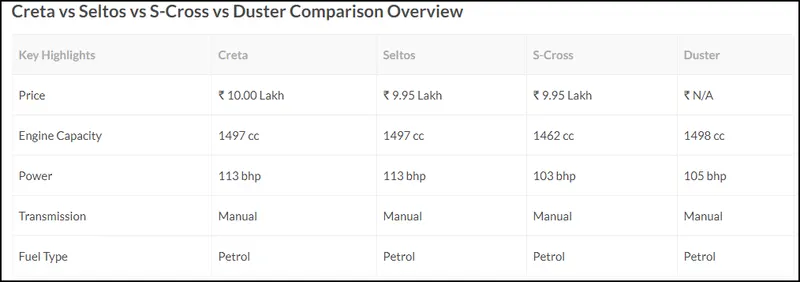
Below is the detailed comparison of the cars chosen for study:
|
Vehicle Model |
Hyundai Creta |
Kia Seltos |
Maruti Suzuki S-Cross |
Renault Duster |
|
Engine & Transmission |
||||
|
Engine |
1497 cc, 4 Cylinders Inline, 4 Valves/Cylinder, DOHC |
1497 cc, 4 Cylinders Inline, 4 Valves/Cylinder, DOHC |
1462 cc, 4 Cylinders Inline, 4 Valves/Cylinder, DOHC |
1498 cc, 4 Cylinders Inline, 4 Valves/Cylinder, DOHC |
|
Engine Type |
1.5 l MPi Petrol |
Smartstream G 1.5 |
K15B Smart Hybrid |
1.5 H4K |
|
Fuel Type |
Petrol |
Petrol |
Petrol |
Petrol |
|
Max Power (bhp@rpm) |
113 bhp @ 6300 rpm |
113 bhp @ 6300 rpm |
103 bhp @ 6000 rpm |
105 bhp @ 5600 rpm |
|
Max Torque (Nm@rpm) |
144 Nm @ 4500 rpm |
144 Nm @ 4500 rpm |
138 Nm @ 4400 rpm |
142 Nm @ 4000 rpm |
|
Mileage (ARAI) (kmpl) |
17 |
16.5 |
18.55 |
14.19 |
|
Driving Range (Km) |
850 |
825 |
890.4 |
825 |
|
Drivetrain |
FWD |
FWD |
FWD |
FWD |
|
Transmission |
Manual - 6 Gears |
Manual - 6 Gears |
Manual - 5 Gears |
Manual - 5 Gears |
|
Emission Standard |
BS 6 |
BS 6 |
BS 6 |
BS 6 |
|
Others |
Regenerative Braking, Idle Start/Stop |
|||
|
Dimensions and Weight |
||||
|
Length (mm) |
4300 |
4315 |
4300 |
4360 |
|
Width (mm) |
1790 |
1800 |
1785 |
1822 |
|
Height (mm) |
1635 |
1620 |
1595 |
1695 |
|
Wheelbase (mm) |
2610 |
2610 |
2600 |
2673 |
|
Ground Clearance (mm) |
190 |
180 |
205 |
|
|
Kerb Weight (kg) |
1144 |
|||
|
Capacity |
||||
|
Doors (Doors) |
5 |
5 |
5 |
5 |
|
Seating Capacity (Person) |
5 |
5 |
5 |
5 |
|
No of Seating Rows (Rows) |
2 |
2 |
2 |
2 |
|
Bootspace (litres) |
433 |
433 |
353 |
475 |
|
Fuel Tank Capacity (litres) |
50 |
50 |
48 |
50 |
|
Suspensions, Brakes, Steering and Tyres |
||||
|
Front Suspension |
McPherson Strut with Coil Spring |
McPherson Strut with Coil Spring |
McPherson strut with coil spring |
Independent McPherson Strut with Coil Spring |
|
Rear Suspension |
Coupled Torsion Beam Axle |
Coupled Torsion Beam Axle (CTBA) with coil spring |
Torsion Beam with coil spring |
Trailing Arm with Coil Springs and Double Acting Shock Absorber |
|
Front Brake Type |
Disc |
Disc |
Ventilated Disc |
Disc |
|
Rear Brake Type |
Drum |
Drum |
Disc |
Drum |
|
Minimum Turning Radius (metres) |
5.5 |
5.2 |
||
|
Steering Type |
Power assisted (Electric) |
Power assisted (Electric) |
Power assisted (Electric) |
Power assisted (Hydraulic) |
|
Wheels |
Steel Rims |
Steel Rims |
Alloy Wheels |
Steel Rims |
|
Spare Wheel |
Steel |
Steel |
Steel |
Steel |
|
Front Tyres |
205 / 65 R16 |
205 / 65 R16 |
215 / 60 R16 |
215 / 65 R16 |
|
Rear Tyres |
205 / 65 R16 |
205 / 65 R16 |
215 / 60 R16 |
215 / 65 R16 |
|
Safety |
||||
|
Airbags |
2 Airbags (Driver, Passenger) |
2 Airbags (Driver, Passenger) |
2 Airbags (Driver, Passenger) |
2 Airbags (Driver, Passenger) |
|
Middle Rear Head Rest |
NO |
NO |
NO |
YES |
|
Tyre Pressure Monitoring System (TPMS) |
YES |
NO |
NO |
NO |
|
Child Seat Anchor Points |
NO |
NO |
YES |
NO |
|
Seat Belt Warning |
YES |
YES |
YES |
YES |
|
Braking and Traction |
||||
|
Antilock Braking System |
YES |
YES |
YES |
YES |
|
Electronic Brake-force Distribution |
YES |
YES |
YES |
YES |
|
Brake Assist |
NO |
NO |
YES |
YES |
|
Comfort and Convenience |
||||
|
Air Conditioner |
Yes (Manual) |
Yes (Manual) |
Yes (Automatic Climate Control) |
Yes (Manual) |
|
Front AC |
Common Fan Speed Control |
Single Zone, Common Fan Speed Control |
Single Zone, Common Fan Speed Control |
Single Zone, Common Fan Speed Control |
|
Rear AC |
Vents Behind Front Armrest |
Vents Behind Front Armrest |
||
|
Heater |
||||
|
Vanity Mirrors on Sun Visors |
Co-Driver Only |
Co-Driver Only |
Driver & Co-Driver |
Co-Driver Only |
|
Cabin-Boot Access |
YES |
YES |
YES |
NO |
|
Anti-glare Mirrors |
Manual - Internal Only |
Manual - Internal Only |
Manual - Internal Only |
Manual - Internal Only |
|
Parking Assist |
NO |
NO |
Reverse Camera |
NO |
|
Parking Sensors |
Rear |
Rear |
Rear |
Rear |
|
Cruise Control |
NO |
NO |
YES |
NO |
|
Headlight & Ignition On Reminder |
YES |
YES |
YES |
YES |
|
Keyless Start/ Button Start |
NO |
NO |
YES |
NO |
|
Steering Adjustment |
Tilt |
Tilt |
Tilt & Telescopic |
Tilt |
|
12V Power Outlets |
1 |
1 |
2 |
YES |
Conclusion:
|
Model
|
Hyundai Creta
|
Kia Seltos
|
Maruti Suzuki S-Cross
|
Renault Duster
|
|
Good Things
|
|
|
|
|
|
Could be Better
|
|
|
|
|
Based on the above comparison and given condition as per user requirements:
I suggest Maruti Suzuki S-Cross be the best option among the other compared cars keeping in mind the requirements of Mr. Pughazhyendhii.