Benchmarking
BENCHMARKING
Aim:- To explain about Benchmarking and finding a good car for Mr.D.S.Pughazhyendhii to complain about all his requirements.
BENCHMARKING:- Benchmarking is a process of measuring the performance of a company’s products, services, or processes against those of another business considered to be the best in the industry, “best in class.”
The point of benchmarking is to identify internal opportunities for improvement. By studying companies with superior performance, breaking down what makes such superior performance possible, and then comparing those processes to how your business operates, you can implement changes that will yield significant improvements.
Installing a new customer relationship management (CRM) system to enable more personalized communications with customers.
There are two basic kinds of improvement opportunities: continuous and dramatic. Continuous improvement is incremental, involving only small adjustments to reap sizable advances. Dramatic improvement can only come about through re-engineering the whole internal work process.
Usually we can do benchmarking regardless of all the applications.
Benchmarking is a key to improvement.
We can do benchmarking internally and also externally.
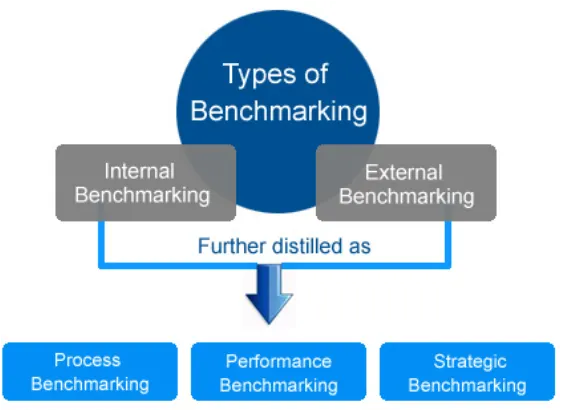
STEP-BY-STEP BENCHMARKING
Benchmarking is a simple, but detailed, five-step process:
- Choose a product, service, or internal department to benchmark.
- Determine which best-in-class companies you should benchmark against, which organizations you’ll compare your business to.
- Gather information on their internal performance, or metrics.
- Compare the data from both organizations to identify gaps in your company’s performance.
- Adopt the processes and policies in place within the best-in-class performers. Benchmarking will point out what changes will make the most difference, but it’s up to you to actually put them in place.
In order to benchmark anything, you need to have quantitative data available to study. That means breaking down internal processes to calculate performance metrics. Quantify everything, because only quantifiable information can be accurately compared.
BENEFITS
In addition to helping companies become more efficient and profitable, benchmarking has other benefits, too, such as:
- Improving employee understanding of cost structures and internal processes
- Encouraging team-building and cooperation in the interests of becoming more competitive
- Enhancing familiarity with key performance metrics and opportunities for improvement company-wide
In essence, benchmarking helps employees understand how one small piece of a company’s processes or products can be the key to major success, just as one employee’s contributions can lead to a big win.
REQUIREMENT
Benchmark with presently available cars in the market for the following case.
Mr. D.S. Pughazhyendhii is a married man who lives in Bangalore which is a highly crowded city. His Family comprises five members including his wife, five-year-old boy, his father, and his mother. He visits his native place Madurai which is 500kms away from Bangalore once in a month. Also, he will be using his car to commute to his office. His budget falls between 8 to 10 lakhs on road. Please suggest to him with options so that he will buy a good car for his family.
Basic characteristics of cars:
- Good seating arrangement.
- Safety.
- BS6 Engine used.
- Good Mileage.
- Good Interiors.
- Lightweight Car body.
- Specifications of cars
SUGGESTIBLE CARS :-
- Tata Nexon
- Mahindra XUV 300
- Maruti Suzuki Vitara Brezza
- Renault Triber
1. TATA NEXON
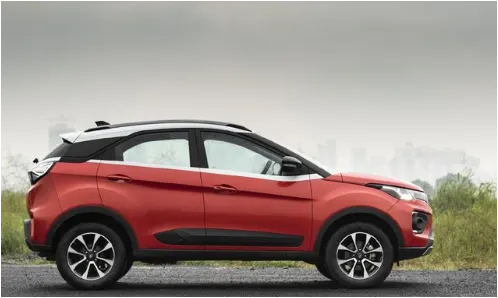
the Tata Nexon is a 5-star rated car.
It was the first compact SUV to get this accreditation as well.
Tata Moters ensured that the Nexon is suitably kitted and gets all the right goodies including a sunroof and petrol/diesel engines with auto transmissions as well.
The Tata Nexon has a 1.2-litre turbo petrol good for 120hp of power and 170Nm whereas the 1.5-litre diesel makes 110hp and 260Nm. Both engines are available with a 6-speed manual or AMT.
Pros:
- Best in class safety package
- Powerful engines (petrol & diesel)
- Ride and feels like a big vehicle
Cons:
- Quality of plastic inside the cabin
- Sluggish infotainment
- Slightly hard ride
|
MODELS / SPECIFICATIONS |
TATA NEXON |
|
ARAI Mileage |
21.5 kmpl |
|
Engine Displacement (cc) |
1497 |
|
Max Torque (nm@rpm) |
260Nm@1500-2750rpm |
|
Transmission Type |
Automatic |
|
Fuel Tank Capacity |
44 |
|
Max Power (bhp@rpm) |
108.5bhp@4000rpm |
|
Seating Capacity |
5 |
|
Boot Space (Litres) |
350 |
|
Body Type |
SUV |
|
Safety |
16.06/17 |
2. Mahindra XUV 300
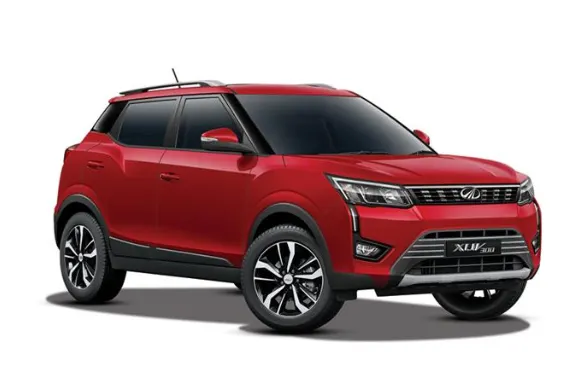
The XUV300 was initially codenamed as S201. Based on European spec Ssangyong Tivoli, it underwent major modifications to suit Indian roads and market conditions. The SUV was wind tunnel tested at Pininfarina facility in Italy. Mahindra officially revealed the name of XUV300 in December 2018. The SUV is wider and taller than Tivoli in dimensions but is made shorter than the counterpart to fit into sub-four-meter segment. It also resembles its sibling XUV500 in looks with similar projector headlamps and DRLs, front grille and the wheel arches. It was launched on 14 February 2019 in India.
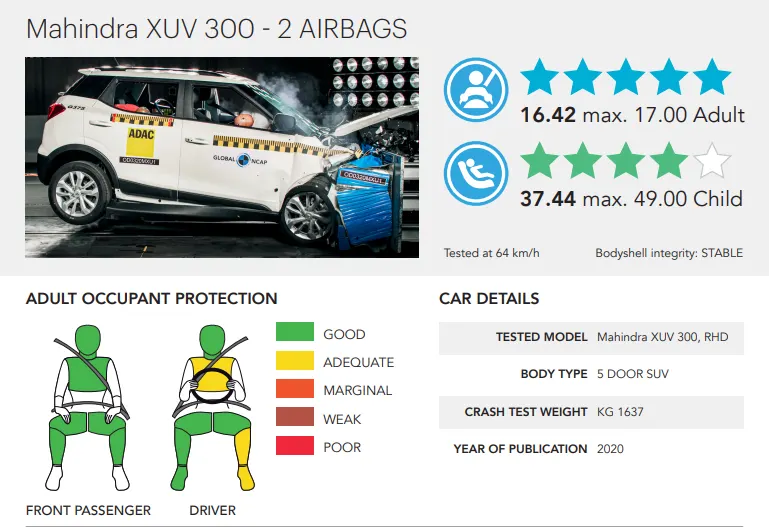
- Pros:
- Looks handsome - The majority will agree that the XUV300 has an attractive front end
- NCAP safety rating - This SUV's five-star rating satisfies growing concerns about safety
- Equipment list - The top-spec variant has a long list of features, safety equipment
- Potent drivetrains - The engines respond well to throttle inputs and aid drivability
- Comfortable ride - One of the few cars that offer a plaint ride regardless of the speed
- Cons:
- Needs a makeover - An update would help attract prospective buyers to the XUV300
- Interior fit/finish - It is not in the league of segment rivals such as the Venue/Seltos
- Petrol AMT gearbox - The engine feels less refined due to the discernible shift shocks
|
MODELS / SPECIFICATIONS |
MAHINDRA XUV 300 |
|
ARAI Mileage |
17 kmpl |
|
Engine Displacement (cc) |
1197 |
|
Max Torque (nm@rpm) |
200Nm@2000rpm |
|
Transmission Type |
Automatic |
|
Fuel Tank Capacity |
42 |
|
Max Power (bhp@rpm) |
109bhp@5000rpm |
|
Seating Capacity |
5 |
|
Boot Space (Litres) |
257 |
|
Body Type |
XUV |
|
Safety |
16.42/17 |
3. Maruti Suzuki Vitara Brezza
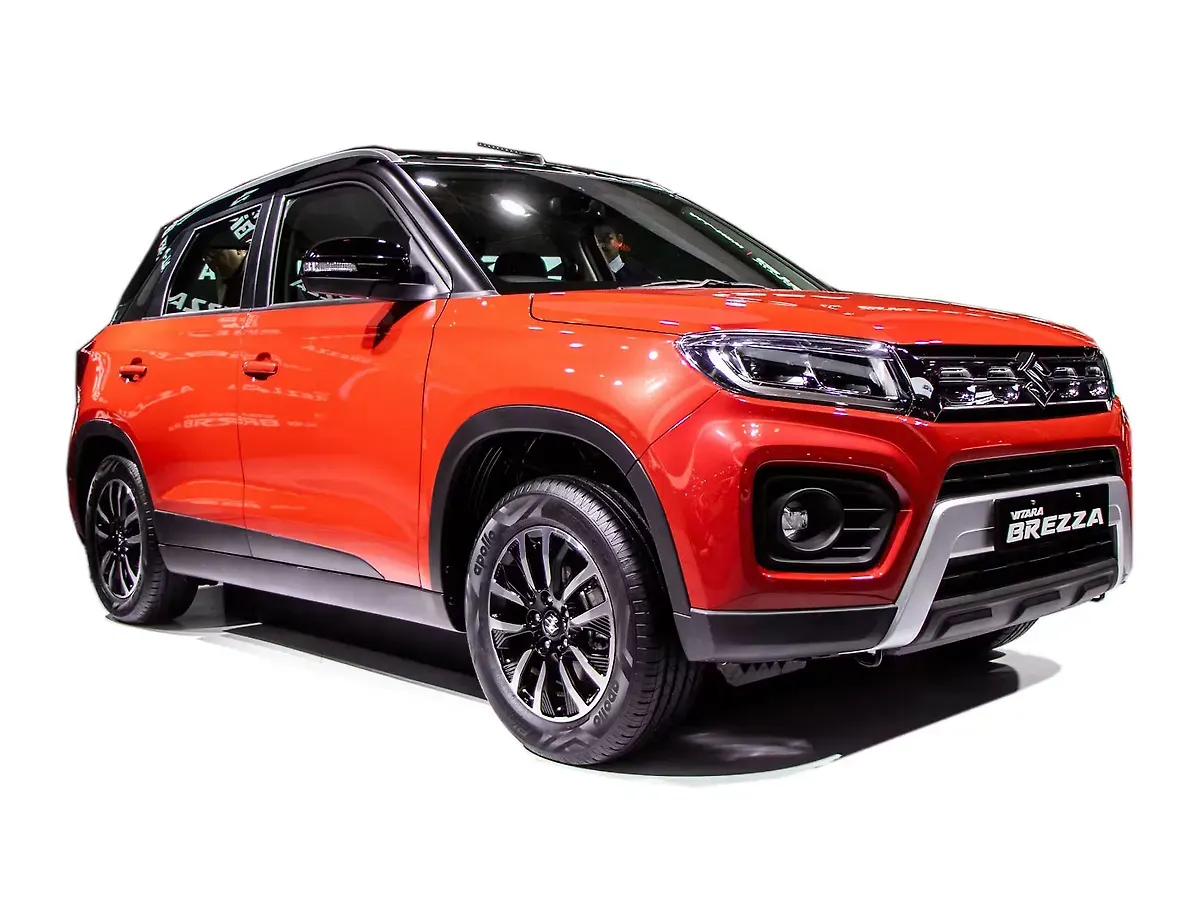
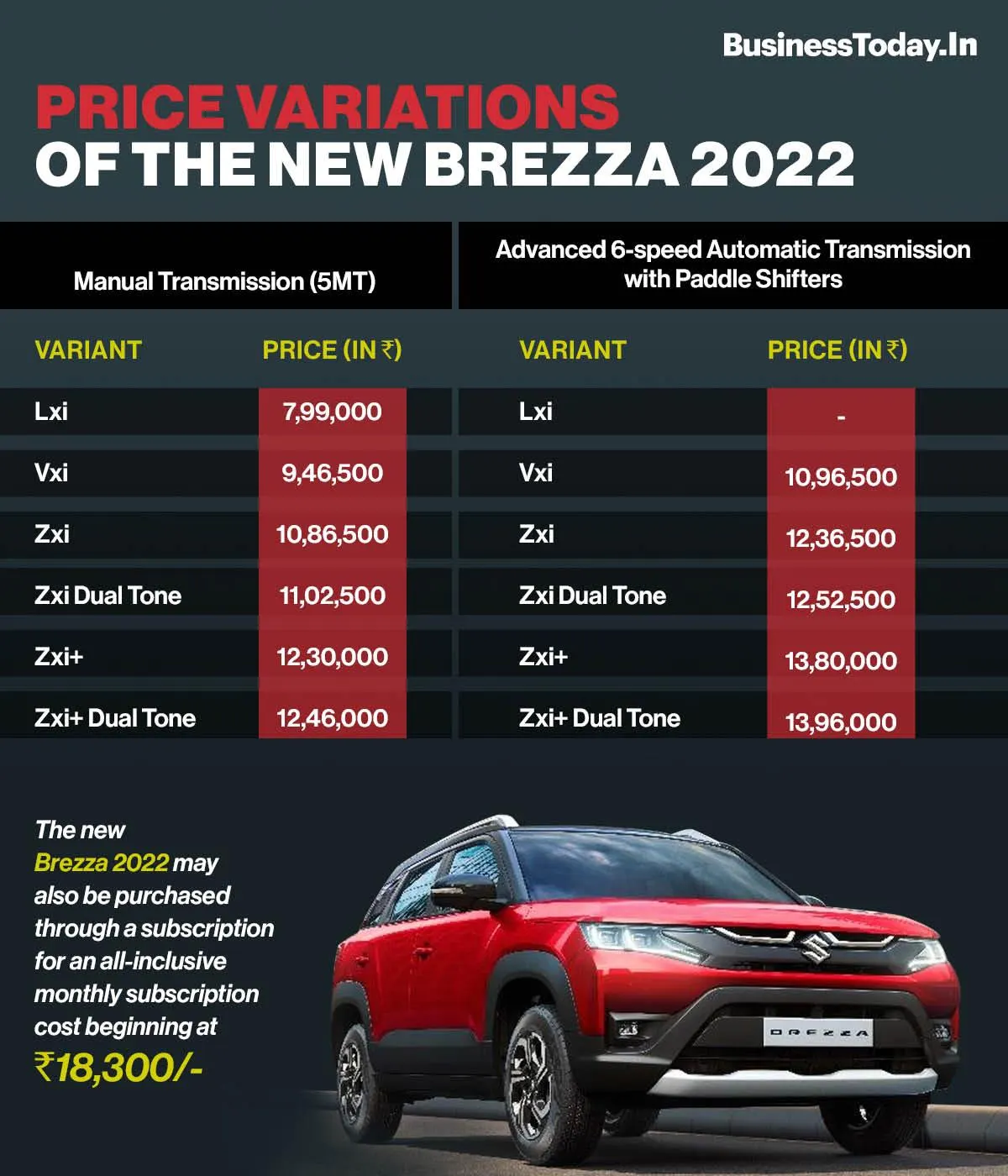
The second-generation Brezza was unveiled in India on 30 June 2022 without the "Vitara" moniker.
The vehicle retained the body shell platform of previous generation with major revisions. It came with revised front and rear fascia, redesigned C-pillar, thicker body claddings, redesigned 16-inch alloy wheels, shark fin-type antenna and electric sunroof. The dimensions are also nearly identical to the outgoing model, except for the 45 mm (1.8 in) height increase due to the shark fin antenna.
Pros:
Spacious interior with a wide backseat. A good 5-seater
Comfortable ride quality
Compact dimensions and light controls make it a great city car
Expansive list of features: Heads-up display, 360-degree camera, 9-inch touchscreen, sunroof
Cons:
Interior quality should have been better for the price
No diesel engine option available unlike many alternatives
Engine offers good useability but isn’t exciting
|
MODELS / SPECIFICATIONS |
Maruti Suzuki Vitara Brezza |
|
ARAI Mileage |
20.1 kmpl |
|
Engine Displacement (cc) |
1462 |
|
Max Torque (nm@rpm) |
136.8Nm@4400rpm |
|
Transmission Type |
Automatic |
|
Fuel Tank Capacity |
48 |
|
Max Power (bhp@rpm) |
102bhp@6000rpm |
|
Seating Capacity |
5 |
|
Boot Space (Litres) |
328 |
|
Body Type |
SUV |
|
Safety |
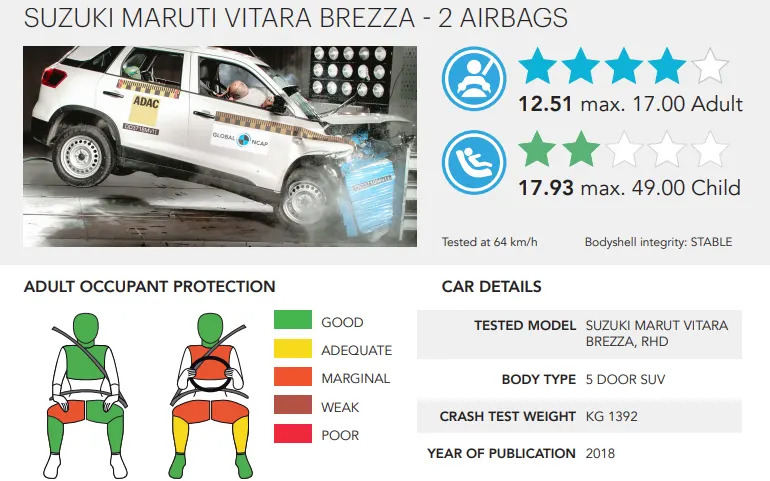
12.51/17 |
5. Renault Triber
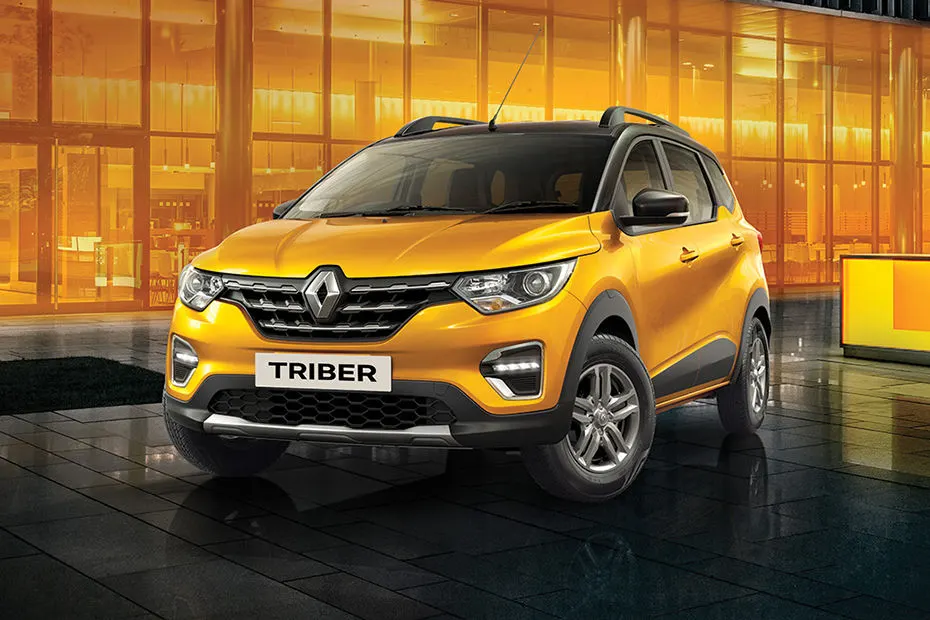
Pushing the envelope is something Renault does best.
And here, without a shadow of doubt, is proof.
The design is outstanding, the packaging is brilliant, and then, as you stand there going wow, you are hit with the killer price.
Renault managed to deliver all this: the impressive build, the high-quality bits, the generous amount of kit, and seven usable seats.
The main thing is renualt firm working hardly to bring a 7 seater car with 4m sub category. it's a one of the reason why the car price was economic we would the price is also equal to the 5 seater in the market.
Pros:
- Practicality - Space utilisation is simply ingenious, especially at this price point
- City runabout - Despite being big, the compact footprint allows easy city manoeuvring
- Affordable six-seater - The Triber is a lot of car for the money hence good value
- Ride quality - Glides over potholed roads effortlessly due to the well-judged damping
- Road presence - Be it design or visual appeal, the Triber undoubtedly has it in spades
Cons:
- Performance - The engine needs more grunt to perform quick overtakes on the highway
- Boot - There is no luggage space on offer when passengers are seated in all three rows
- Cabin plastic - Lacking look/feel inside the cabin, plastic all around seems tacky
|
MODELS / SPECIFICATIONS |
Renault Triber |
|
ARAI Mileage |
20.0 kmpl |
|
Engine Displacement (cc) |
999 |
|
Max Torque (nm@rpm) |
96Nm@3500rpm |
|
Transmission Type |
Manual |
|
Fuel Tank Capacity |
40 |
|
Max Power (bhp@rpm) |
71.01bhp@6250rpm |
|
Seating Capacity |
7 |
|
Boot Space (Litres) |
84 |
|
Body Type |
MUV |
|
Safety |
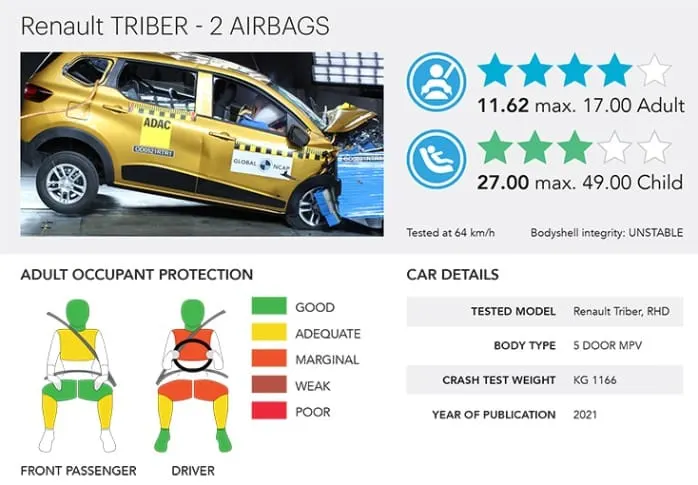
11.62/17 |
COMPARISON
|
MODELS / SPECIFICATIONS |
TATA NEXON |
Mahindra XUV 300 |
MARUTI SUZUKI VITARA BREZZA |
Renault Triber |
|
ARAI Mileage |
21.5 kmpl |
17kmpl |
20.1kmpl |
20kmpl |
|
Engine Displacement (cc) |
1497 |
1197 |
1462 |
999 |
|
Max Torque (nm@rpm) |
260Nm@1500-2750rpm |
200Nm@2000rpm |
136.8Nm@4400rpm |
96Nm@ 3500rpm |
|
Transmission Type |
Automatic |
Automatic |
Automatic |
Manual |
|
Fuel Tank Capacity |
44 |
45 |
48 |
40 |
|
Max Power (bhp@rpm) |
108.5bhp@4000rpm |
109bhp@5000rpm |
102bhp@6000rpm |
71.01bhp@6250rpm |
|
Seating Capacity |
5 |
5 |
5 |
7 |
|
Boot Space (Litres) |
350 |
257 |
328 |
84 |
|
Body Type |
SUV |
XUV |
SUV |
MUV |
|
Safety |
5 stars NCAP rating |
4 stars NCAP rating |
4 stars NCAP rating |
4 stars NCAP rating |
CONCLUSION
I would suggest Tata Nexon for Mr. D.S. Pughazhyendhii family, Nexon is an excellent offering which is the safest car in its segment. It is also a value for money product with class leading features.