Basics of Probability and Statistics Week 1 Challenge
1)Why there is a difference in the formula of variance for population and sample
Variance of population :
`sigma^2=sum(x_i-mu_x)^2/N`
Variance of sample :
`sigma^2=sum(x_i-mu_x)^2/(N-1)`
The logic of doing that is to compensate our lack of information about the sample data.
Obviously we can't sample each and everyone for obtaining a result so we we subrtact 1 from the denominator .
The variance of sample has (N-1) in denominator because it is verified emperically that this (N-1) in the denominator produces more accurate results than when there is "N" in the denominator as found in variance of population.
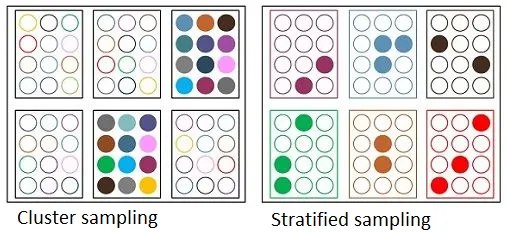
| Cluster Sampling | Stratified Sampling | |
| Definition |
Members of this sample are chosen frm narutally divided groups called clusters,by randomly selecting elements to be a part of the sample |
Members of it's sample are randomly chosen from non-overlapping , homogenous strata . |
| Purpose |
Cost reduction & increased effeciency |
Enhanced precision & population depiction |
| Sample |
Selection of sample is done by randomly selected clusters & including all the members from these clusters |
Selection of the sample is done by randomly selecting members from various formed strata |
| Division type |
Naturally formed |
Depends on the researcher |
| Heterogenity |
Internally with the cluster |
Externally on the researcher |
| Homogenity |
Externally between various clusters |
Internally with the strata |
3) How many different samples can be created out of population of size n
Let A={1,2,3,4}
The set A contains 4 elements making n=4.
The number of subsets from this sample is as follows
A={} ,{1}, {2}, {3}, {4},
{1,2},{1,3},{1,4}
{2,3},{2,4}
{3,4}
{1,2,3},{1,3,4},{1,2,4}
{2,3,4}
{1,2,3,4}
There are 16 subsets in total which is `2^n=2^4`.
Types of subsets ,
A proper subset is one that contains a few elements of the original set whereas an improper subset, contains every element of the original set along with the null set.
A subset which contains all the elements of the original set(includes null set) is called an improper subset.
Since we are choosing 2 jacks from 4 jacks from the standard deck of cards ,
We can draw one jack from a deck of cards and it's probabilty is 4/52.
Also when we replace the first crd in the same deck the probablity of drawing a jack from 52 cards is 4/52.
So , the total probability of drawing 2 jack's from a deck of cards is 4/52*4/52 = 1/169 = 0.005917
Without replacement :
We can draw one jack from a deck of cards and it's probabilty is 4/52.
Without replacing the first card in the deck of cards we are left with 51 cards and 3 jacks assuming that we picked a jack on our first chance .
The probability of getting a jack on our second attempt is 3/51.
Total probability of drawing 2 jacks in 2 attempts is 4/52*3/51 = 1/221 = 0.004528
Below is the number of outcomes of rolling 2 dice ,The total number of outcomes of rolling a dice is (number of outcomes of rolling a dice)^(number of dice rolled)
Here number of outcomes of rolling a dice is 6 & the number of dice rolled is 2 so total number of outcomes = `6^2= 36`
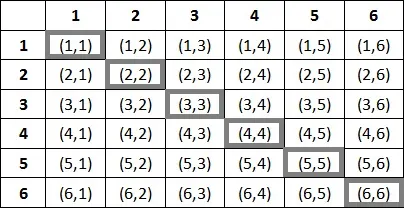
The enclosed outcomes in grey is the total number of outcomes with same numbers on both dice
So the probability of getting 2 same numbers when rolling a dice is 6/36 =1/6
6) Why standard deviation when variance can measure the dispersion in data
Standard deviation is used to normalise the dimentional units of a quantity that we squared to find variance .
When we find the variance
We will look at an example to understand this .
Properties of standard deviation
When using standard deviation keep in mind the following properties.
- Standard deviation is only used to measure spread or dispersion around the mean of a data set.
- Standard deviation is never negative.
- Standard deviation is sensitive to outliers. A single outlier can raise the standard deviation and in turn, distort the picture of spread.
- For data with approximately the same mean, the greater the spread, the greater the standard deviation.
- If all values of a data set are the same, the standard deviation is zero (because each value is equal to the mean).
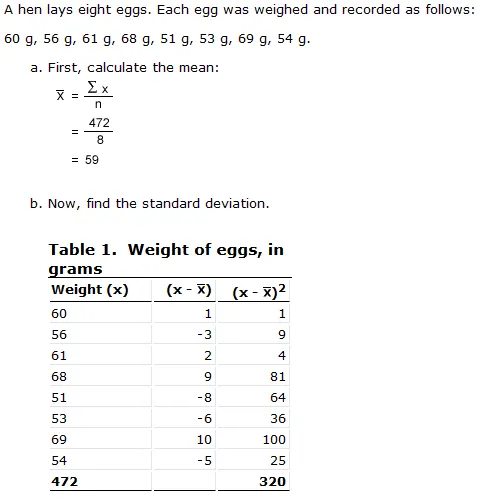
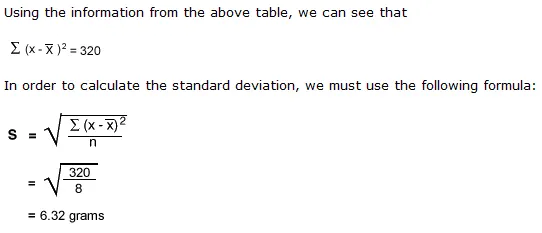
Here the units of sum of all variance of the weights of eggs is g^2.
To know the quantity in normal units we use standard deviation