Assignment 5-RADIOSS Interfaces & Study of Effect of Notches Challenge
AIM: To mesh the given bumper model with the target element as 6mm. To import crash tube rad file and to run 6 different cases to compare the results of Rwall forces, contact forces, internal energy, kinetic energy, contact energy.
PART 1
PROCEDURE:
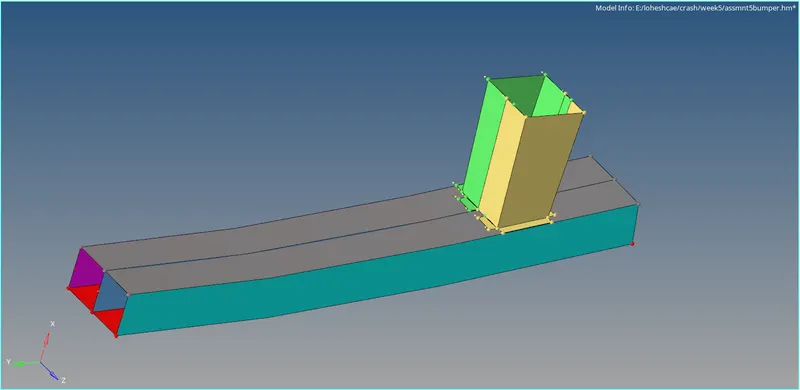
To import this model in the hyper mesh using the import model option.
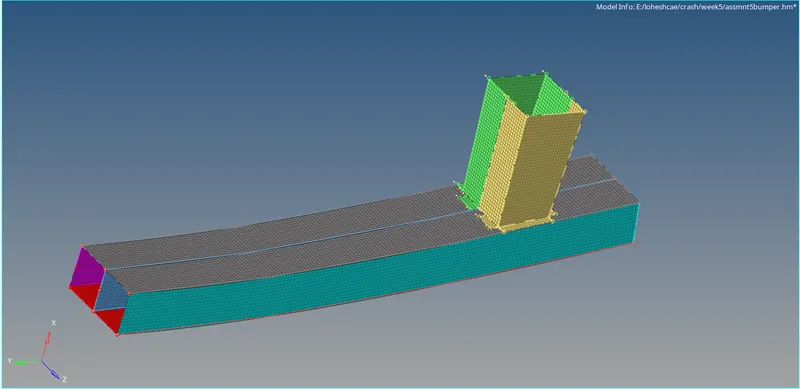
change it from wireframe to surface mode and to mesh the model with 6mm as target element length for every part in the model.
there will be no problem in this mesh creation since all the parts have linear area meshing is done perfectly for this.
once done with meshing check for free edges if any, using the edges option, find edges by selecting the whole component, and if any are found click on preview equivalence and equivalence to eliminate free edges and at last once edges are cleared, delete the edges card.
Thus mesh is created perfectly for the bumper model.
PART 2
CASES:
- Run the crash tube model as it is.
- Change the Inacti=6 and run.
- Create the type 11 contact and run.
- Remove both notches and remove boundary condition on rigid body node then run.
- Create a new notch in the middle, select the whole section and run.
- Create a new notch with nodes only from opposing 2 faces and run.
Import the model in the hyper mesh by using import solver deck and as radioss file type and select the file o.rad in the file to be imported area and click on import.
crash tube model will be opened in the hyper mesh.
now the following 6 cases should be applied and results are to be noted as follows.
OBSERVATION:
CASE1
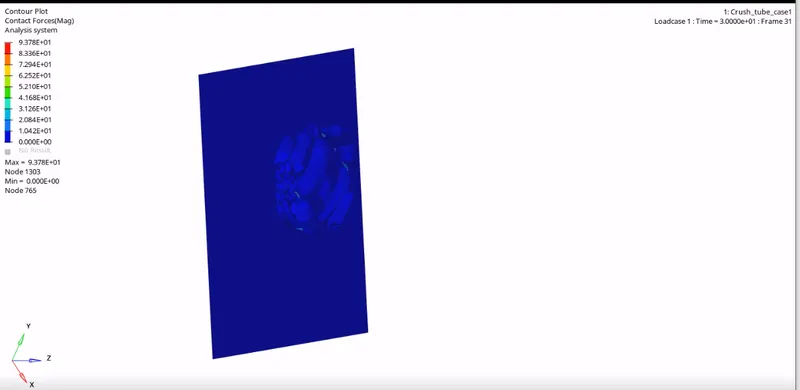
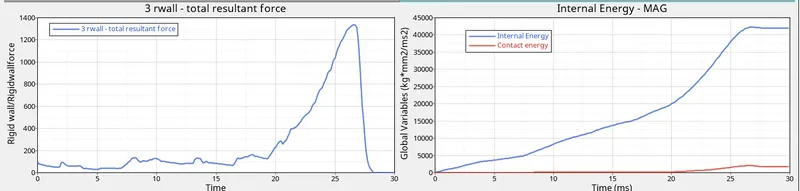
For this case 1, the model crash tube is to be run as it is.
The total no. of cycles run is 83496, with an elapsed time of 134.42s.
The energy error is -3.8% which is acceptable and the mass error is 0.
Contact forces had a peak of 937N. It is the force that requires contact to occur.
Internal energy has a peak at 26ms which means that the crash tube has undergone crushing till that, so the energy is seen to be raising linearly till 26ms. After that the curve sets to go flat, this means there is no further internal energy generated.
Contact energy is seen to be flat and has a spike at 20ms to 30ms, this means there is a max rise in contact energy at 26ms which means at that time contact energy is experienced more which means there is more element to element crushing contact at this time and it starts to go flat after that since the crash is complete.
The Rwall forces, from 0 to 22 there is a force generated due to crushing force generated on the wall and then there is a sudden spike at 26ms because the crush tube is crushed completely at a max level force and it falls drastically after that due to there is no force to be generated further against the wall.
CASE2
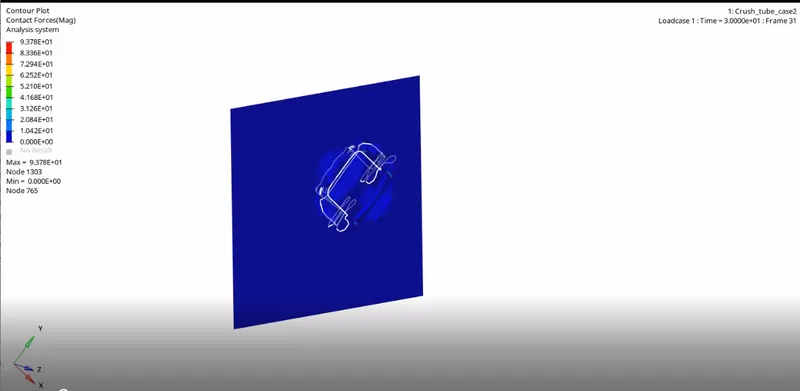
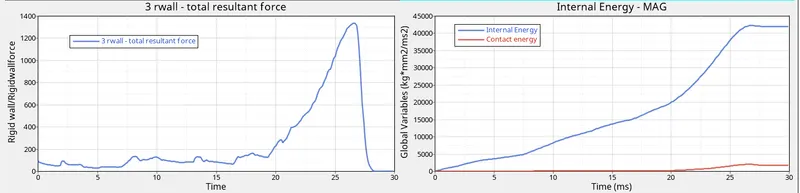
For this case 2, the model crash tube is to be run with Inacti is changed to 6 for good accuracy. In this, the gap is reduced and scaled.
The total no. of cycles run is 83496, with an elapsed time of 134.68s.
The energy error is -3.8% which is acceptable and the mass error is 0.
Contact forces had a peak of 937N. It is the force that requires contact to occur.
The Rwall force, internal energy, contact energy tend to be the same as that of case 1, this tells us there is no initial penetration taken place.
CASE3
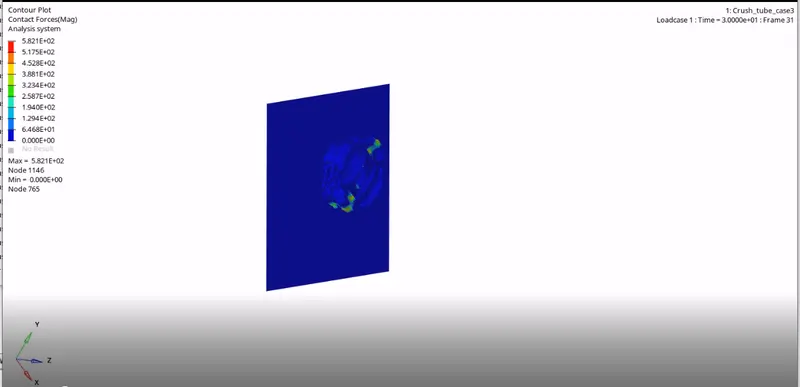
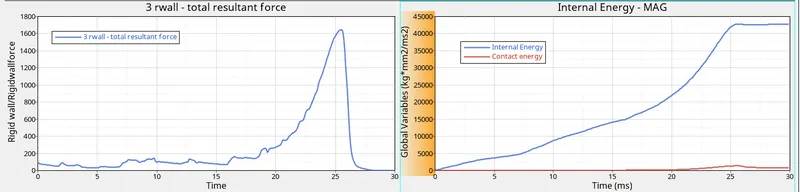
For this case 3, the model crash tube is to be run after creating TYPE11 contact, this contact checks if there is any line-to-line penetration existing and corrects them.
The total no. of cycles run is 105557, with an elapsed time of 357.10s.
The energy error is -1.7% which is a very good value and near to zero and the mass error is 0.
Contact forces had a peak of 582N. It is the force that requires contact to occur. Low contact force due to the application of TYPE11 contact.
Internal energy is seen to be showing a rise when compared to cases 1 and 2, this is because the new contact applied, thus this contact checks for the line to line penetration between the elements, and thus there is a rise in internal energy at 26ms and after it tends to go flat thus there is no internal energy produced further.
Contact energy is seen to be a little reduced when compared to cases 1 and 2 because here it checks and clears the line-to-line penetration and thus there is no rise in contact energy in the crush tube.
Rwall forces tend to be the same as cases 1 and 2, but here the peak force generated before the time compared to previous cases, due to there are three types of contact applied here, the radioss calculates finely in a quick time when compared to 1 and 2 cases.
CASE4
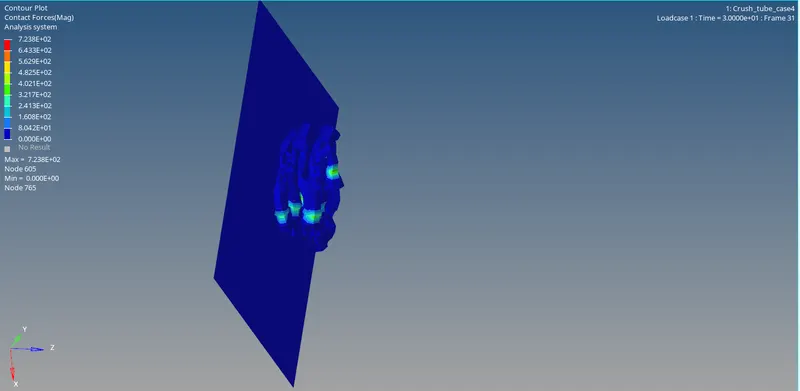
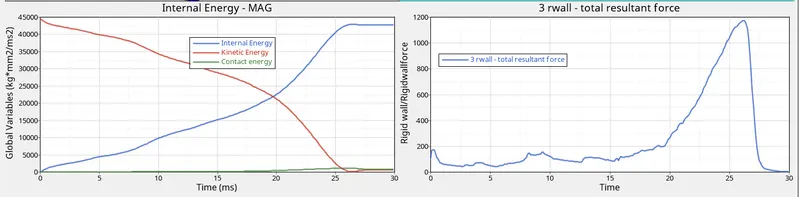
For this case 4, the model crash tube is to be run by removing both the notches and boundary conditions (BCS) on the rigid body.
The total no. of cycles run is 94656, with an elapsed time of 308.86s.
The energy error is -1.6% which is a good value and the mass error is 0.
Contact forces had a peak of 723N. It is the force that requires contact to occur.
Internal energy remains to show a similar output, it has a peak at 26ms and after that, no more internal energy is generated. This means the crush tube has undergone a complete crash.
Contact energy as same from above cases shows similar energy, but here since there are no notches, we can see the contact energy rise at 17ms, this is earlier when compared to other cases with notches. Thus, since there is no notch available in this case the crush tube when in the application of force it crushes at a faster rate. so, the contact energy raises before itself due to a rise in element-to-element contact.
Kinetic energy as we can see here is starting from a high value and dropping linearly to a minimum, is because at first the force is applied at a higher rate and the rate of energy generated to the crush tube reduces when the crush tube is fully crushed at the end, and the little rise in the graph at the end is because the crush tube experiences full crush and due to the material rebound at final it is showing a little rise in graph.
Rwall forces when seen, we can confirm that the crush tube when notches are taken, the Rwall force generated is lesser when compared to other. since there are no notches available there is a rise at first itself, this is due to high initial force to the wall from the crush tube as there are no notches in this case. From the graph we can say, the Rwall forces in the no-notch crush tube have a peak at only 1200N, which is much lower when compared to the crush tube with two notches of value 1700N. so, we can conclude by saying that the crush tube with two notches needs 1700N for full crush, whereas the crush tube with no notches needs only 1200N for full crush which is not safe.
CASE5
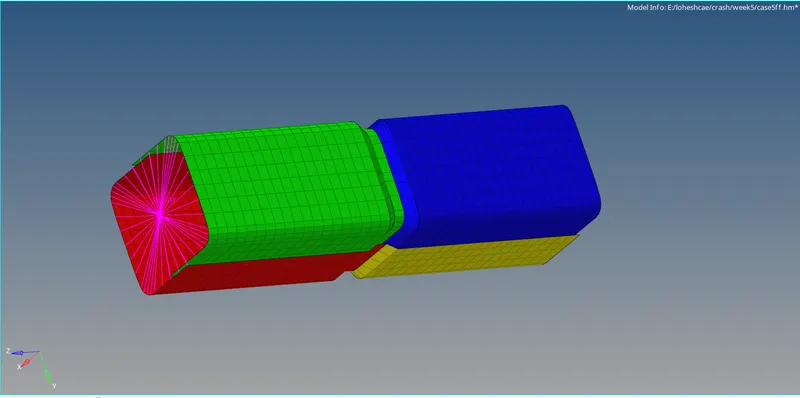
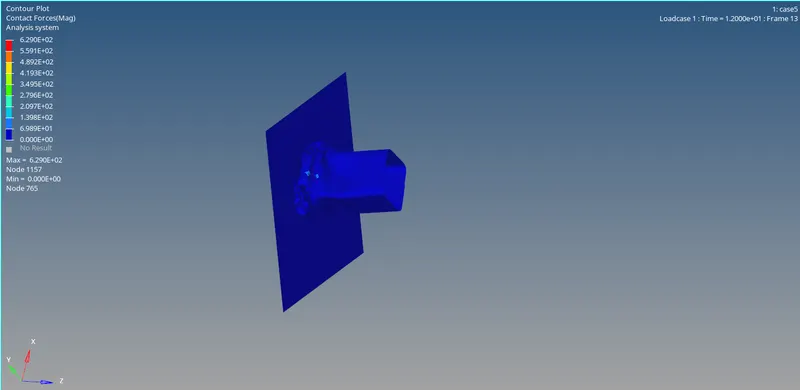
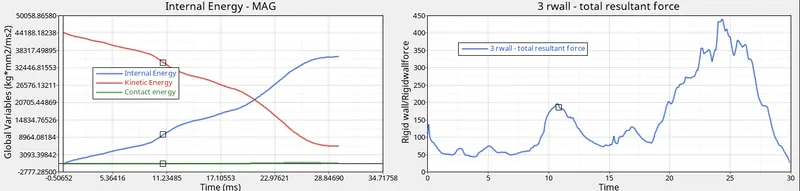
For this case 5, a new notch is created only in the middle of the crush tube and then made to run.
The total no. of cycles run is 100540, with an elapsed time of 295.12s.
The energy error is -0.3% which is acceptable and the mass error is 0.
Contact forces had a peak of 629N. It is the force that requires contact to occur.
Internal energy shows a linear curve, thus it is similar to the other cases where it raises to a particular level and resides after as there is no further energy generated.
Kinetic energy also can be seen having a similar opposite curve to the internal energy curve, as it starts from a peak and ends at 30ms after complete crushing is done.
The contact energy can be seen generating at a low level, due to the new notch and TYPE11 contact eliminates the edge-to-edge contact and thus it is generated at a lower rate. We can also say that in this case as the notch is only at the middle of the crash tube the energy experienced is neutralized throughout the crash tube and while crushing.
From Rwall force we can say that the force at a higher rate of 130N is experienced at the starting level due to the notch created at the middle. The complete graph can be seen producing a higher level graph ratio because of the new notch and it has a peak at 440N which is minimum when compared to other cases. It has a peak at 24ms and subsides after generating complete force to the wall. When compared to others this is weak in the case of generation of force where it deforms in just 440N hence it is not safe.
CASE6
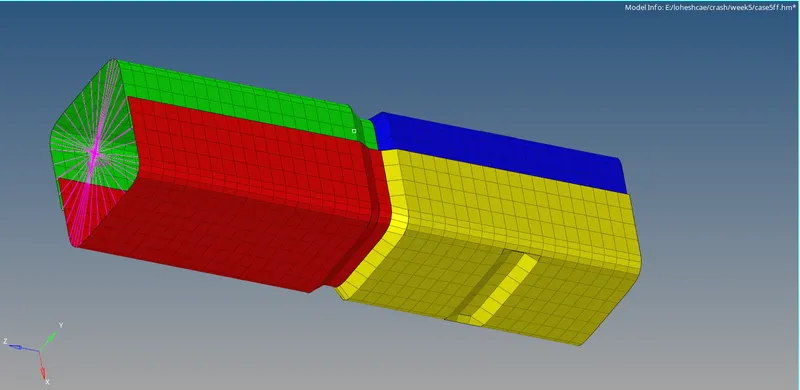
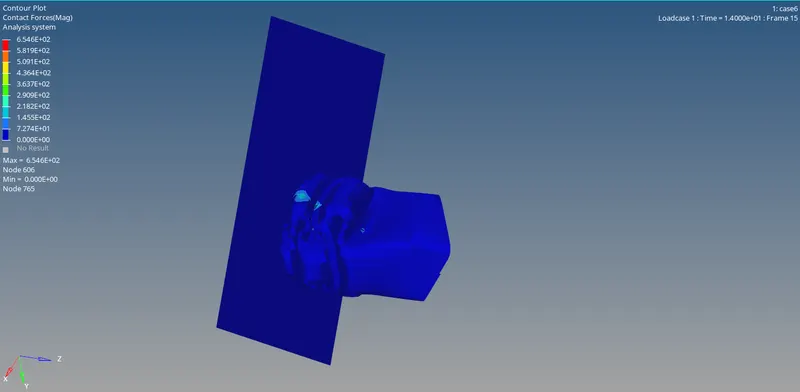
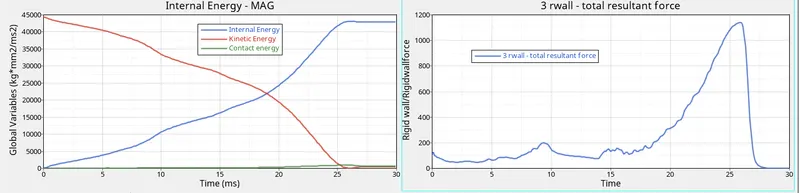
For this case 6, a new notch is created only in the middle of the crush tube and to create two-notch in only opposing two faces and made to run.
The total no. of cycles run is 105825, with an elapsed time of 341.70s.
The energy error is -1.4% which is acceptable and the mass error is 0.
Contact forces had a peak of 654N. It is the force that requires contact to occur.
Internal energy remains to be same as it raises linearly and subsides from 26ms.
Kinetic energy also has a linear decreasing curve and at 26ms it ends and it experiences a little jump in the curve due to the rebound of the crash tube.
Contact energy raises from 17ms and slightly increases from then to 30ms due to the presence of two opposite notch created.
Rwall force is starting from 130N due to the presence of the middle notch and extra two opposite notch created this exerts more force to deform, so there is a spike at first. We can see due to the extra notches created at opposite sides of the crash tube, thus it intakes much force and it takes more force to deform thus the force raises to 1100N, and after that, it resides since there is no force to penetrate further.
CONCLUSION
Learned about notches, creating of notches, use of notches.
Types of notch creation and adv and dis adv of that.
Case5 shows the best result by having a -0.3% energy error and middle notch creation for the crush tube shows the best result.
Incti=6 actually shows good accuracy by reducing the penetration gap and also scaling.
TYPE11 contact is applied to eliminate and correct the line-to-line penetration. It takes more time and cycles but the result will be good.
Thus by creating notches the impact force on the opposite car will be less when compared to crush tube with no notches.