Assignment 4-RADIOSS Material Laws Challenge

Objective:
- To study Different material laws used in Radioss
- Observe the elemental behavior, when there is a change in the material properties of a plate.
- Analyze the differences with and without using the “Ixfem” parameter in Law2 type material.
Case Setup:
7 different cases are set up to study the material laws. For the same plate, material laws and parameters are modified.
- Case 1: Law2_epsmax_failure
- Case 2: Law2_epsmax_crack
- Case 3: Law 2_epsmax_nofail
- Case 4: Law2
- Case 5: Law 1
- Case 6: Law36
- Case 7: Law 27
- Case 1: Law2_epsmax_failure
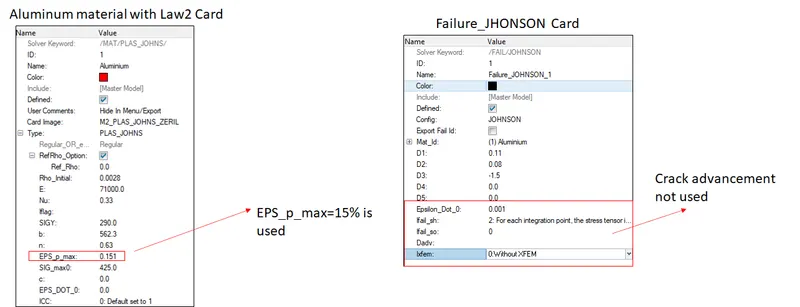
- In this case, the “M2_PLAS_JOHNS_ZERIL” card is used along with the “Failure_JHONSON” failure card.
- In the “Failure_JHONSON” card, Ifail_Sh=2, Dadv=0, Ixfem=0 is used (crack advancement criteria is not used).
-
Case 2: Law2_epsmax_crack
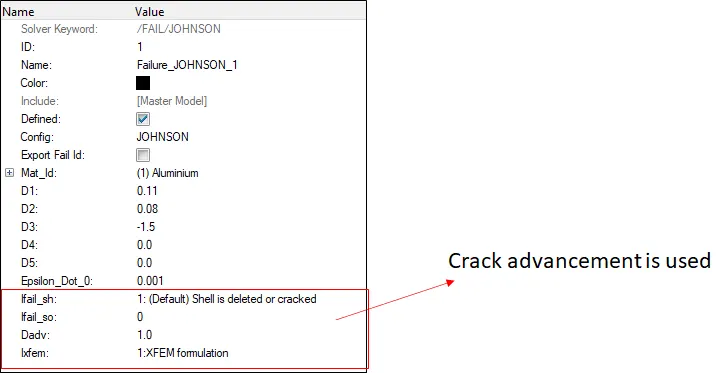
- In this case, “M2_PLAS_JOHNS_ZERIL” is used along with the “Failure_JHONSON” failure card. ( Same as Case 1)
- In the “Failure_JHONSON” card, Ifail_Sh=1, Dadv=1, Ixfem=1 is used (Crack advancement criteria is used)
-
Case 3 : Law 2_epsmax_nofail
- In this case, the “M2_PLAS_JOHNS_ZERIL” card is used. And the “Failure_JHONSON” card is deleted. ( To Check the effect on elements without JHONSON failure card)
Case 4: Law2
- In this case, the “M2_PLAS_JOHNS_ZERIL” card is used and the EPS_p_max value is set to “0”.(To check the effect on elements without plastic failure strain).
-
Case 5: Law 1
- Elastic material with the same E, nu, and Density is used.
Case 6: Law36
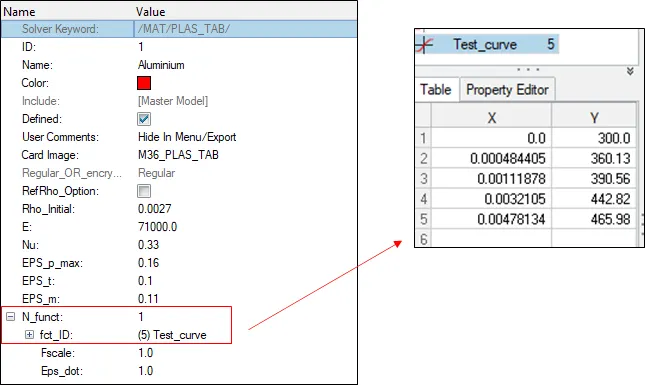
- In this case, the “M36_PLAS_TAB” card is used along with the given curve function( shown below)
-
Case 7: Law 27
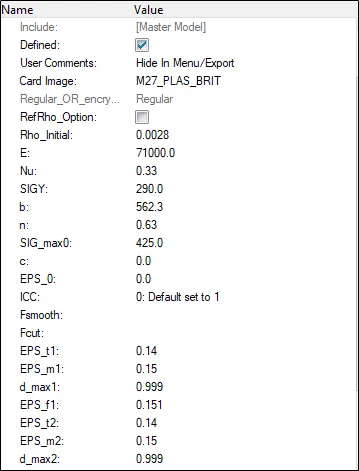
- In this case, the “M27_PLAS_BRIT” card is used.
- It is the same as JHONSON COOK(LAW2) properties but has different EPS failure values.
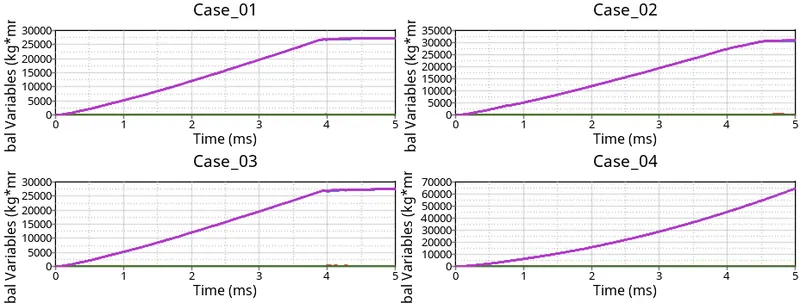
Observations: Energy Error and Mass Error are within the allowable limit.
|
Energy Error % |
Mass Error |
|
|
Case1 |
0.8 |
0 |
|
Case2 |
4.1 |
0 |
|
Case3 |
0.8 |
0 |
|
Case4 |
3 |
0 |
|
Case5 |
1.3 |
0 |
|
Case6 |
-1.8 |
0 |
|
Case7 |
-7.1 |
0 |
Results:
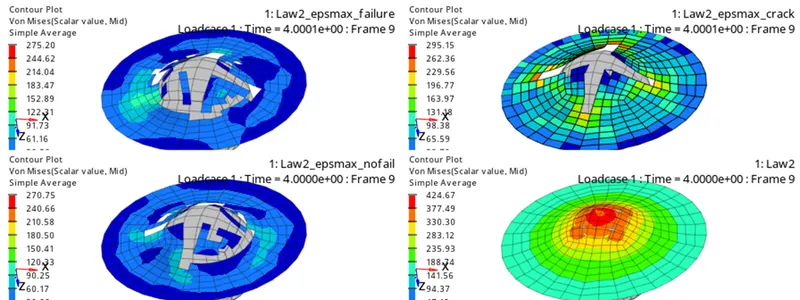
- In Case 1 and Case 3, the Crack advancement feature is not there (Dadv=0, Ixfem=0). Elements are getting deleted after anyone integration point of the element reaches 15.1% of plastic strain ( EPS_p_max=0.151 and SIG max=425).
- In Case 2, the "Ixfem" formulation is present in the material so elements are getting cracked and forms smaller elements from bigger elements.
- In Case 4, EPS_p_max value is zero, it considers infinite strain. But SIG Max is 425, takes this value as maximum strain, and elements above this strain value are get deleted. ( In image strain values are below SIG Max).
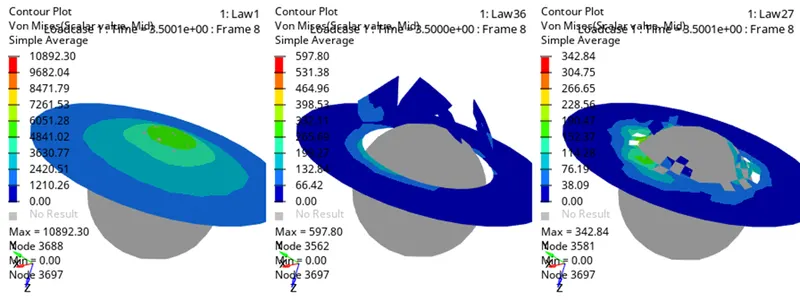
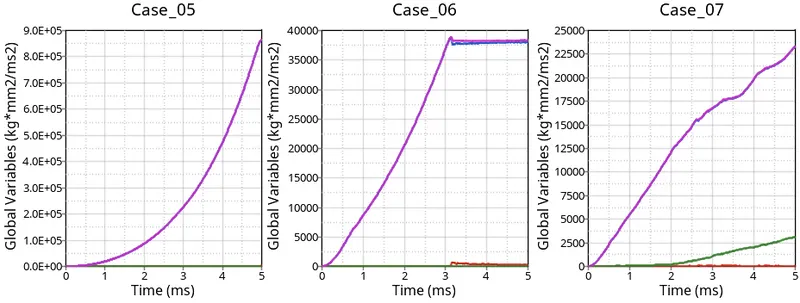
- In Case5 (Law1), Elastic material is used. Elements get stretched but there has been no failure.
- In Case6 (Law 36), a User-defined function is used for the stress-strain curve, based on that data check for maximum strain and elements get fails by considering EPS_p_max percentage, and elements get deleted from the system.
- In Cae 7, ( Law 27) Elastoplastic material with brittle failure is used. This is the same as “Law2” but damage and rupture are defined with epsilon parameters. We can see in the image that a sudden rupture of material happened due to brittle properties.
Graphs:
Conclusion:
- From all the above observations Case6 ( Law36) gives the good elemental behavior and options to use stress-strain function curves from lab data. This makes Law 36 is better option compare to Law2