Assignment 3-2D Element Formulation Challenge

Objective:
- Run the simulation for both the base model (Run1) and the improved shell element properties model (Run2). Compare the results and analyze the difference.
Run Setup for Base Model(Run1): Below elemental properties for the Run1 model are default settings for both “Hat-section” and “Close-out panel” components. And DEF_SHELL is not defined in the model, so default values are considered.
- Ishell = 0
=1 Default, Q4, visco-elastic hourglass modes orthogonal to deformation and rigid modes (Belytschko)
- Ismstr=0
= 2 Default, if /DEF_SHELL is not defined
Full geometric nonlinearities with possible small strain formulation activation in Radioss Engine
- Ish3n = 2 Default, if /DEF_SHELL is not defined
Standard triangle (C0) with modification for large rotation.
- N= 5
- Ithick= 1, Thickness change is taken into account
- Iplas= 1, Iterative projection with three-newton iterations.
- The model has submitted for Run in Radioss solver and then checked for energy error and mass error in the “FIRST_RUN_0001.out” file.
- Energy error is -10.3%, this is an acceptable value.
Run Setup for Run2 Model:
- For the Run2 model below are the elemental properties for both “Hat-section” and “Close-out panel” components.
- Ishell = 24 QEPH shell formulation
- Ismstr= 2
- Ish3n = 2
- N= 5
- Ithick= 1
- Iplas= 1
- The model has submitted for Run in Radioss solver and then checked for energy error and mass error in the “FIRST_RUN_updated_0001.out” file.
- Energy error is -0.1%, this is an acceptable value.
Results:
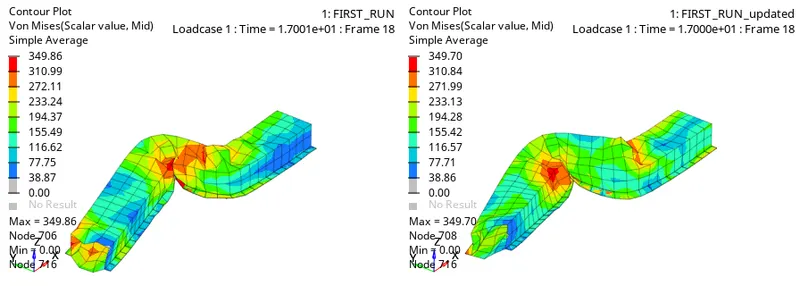
- Stress distribution for both models is observed in the animation file. And it is observed that stress distribution in the Run1 model is not smooth as compared to the Run2 model and a difference in elemental behavior is observed. This is because Ishell properties are different.
- In Run1, Q4 Ishell 2 elements use the viscous method to control hourglass modes, in this method force is applied on nodes to stabilize deformation. But in Run2 QEPH elements uses the stiffness method, in this method hourglass treatment is done at the material level. Stiffness added to materials. So Run2 has effective deformation than the Run1 model.

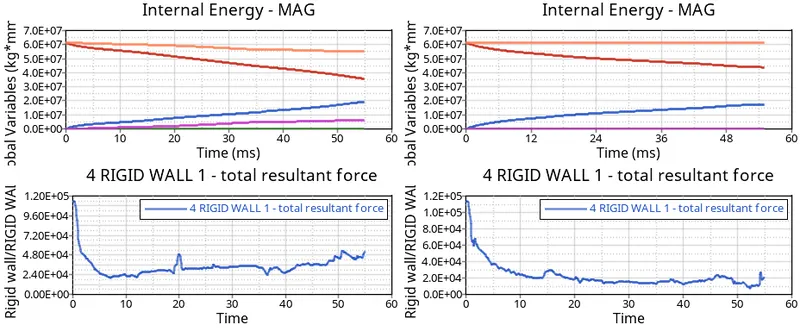
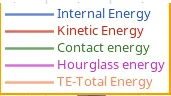
- Hourglass energy is increasing in the Run1 model due to Q4 Ishell element properties. It added external force to nodes to control hourglass modes. This increases the hourglass energy, reduces the total energy.
- In Run2 Hourglass energy is almost zero. Hence the total energy is almost equal to the sum of internal energy and kinetic energy.
- So QEPH Ishell 24, 4 node shell element formulation flag is recommended to control hourglass mode.