Assignment 4-RADIOSS Material Laws Challenge
Objective:
- The objective of the challenge is to perform the simuation in 7 different cases and Compare 7 cases w.r.t the output obtained from the respective data of that particular case as per the given requirement.
1. The Total number of cycles, Energy error, mass error, and simulation time.
2. Notice the animation of all 5 and describe the animations in brief based on whether the elements are being deleted or cracked.
3. Plot energies and notice any difference.
4. Based on all the results, which case would represent the on-field scenario.
5. Prepare a ppt/Docx and list down case by case results and your conclusion as to why the failure happened.
Case 1:
- Download the FAILURE_JOHNSON_0000.
- Import the FAILURE_JOHNSON_0000.rad file.
- Click on Analysis>Radioss>Save File as Law2_epsmax_failure_0000.rad>Options: -nt 4>Radioss.
- As per the output file.
1. The Total number of cycles = 49380
Energy error = 0.8%
Mass error = 0
Simulation time = STARTER+ENGINE RUNTIME = 284.32s (00:04:44).
Case 2:
- Import the Law2_epsmax_failure_0000.rad file.
- Enable and edit the failure plastic strain (EPS_p_max) as shown.
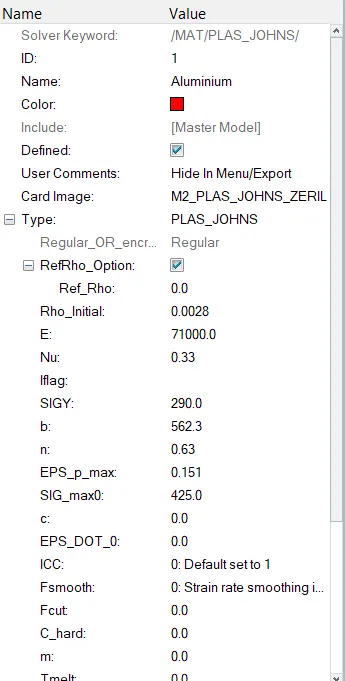
- Changes to be made in /FAIL/JOHNSON card as shown.
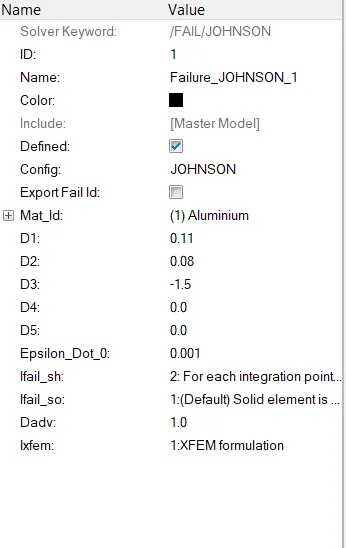
- Properties to be edited as shown.
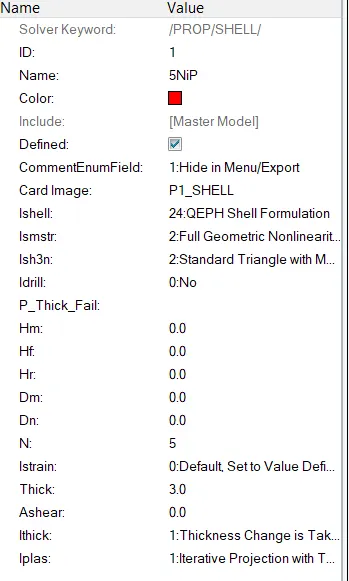
- Click on Analysis>Radioss>Save File as Law2_epsmax_crack_0000.rad>Options: -nt 4>Radioss.
- As per the output file.
1. The Total number of cycles = 49499
Energy error = 0.2%
Mass error = 0
Simulation time = STARTER+ENGINE RUNTIME = 122.46s (00:02:02).
Case 3:
- Import the Law2_epsmax_crack_0000.rad file.
- Delete the /FAIL/JOHNSON card as shown.
- Click on Analysis>Radioss>Save File as Law2_epsmax_nofail_0000.rad>Options: -nt 4>Radioss.
- As per the output file.
1. The Total number of cycles = 49408
Energy error = 0.8%
Mass error = 0
Simulation time = STARTER+ENGINE RUNTIME = 106.49s (00:01:46).
Case 4:
- Import the Law2_epsmax_nofail_0000.rad file.
- Delete the /FAIL/JOHNSON card and EPS_P_max as 0
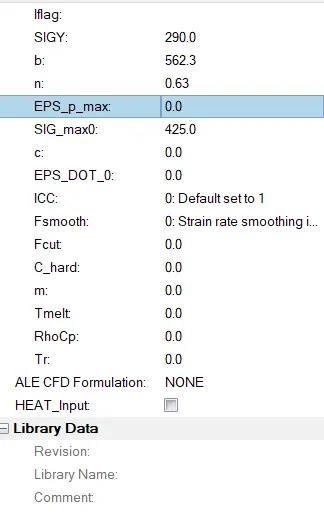
- Click on Analysis>Radioss>Save File as Case 4_0000.rad>Options: -nt 4>Radioss.
- As per the output file.
1. The Total number of cycles = 48737
Energy error = 3.0%
Mass error = 0
Simulation time = STARTER+ENGINE RUNTIME = 106.36s (00:01:46)
Case 5:
- Import the case 4 rad file.
- Change the material card to Law 1 ie.., M1_ELAST, Keep the same value for rho=0.0028, E=71000, and nu=0.33 values.
- Click on Analysis>Radioss>Save File as Case 5_0000.rad>Options: -nt 4>Radioss.
- As per the output file.
1. The Total number of cycles = 47969
Energy error = 1.3%
Mass error = 0
Simulation time = STARTER+ENGINE RUNTIME = 111.22s (00:01:51).
Case 6:
- Import the Law2_epsmax_failure_0000.rad file.
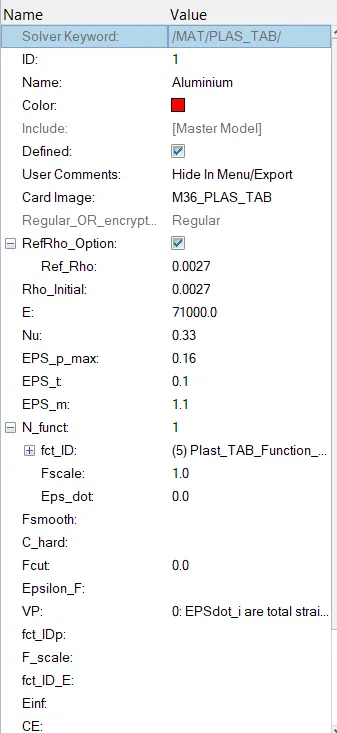
- Change the material card to Law 36 ie.., M36_PLAS_TAB, Keep the same values as shown.
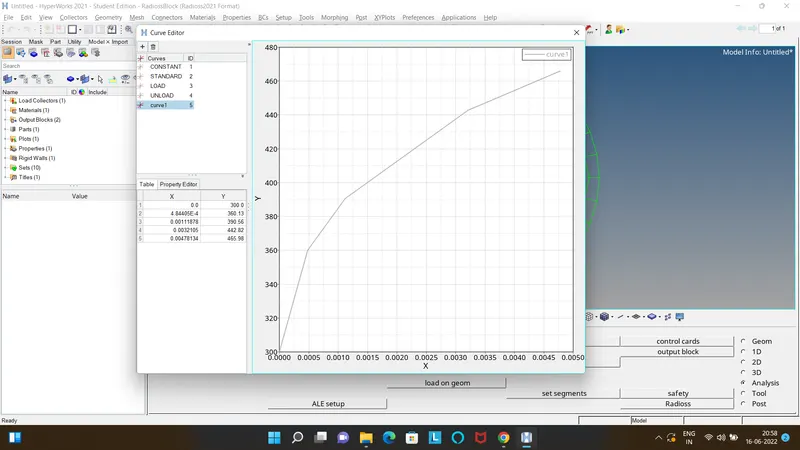
- Create a Curve as per the given values and assign it to the Material @fct_ID.
- Click on Analysis>Radioss>Save File as Case 6_0000.rad>Options: -nt 4>Radioss.
- As per the output file.
1. The Total number of cycles = 52984
Energy error = 1.1%
Mass error = 0
Simulation time = STARTER+ENGINE RUNTIME = 119.86s (00:01:59)
Case 7:
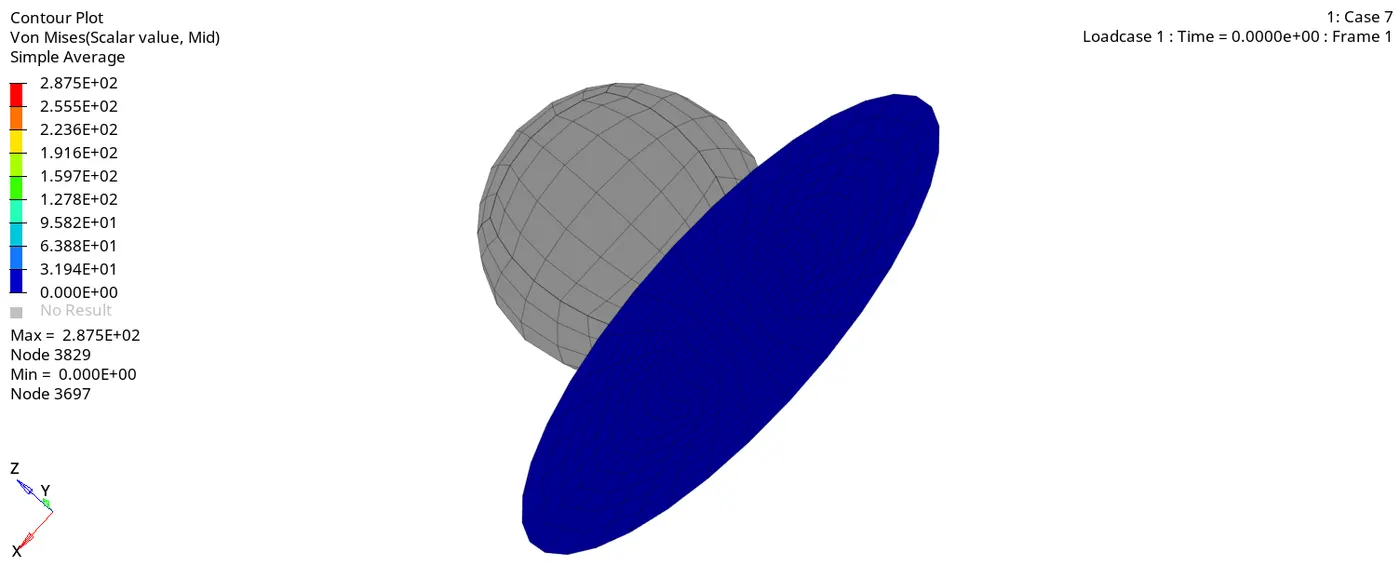
- Import the Law27_0000.rad file.
- Use the properties as shown in the image.
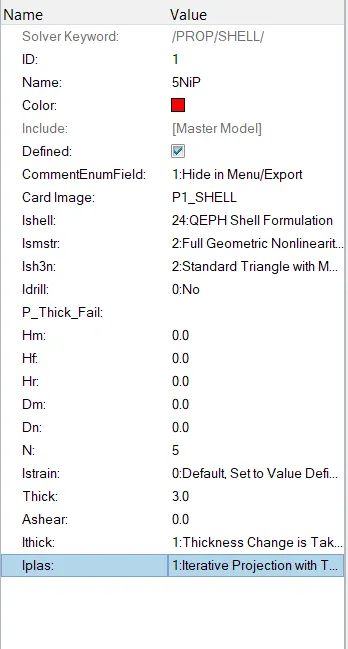
- Click on Analysis>Radioss>Save File as Case 7_0000.rad>Options: -nt 4>Radioss.
- As per the output file.
1. The Total number of cycles = 49508
Energy error = 0.8%
Mass error = 0
Simulation time = STARTER+ENGINE RUNTIME = 114.37s (00:01:54).
Comparision:
(1, 2 & 3)
| Ascending Order of Values According to the output 1 is the Least and 7 is the Highest | 1 | 2 | 3 | 4 | 5 | 6 | 7 |
|
The Total number of cycles: |
47969 | 48737 | 49380 | 49408 | 49499 | 49508 | 52984 |
|
Energy error: |
0.2% |
0.8% |
0.8% | 0.8% | 1.1% | 1.3% | 3.0% |
|
Mass error: |
0 | 0 |
0 |
0 | 0 | 0 | 0 |
|
Simulation time: |
106.36s (00:01:46) | 106.49s (00:01:46) | 111.22s (00:01:51) | 114.37s (00:01:54) | 119.86s (00:01:59) | 122.46s (00:02:02) |
284.32s (00:04:44) |
|
Internal Energy(N-mm) |
27114(case 2) |
27322(case 1) | 27443(case 3) | 29476(case 7) | 64665(case 4) | 103305(case 6) | 862533(case 5) |
| Kinetic Energy(n-mm) |
3.77(case 4) |
125(case 6) | 179(case 1) | 332(case 3) | 395(case 2) | 425(case 7) |
3245(case 5) |
| Contact Energy(N-mm) | 0 | 0 | 0 | 0 | 0 | 0 | 0 |
| Hourglass Energy(N-mm) | 0 | 0 | 0 | 0 | 0 | 0 | 0 |
| Total Energy(N-mm) |
27196(case 2) |
27375(case 1) |
27528(case 3) |
29581(case 7) | 64668(case 4) | 103318(case 6) |
865645(case 5) |
Casewise Elemental Behaviour:
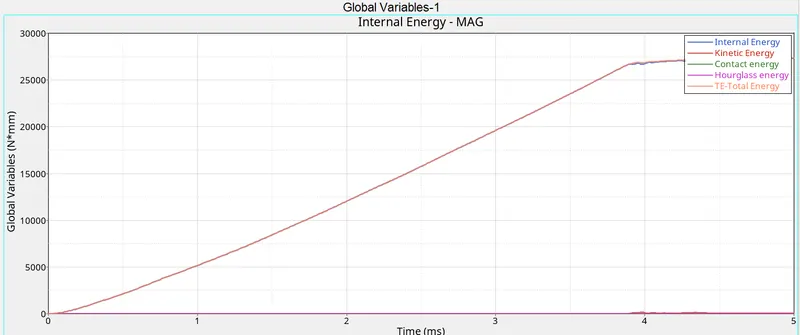
Case 1: Elements are observed to be deleted and separated but no cracking observed and the energy plots are in such a way that their is a progress in the energies are as follows:
Internal Energy: Overally the magnitude of the energy is increasing w.r.t the time but from 3.8 ms to 5 ms the slope of the curve is unstable.
Kinetic Energy: The magnitude of the energy is slowly increasing w.r.t the time but from 3.8 ms to 5 ms the curve is unstable.
Contact Energy: Zero throught the time.
Hourglass Energy: Zero throught the time.
Total Energy: Overally the magnitude of the energy is increasing till the coordinate of 391th point ie..., till 3.910081148147583 ms but from that point till the end of 5 ms the slope of the curve is behaving unstable.
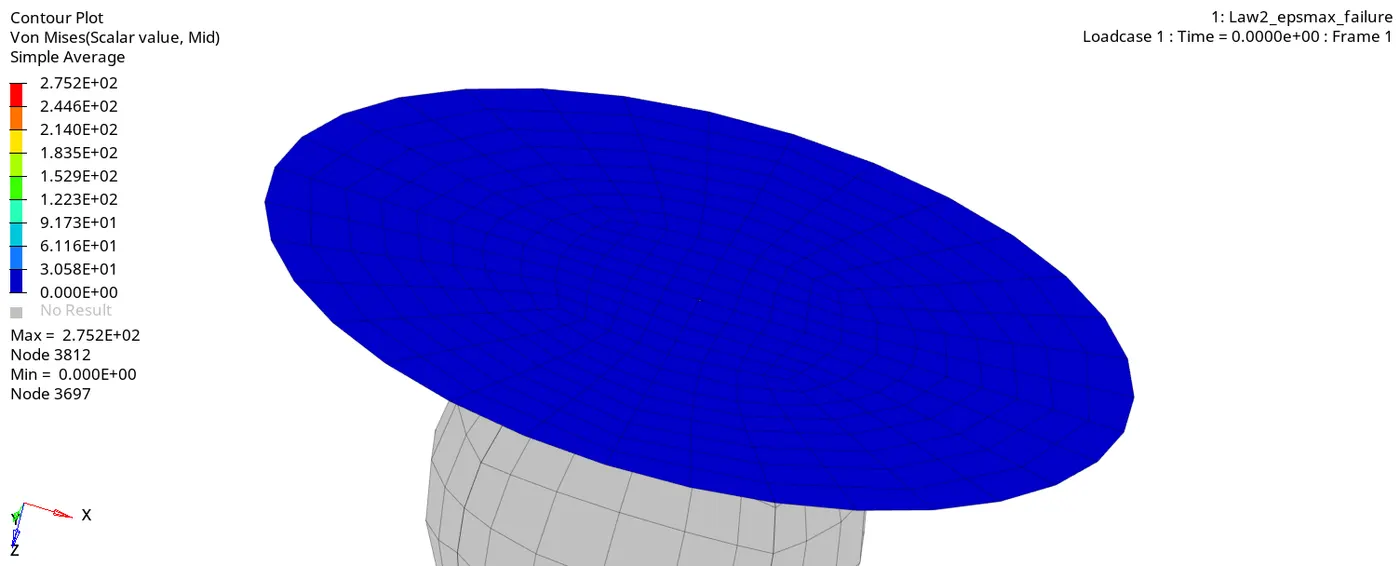
Case 2: Elements are observed to be deleted and separated but no cracking observed and the energy plots are in such a way that their is a progress in the energies are as follows:
Internal Energy: From 0 to 389 point the magnitude of the energy is increasing but from 389th point ie.., 3.890028476715088 ms their is an unstability observed in the slope of the curve.
Kinetic Energy:Overally the magnitude of the energy is increasing but their is an instability of the curve from the start point till the end.
Contact Energy: It is zero through out the time.
Hourglass Energy: It is zero through out the time.
Total Energy: Overally the magnitude of the energy but their is an instability from point 395 ie.., 3.950031042098999 ms till the 5th ms.
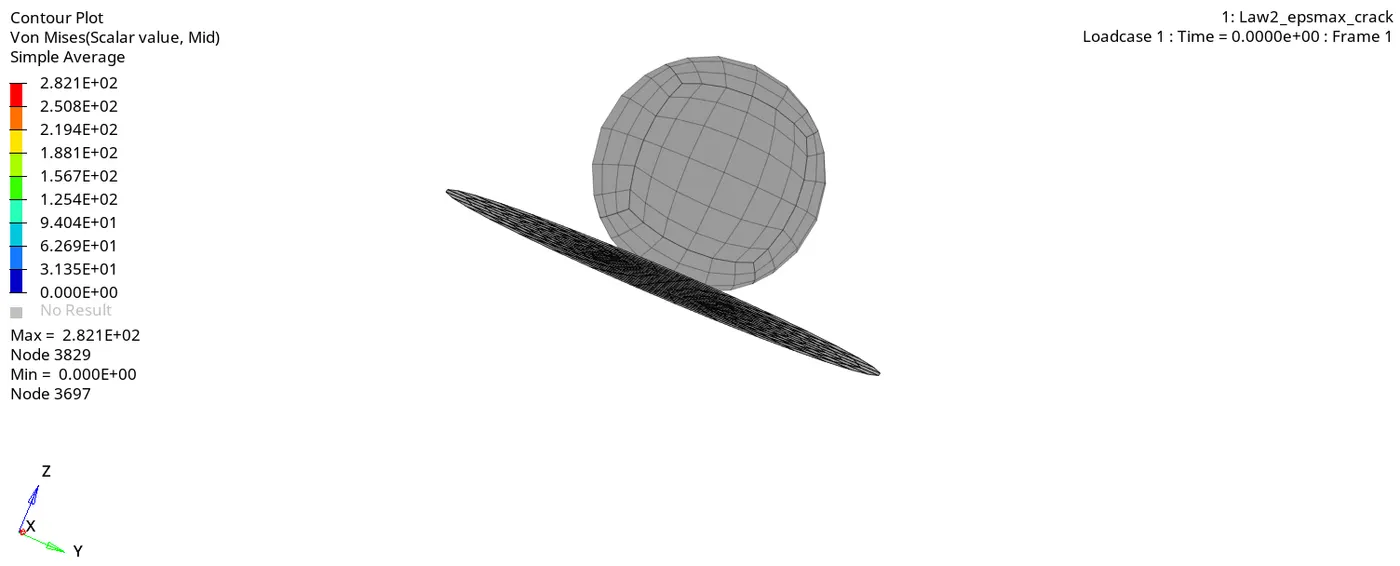
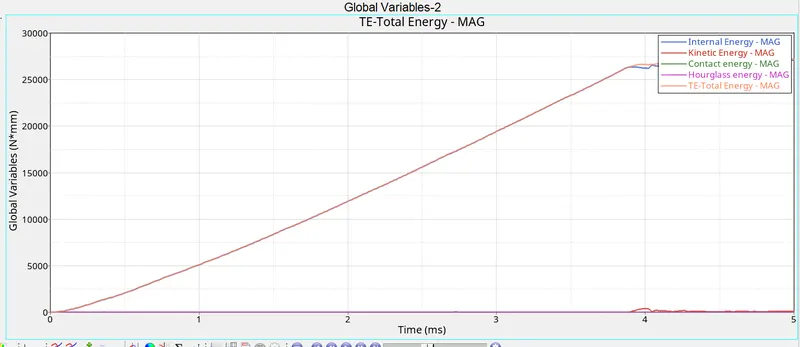
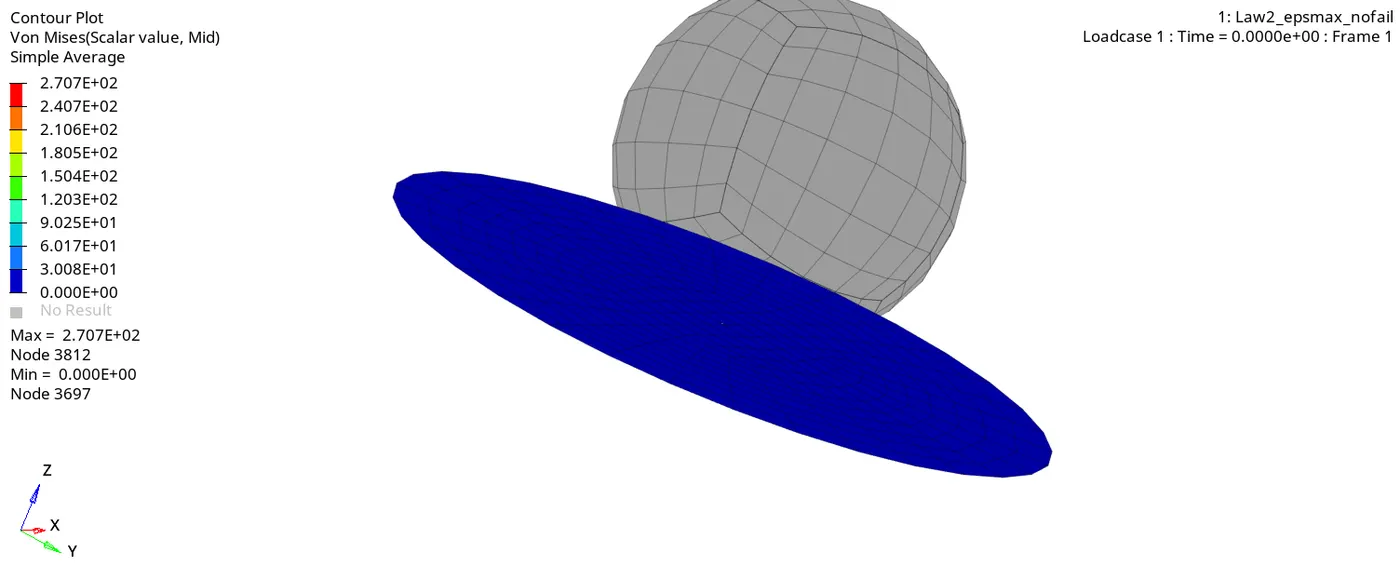
Case 3: Elements are observed to be deleted and separated but no cracking observed and the energy plots are in such a way that their is a progress in the energies are as follows:
Internal Energy: From 0 to 394th point the magnitude of the energy is increasing but from 394 point ie.., 3.9400646686553955 ms their is an unstability observed in the slope of the curve.
Kinetic Energy: Overally the magnitude of the energy is increasing but their is an instability of the curve from the start point till the end..
Contact Energy: It is zero through out the time.
Hourglass Energy: It is zero through out the time.
Total Energy: Overally the Magnitude of the energy is increasing but their is an instability from point 395 ie.., 395 3.9500601291656494 ms till the 5th ms in the slope of the curve.
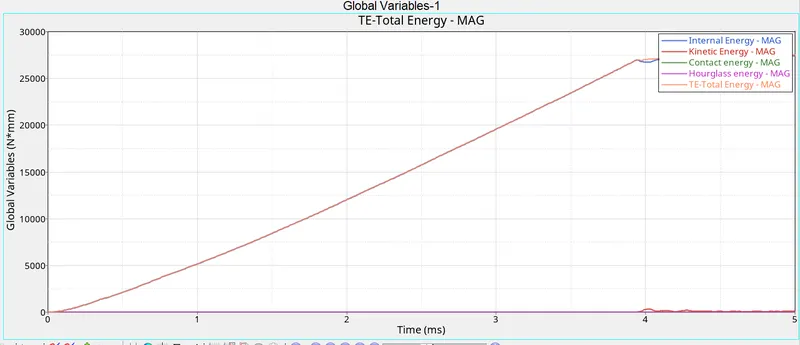
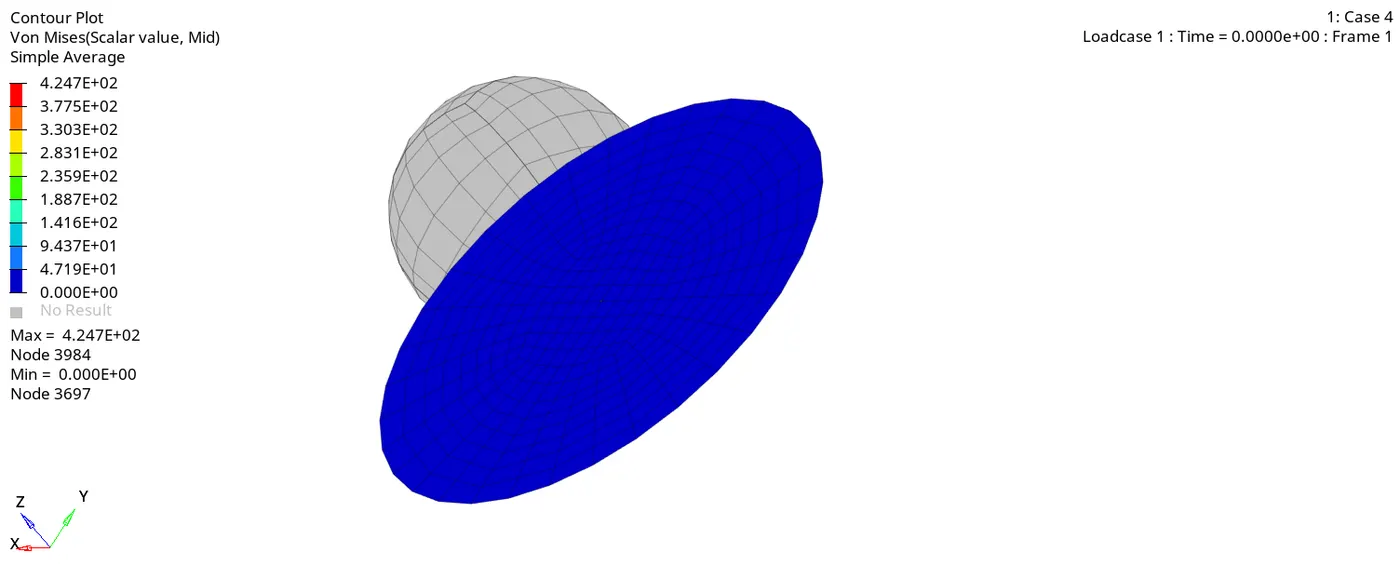
Case 4: No elements are breaking or failing and the energy plots are in such a way that their is a progress in the energies are as follows:
Internal Energy: The magnitude as well as the slope of the curve is increasing throught the time.
Kinetic Energy: Very less magnitude and instability in the slope of the curve observed.
Contact Energy: It is zero through out the time.
Hourglass Energy: It is zero through out the time.
Total Energy: The magnitude as well as the slope of the curve is increasing throught the time.
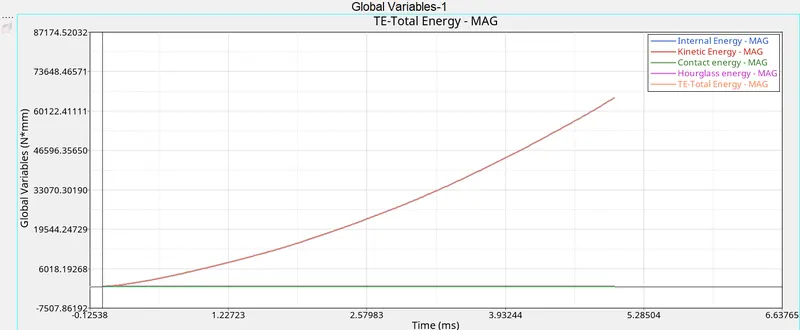
Case 5: No elements are breaking or failing and the energy plots are in such a way that their is a progress in the energies are as follows:
Internal Energy: The magnitude as well as the slope of the curve is increasing throught the time but in very near end ie.., approximately from the coordinate point of 494th the slope is decreased gradually.
Kinetic Energy: Very less magnitude and instability in the slope of the curve is observed but from 490th point the the magnitude of the energy is increased gradually.
Contact Energy: It is zero through out the time.
Hourglass Energy: It is zero through out the time.
Total Energy: The magnitude as well as the slope of the curve is increasing throught the time but in very near end ie.., approximately from the coordinate point of 494th the slope is decreased gradually.
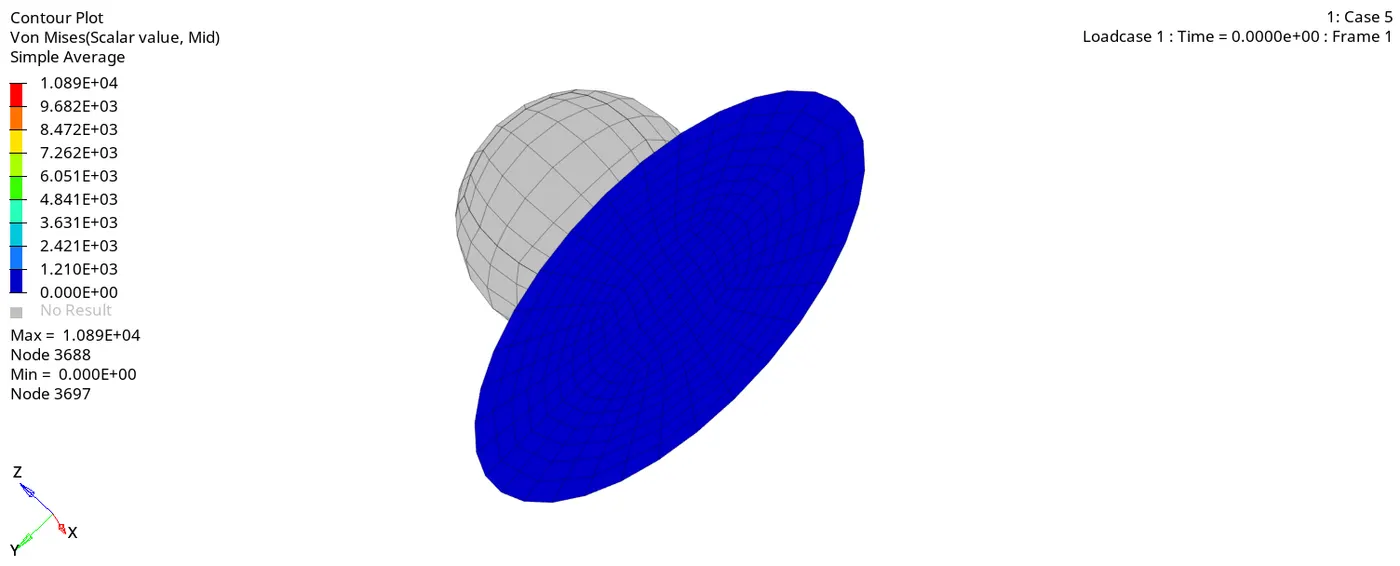
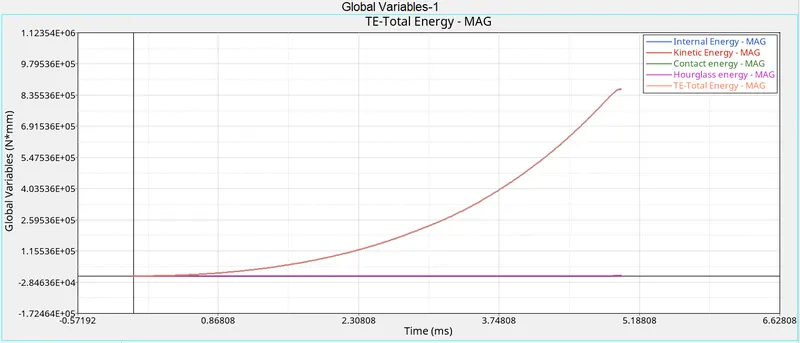
Case 6: Elements are observed to be deleted and separated but no cracking observed and the energy plots are in such a way that the deformation and deletion is observed in 0 to 60ms but but from their is a progress in the energies as follows:
Internal Energy: The magnitude as well as the slope of the curve is increasing throught the time.
Kinetic Energy: Very less magnitude and instability in the slope of the curve is observed through out the time.
Contact Energy: It is zero through out the time.
Hourglass Energy: It is zero through out the time.
Total Energy: The magnitude as well as the slope of the curve is increasing throught the time.
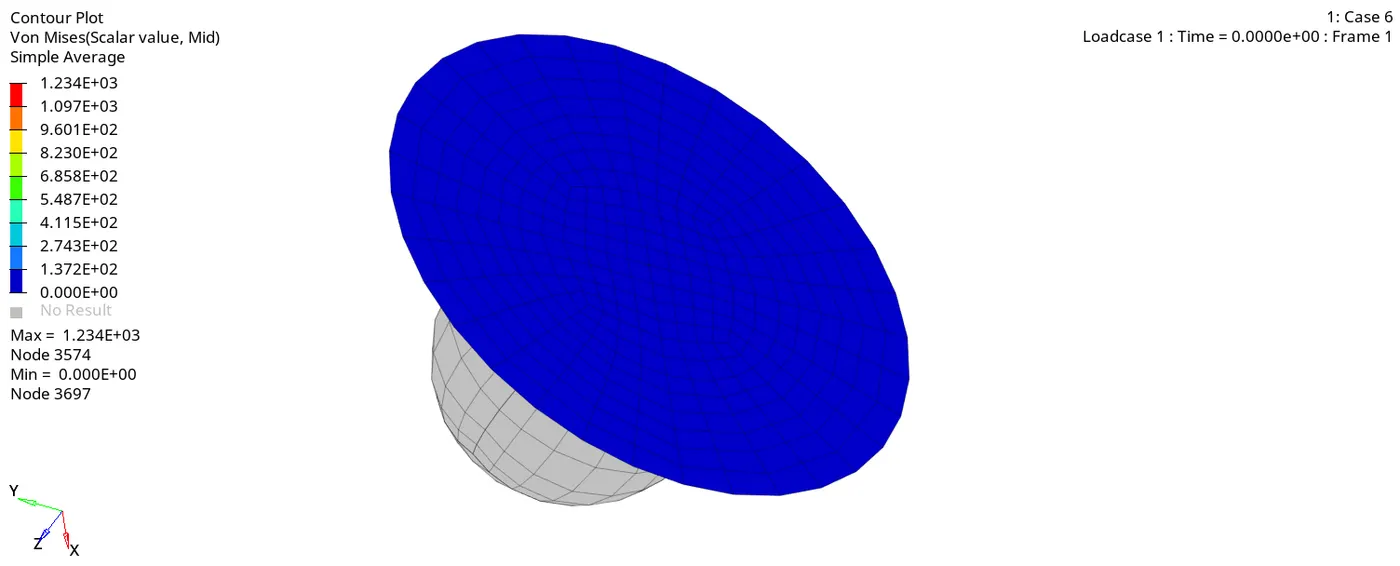
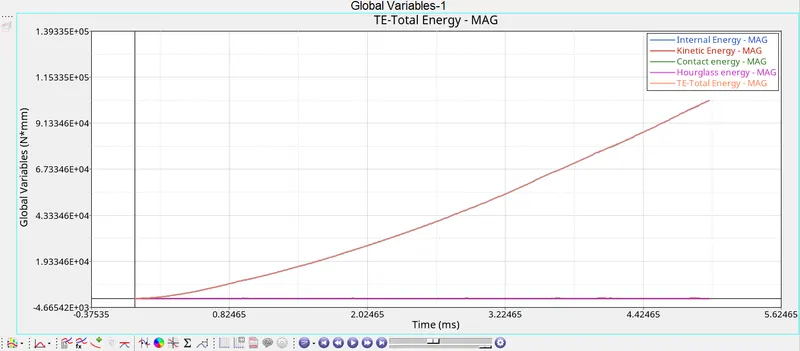
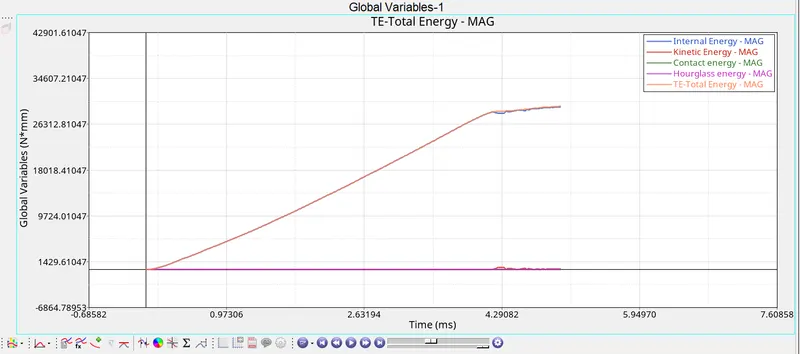
Case 7: Elements are observed to be deleted and separated but no cracking observed and the energy plots are in such a way that the deformation and deletion is observed in 0 to 60ms but but from their is a progress in the energies as follows:
Internal Energy: From 0 to 418th point the magnitude of the energy is increasing but from 418th point ie.., 418 4.180019855499268 ms their is an unstability observed in the slope of the curve.
Kinetic Energy: Very less magnitude and instability in the slope of the curve is observed through out the time.
Contact Energy: It is zero through out the time.
Hourglass Energy: It is zero through out the time.
Total Energy: The magnitude as well as the slope of the curve is increasing throught the time but in very near end ie.., approximately from the coordinate point of 417th the slope is decreased gradually.