Analysis of crash tube with different material types.
AIM:-
To set up, run and simulate 7 cases and compare them to give the proper conclusion.
SOFTWARE:-
HYPERWORKS
PROCEDURE:-
Firstly, open the hypermesh and set the user profile to RADIOSS.
CASE 1
Import the .rad starter file to the graphical by using solverdeck.
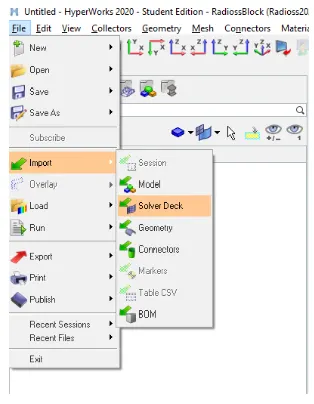
After importing the model goto > analysis > radioss.
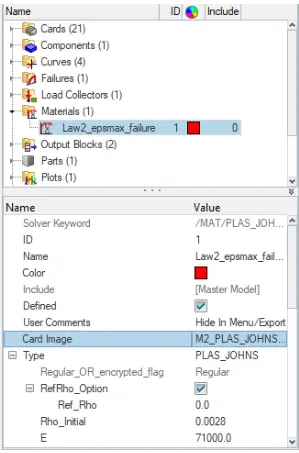
The model material card has M2_PLAS JOHNS which is also known as Johnson cook material card. It comes under isotropic elasticity material category.
Select the input directory to save it in case 1 folder.
Enter the option value as “-nt 4” and radioss.

After the file simulation is runned. It generates files like .h3d,T01, starter file and engine file etc.
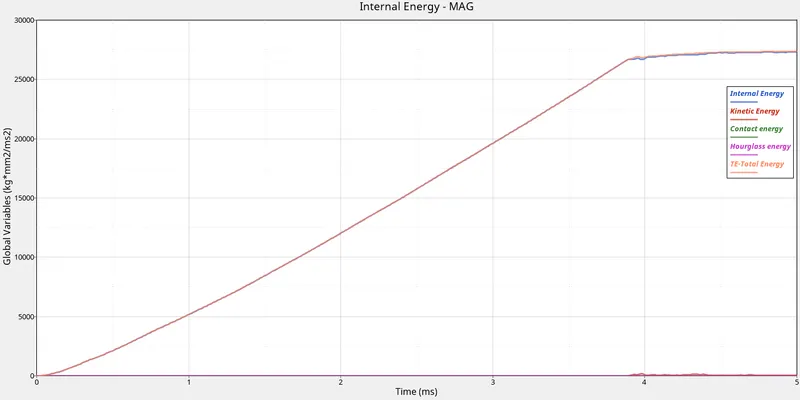
Now open the .T01 file in hypergraph to plot internal energy, total energy, hourglass energy and contact energy to compare with other cases.
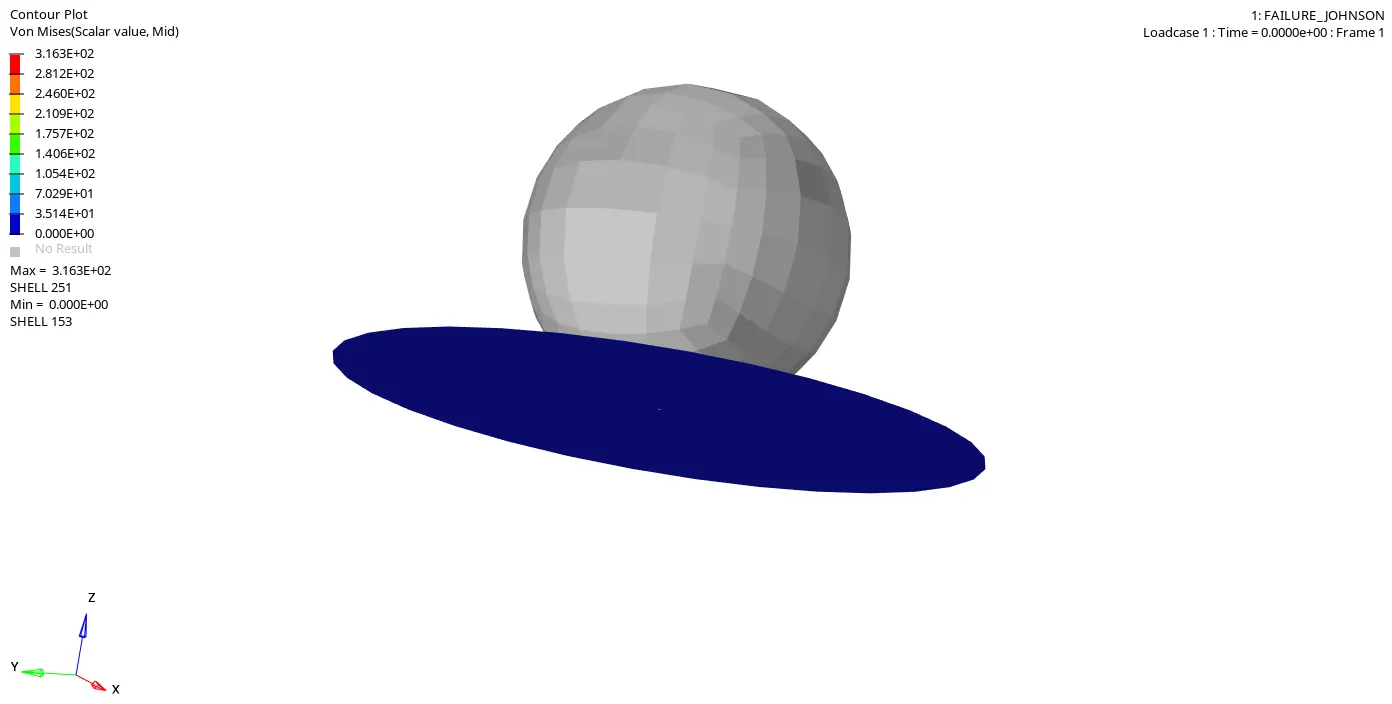
Open the simulation by using the .h3d file in hyperview to see the animation.
CASE 2
In this case we need the same case 1 starter file and edit it.
Change the name of the material card to law2_EPSmax_Crack.
Edit the failure card values Ifail_sh=1, Dadv=1 & Ixfem=1.
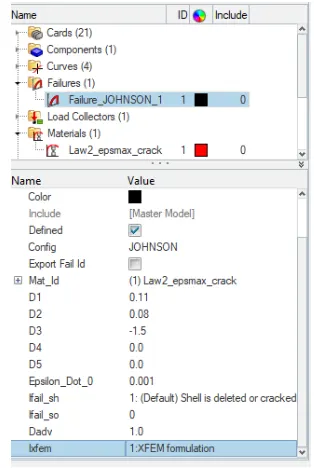
Ifail_sh is the shell failure flag.
Dadv is the criterion for the crack advancement.
Ixfem is used to represent cracks over an element or layer and it will give realistic behaviour to the model.
After editing the failure card, save the file to case 2 folder and run the simulation.
Then, open the .T01 file in hypergraph to plot internal energy, total energy, hourglass energy and contact energy.
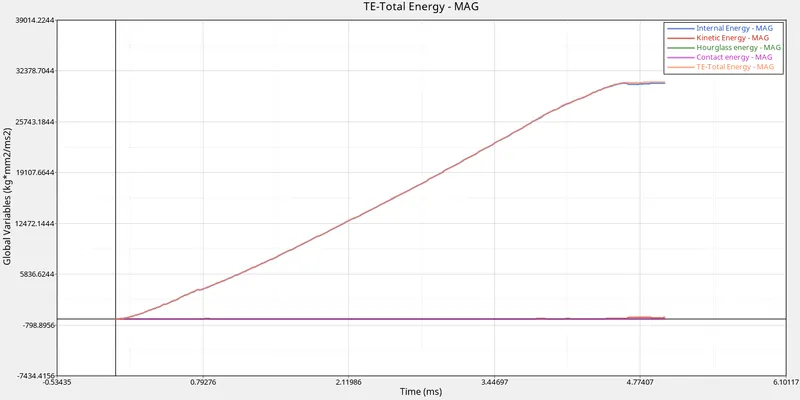
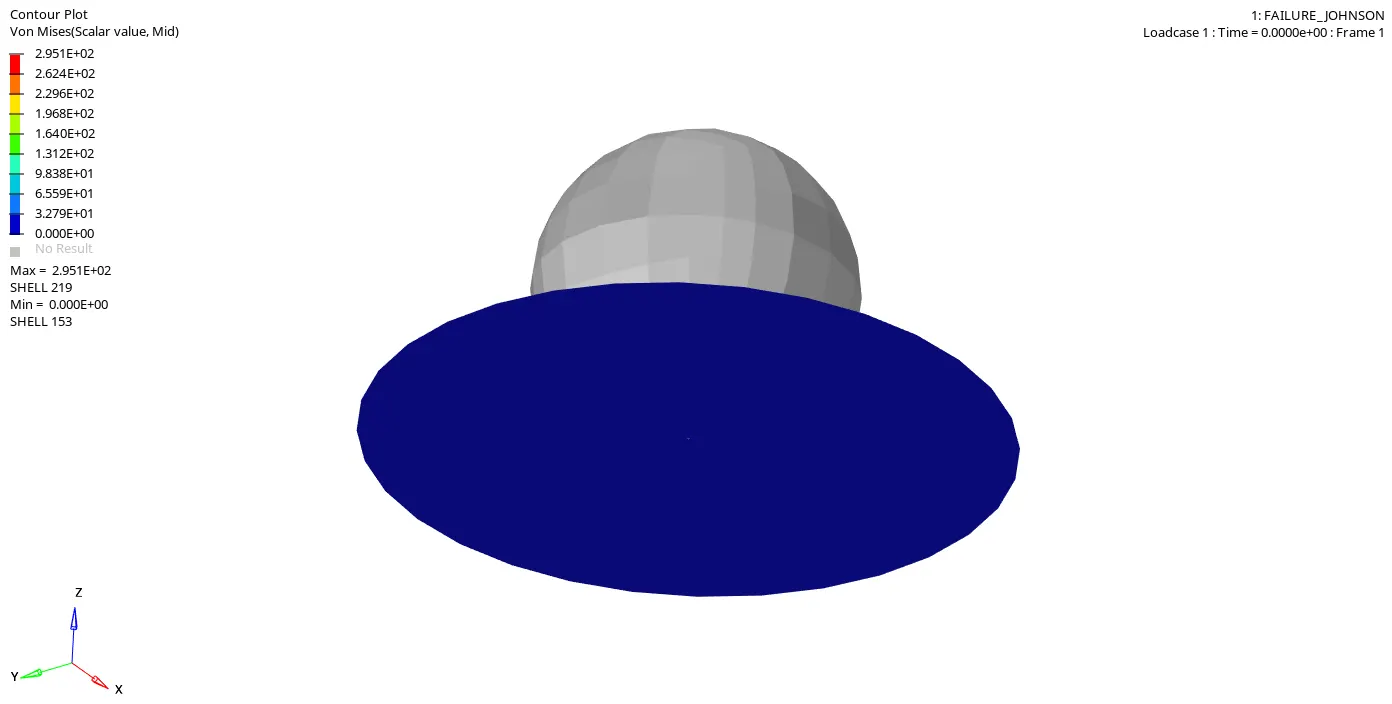
Open the simulation by using the .h3d file in hyperview to see the animation.
CASE 3
In this case we need the same case 2 starter file.
In this case delete the failure card.
And rename the material card as law2_EPSmax_nofail.
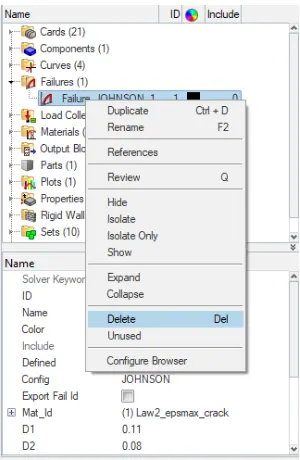
Save the file to case 3 folder and run the simulation.
Similarly, open the .T01 file in hypergraph to plot internal energy, total energy, hourglass energy and contact energy.
Open the simulation by using the .h3d file in hyperview to see the animation.
CASE 4
In this case we need the case 3 file .
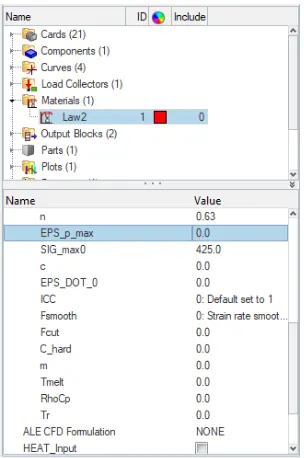
Just remove the value of “EPSmax” in the material card and rename it as “law2”.
Save as Case 4 and run the simulation.
Similarly, open the .T01 file in hypergraph to plot internal energy, total energy, hourglass energy and contact energy.
Open the simulation by using the .h3d file in hyperview to see the animation.
CASE 5
In this case we are using case 4 starter file.
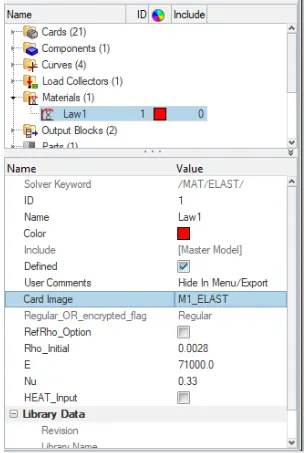
In this change the material card to law 1 /M1_ELAST with the same values of density, modulus and poisson's ratio.
𝜌=0.0028
E=71000
nu=0.33
Save as case 5 and run the simulation.
Similarly, open the .T01 file in hypergraph to plot internal energy, total energy, hourglass energy and contact energy.
Open the simulation by using the .h3d file in hyperview to see the animation.
CASE 6
In case 6, import the law 27.rad file.
The material card is assign with Law 27 /M27_PLAS_BRIT
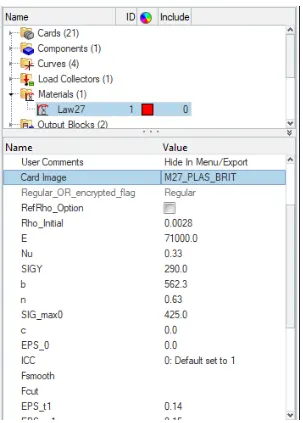
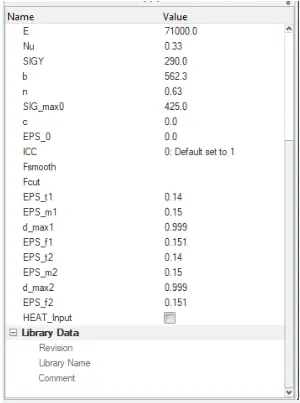
M27_PLAS_BRIT is a law that combines an isotropic elasto-plastic Johnson-Cook material model with an orthotropic brittle failure model.
Failure and damage occur only in tension.
This law is applicable only for shells.
After changing the shell property to recommended shell properties, save as case 6 and run the simulation.
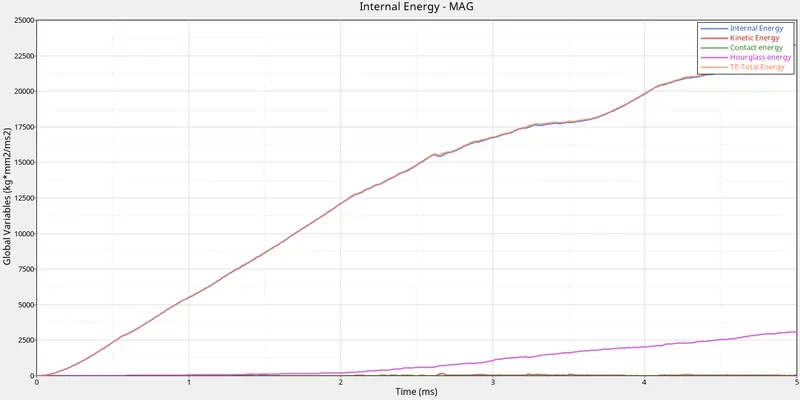
Similarly, open the .T01 file in hypergraph to plot internal energy, total energy, hourglass energy and contact energy.
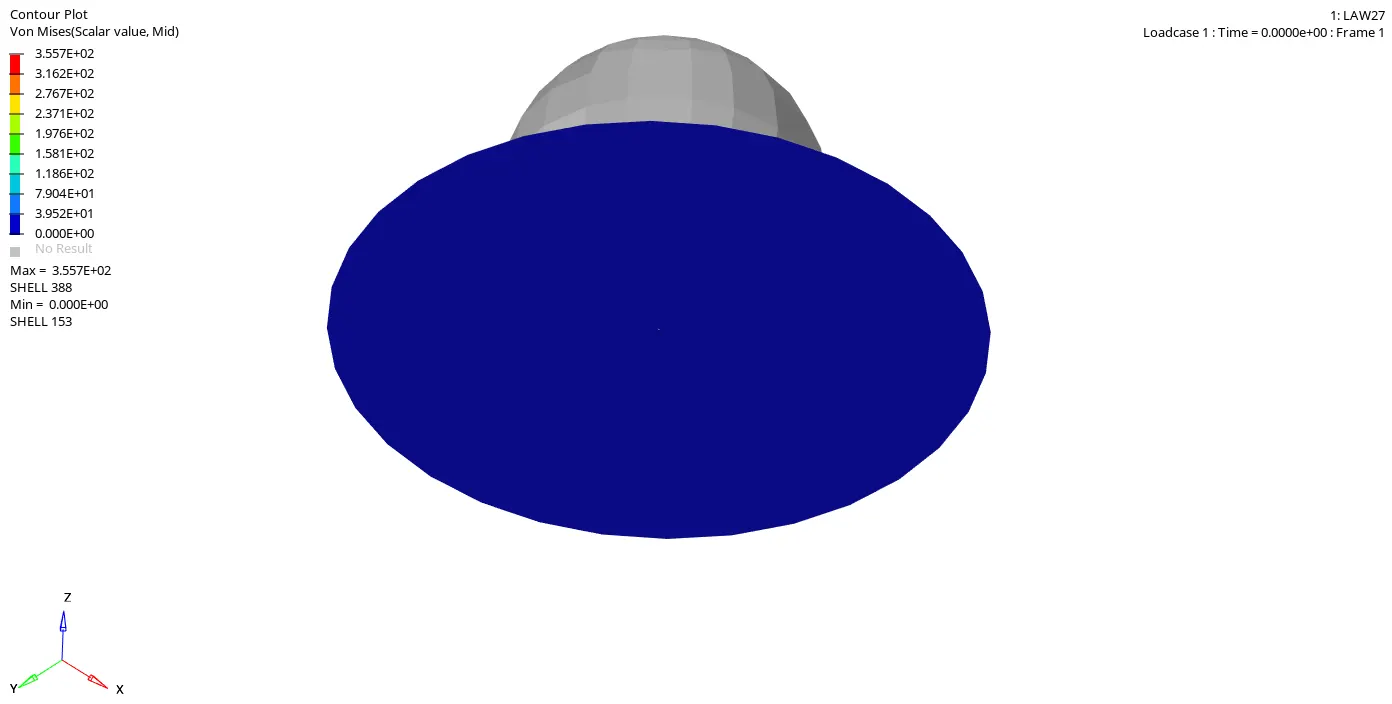
Open the simulation by using the .h3d file in hyperview to see the animation.
CASE 7
In this case we need case 5 starter file.
The material card law 36/ M36_PLAS_TAB is used.
Some of the values are given which needs to be edited in the material card.
Density=0.0028
Young’s Modulus=71000
Poisson's ratio=0.33
EPS_p_max=0.16
EPS_t=1
EPS_m=1.1
N_funct=1
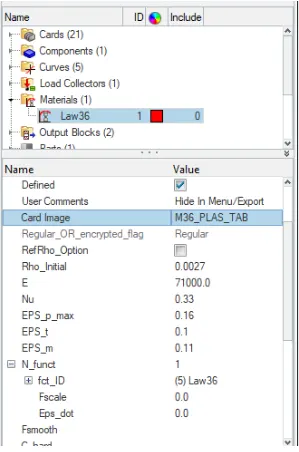
As we enter the value of N_funct it says to select the user defined function by curve.
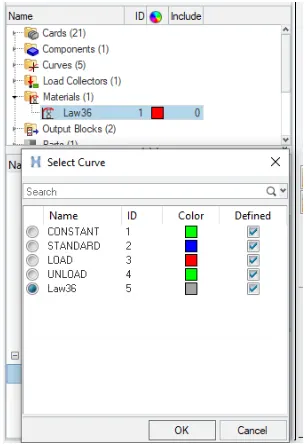
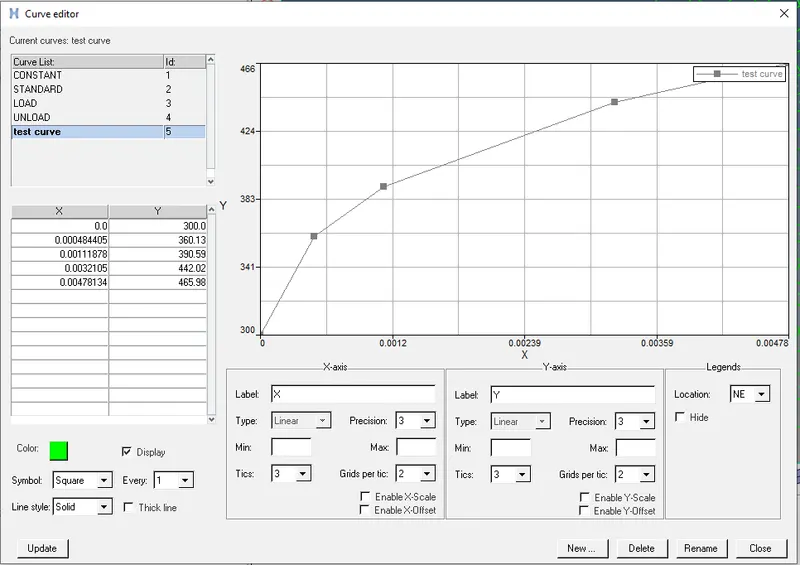
As per the given coordinations create a curve and edit it to the material card.
Save the model as case 7 and run the simulation.
Similarly, open the .T01 file in hypergraph to plot internal energy, total energy, hourglass energy and contact energy.
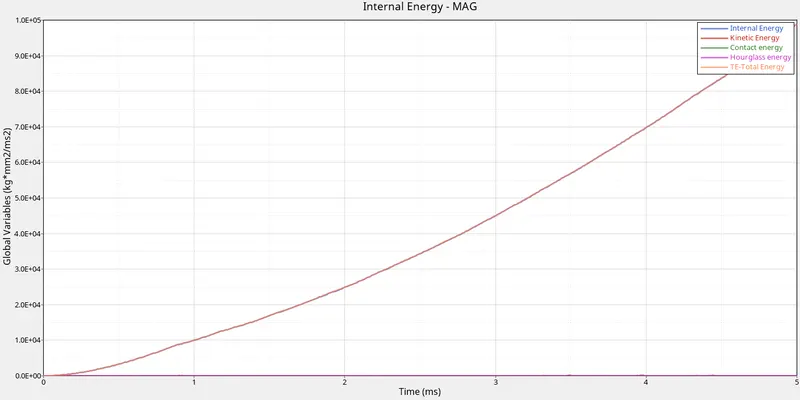
Open the simulation by using the .h3d file in hyperview to see the animation.
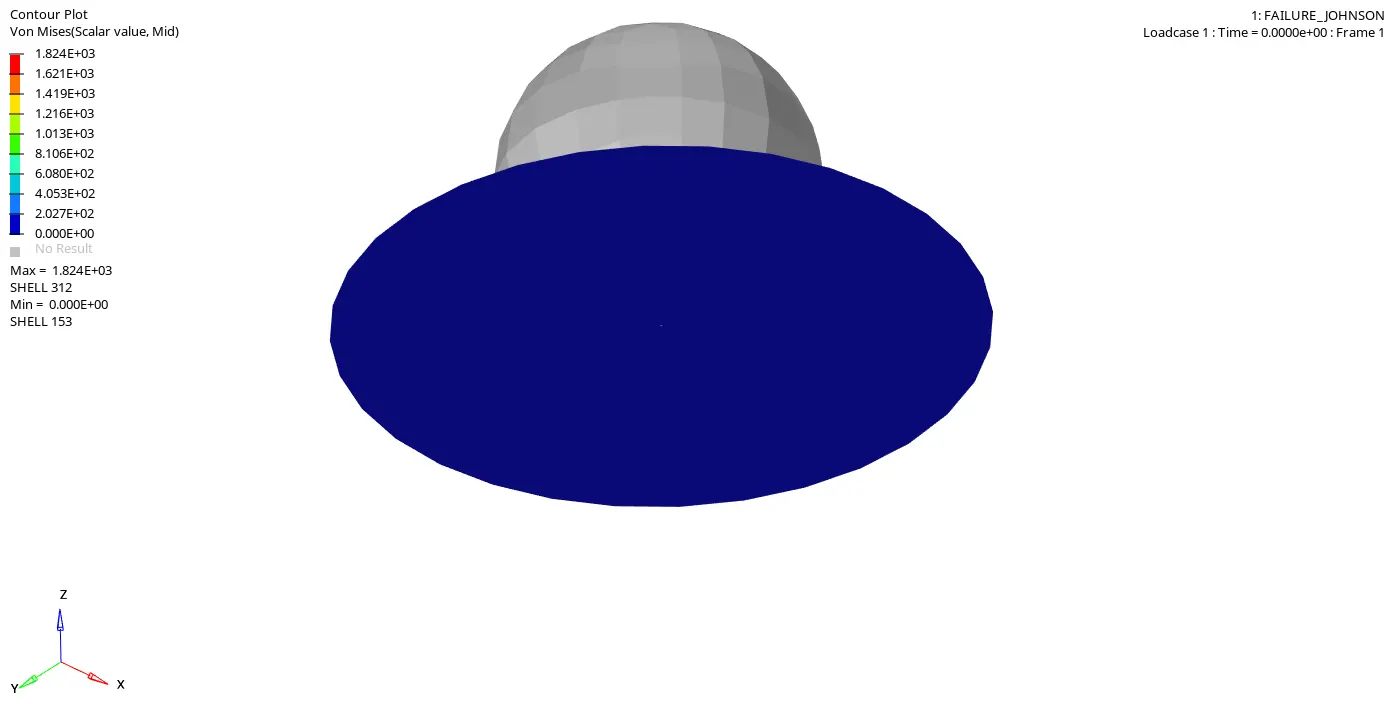
Comparison of case 1 & case 2:-
As we are comparing the first and second which is generated form same file but by difference in the failure card values which result in breaking and deletion of elements as the values of Ixfem given in cases.
Ixfem:- It is define the element to fail as either by directly breaking(i.e case 1) and deleting or cracking under loaded condition (i.e case 2) by keeping the value 0 or 1.
Case 1
When the ball is been falling on the rupture plate due to high internal force and no crack advancement (i.e Ixfem=0) result in direct breaking of elements and deletion of them
Case 2
When the ball is been falling on the rupture plate with high internal force it is slowly getting cracked and generating a proper hole as it has crack advancement (ie Ixfem=1).
Comparison of case 3 & case 4:-
As we are comparing case 3 and 4 which is generate from the same starter file but with no failurecard and no EPS_p_max value.
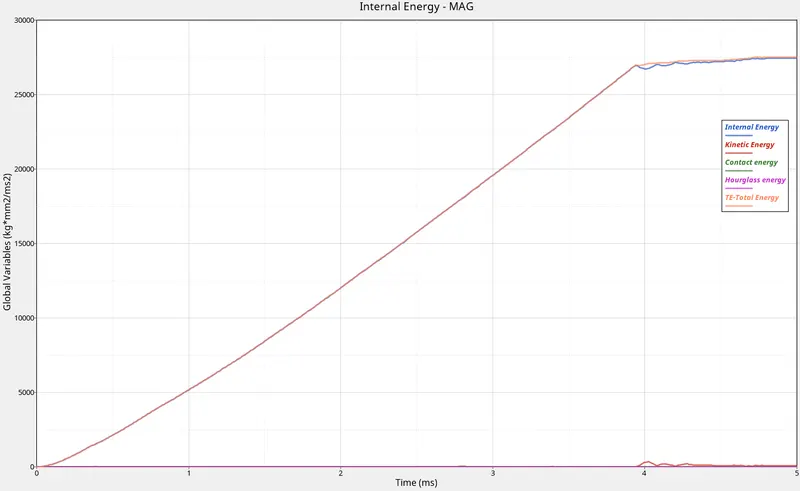
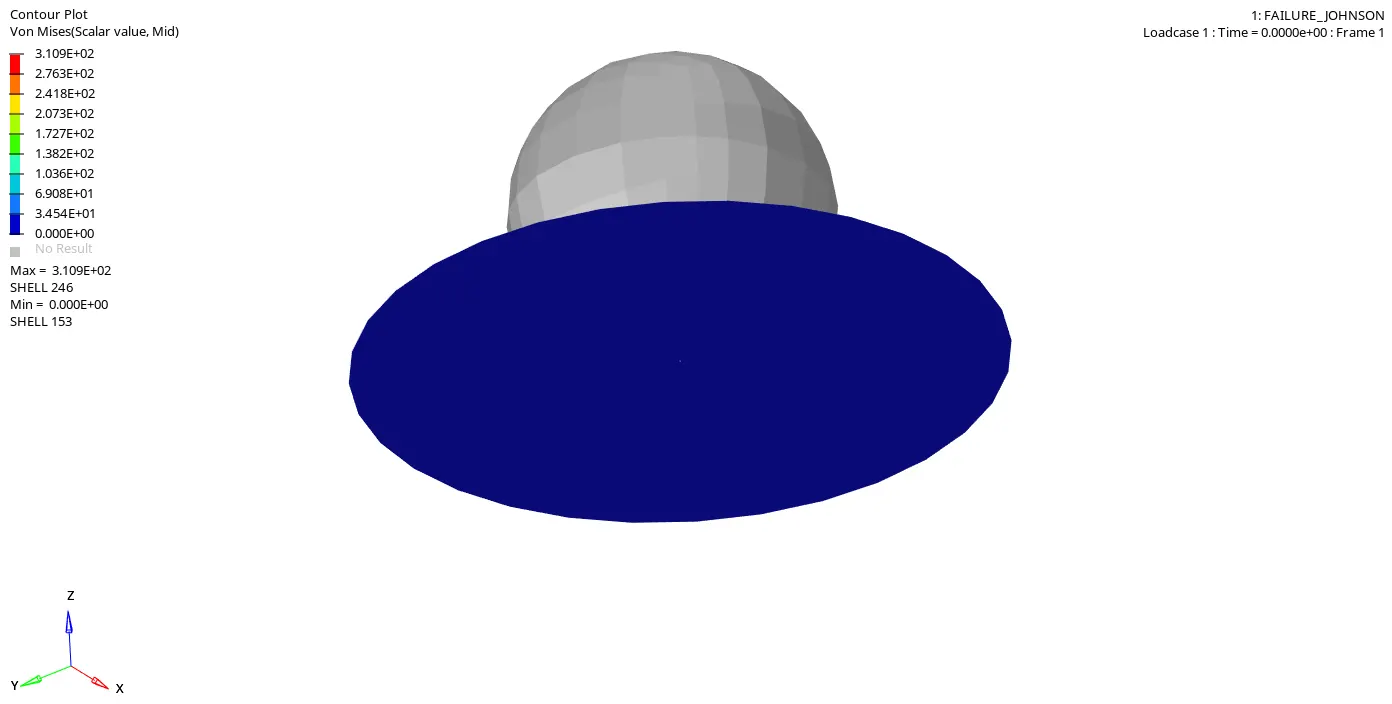
In case 3 hole has been created in unproper manner because of deletion of failure card.
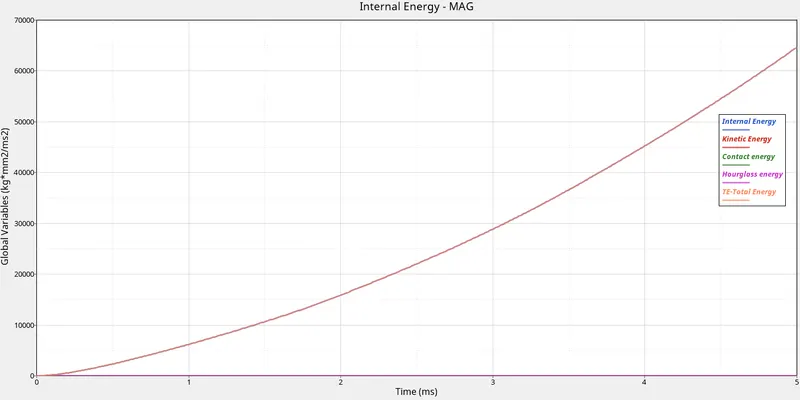
In case 4 the elements reaches it maximum elasticity because the value of EPS_p_max has been kept zero.
When the EPS_p_max is kept zero the element by default results in infinite strain.
As in the case 3 the EPS_p_max value was 0.15 which means the elasticity of the material has been 15% after that the element failure has been seen.
In case 4 the element has not been cracked but the stress on the elements has been increased.
The internal energy starts flucting when the elements starts breaking in case 3.
The internal energy kept constantly increasing due to no EPS_p_max value in case 4.
Comparison of case 5 & case 6:-
As we are comparing the case 5 & 6 which has been generated from the same file but with different material cards values.
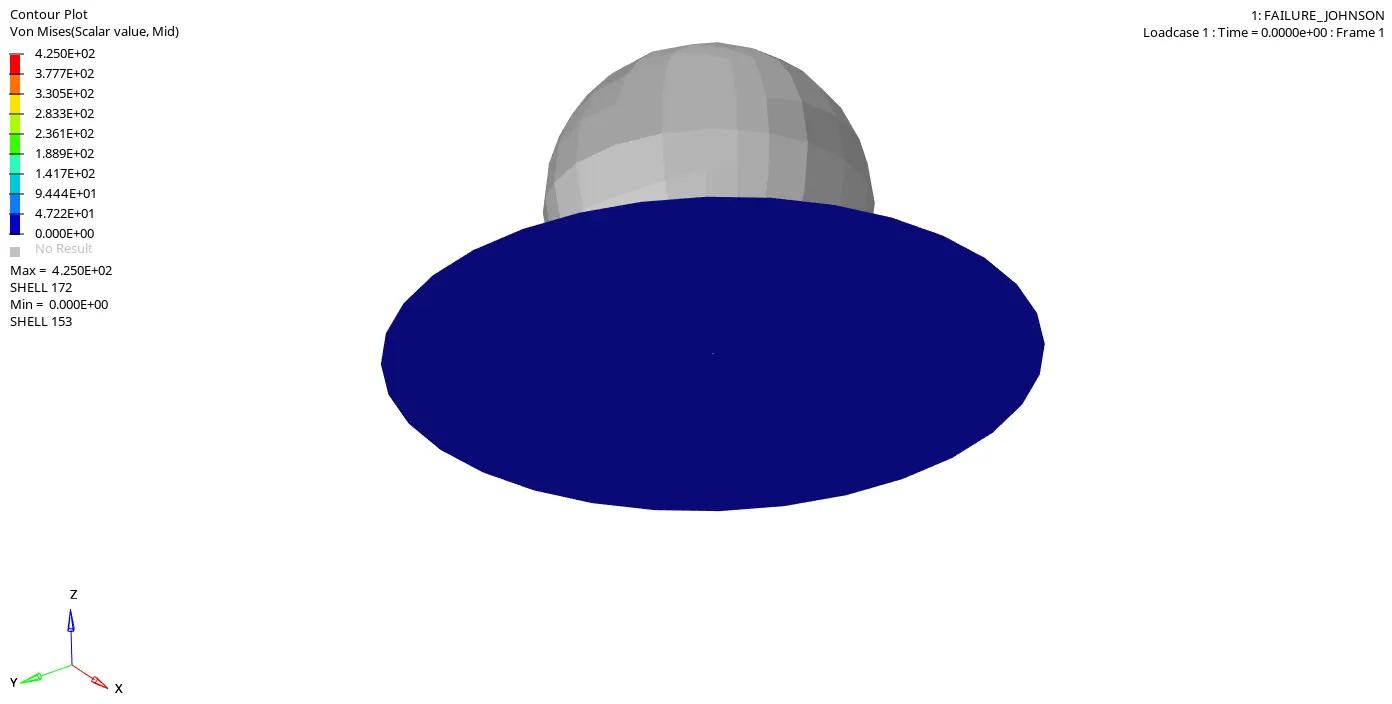
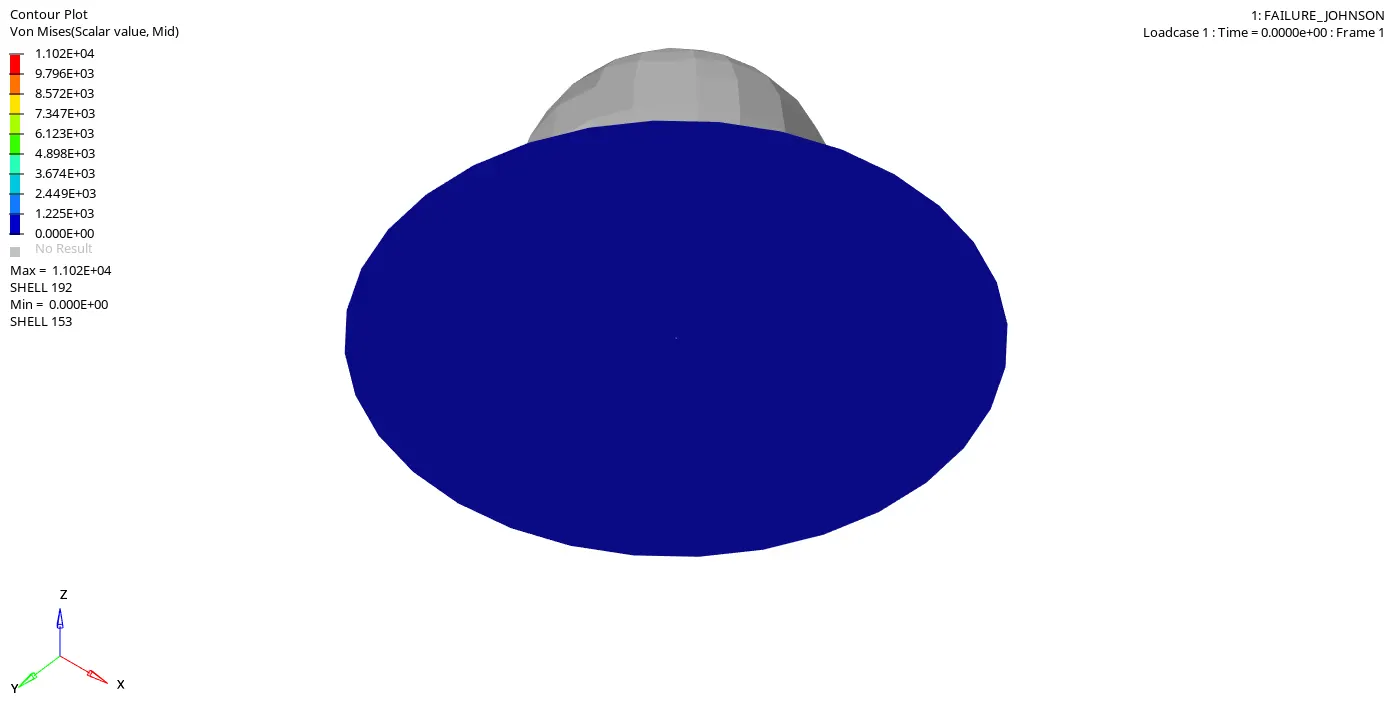
In case 5 the elements are been acting as elastic material due to adding the material card as law 2 / M2_ELAST.
law 2 / M2_ELAST is an Isotropic, linear elastic material using Hooke's law which is applicable only on Metals and elastic materials for small deformation.
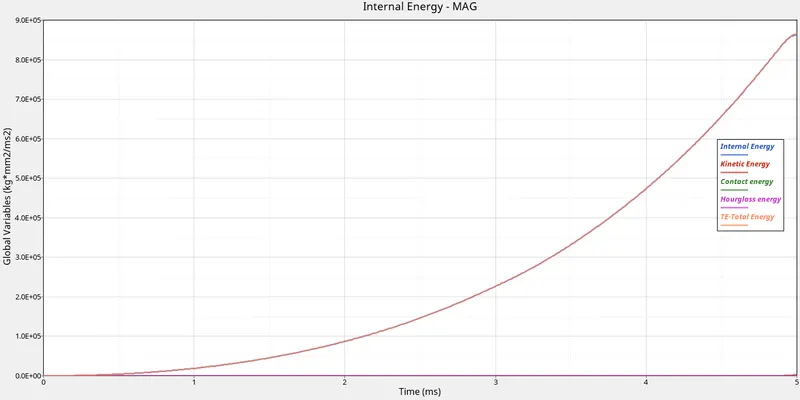
As it is an eleastic material it will absorb the energy as well as relase the energy and comes back to initial stage.
In case 6 the ball when hitting the elements creating a proper hole because the material is assign as Law 27 / M27_PLAS_BRIT due to its brittleness property.
Law 27 / M27_PLAS_BRIT is an Elasto-plastic material such as Brittle Metal and Glass which can be applicable for Hard steel, Dualphase steel, DP800, DP1000, casting, aluminum, magnesium, poly carbonate, and glass.
The maximum von mises reaches with some internal energy but the strain on the elements is constantly increasing in case 5.
The elements getting deleted by creating a proper hole as the stress on the element is very less in case 6 as compared with case 5.
Comparison of case 7 & case 5:-
As we are comparing the case 7 & 5 which has been generated from the same file but with different material cards values.
In case 7 model has been cracking properly due to material card assign as Law 36 / M36_PLAS_TAB which has elastic plastic property.
Law 36 / M36_PLAS_TAB is an Elasto-plastic materials, tabulated piecewise linear which is applicable on metals and other Elasto-plastic material. It can be used for all types of elememts because it is easier to manage failures.
In case 5 the elements are been acting as elastic material due to adding the material card as law 2 / M2_ELAST.
law 2 / M2_ELAST is an Isotropic, linear elastic material using Hooke's law which is applicable only on Metals and elastic materials for small deformation.
As it is an eleastic material it will absorb the energy as well as relase the energy and comes back to initial stage.
After maximum plasticity the elements gets rupture and create a hole. The stress in this model has been less than in case 5.
The maximum von mises reaches with some internal energy but the strain on the elements is constantly increasing in case 5.
From all the above cases we see that the Law 36/MAT/M36_PLAS_TAB material has a good results as it can be used for all materials.
Therefore this material is used for industrial standards.
From case 1 to case 5 we used same material card Law 2/MAT/M2_JOHNS_PLAS_ZERIL material which includes temperature with strain rates.
In case 6 Law 27/ M27_PLAS_BRIT material is used which has brittle property.
In case 7 Law 36/ M36_PLAS_TAB material is used which has elasto-plastic property.
All the cases energy errors has been shown below
CASE 1

CASE 2

CASE 3

CASE 4

CASE 5

CASE 6

CASE7

RESULT:-
The simulation is completed and cases are compared with each other.
CONCLUSION:-
By enter the correct parameter values we can get a proper result, but even with a single value been entered incorrect will change the whole simulation result.